


When to Repair vs. Replace Industrial Scales: A Strategic Guide for Australian Industry
A single inaccurate measurement can compromise an entire production run and jeopardize your NATA accreditation. While the immediate instinct is often to fix a malfunctioning component, the long-term financial reality is frequently more complex. Deciding when to repair vs replace industrial scale equipment requires a methodical assessment of systemic reliability rather than just a comparison of part costs. You need to maintain 100% measurement accuracy while managing strict capital expenditure budgets and avoiding unexpected downtime.
We understand the pressure to balance operational continuity with the risks of non-compliance under ISO 17025 or National Measurement Institute (NMI) standards. This guide provides a technical framework to help you evaluate the viability of your weighing systems. We'll analyze the industry-standard 50% rule, where a repair exceeding half the cost of a new unit signals the need for replacement. You'll learn how to identify signs of technical obsolescence and how to use data-driven benchmarks to ensure your facility remains compliant, accurate, and cost-efficient.
Key Takeaways
- Apply the 50% Rule to determine if repair costs justify the investment or if a full system replacement is required for long-term fiscal health.
- Understand how mandatory compliance with AS 1379 and NATA accreditation standards dictates the necessity of equipment upgrades over simple maintenance.
- Identify critical failure indicators, such as unexplained drift and non-repeatability, that signal terminal structural fatigue in industrial weighing scales.
- Establish a technical framework for when to repair vs replace industrial scale units based on systemic reliability and total cost of ownership.
- Learn how objective "repair vs. replace" audits can minimize production downtime and ensure 100% measurement accuracy across your facility.
The Decision Framework: Repair vs. Replace Industrial Weighing Equipment
A passed calibration certificate confirms that a system was accurate at a specific moment in time. It does not guarantee future reliability. In high-demand industrial environments, an "Accuracy System" consists of the mechanical structure, the electronic components, and the surrounding environment. When deciding when to repair vs replace industrial scale units, operations managers must look beyond the most recent calibration report. A scale might pass a static test but fail consistently under dynamic operational loads due to structural fatigue or environmental degradation.
The "Break-Fix" trap occurs when a facility relies on repeated minor repairs to keep obsolete equipment operational. While these individual costs appear manageable on a monthly maintenance budget, they often mask systemic failures. In Australia, factors such as extreme thermal expansion, high humidity, and abrasive dust ingress accelerate the wear of critical components. The Reliability Threshold is the point where repair costs and downtime risk intersect to make capital replacement the more viable strategic option. Continuing to repair a system past this threshold compromises both fiscal efficiency and measurement integrity.
Systemic Reliability vs. Isolated Component Failure
Distinguishing between a one-off fault and systemic wear is essential for maintaining operational uptime. A single damaged cable is a clear repair candidate; however, drifting readings often indicate that load cells are reaching the end of their functional life. If multiple load cells in a single system require replacement within a short period, the integrity of the entire weighing scale structure is likely compromised. In such cases, a partial upgrade of the electronics may provide a temporary fix, but a full system replacement is often the only way to ensure long-term NATA compliance and accuracy.
The Cost of "It Still Works"
Operating with aging equipment carries significant hidden costs that don't appear on a standard repair invoice. Inconsistent readings between professional calibration services lead to batching errors, which are particularly critical in concrete production. Inaccurate measurements can result in non-compliant material that fails to meet building standards, creating massive legal and financial liability. Furthermore, obsolete indicators and displays often lack the diagnostic capabilities of modern systems. This makes troubleshooting slower and extends the duration of every service call. When a facility requires concrete batching plant calibration, the cost of a failed audit due to unstable equipment far outweighs the investment in a modern, reliable weighing system.
Financial and Operational Indicators: The 50% Rule and Beyond
The most common benchmark for capital equipment is the 50% rule. If the quote for a comprehensive repair exceeds 50% of the cost of new industrial weighing scales, replacement is usually the superior financial decision. This calculation must include the cost of professional installation and re-verification, which are significant factors in the Australian industrial sector. Relying solely on the price of a spare part ignores the broader operational context and the likelihood of subsequent failures in aging equipment.
Total Cost of Ownership (TCO) provides a more accurate picture than initial purchase price. Modern indicators and displays offer improved energy efficiency and better integration with digital management systems. According to 2024 industry data, energy-efficient weighing systems can reduce power consumption by up to 17%. When you factor in the value of a new manufacturer's warranty and reduced maintenance frequency, the ROI on a new system often materializes within the first 24 months of operation.
Downtime analysis is the most critical variable when determining when to repair vs replace industrial scale equipment. You must calculate the cost per hour of a production stoppage at your facility. If a legacy scale requires a part that is no longer stocked in Australia, the lead time for international shipping can result in days of lost revenue. Legacy systems are a ticking time bomb for operations because the lack of technical support and spare parts availability makes every minor fault a potential catastrophe.
When Repair is the Logical Choice
Repair is suitable for equipment less than five years old that has suffered isolated mechanical damage. If the structural integrity of the platform or hopper remains high, performing a load cell repair or replacement can restore the system to full operational capacity. This approach is also necessary when budget cycles restrict immediate capital expenditure, provided the repair guarantees NATA-compliant performance for the short term.
When Replacement Offers Higher ROI
Replacement is recommended for systems exceeding 10 to 15 years of service. At this age, frequent drifting and component fatigue become systemic. Upgrading allows you to leverage technological leaps, such as transitioning to high-precision conditioners and transmitters that offer better signal stability. If you observe significant corrosion or structural warping, a new installation is the only way to ensure 100% measurement accuracy. You can view our full range of weighing equipment supply to compare modern alternatives to your current setup.
Critical Compliance: When NATA Accreditation and AS 1379 Force Your Hand
In the Australian industrial sector, compliance isn't a suggestion; it is a legal and operational mandate. For the construction and civil engineering industries, AS 1379 (Specification and supply of concrete) dictates strict tolerances for batching accuracy. If your equipment fails a concrete batching plant calibration, you cannot legally supply material to major infrastructure projects. This regulatory pressure often simplifies the decision of when to repair vs replace industrial scale systems. When a repair cannot guarantee that the equipment will hold its calibration until the next scheduled interval, replacement becomes the only compliant path forward.
NATA accreditation, specifically under the ISO/IEC 17025 standard, ensures that calibration and testing laboratories maintain technical competence. A failed NATA audit due to unstable equipment results in immediate operational suspension. The financial fallout from such a failure, including re-testing fees and the loss of client trust, usually outweighs the cost of new equipment. A critical "canary in the coal mine" is the calibration interval. If a scale requires monthly adjustments to stay within spec, it's a candidate for replacement. Modern systems simplify this process by providing automated documentation and traceability, which are essential for meeting the stringent requirements of Australian regulators.
The Risks of Non-Compliant Repairs
Attempting to fix high-precision equipment with uncertified parts or non-accredited technicians can void existing NATA certificates. It's vital to use technicians with proven expertise in specialized areas like force gauge calibration to ensure all work meets national standards. Inaccurate weighing in commercial trade carries severe legal implications under the National Measurement Act. A single non-compliant repair can lead to heavy fines and the forced decommissioning of your weighing infrastructure.
Future-Proofing for Regulatory Changes
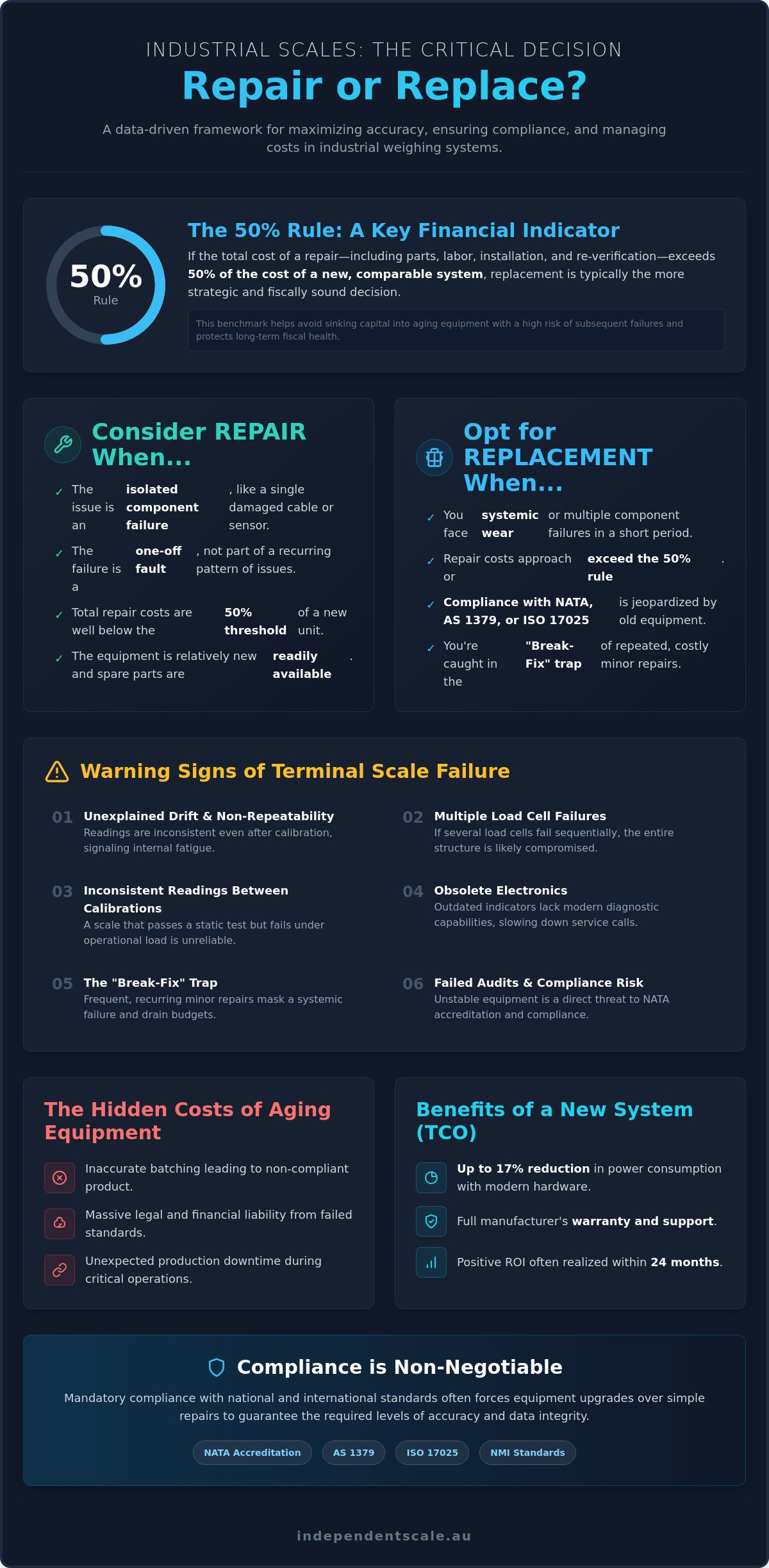
7 Warning Signs of Terminal Industrial Scale Failure
Identifying terminal failure before a total system collapse is essential for maintaining operational continuity. While some issues are fixable, certain symptoms indicate that the internal components have reached their physical limits. Assessing these signs helps determine when to repair vs replace industrial scale systems before they cause a major production stoppage. Look for these seven critical indicators of equipment degradation:
- Unexplained Drift: The zero point shifts constantly between batches, indicating that the load cells or internal electronics can no longer maintain a stable reference.
- Non-Repeatability: The scale provides different weight readings for the same known load in consecutive tests. Precision is the foundation of industrial weighing; once lost, the system's utility is compromised.
- Moisture Ingress: Visible corrosion on the scale body or swollen, cracked cables. In the Australian climate, humidity and wash-down procedures often lead to internal oxidation that is impossible to fully reverse.
- Structural Fatigue: Visible cracks or warping in the platform or at hopper calibration mounting points. Metal fatigue is a permanent structural failure.
- Erratic Display: "Ghosting," flickering, or frozen digits on the indicator that persist even after a power reset. This often points to a failing mainboard or power supply.
- Slow Stabilization: The indicator takes an increasing amount of time to settle on a final weight. This lag reduces throughput and often signals failing analog-to-digital conversion.
- Non-Linearity: The scale is accurate at low weights but shows increasing error as the load increases. This suggests the mechanical structure is no longer flexing within its designed elastic range.
Diagnostic Tests You Can Perform On-Site
You don't always need a technician to spot early warning signs. Perform a Corner Test by placing a test weight on each corner of the platform; the readings should be identical. Conduct a visual inspection for "binding," where debris or spilled material interferes with the load path and creates false readings. Finally, check cable integrity. Rodent damage or chemical corrosion in junction boxes is a leading cause of signal noise and erratic performance in harsh industrial settings.
Interpreting Calibration Reports
Analyze your historical calibration data to identify wear trends. A "marginal pass" means your equipment is barely within legal tolerance and will likely fail before the next scheduled visit. Pay close attention to the "as-found" versus "as-left" data. If a scale is consistently found out of tolerance before adjustment, it's no longer holding its calibration. This lack of stability is a primary driver for replacement. If your equipment shows these signs, schedule a professional calibration audit to determine the most cost-effective path forward.
Strategic Lifecycle Management with Independent Scale Service
Independent Scale Service provides a technical bridge between operational needs and fiscal responsibility. We conduct objective audits to determine when to repair vs replace industrial scale systems, removing the guesswork from capital expenditure decisions. Our methodology evaluates mechanical integrity, electronic stability, and compliance history. This structured approach ensures you don't overspend on terminal equipment or prematurely decommission reliable assets. A NATA-accredited maintenance programme extends the service life of your weighing infrastructure by identifying wear before it causes a system failure.
Downtime is a direct threat to your profitability. Our rapid response teams based in Sydney and Melbourne are equipped to handle urgent repairs and replacements with minimal notice. We maintain an extensive stock of critical components to ensure that your facility returns to full capacity as quickly as possible. By partnering with a seasoned expert, you gain the assurance of methodical, precise, and utterly reliable weighing management. Our focus remains on measurement, but for other critical plant assets like heavy rotating equipment, specialists such as Kelsey Machine Services provide essential repair and refurbishment to ensure total operational uptime.
Expert Fault Diagnosis and Repair
Precision measurement requires specialized expertise. We provide NATA accredited ISO/IEC 17025 repair and calibration services designed for heavy industrial environments. Our technicians specialize in concrete batching plant systems where accuracy is mandated by AS 1379. We don't just replace parts; we provide full programming and integration of new indicators into your existing operational workflows. This ensures seamless data transfer and minimizes the learning curve for your operators after a technical intervention.
Turnkey Replacement Solutions
When a system reaches its Reliability Threshold, we provide a comprehensive weighing equipment supply to facilitate immediate replacement. Our inventory includes high-quality load cells, specialized shackle pins, and complete weighing assemblies. Professional installation and commissioning are standard components of our replacement service. We ensure Day 1 compliance with NMI and NATA standards, providing all necessary documentation for your audit trail. Whether you require a standard platform upgrade or a custom solution for specialized weighing needs, our teams deliver technical competence across Australia to determine when to repair vs replace industrial scale assets effectively.
Optimising Weighing Infrastructure for Regulatory Compliance
Managing industrial weighing equipment requires a technical balance between immediate maintenance costs and the long-term risk of non-compliance. You've seen how the 50% rule provides a financial baseline; however, the decision when to repair vs replace industrial scale systems ultimately rests on systemic reliability and mandatory NATA standards. Unstable equipment compromises your AS 1379 compliance and leads to costly, unplanned production downtime. Identifying terminal failure signs early protects your facility from the legal and financial liabilities of inaccurate measurement.
As NATA Accredited experts to ISO/IEC 17025, Independent Scale Service provides the technical competence required for high-stakes industrial environments. We are recognized AS 1379 compliance experts, servicing Sydney, Melbourne, and regional Australia with a focus on minimising client downtime. Our team delivers methodical assessments that prioritise your operational integrity and budget efficiency. We look forward to ensuring your weighing systems remain accurate and fully compliant with national standards.
Request a Professional Scale Audit or Repair Quote
Frequently Asked Questions
How long do industrial scales typically last before needing replacement?
Industrial scales typically last between 10 and 15 years under standard operating conditions. In high-intensity Australian environments characterized by abrasive dust or extreme thermal shifts, this lifespan may decrease. Regular NATA-accredited maintenance is the primary factor in extending equipment longevity. When structural fatigue or electronic obsolescence occurs, the system's reliability threshold has likely been reached, necessitating a full replacement to maintain accuracy.
Does repairing an industrial scale affect its NATA calibration status?
Performing major repairs on a scale effectively voids its current NATA calibration certificate. Any intervention that involves replacing load cells or mainboards requires a fresh calibration to ensure the system meets ISO/IEC 17025 standards. This re-verification is a legal requirement for trade-use scales and essential for maintaining the integrity of your quality management system. Always schedule a professional calibration immediately following any significant repair work.
What is the 50% rule for industrial equipment repair?
The 50% rule suggests that if a repair quote exceeds 50% of the cost of a new unit, replacement is the more viable financial path. This benchmark helps managers decide when to repair vs replace industrial scale assets by accounting for more than just the immediate parts cost. You must also factor in the price of NATA re-verification and the improved energy efficiency and warranty coverage provided by modern weighing systems.
Can a scale pass calibration but still need to be replaced?
A scale can pass a static calibration test while remaining fundamentally unreliable for daily operations. Calibration only confirms accuracy at a single point in time under controlled conditions. If the scale exhibits unexplained drifting or non-repeatability shortly after the technician leaves, the underlying structural or electronic issues remain. In these cases, the equipment is a candidate for replacement despite having a current calibration sticker.
How much does industrial scale downtime actually cost a business?
The cost of downtime is calculated by adding lost production revenue, idle labor costs, and potential penalties for missed contract deadlines. In high-volume sectors like concrete batching, a single day of equipment failure can result in thousands of dollars in lost profit. Investing in a new system often pays for itself by eliminating the frequent, unpredictable stoppages associated with aging or poorly maintained legacy equipment.
What are the signs that a load cell has failed and cannot be repaired?
Load cell failure is typically indicated by permanent zero-point drift or a total loss of signal. Physical signs include visible corrosion, swelling of the load cell body, or cracked cable insulation that allows moisture ingress. Once the internal strain gauge is compromised by environmental factors or mechanical overload, the component cannot be repaired and must be replaced to restore the system's measurement integrity.
Is it worth upgrading just the indicator if the scale structure is still good?
Upgrading the indicator is a cost-effective strategy if the mechanical structure and load cells are still in excellent condition. Modern indicators provide enhanced data logging, better integration with cloud-based management systems, and improved diagnostic capabilities. This partial upgrade can extend the life of your system while providing the technological benefits of a new scale, provided the underlying accuracy system remains stable and compliant.
How do Australian standards like AS 1379 impact repair decisions?
AS 1379 sets rigorous accuracy tolerances for the specification and supply of concrete in Australia. If a batching plant scale cannot consistently meet these narrow margins, it must be repaired or replaced immediately to maintain legal compliance. This standard often dictates the decision of when to repair vs replace industrial scale units because failing a mandatory audit prevents the facility from supplying material to any regulated construction project.
