


The Essential Guide to Industrial Load Cells
Inaccurate measurements can compromise production quality, lead to costly material waste, and result in significant operational downtime. At the core of any high-performance industrial weighing system is a precisely calibrated and correctly specified load cell. Yet, selecting the right one from a vast array of options presents a significant challenge, with confusing technical specifications often leading to incorrect choices and equipment failure.
This essential guide eliminates that uncertainty. We will deconstruct the fundamental principles of how these critical sensors work, detail the different types available-from shear beam to compression-and provide a clear framework for selection. By the end, you will have the expert knowledge to confidently choose a load cell that ensures your operations are accurate, efficient, and compliant, minimising risk and maximising productivity for your Australian enterprise.
Key Takeaways
- Understand the core principle of how a load cell converts physical force into a measurable electrical signal for industrial operations.
- Discover the main load cell designs and learn how to match the correct type to your specific application and force direction.
- Demystify technical datasheets by identifying the critical specifications to consider when selecting a new load cell for maximum accuracy.
- Recognise why routine calibration and maintenance are essential for ensuring the long-term accuracy and reliability of your weighing systems.
What is a Load Cell and How Does It Work?
At its core, a load cell is a highly specialised transducer designed for a single, critical function: to convert a mechanical force-such as weight, tension, compression, or torque-into a precise and measurable electrical signal. For a simple analogy, consider it an industrial-strength version of the sensor found in a digital bathroom scale, engineered for superior accuracy, durability, and capacity. While there are various types, including hydraulic and pneumatic, the vast majority of modern industrial weighing systems rely on the strain gauge load cell for its reliability and precision.
This device forms the foundation of any accurate weighing system, from laboratory balances to large-scale weighbridges. Understanding its function is essential for ensuring operational integrity and compliance. For a broad technical overview, Wikipedia offers a foundational resource on What is a Load Cell?, covering the primary designs. In practical industrial settings, however, the focus remains on how this component integrates into a complete, functional system.
The Basic Principle: Strain Gauge Technology
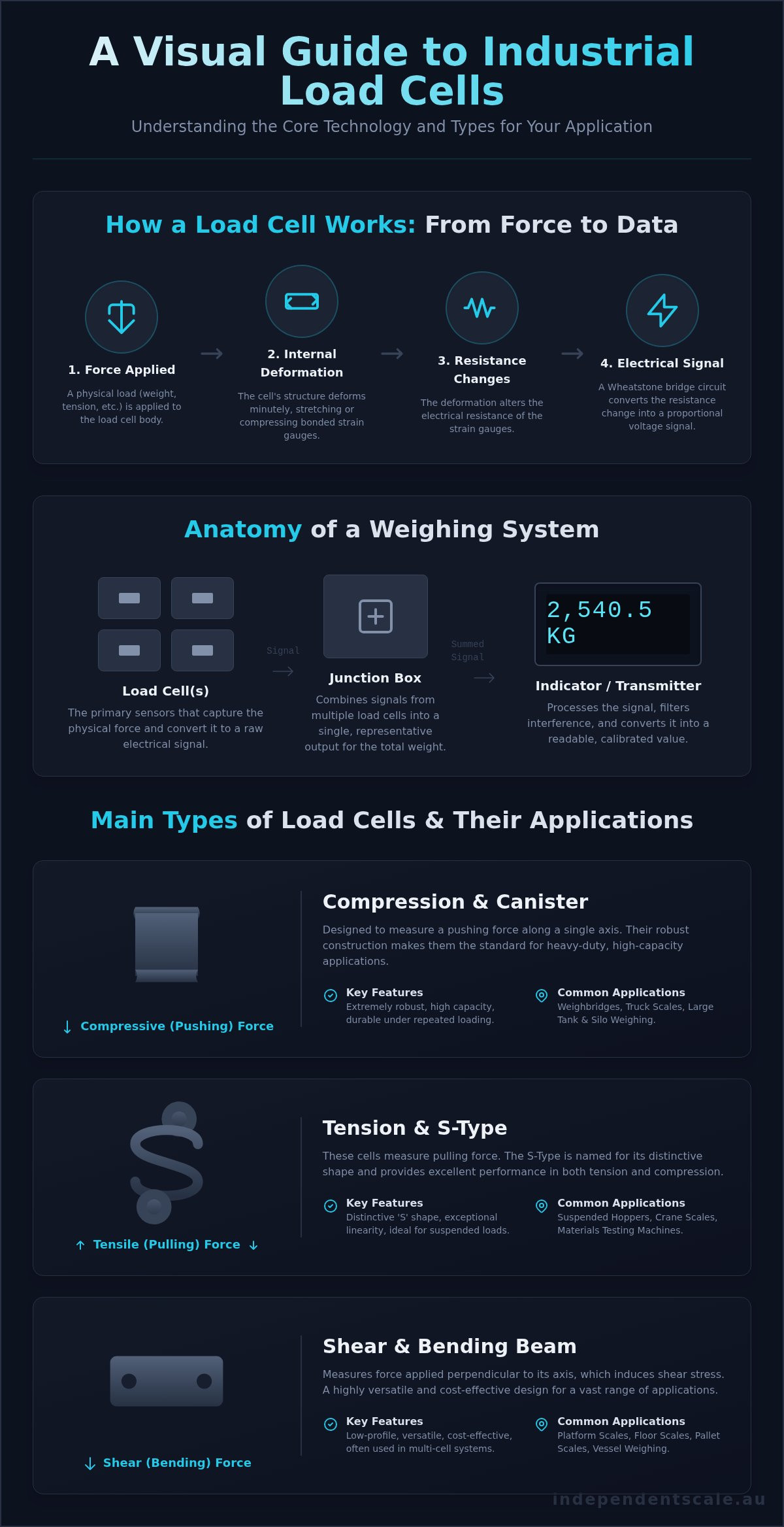
The operational principle of a strain gauge load cell is based on the physical deformation of its core structure. Precision-engineered strain gauges-essentially metallic foil resistors-are bonded to the cell's body. When a load is applied, the structure deforms minutely, stretching or compressing the gauges. This physical change alters their electrical resistance. This minute change is detected by a Wheatstone bridge circuit, which outputs a low-voltage electrical signal directly proportional to the applied force. This signal is then sent to a digital indicator for processing.
Components of a Complete Weighing System
A load cell operates as part of an integrated system. For accurate and reliable weight measurement, several key components must work in unison:
- The Load Cell: The primary sensor that captures the physical force or weight and converts it into a raw electrical signal. Systems can use a single cell or multiple cells depending on the application (e.g., a four-cell weighbridge platform).
- The Junction Box: In systems with multiple load cells, a junction box (or summing box) is used to combine the individual signals into a single, representative signal for the total weight.
- The Indicator/Transmitter: This is the processing unit of the system. It receives the raw signal from the load cell(s), filters out interference, converts it into a readable value (e.g., kilograms), and displays it. See our range of Indicators and Displays for system integration.
The Main Types of Load Cells and Their Applications
Selecting the correct load cell is critical for achieving accurate and reliable weight measurement. The design is engineered specifically for the type and direction of force it needs to measure-whether pushing, pulling, or bending. Understanding these fundamental categories ensures you can specify the right component for your industrial weighing system, guaranteeing optimal performance and operational safety. This guide outlines the most common designs and their primary use cases to help you identify the appropriate solution for your needs.
Compression and Canister Load Cells
Compression load cells are designed to measure a pushing or compressive force along a single axis. Characterised by their extremely robust construction, often using high-grade stainless or tool steel, they are the standard for heavy-duty industrial applications. Their high capacity makes them the default choice for weighbridges, truck scales, and large-scale tank and silo weighing systems where durability under substantial, repeated loading is paramount. Their sturdy, often hermetically sealed design ensures reliable operation in harsh industrial environments.
For systems requiring precise level control and inventory management, explore our purpose-built Tank & Silo Weighing Assemblies.
Tension and S-Type Load Cells
As their name suggests, tension load cells measure a pulling force. The most common configuration is the S-Type, named for its distinctive 'S' shape that provides exceptional performance and linearity in both tension and compression applications, though it excels at tension. These are ideal for suspended weighing systems like hoppers, crane scales, and mechanical scale conversions. They are also integral to materials testing machines where precise tensile force measurement is critical for quality control and research.
Shear Beam and Bending Beam Load Cells
Shear beam and bending beam load cells measure force applied perpendicular to the cell's longitudinal axis, which induces shear stress. This low-profile design is highly versatile and cost-effective, making it suitable for a vast range of applications, including platform scales, floor scales, pallet scales, and vessel weighing. It is standard practice to use multiple shear beam cells in a single system-such as a four-cell configuration under a large platform-connected via a summing junction box to provide a stable, accurate weight reading across the entire surface.
How to Choose the Right Load Cell: Key Specifications Explained
Interpreting a technical datasheet can be a significant challenge. Selecting the correct specifications is not merely a technical exercise; it is essential for ensuring operational accuracy, safety, and longevity. A mismatch between the load cell and the application is a direct cause of premature failure, inaccurate data, and costly operational downtime. Understanding the following core parameters is the first step in making an informed, cost-effective decision.
Capacity and Safe Overload
Capacity is the maximum load the cell is rated to measure accurately. A critical error is selecting a capacity that is too close to the maximum expected working load. As a rule, choose a capacity at least 25-50% higher than your maximum load to provide a safety margin. The Safe Overload rating (often 150% of capacity) specifies the maximum load the cell can withstand without permanent damage. This is vital for applications involving potential shock loading, such as hoppers or weighbridges, where transient forces can far exceed the static weight.
Material and Environmental Protection (IP Rating)
The operating environment dictates the required material and protection level. For dry, indoor applications, nickel-plated alloy steel is a cost-effective solution. However, for food processing, chemical plants, or marine environments common in Australia, stainless steel is non-negotiable due to its superior corrosion resistance. The Ingress Protection (IP) rating defines its sealing effectiveness. For example:
- IP67: Fully protected against dust and capable of withstanding temporary water immersion.
- IP68: Fully dust-tight and protected against continuous immersion under specified pressure.
Matching the IP rating to your environment-from dusty quarries to high-pressure washdown areas-is essential for reliability.
Accuracy, Resolution, and OIML Class
Accuracy defines how close a measurement is to the true value. It is often expressed as an OIML (International Organization of Legal Metrology) class, such as C3, which indicates 3000 verifiable divisions of its capacity. For applications requiring certification for trade use in Australia, an OIML-approved load cell is mandatory. Resolution, on the other hand, is the smallest change in weight the system can detect. High-precision batching requires high accuracy and resolution, whereas simple level monitoring in a silo may not. Evaluating your process requirements will prevent over-investing in unnecessary precision.
Selecting the correct components is a critical engineering decision. For expert guidance tailored to your specific application, consult with the technical team at Independent Scale Service to ensure your system is built for performance and compliance.
The Critical Role of Load Cell Calibration and Maintenance
Selecting the right load cell is only the first step. To ensure sustained accuracy and operational integrity, a structured approach to calibration and maintenance is non-negotiable. A high-specification load cell is rendered ineffective-and potentially dangerous-if its measurements are not verified. Inaccurate data from uncalibrated equipment leads to significant production errors, material waste, and non-compliance with critical Australian industry standards.
Why is Regular Calibration Essential?
Regular calibration is a fundamental requirement for any industrial weighing system. It moves measurement from an estimate to a verifiable fact, directly impacting operational efficiency, safety, and compliance. Key benefits include:
- Ensures Accuracy: Prevents costly batching errors, incorrect invoicing, and wasted materials by guaranteeing measurement precision.
- Maintains Compliance: Satisfies the stringent requirements of quality management systems like ISO 9001 and Australian Standards such as AS 1379 for concrete production.
- Improves Safety: Prevents dangerous overloading of structures, vessels, and vehicles, mitigating risks to personnel and equipment.
- Provides Traceability: Delivers official calibration certificates that provide a documented, traceable record of an instrument's accuracy, essential for audits and quality control.
Understanding NATA Accredited Calibration
In Australia, the National Association of Testing Authorities (NATA) is the peak body for laboratory accreditation. Choosing a NATA accredited calibration provider offers the highest level of assurance. Accreditation to ISO/IEC 17025 confirms a laboratory's technical competence, impartiality, and adherence to internationally recognised procedures. This means the results are reliable, repeatable, and legally defensible. For mission-critical applications, NATA accreditation is the definitive standard. Independent Scale Service provides expert NATA Accredited Load Cell Calibration to guarantee your equipment meets these exacting requirements.
Common Signs of Load Cell Failure
Proactive maintenance includes monitoring for signs of degradation or failure. Addressing these symptoms early can prevent catastrophic failure and costly downtime. Key indicators that a load cell requires immediate inspection or replacement include:
- Inconsistent Readings: The output value drifts or fluctuates erratically, even with a stable load applied.
- Failure to Return to Zero: After a load is removed, the reading does not return to a true zero value.
- Measurement Discrepancies: Significant variations in readings when comparing with other calibrated scales or systems.
- Visible Physical Damage: Obvious signs of corrosion, moisture ingress, denting, or damage to the cable or connectors.
Partner with the Experts for Your Load Cell Requirements
As we've explored, selecting the correct industrial weighing equipment is a critical decision. Success hinges on a clear understanding of the different types, meticulous attention to key specifications, and an unwavering commitment to regular calibration to ensure your chosen load cell delivers consistent, accurate results. These elements are fundamental to operational efficiency, safety, and compliance.
For over 30 years, Independent Scale Service has been the trusted supplier to leading Australian industrial companies. Our NATA Accreditation to ISO/IEC 17025 is your guarantee of precision and compliance. We provide not only expert advice but also the robust equipment and 24/7 emergency repair services necessary to minimise downtime and protect your investment.
Equip your operations for maximum accuracy and reliability. Browse our extensive range of industrial load cells or contact our expert team for tailored advice on your specific application.
Frequently Asked Questions About Load Cells
What is the difference between a load cell and a strain gauge?
A strain gauge is the core sensing element that measures strain, while a load cell is the complete transducer assembly. A load cell’s engineered body houses one or more strain gauges and is designed to isolate and direct force onto them. The load cell then translates this mechanical force into a calibrated and measurable electrical signal, whereas a strain gauge only provides a raw resistance change.
How often should industrial load cells be calibrated?
Calibration frequency depends on usage, environment, and the application's criticality. As a baseline for most industrial applications in Australia, annual calibration is essential to maintain accuracy and compliance. However, systems under heavy use, in harsh environments, or those critical for trade and safety may require more frequent verification-such as biannually or quarterly-to prevent operational downtime and ensure consistent, accurate performance.
Can you repair a faulty load cell or does it need to be replaced?
Minor external issues, such as damaged cabling or connectors, can often be repaired by a qualified technician. However, internal damage from severe overload, shock loading, or moisture ingress is typically irreparable. In these critical situations, replacing the faulty load cell is the only method to guarantee the accuracy, reliability, and ongoing compliance of the weighing system. Attempting to repair a critically damaged unit is not a viable long-term solution.
What does NATA accredited calibration mean for load cells?
NATA (National Association of Testing Authorities) accreditation to ISO/IEC 17025 confirms a laboratory's technical competence to perform calibrations to the highest standard. For a load cell, a NATA-endorsed calibration certificate provides independently verified and legally defensible proof of its accuracy. This is essential for trade-approved weighing systems, quality assurance programs, and meeting regulatory requirements across Australian industries.
What are the most common causes of load cell damage?
The most common causes of failure are mechanical overload and shock loading, where the force applied exceeds the cell's rated capacity. Other significant factors include moisture ingress from failed seals, leading to internal corrosion, and electrical damage from power surges or lightning. Improper installation that introduces off-axis forces, such as side-loading or torsion, is also a primary contributor to premature failure and inaccurate readings.
What is a load cell summing box and when do I need one?
A load cell summing box, or junction box, is required for any weighing system that utilises multiple load cells, such as a weighbridge, tank scale, or large platform scale. Its purpose is to combine the individual millivolt signals from each load cell into a single, stable output for the weight indicator. A summing box also enables corner-load trimming to ensure the system reads accurately regardless of load position.
How do I protect load cells from electrical surges or lightning?
Effective protection requires a robust grounding system for the scale structure and associated instrumentation. It is essential to install specialised surge protection devices designed for load cell circuits, both at the junction box and at the weight indicator. During nearby welding or severe electrical storms, disconnecting the instrumentation provides an additional layer of protection against catastrophic electrical damage.
