


Calibration Services: The Authoritative Guide for Australian Industry
In Australian industry, non-compliance is not an option. A failed audit, costly production downtime, or a rejected batch of product can all be traced back to a single source: inaccurate measurement equipment. Maintaining operational integrity and product quality hinges on the precision of your instruments. This requires a systematic approach to professional calibration services, yet many businesses remain unsure of the specific level of service required to meet critical standards like AS 1379.
This authoritative guide provides the essential information your operation needs. We will detail the core types of industrial calibration, explain why NATA accreditation to ISO/IEC 17025 is non-negotiable for ensuring compliance, and provide a clear framework for selecting the right service provider. The objective is to equip you with the technical knowledge to eliminate uncertainty, guarantee accuracy, and protect your business from the significant costs of measurement error. Achieve and maintain compliance while maximising your operational efficiency.
Key Takeaways
- Grasp why calibration is a non-negotiable business imperative for ensuring operational accuracy, safety, and compliance with Australian standards.
- Learn why NATA accreditation is the definitive benchmark for technical competence in Australia, guaranteeing a provider meets the rigorous ISO/IEC 17025 standard.
- Utilise a practical checklist to select the right partner for your calibration services, evaluating crucial factors like NATA scope, technical expertise, and turnaround times.
- Understand the complete calibration workflow, from initial contact and on-site assessment to the final delivery of your NATA-endorsed certificates.
What Are Calibration Services and Why Are They a Business Imperative?
In industrial operations, precision is not a goal; it is a fundamental requirement. At its core, calibration is the highly disciplined process of comparing the measurements of a device against a traceable standard of known accuracy. It is a common misconception that calibration is simply an adjustment. In reality, understanding what is calibration reveals it is a rigorous comparison that quantifies an instrument's deviation from the standard. This data is essential for maintaining quality control, ensuring operational safety, and meeting stringent regulatory compliance obligations.
Failing to calibrate equipment introduces significant financial and operational risks. Inaccurate measurements lead directly to product waste, costly rework, and potential liability issues. Every measurement has an associated level of doubt, known as measurement uncertainty. Professional calibration services are critical because they don't just confirm accuracy; they quantify this uncertainty, providing the data necessary to make informed decisions, manage risk, and run a compliant, profitable operation.
Beyond Accuracy: The Business Case for Regular Calibration
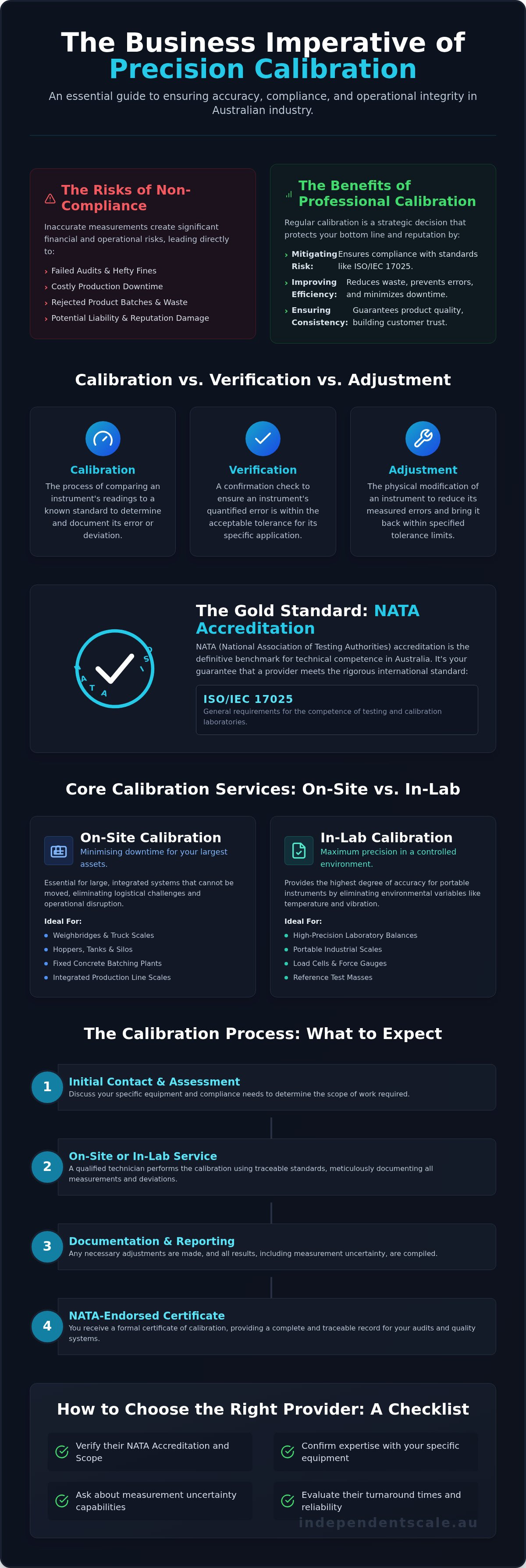
Engaging professional calibration is a strategic business decision that protects your bottom line and reputation. The benefits are direct and quantifiable:
- Mitigating Risk: Regular calibration ensures compliance with industry standards, such as ISO/IEC 17025, helping to avoid significant fines, legal challenges, and damage to your company’s reputation.
- Improving Efficiency: Accurate instruments reduce waste of raw materials and prevent costly production errors. This optimises processes, minimises downtime, and directly improves profitability.
- Ensuring Consistency: Guaranteed measurement accuracy leads to consistent product quality. This builds customer trust and satisfaction, which are essential for long-term business success.
Calibration vs. Verification vs. Adjustment: Clarifying the Terms
Understanding the distinction between these key terms is critical for effective equipment management. While often used interchangeably, they represent distinct procedures:
- Calibration: The process of comparing an instrument's readings to a known standard to determine and document its error or deviation.
- Verification: A confirmation process that checks if an instrument's quantified error is within the acceptable tolerance for its specific application.
- Adjustment: The physical modification of an instrument to reduce its measured errors and bring it back within specified tolerance limits.
Core Calibration Services for Industrial Weighing and Force Measurement
Industrial operations depend on the precise measurement of mass and force. This requires specialised calibration services for a diverse range of equipment, from massive concrete batch plants to sensitive laboratory instruments. Handling heavy industrial systems demands expert technicians who understand the unique environmental, operational, and safety challenges involved, ensuring that every measurement is both accurate and compliant.
On-Site vs. In-Lab Calibration: Which is Right for Your Equipment?
The decision between on-site and in-lab calibration is determined by the equipment's size, function, and operational context. On-site calibration is essential for large, integrated systems that cannot be moved, such as weighbridges, silos, and fixed batching plants. This approach minimises operational downtime and eliminates the significant logistical challenges of transporting heavy machinery. Conversely, in-lab calibration provides a controlled environment ideal for portable instruments like high-precision scales and force gauges, where variables like temperature and vibration must be eliminated to achieve the highest degree of accuracy.
Specialised Calibration for Weighing Systems
Accurate weighing systems are fundamental to production efficiency, inventory control, and regulatory compliance. Our comprehensive calibration services cover the critical components that drive your operations:
- Load Cells: As the foundational sensors in nearly all industrial weighing equipment, their precise calibration is non-negotiable for ensuring system-wide accuracy.
- Hoppers, Tanks & Silos: We provide expert calibration for these large-volume containers to guarantee exact batching in manufacturing processes and support reliable, data-driven inventory management.
- Industrial Scales: Our services extend to a broad range of equipment, including platform scales, crane scales, and pallet scales used throughout production and logistics chains.
Force Measurement Calibration Services
Beyond static weight, the accurate measurement of force-both tension and compression-is critical in modern manufacturing and research. Force gauges and tension links are essential tools for quality control, material strength analysis, and safety compliance testing. Verifying their accuracy is vital for product integrity and performance validation. This process involves using certified reference standards with traceability back to primary standards maintained by Australia's National Measurement Institute (NMI), ensuring your equipment meets stringent legal and technical requirements.
The Gold Standard: Why NATA Accreditation and Compliance Matter
In Australia, the benchmark for quality and competence in measurement is set by the National Association of Testing Authorities (NATA). As the national accreditation body, NATA provides independent assurance of technical competence through a process of peer-review. This assessment is performed against the international standard ISO/IEC 17025, which is the global requirement for testing and calibration laboratories. Choosing a provider with NATA accreditation ensures that your equipment is calibrated to a legally recognisable and traceable standard, providing irrefutable evidence of accuracy.
What NATA Accreditation to ISO/IEC 17025 Guarantees
A NATA-endorsed calibration report is not just a certificate; it is a guarantee of technical excellence. This accreditation validates several critical aspects of the calibration process:
- Technical Competence: Confirmation that the laboratory and its technicians are qualified and proficient to perform the specific calibrations.
- Traceability of Measurements: A documented and unbroken chain of comparisons linking your instrument's measurement to national and international standards.
- Method Validity: Assurance that the calibration methods used are appropriate for the instrument and are performed correctly.
- Formal Endorsed Report: The issuance of a NATA calibration report, a formally recognised document for legal, regulatory, and quality assurance purposes.
Traceable Calibration vs. NATA Accredited Calibration
It is essential to understand the distinction between a "traceable" calibration and a "NATA accredited" calibration. A traceable certificate simply indicates that the measurements are linked back to a known national standard. However, it lacks the formal, third-party validation of the provider's competence and processes.
NATA accreditation is the highest level of assurance. It includes traceability but adds a rigorous, ongoing audit of the laboratory’s quality management system, equipment, and staff proficiency. While a traceable certificate may suffice for internal, low-risk process checks, a NATA-endorsed report is mandatory for regulatory compliance, quality system audits, and when contractual obligations demand the highest level of measurement confidence.
Meeting Specific Industry Standards like AS 1379
For many industries, compliance with specific Australian Standards is non-negotiable. The concrete industry, for example, is governed by AS 1379: Specification and supply of concrete. This standard mandates strict accuracy for weighing systems in concrete batching plants to ensure the quality, strength, and consistency of the final product. Our NATA-accredited calibration services directly support this compliance, providing the formal documentation required to prove that weighing equipment meets the tolerances specified in AS 1379. This protects product integrity, reduces waste, and mitigates liability.
How to Choose the Right Calibration Service Provider: A Checklist
Selecting a partner for your industrial calibration services is a critical operational decision. The right provider ensures your equipment remains accurate, compliant, and reliable, directly impacting product quality, safety, and profitability. While cost is a factor, a comprehensive evaluation based on technical competence, industry expertise, and responsiveness is essential for a long-term, effective partnership. This checklist provides a framework for making an informed choice.
Criterion 1: Accreditations and Scope
The most fundamental check is for official accreditation. In Australia, this means verifying the provider’s NATA (National Association of Testing Authorities) accreditation to ISO/IEC 17025. However, accreditation alone is not enough. You must review their official ‘Scope of Accreditation’ on the NATA website to confirm it covers:
- The specific types of equipment you operate (e.g., load cells, weighbridges, hopper scales).
- The required measurement ranges and uncertainties for your processes.
A mismatch in scope means any calibration performed may not be compliant or valid for your application.
Criterion 2: Industry Experience and Expertise
Look for a provider with a proven track record in your specific industry, whether it's concrete production, manufacturing, or logistics. A specialist understands your operational challenges, regulatory requirements (like AS 1379 for concrete plants), and the unique behaviour of your equipment. Ask for relevant case studies or client references. An experienced technician does more than verify readings; they can diagnose underlying mechanical or electronic issues that cause drift, providing a solution rather than a simple adjustment.
Criterion 3: Turnaround Time and On-Site Capability
Downtime is a significant cost. Therefore, logistical capability is as important as technical skill. When evaluating potential providers, ask direct questions about their operational capacity:
- What are your standard turnaround times for both in-lab and on-site calibration?
- What is your geographic service area for on-site technicians?
- Do you offer emergency support for critical equipment failures?
Minimising operational interruption is paramount. A provider with a robust field service team and emergency availability can be an invaluable asset. Need emergency 24/7 support? Contact our team.
The Calibration Process: What to Expect from Start to Finish
Engaging professional calibration services should be a straightforward process designed to enhance your operational integrity, not disrupt it. Our methodology is structured to provide complete transparency and minimise downtime from the initial contact through to final certification. We manage every detail, ensuring your equipment is returned to service with verified accuracy and full compliance documentation.
Step 1: Consultation, Assessment, and Quoting
The process begins with a detailed consultation to understand your specific operational and regulatory requirements. We discuss the type of equipment, its application, and any compliance standards you must adhere to, such as ISO 9001 or industry-specific regulations. Based on this assessment, we determine the most efficient service delivery method-either on-site at your facility to reduce downtime or in our controlled laboratory for instruments requiring a specialised environment. You will then receive a comprehensive, transparent quote with a clear breakdown of costs and no hidden fees.
Step 2: Performing the Calibration
Once approved, we schedule the service at a time that minimises impact on your production schedule. Our expert technicians arrive equipped with certified reference standards, traceable to national and international standards, to perform the calibration. A critical part of our procedure is the meticulous documentation of both 'as found' and 'as left' data. This provides a clear record of the instrument's performance before and after service, which is essential for quality audits and identifying performance drift over time.
Step 3: Certification and Reporting
Following a successful calibration, we issue a detailed certificate for each piece of equipment. For services within our scope of accreditation, this will be a NATA-endorsed certificate, providing the highest level of assurance and compliance. Each certificate includes:
- A clear statement of conformity to specified tolerances.
- The complete measurement results, including 'as found' and 'as left' values.
- The calculated measurement uncertainty for each test point.
- Full traceability to Australian or international measurement standards.
This comprehensive report not only satisfies audit requirements but also provides valuable insights. We include professional recommendations for optimal calibration intervals and notify you of any potential repairs required to maintain peak performance and reliability.
This focus on detailed, auditable documentation extends to other critical industrial processes. In fields like fabrication, for example, managing welding procedures and qualifications requires a similar level of rigor. For operations looking to streamline this, digital platforms like SOCWeld provide specialized software to automate and manage welding documentation, ensuring full compliance and traceability.
Our structured approach ensures that our calibration services deliver not just accuracy, but also confidence and auditable proof of compliance. To discuss your specific requirements, contact our expert team at independentscale.au.
Secure Your Operational Integrity with Expert Calibration
This guide has established that regular, precise calibration is not merely a technical task but a fundamental pillar of operational success. The key takeaways are clear: consistent calibration underpins accuracy and safety, NATA accreditation provides the benchmark for quality and compliance in Australia, and a rigorous selection process is vital for choosing a provider. Selecting the right partner for these essential calibration services is a critical decision that directly impacts your productivity and legal standing.
For over 30 years, Independent Scale Service has provided Australian industry with unparalleled expertise. As a provider fully NATA Accredited to ISO/IEC 17025, we guarantee the highest standards of precision, backed by 24/7 emergency support to minimise your downtime. Don't leave your operational compliance and accuracy to chance.
Request a quote for NATA accredited calibration services. Take the definitive step towards operational certainty and compliance.
Frequently Asked Questions
How often should I get my equipment calibrated?
Calibration frequency depends on manufacturer recommendations, regulatory requirements, and the instrument's usage. For critical applications or high-use equipment, semi-annual or quarterly calibration may be necessary to mitigate risk. For most other industrial instruments, an annual calibration schedule is a standard baseline. We recommend a risk-based assessment to establish an optimal frequency that ensures consistent accuracy and maintains compliance with relevant standards, such as AS 1379 for concrete production.
What is the difference between NATA accredited and traceable calibration?
A NATA accredited calibration is performed by a facility formally recognised by the National Association of Testing Authorities, Australia, as competent to meet the technical requirements of ISO/IEC 17025. This provides the highest level of assurance. A traceable calibration simply means the measurement can be linked to a national standard via an unbroken chain of comparisons. It does not, however, certify the technical competence of the laboratory performing the work. For critical applications, NATA accreditation is the definitive industry benchmark.
What information is included in a calibration certificate?
A comprehensive calibration certificate provides essential data for traceability and compliance. It includes the unique identification of the calibrated instrument, the calibration date, and the environmental conditions during the test. The certificate details the 'as found' and 'as left' measurement results, the associated measurement uncertainty, and a statement of conformity. A NATA-endorsed certificate also displays the official NATA logo and the laboratory's accreditation number, confirming its authority under ISO/IEC 17025.
Can you calibrate equipment from any manufacturer?
Yes. Our technicians are proficient in calibrating a comprehensive range of industrial weighing and measurement equipment, regardless of the original equipment manufacturer (OEM). With over 30 years of industry experience, we possess the expertise and certified reference standards required to service equipment from all major brands as well as specialised or legacy systems. Our focus is on achieving technical compliance and accuracy, not the brand name, ensuring universal service capability.
What are your service areas in Australia for on-site calibration?
We provide on-site calibration services across key industrial hubs. Our primary service areas include the Greater Sydney metropolitan area, the Central Coast, Newcastle, and the Illawarra region in New South Wales, as well as Melbourne, Victoria. Our mobile service units are fully equipped to perform NATA accredited calibrations directly at your facility, minimising operational downtime. For major projects or clients located outside these core service areas, please contact Independent Scale Service to discuss your specific requirements, as we may be able to arrange services across wider regions by appointment.
How much do calibration services typically cost?
The cost of calibration is determined by the equipment's type and complexity, the required level of accreditation (NATA vs. traceable), and whether the service is performed on-site or in our laboratory. A basic instrument may start from A$150, while complex on-site work for multiple systems will be quoted on a project basis. We provide transparent, itemised quotes that detail the work required to ensure your equipment is accurate, compliant, and reliable for your operations.
What happens if my equipment fails calibration?
If an instrument is found to be outside its specified tolerance, it fails calibration. Our technician will immediately document the 'as found' readings and notify you of the non-conformance. We then provide a direct assessment and recommend a course of action, which may include adjustment, component repair, or if necessary, replacement. Our primary objective is to resolve the issue efficiently to restore your equipment to a compliant and accurate operational status with minimal disruption.
