


Industrial Weighing Scale: The Complete Guide for Australian Businesses
In any industrial operation, inaccurate measurements lead to significant consequences: wasted materials, compromised product quality, and costly compliance breaches. Selecting the correct industrial weighing scale is not merely an operational choice; it is a critical investment in your business's efficiency, profitability, and legal standing. An unsuitable or uncalibrated scale can halt production and expose your business to unnecessary risk, making the right decision essential from the outset.
This complete guide for Australian businesses provides the technical clarity needed to make an informed decision. We will detail the different types of industrial scales and their specific applications, from heavy-duty weighbridges to precise platform scales. You will learn how to evaluate essential features for harsh environments, understand the critical difference between 'NATA accredited' calibration and 'Legal for Trade' certification, and establish a framework for ensuring long-term accuracy. By the end, you will have the knowledge to select a reliable scale, maintain compliance with Australian standards, and improve your operational control.
Key Takeaways
- Differentiate an industrial scale from commercial models by evaluating its high-capacity construction, durability, and resistance to harsh operational environments.
- Match the correct scale type-from platform scales to weighbridges-to your specific industrial application for optimal performance and efficiency.
- Develop a technical checklist to select the right industrial weighing scale, ensuring your choice meets critical criteria for capacity, accuracy, and operational features.
- Recognise regular calibration not as a cost, but as an essential process to maintain long-term accuracy, prevent costly errors, and ensure compliance.
What Defines an Industrial Weighing Scale?
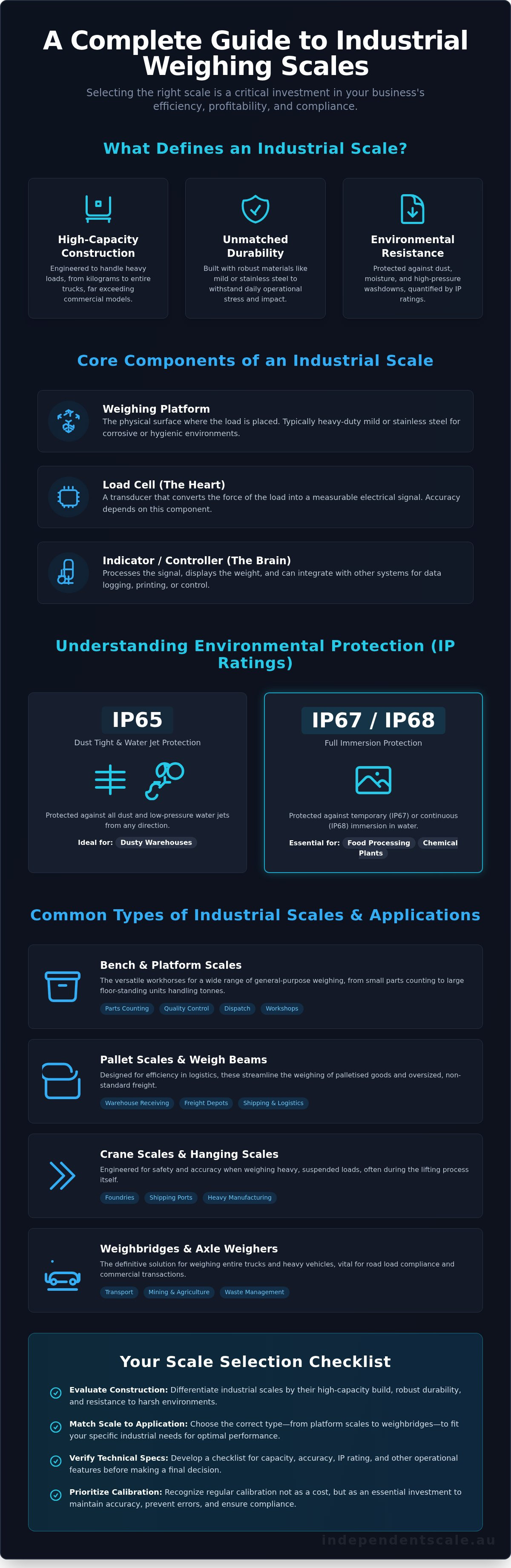
Unlike commercial or high-precision laboratory scales, an industrial weighing scale is engineered for one primary purpose: to deliver accurate and repeatable measurements under demanding operational conditions. While the fundamental principle of measuring mass remains the same for any device answering the question of what is a weighing scale?, industrial models are distinguished by their high capacity, robust construction, and resistance to environmental factors. These systems are not optional accessories; they are essential instruments integrated into critical processes across logistics, manufacturing, and quality control, ensuring compliance, safety, and operational efficiency.
Core Components of an Industrial Scale
Every industrial weighing system is composed of three essential components working in unison to provide a reliable weight reading:
- The Weighing Platform: This is the physical surface where the load is placed. Construction is typically heavy-duty mild steel for general use or stainless steel for corrosive or hygienic environments like food processing.
- The Load Cell: The heart of the scale, the load cell is a transducer that converts the force of the load into a measurable electrical signal. The accuracy and longevity of your scale depend entirely on this component. Explore our range of high-quality industrial load cells to understand the available options.
- The Indicator/Controller: This is the 'brain' of the system. It processes the signal from the load cell, displays the weight reading, and can perform other functions like data logging, printing, or controlling other equipment.
Durability and Environmental Protection (IP Ratings)
Because industrial environments are rarely clean or dry, the durability of an industrial weighing scale is paramount. Its resilience is quantified by an Ingress Protection (IP) rating-a critical specification defining the enclosure's effectiveness against foreign bodies (dust, dirt) and moisture. This rating is crucial for protecting sensitive electronics and ensuring long-term accuracy.
For example, an IP65-rated scale is dust-tight and protected against low-pressure water jets, making it suitable for dusty warehouses. In contrast, an IP67 or IP68 rating is essential for food processing or chemical plants where equipment undergoes regular high-pressure washdowns. Selecting the correct IP rating for your specific environment is a non-negotiable step in protecting your investment.
Common Types of Industrial Scales and Their Applications
Selecting the correct industrial weighing scale begins with understanding the primary categories available. Each type is engineered for a specific task, load profile, and operational environment. This overview outlines the most common scale types to help you identify the solution that best aligns with your business requirements, ensuring accuracy and operational efficiency.
Bench and Platform Scales
These are the versatile workhorses of many industries. Bench scales are ideal for smaller tasks like parts counting, quality control, and dispatch, while larger floor-standing platform scales handle heavier loads. With capacities ranging from a few kilograms up to several tonnes, they are essential equipment in workshops, warehouses, and on production lines for a wide range of general-purpose weighing tasks.
Pallet Scales and Weigh Beams
Designed for efficiency in logistics, these scales streamline the weighing of palletised goods and oversized items. U-frame pallet scales allow for easy loading with a pallet jack, minimising handling time. For greater flexibility with non-standard freight, weigh beams consist of two separate bars that can be positioned at any width. They are critical tools at warehouse receiving docks, in freight depots, and for shipping and logistics operations.
Crane Scales and Hanging Scales
When weighing heavy, suspended loads, safety and accuracy are paramount. Crane scales are engineered to be attached to a crane or hoist, allowing for efficient weighing during the lifting process itself. Common in foundries, shipping ports, and heavy manufacturing, these robust devices often include features like remote controls and displays to keep operators at a safe distance from the suspended load.
Weighbridges and Axle Weighers
For weighing entire trucks and heavy vehicles, a weighbridge is the definitive solution. These large-scale systems are vital for ensuring compliance with road load limits and providing accurate data for commercial transactions. Full-length weighbridges capture a vehicle's total weight at once, while portable axle weighers offer a flexible solution for measuring weight per axle group. These systems are essential for the transport, mining, agriculture, and waste management industries, where scales must be trade-approved and calibrated to meet strict National Measurement Institute (NMI) standards.
How to Choose the Right Industrial Scale: Key Selection Criteria
Selecting the correct industrial weighing scale is an investment in your operational accuracy, efficiency, and compliance. Moving beyond general types, this assessment requires a detailed evaluation of technical specifications to ensure the equipment meets the precise demands of your application. Use the following criteria to ask the right questions and make an informed decision.
Capacity, Resolution, and Accuracy
These three factors are fundamentally linked. Maximum Capacity is the heaviest load the scale can measure, while Readability (or division size) is the smallest increment it can display. A 3000 kg capacity platform scale with 0.5 kg divisions is ideal for pallets but useless for measuring 10-gram ingredients. True Accuracy-how close a measurement is to the true value-is critical. Inaccurate measurements lead directly to material waste, inconsistent product quality, and lost revenue.
Platform Size and Material
The scale platform should be large enough to fully support the footprint of the largest item you will weigh, preventing instability and inaccurate readings. The construction material is dictated by your operating environment:
- Painted Mild Steel: A cost-effective and durable choice for dry, general-purpose industrial or warehouse settings.
- Stainless Steel: Essential for environments requiring frequent washdowns, such as food processing (food-grade certified) or pharmaceutical applications, and for resistance to corrosive chemicals.
For hazardous areas with flammable gases or dust, scales with an Intrinsically Safe (IS) rating are mandatory for safety compliance.
Compliance: 'Legal for Trade' and NATA
Understanding compliance is non-negotiable. If you sell goods by weight in Australia, your scale must be 'Legal for Trade' (also known as trade-approved). This certification from the National Measurement Institute (NMI) ensures the scale meets stringent standards for fair commerce. This is different from NATA Calibration, which is a service that verifies and certifies a specific scale's accuracy against national standards under ISO/IEC 17025. While Legal for Trade is a legal requirement for sales, NATA calibration is essential for quality management systems and process control. Failure to comply can result in significant fines.
Connectivity and Data Integration
Modern weighing operations depend on data. Evaluate the scale's output options-such as RS-232, USB, and Ethernet-to ensure it can communicate with your existing systems. A fully integrated industrial weighing scale can send data directly to printers, inventory management software, or PLC control systems, eliminating manual entry errors and automating your workflow. The hub for this functionality is often found in advanced scale indicators and displays, which process weight data and manage communication with other devices.
The Critical Role of Calibration and Maintenance
Purchasing a high-quality industrial weighing scale is only the first step. To ensure its ongoing reliability and accuracy, a structured approach to calibration and maintenance is essential. This is not an operational cost; it is a fundamental quality assurance process that protects your business from significant financial and legal risks.
Even the most robustly engineered scales experience drift over time. Factors such as mechanical wear, environmental changes, and frequent use inevitably impact performance. An uncalibrated scale can lead to inaccurate batching, product giveaway, and non-compliance with industry regulations, resulting in costly penalties and loss of customer trust.
Why Regular Calibration is Non-Negotiable
Scheduled calibration verifies that your equipment performs to its specified tolerance. It is a critical procedure for any operation that relies on precise weight data. The core benefits include:
- Consistent Accuracy: Guarantees that your measurements are correct, protecting product quality and profitability.
- Quality System Compliance: Meets the stringent requirements of quality management systems, including ISO 9001.
- Traceability and Auditing: Provides documented, traceable proof of accuracy, which is indispensable during audits and for regulatory compliance.
For operations requiring the highest standard of verification, we provide professional NATA accredited scale calibration services to ensure your equipment is fully compliant and accurate.
Understanding NATA Accreditation (ISO/IEC 17025)
In Australia, the National Association of Testing Authorities (NATA) is the national body for accrediting laboratories and technical facilities. NATA accreditation to ISO/IEC 17025 is the international standard for the competence of testing and calibration laboratories. Choosing a NATA-accredited provider means you are receiving a service that has been independently assessed for technical expertise, providing the highest possible level of confidence in your calibration results.
Preventative Maintenance and Repair Services
Proactive maintenance is the most effective strategy to maximise the lifespan of your industrial weighing scale and ensure maximum uptime. Our technicians are trained to identify and rectify common issues before they cause a critical failure. Common points of failure include load cell damage, indicator faults, and compromised wiring. In many cases, faults can be traced to peripheral components like signal conditioners and transmitters.
Scheduled maintenance checks prevent costly, unplanned breakdowns. Should a fault occur, our expert repair services can restore functionality and extend the operational life of your valuable equipment. Contact Independent Scale Service to discuss a maintenance plan for your weighing systems.
Partner with an Expert for Compliant Weighing Solutions
Selecting the appropriate industrial weighing scale is a critical investment in your operational efficiency, safety, and compliance. As this guide has detailed, the process requires careful consideration of application, capacity, and environmental factors. However, the commitment to precision doesn't end at procurement; ongoing professional calibration and maintenance are fundamental to ensuring sustained accuracy and adherence to mandatory Australian standards.
For over 30 years, Independent Scale Service has provided Australian businesses with expert guidance and technically proficient solutions. As a NATA Accredited laboratory to ISO/IEC 17025, we guarantee that your weighing systems are not only accurate but fully compliant with key standards like AS 1379. To ensure your operations are built on a foundation of precision, request an expert consultation on your industrial weighing needs. Let our expertise become your operational advantage.
Frequently Asked Questions About Industrial Weighing Scales
How often should an industrial scale be calibrated?
Calibration frequency depends on usage, environment, and quality management requirements. For high-use scales in demanding environments or those critical to production, quarterly or semi-annual calibration is recommended. For less frequent use, an annual calibration may suffice. Adherence to an ISO/IEC 17025 accredited calibration schedule is essential for maintaining accuracy and compliance, preventing costly errors and production downtime. A professional assessment can determine the optimal schedule for your specific application.
What is the difference between a NATA calibration and being 'Legal for Trade'?
A NATA calibration certifies that a scale has been tested by an accredited facility according to ISO/IEC 17025 standards, providing documented, traceable proof of its measurement accuracy. 'Legal for Trade' certification, issued by the National Measurement Institute (NMI), is a legal requirement for any scale used to determine a price, such as in freight or retail. While a scale can be both, NATA calibration verifies accuracy, whereas Legal for Trade approves its use in commerce.
Can you integrate a new industrial scale with my existing software or PLC system?
Yes, integration is a standard requirement for modern weighing systems. Our technicians are experienced in connecting industrial scales to a wide range of systems, including PLCs, SCADA, and ERP software. We configure data outputs such as 4-20mA, Ethernet/IP, or serial connections to ensure seamless communication. This process allows for automated data logging, batch control, and process monitoring, enhancing operational efficiency and accuracy within your existing infrastructure.
What does an IP rating on a weighing scale actually mean for my workplace?
An IP (Ingress Protection) rating defines a scale's resistance to solids and liquids. The first digit indicates protection against solids (e.g., dust), and the second indicates protection against liquids (e.g., water). For example, an IP65-rated industrial weighing scale is dust-tight and protected from water jets, making it suitable for dusty factories. An IP68 rating means the scale can be fully submerged, which is essential for environments requiring high-pressure washdowns, such as food processing plants.
Is stainless steel always the best material for an industrial scale?
Not necessarily. Stainless steel offers superior corrosion resistance and is essential for hygienic applications in food, pharmaceutical, or chemical industries. However, for dry, non-corrosive environments like general manufacturing or warehousing, a powder-coated mild steel scale is often a more cost-effective and durable solution. The optimal material is determined by the specific operational environment, cleaning protocols, and substances being weighed to ensure longevity and performance.
What are the first steps to take if my industrial scale is giving inaccurate readings?
First, perform a basic visual inspection. Ensure the weighing platform is level, clear of any debris underneath or around its edges, and not physically touching adjacent structures. Confirm there are no obstructions interfering with the load cells. If these simple checks do not resolve the inaccuracy, cease using the scale and contact a qualified technician immediately. Continuing to operate an inaccurate industrial scale can lead to significant production and financial losses.
