


The ROI of Regular Equipment Calibration: Protecting Industrial Profit Margins in 2026
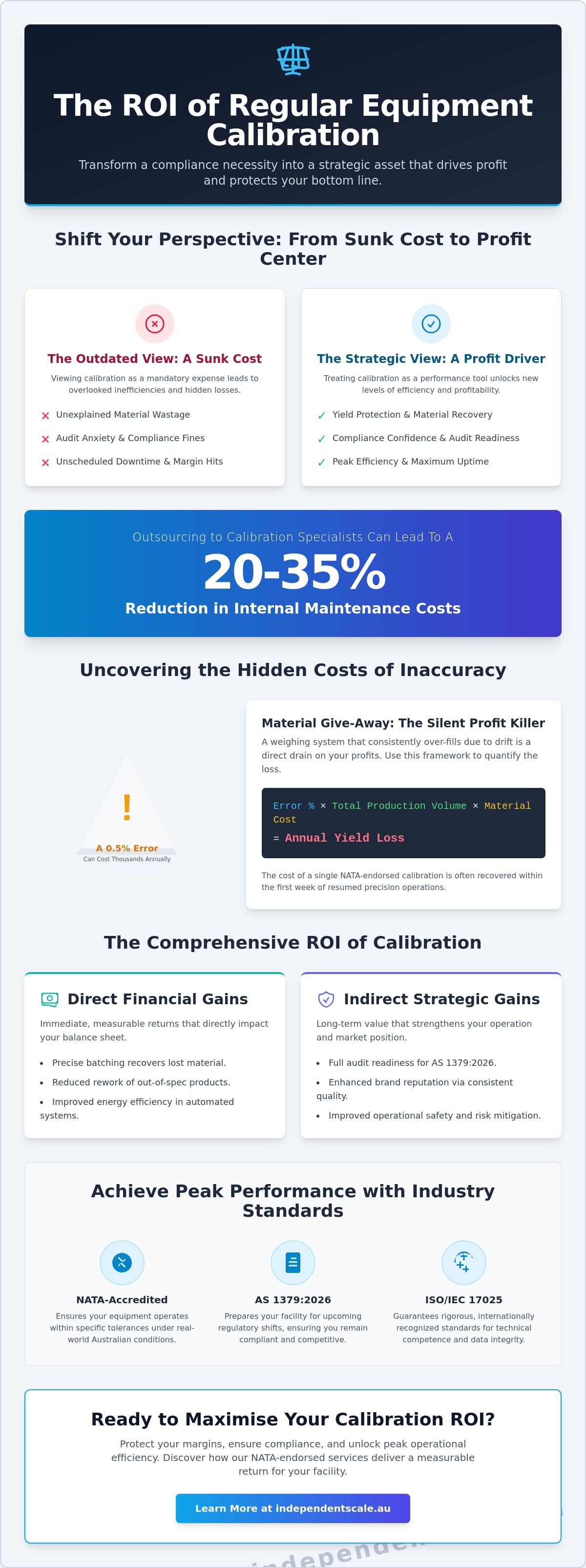
Industrial enterprises that outsource their calibration needs to specialized providers can achieve a 20-35% reduction in internal maintenance costs. Despite this, many operators still view precision measurement as a sunk compliance expense rather than a profit driver. It's frustrating to manage unexplained material wastage or the audit anxiety associated with the new AS 1379:2026 requirements. You know that unscheduled downtime from a faulty load cell or hopper scale is a direct hit to your quarterly margins. The ROI of regular equipment calibration is found in the intersection of technical precision and fiscal discipline.
We'll show you how to transform calibration into a high-yield strategic asset that protects your bottom line. This guide provides a clear framework to calculate your return and demonstrates how NATA-endorsed testing reduces expensive material give-away. You'll discover how maintaining rigorous standards under ISO/IEC 17025 doesn't just satisfy auditors; it ensures your facility operates at peak efficiency through the 2026 regulatory shifts.
Key Takeaways
- Reframe calibration as a yield-protection strategy rather than a mandatory compliance tax to recover lost industrial margins.
- Utilize a technical framework to calculate the fiscal impact of material give-away and production rework caused by measurement drift.
- Maximize the ROI of regular equipment calibration by ensuring strict compliance with AS 1379:2026 and ISO/IEC 17025 standards.
- Establish a risk-based schedule for load cells and hopper scales to optimize service intervals without compromising accuracy.
- Identify why rapid technical response is critical for eliminating the high costs associated with unplanned production downtime.
The Economics of Accuracy: Reframing Calibration as a Strategic Asset
Industrial profitability in 2026 depends on the precision of your measurement chain. While many facility managers view annual testing as a mandatory compliance hurdle, the ROI of regular equipment calibration is a measurable gain in recovered material and reduced liability. It's a strategic shift in perspective. Instead of treating calibration as a recurring "maintenance tax," leading Australian enterprises utilize it as an operational performance tool to protect EBITDA. To understand the technical foundation, one might ask, What is equipment calibration? It's the documented comparison of a measurement device against a traceable standard to ensure accuracy. In sectors like concrete production, mining, and bulk chemical processing, even a 0.5% deviation in a load cell can lead to thousands of dollars in annual material give-away. "Good enough" measurements are often the primary cause of margin erosion.
The Measurement Uncertainty Gap
Measurement uncertainty isn't a static number; it's a cumulative risk factor that compounds across high-volume production lines. In Australia, extreme environmental factors like temperature fluctuations and high humidity accelerate drift in sensitive components. A factory-standard accuracy rating doesn't account for these on-site stressors over time. NATA-accredited performance verification ensures your equipment operates within specific tolerances under real-world conditions. This closes the gap between theoretical accuracy and actual production yield, which is essential for maintaining the ROI of regular equipment calibration as assets age.
Direct vs. Indirect Financial Gains
Reframing calibration as a strategic asset requires evaluating both sides of the balance sheet. Research indicates that businesses outsourcing their calibration needs can achieve a 20-35% reduction in internal maintenance costs. These savings are distributed across several categories:
- Direct Gains: These include immediate material recovery from precise batching, reduced rework of out-of-spec products, and improved energy efficiency in automated systems.
- Indirect Gains: These involve audit readiness for AS 1379:2026, enhanced brand reputation through consistent quality, and improved employee safety.
Implementing professional calibration services is a core component of long-term asset management. It extends the service life of your tank and silo weighing assemblies while ensuring data integrity that aligns with the ISO 9001:2026 revisions. Precise measurement isn't a luxury; it's a technical necessity for any serious industrial operation focused on fiscal discipline.
Calculating the Cost of Inaccuracy: A Framework for ROI
Quantifying the ROI of regular equipment calibration requires a shift from qualitative benefits to quantitative fiscal data. Inaccuracy in industrial weighing systems manifests as a direct drain on liquidity through material give-away, rejected batches, and premature component failure. To assess the true cost of measurement drift, facility managers must look beyond the service invoice and calculate the risk-adjusted expenses associated with unverified data. Precision is the boundary between a profitable run and a net loss.
Material Give-Away: The Silent Profit Killer
Material give-away occurs when a weighing system consistently over-fills due to negative drift. While a 1% error might seem negligible on a single batch, it becomes catastrophic across high-volume annual production. Use this formula to determine your annual yield loss: (Error % x Total Production Volume x Material Cost) = Annual Yield Loss. For high-value materials such as chemical additives or specialized aggregates, the financial impact is amplified. Professional load cell calibration serves as the primary technical defense against this profit erosion by ensuring every gram is accounted for correctly. Data suggests that the cost of a single NATA-endorsed calibration is often recovered within the first week of resumed precision operations.
Impact on Equipment Longevity and TCO
Measurement accuracy is intrinsically linked to the mechanical health of your plant. Uncalibrated equipment often operates outside its optimal mechanical parameters, leading to uneven distribution of stress across weighing assemblies. Regular testing facilitates early fault diagnosis in industrial load cells, identifying structural fatigue or moisture ingress before a catastrophic failure occurs. This proactive approach reduces mechanical wear and significantly extends the service life of your assets, lowering the Total Cost of Ownership (TCO). If you suspect your current measurements are drifting, you can request a technical assessment to verify your system's integrity.
The cost of unscheduled downtime is a critical variable in the ROI equation. When a sensor fails unexpectedly, the entire production line stops. The cost of this idle time includes lost production, wasted labor, and the premium paid for emergency repairs. Additionally, batch rejection due to non-compliance with standards like AS 1379:2026 can lead to significant waste and potential product liability claims. This is why 72% of industrial enterprises prioritize using calibration providers accredited to ISO/IEC 17025. By maintaining a rigorous calibration schedule, you mitigate these high-risk financial exposures while protecting your operational margins through 2026 and beyond. Precision isn't just about compliance; it's about eliminating the hidden costs that erode your bottom line.
The Compliance Multiplier: Navigating NATA and AS 1379
Compliance is a risk management strategy that functions as a force multiplier for your bottom line. While previous sections detailed the direct material gains of precision, the ROI of regular equipment calibration is equally defined by the costs you avoid. Failing a NATA audit or an ISO/IEC 17025 inspection carries heavy financial consequences, ranging from immediate production halts to the loss of Tier 1 supplier status. For companies in the Australian construction supply chain, adherence to the updated AS 1379:2026 standard is non-negotiable. Operating without verified accuracy doesn't just risk a fine; it jeopardizes your legal standing in contractual disputes where measurement data is the primary evidence.
Maintaining a state of "audit readiness" through scheduled servicing reduces administrative overhead and eliminates the panic of reactive compliance. It transforms a high-stress event into a routine verification of technical competence. When your records are current and NATA-endorsed, you possess a legal safeguard that protects your business from liability claims related to structural failure or batch inconsistency.
ISO/IEC 17025 and Traceability
Measurement traceability to national standards (SI units) is the foundation of industrial trust. NATA accreditation verifies that a laboratory has the technical competence to perform specific calibrations under the ISO/IEC 17025 standard. It's critical to distinguish between "NATA-traceable" and "NATA-endorsed" certificates. A NATA-endorsed report confirms the calibration was performed by a laboratory with proven proficiency, which is a mandatory requirement for most commercial transactions. Utilizing NATA-accredited weighing scale calibration ensures your data integrity meets global benchmarks, satisfying both local regulators and international partners. Over 72% of industrial enterprises now prioritize providers with this specific accreditation to mitigate technical risk.
Regulatory Risk Mitigation in Australia
The Australian regulatory landscape is becoming increasingly rigorous. Inaccurate industrial weighing can lead to significant legal costs and project-wide rejections. For example, concrete batching plant calibration is essential for preventing structural failures that could lead to catastrophic litigation. Beyond the plant, accurate measurement records are a core component of meeting Chain of Responsibility (CoR) requirements. If a vehicle is overloaded due to a faulty silo or hopper scale, the liability extends through the entire supply chain. Precise, documented calibration acts as your primary defense against these systemic risks, ensuring your facility remains profitable and legally compliant through the 2026 standard revisions.
Strategic Implementation: Optimising Calibration Intervals
Maximising the ROI of regular equipment calibration requires a shift from fixed calendar dates to a risk-based methodology. Instead of applying a uniform schedule across the entire facility, technical managers should analyse equipment criticality to determine the most cost-effective frequency. This transition from reactive maintenance to a proactive, data-driven schedule ensures that resources are allocated where they generate the highest yield protection. By leveraging historical drift data, you can extend intervals on stable equipment while increasing oversight on high-wear components without compromising process integrity.
Integrating calibration events with existing planned downtime is essential to minimise production impact. Scheduling NATA-endorsed verification during routine plant shutdowns ensures that precision is maintained without adding to your unscheduled downtime metrics. This methodical approach transforms calibration from a disruptive necessity into a streamlined operational process that protects your profit margins through 2026 and beyond.
Criticality Mapping for Maximum Payback
Effective implementation begins with identifying bottleneck equipment where measurement error has the highest impact on throughput. High-risk assets include those directly involved in high-volume batching or legal-for-trade transactions. For bulk material handling, a specific focus on hopper and silo calibration is necessary, as these systems often experience significant vibration and environmental stress. Categorising your equipment into high, medium, and low risk allows for a tiered service model that prioritises accuracy where the financial stakes are highest.
Leveraging Modern Indicators and Software
Advancements in digital measurement technology facilitate real-time monitoring of system health. Smart indicators and displays can now flag potential drift or signal instability before it impacts your final product yield. When paired with high-quality conditioners and transmitters, these systems maintain signal integrity over long distances and in electrically noisy environments. Digital records generated by these devices streamline the ROI reporting process, providing management with quantifiable proof of accuracy and compliance. This data-centric approach ensures that your ROI of regular equipment calibration is transparent, verifiable, and aligned with ISO 9001:2026 data integrity requirements.
To optimise your facility's performance and establish a risk-based schedule, contact our technical team for a site audit.
Partnering for Industrial Reliability: The Independent Scale Advantage
Realizing the full ROI of regular equipment calibration requires a partner who understands the mechanical and regulatory complexities of the Australian industrial sector. Independent Scale Service provides the technical precision necessary to transform measurement from a compliance burden into a strategic asset. Our comprehensive "Supply, Repair, Calibrate" model reduces vendor management costs and ensures that every component in your weighing chain is optimized for performance. Unplanned downtime is the single greatest threat to industrial profitability. Our 24/7 emergency support acts as a critical insurance policy, ensuring that technical faults are addressed with urgency to minimize production losses.
Technical Expertise and NATA Accreditation
Our team brings over 30 years of experience to Australian industrial weighing environments. This tenure allows us to provide expert diagnosis that prevents the "blind replacement" of functional components, a common hidden cost in industrial maintenance. We specialize in the on-site calibration of large-scale tank and silo weighing assemblies, ensuring that high-capacity systems maintain accuracy without the need for disruptive equipment removal. This on-site proficiency is essential for maintaining the ROI of regular equipment calibration in high-volume facilities where logistics and downtime are primary concerns.
Minimising Total Cost of Ownership (TCO)
Precision is the foundation of industrial profitability. If your facility is experiencing unexplained material loss or if you're preparing for an upcoming audit, proactive technical intervention is required. Contact Independent Scale Service for a NATA-accredited ROI audit to verify your system's integrity and secure your profit margins for 2026.
Securing Industrial Profitability through Precision
Precision measurement is the definitive boundary between operational waste and sustained profitability. By shifting from a reactive maintenance model to a risk-based strategy, you secure your facility against the high costs of material give-away and regulatory non-compliance. The ROI of regular equipment calibration is realized through verified accuracy that satisfies the rigorous demands of AS 1379:2026 while extending the service life of critical weighing infrastructure. Expert verification is the most effective method to eliminate unexplained wastage and ensure total audit readiness across your production lines.
It's time to transition your calibration program from a compliance burden into a high-yield strategic asset. With over 30 years of Australian industrial expertise, our technicians ensure your systems remain NATA Accredited to ISO/IEC 17025. We provide the technical competence required to minimize downtime and protect your bottom line in an increasingly competitive environment. Don't leave your margins to chance when professional oversight is available. Request a NATA-Accredited Calibration Quote to Protect Your Profits. Secure your operational integrity and start recovering your lost yield today.
Frequently Asked Questions
What is the typical ROI for industrial scale calibration?
The typical ROI is realized through a 20-35% reduction in internal maintenance costs when outsourcing to specialized providers. Beyond labor savings, the financial return includes recovered material yield and the prevention of expensive batch rejections. For high-volume operations, the cost of a NATA-endorsed service is often recovered within days by eliminating minor measurement drift that causes material give-away.
How does NATA accreditation impact the financial value of a calibration?
NATA accreditation provides the legal and technical validity required for commercial transactions and regulatory audits. A certificate endorsed under ISO/IEC 17025 acts as a legal safeguard in contractual disputes, offering a level of technical assurance that non-accredited reports lack. This accreditation is a primary differentiator that ensures your measurement data is recognized by Tier 1 contractors and government bodies.
Can regular calibration really extend the life of my load cells?
Regular testing facilitates early fault diagnosis by identifying moisture ingress or structural fatigue before a catastrophic failure occurs. By ensuring weighing assemblies operate within their intended mechanical parameters, you reduce uneven stress and premature wear on sensitive components. This proactive approach significantly lowers the Total Cost of Ownership (TCO) by avoiding the high capital expenditure of premature equipment replacement.
How do I calculate the cost of measurement error in my facility?
The cost of measurement error is calculated using the formula: (Error % x Total Production Volume x Material Cost). Even a 0.5% deviation in high-value material batching can lead to thousands of dollars in annual losses. By quantifying this silent profit killer, you can clearly define the ROI of regular equipment calibration as the value of recovered material minus the service cost.
What are the risks of skipping a scheduled AS 1379 calibration?
Skipping scheduled services leads to immediate non-compliance with the AS 1379:2026 standard, which is mandatory for the Australian construction supply chain. The risks include project-wide batch rejections, significant fines, and potential product liability claims if structural failures occur. Maintaining a rigorous schedule ensures your facility remains audit-ready and legally protected against claims of negligence in measurement accuracy.
How often should industrial weighing equipment be calibrated for optimal ROI?
Optimal frequency is determined by a risk-based criticality assessment rather than a generic calendar. High-use equipment or bottleneck assets often require quarterly or bi-annual testing to maintain precision. Stable, low-impact equipment might move to annual intervals. Leveraging historical drift data allows you to optimize the ROI of regular equipment calibration by focusing resources on the most sensitive points in your production chain.
Does regular calibration help reduce unscheduled downtime?
Regular calibration is a critical tool for reducing unscheduled downtime by identifying signal instability and drift before they cause a system halt. It transforms reactive repairs into planned maintenance events that align with existing plant shutdowns. This methodical oversight ensures your facility operates at peak capacity, eliminating the high costs associated with idle labor and emergency technical call-outs.
Is on-site calibration more cost-effective than laboratory testing?
On-site calibration is the most cost-effective method for large-scale tank and silo weighing assemblies because it accounts for real-world environmental stressors. Testing equipment in its installed environment reflects the actual performance under load, vibration, and temperature fluctuations. This approach eliminates the logistical costs and production delays associated with removing and transporting heavy industrial hardware to a remote laboratory.
