


Concrete Batching Plant Calibration: A Complete Guide to AS 1379 Compliance
Inconsistent batches, failed project audits, and costly material wastage are not just operational headaches-they are direct threats to your project's profitability and reputation. The critical factor separating a high-performance operation from one facing constant issues is the precision of its equipment. This is why expert concrete batching plant calibration is not just recommended; it is essential for any serious producer in Australia. Neglecting this process leads to poor-quality concrete, financial loss, and significant compliance risks.
This comprehensive guide details the entire process required to achieve and maintain full compliance with Australian Standard AS 1379. We will break down the technical requirements, outline the benefits of accurate calibration-from producing consistent, high-strength concrete to minimising cement wastage-and explain how to confidently pass any quality audit. Master this process to reduce operational costs, eliminate unexpected downtime, and ensure every batch meets specification without fail.
Key Takeaways
- Understand the direct link between precise weigh-batcher calibration and the structural integrity and compliance of your final concrete product.
- Learn why adherence to Australian Standard AS 1379 is not optional, but a critical legal and contractual obligation for ready-mixed concrete suppliers.
- Discover the essential steps of a professional concrete batching plant calibration service, including the mandatory use of NATA-certified test masses for verification.
- Identify the common warning signs of calibration drift and establish a compliant maintenance schedule to prevent inaccurate batches and material waste.
Why Accurate Calibration is Critical for Your Concrete Batching Plant
In the concrete production industry, precision is not a goal; it is a fundamental requirement. The process of concrete batching plant calibration is far more than a routine compliance check-it is the bedrock of your quality control system. Even minor inaccuracies in the weighing of cement, aggregates, water, or admixtures can have significant consequences, impacting everything from the structural integrity of the final product to your operational profitability. An uncalibrated or poorly calibrated concrete batching plant introduces unacceptable risks, leading to material waste, project delays, and potential liability.
Failure to invest in expert calibration services directly threatens project timelines and budgets. A single rejected batch due to non-compliant strength testing can halt construction, trigger disputes, and damage your professional reputation. Accurate calibration is your primary defence against these costly and avoidable outcomes.
Ensuring Consistent Concrete Quality and Strength
The structural performance of concrete is dictated by the precise ratio of its components. Inaccurate measurements during batching directly compromise this performance, leading to critical failures:
- Water-Cement Ratio: An excess of water weakens the concrete, reducing its compressive strength and long-term durability. An insufficient amount can make the mix unworkable.
- Aggregate Weights: Incorrect aggregate proportions alter the density, workability, and strength, failing to meet crucial engineering specifications.
- Admixture Dosing: Millilitre-level errors in admixtures can drastically affect set times, air entrainment, and plasticity, resulting in a failed batch.
Minimising Material Waste and Financial Loss
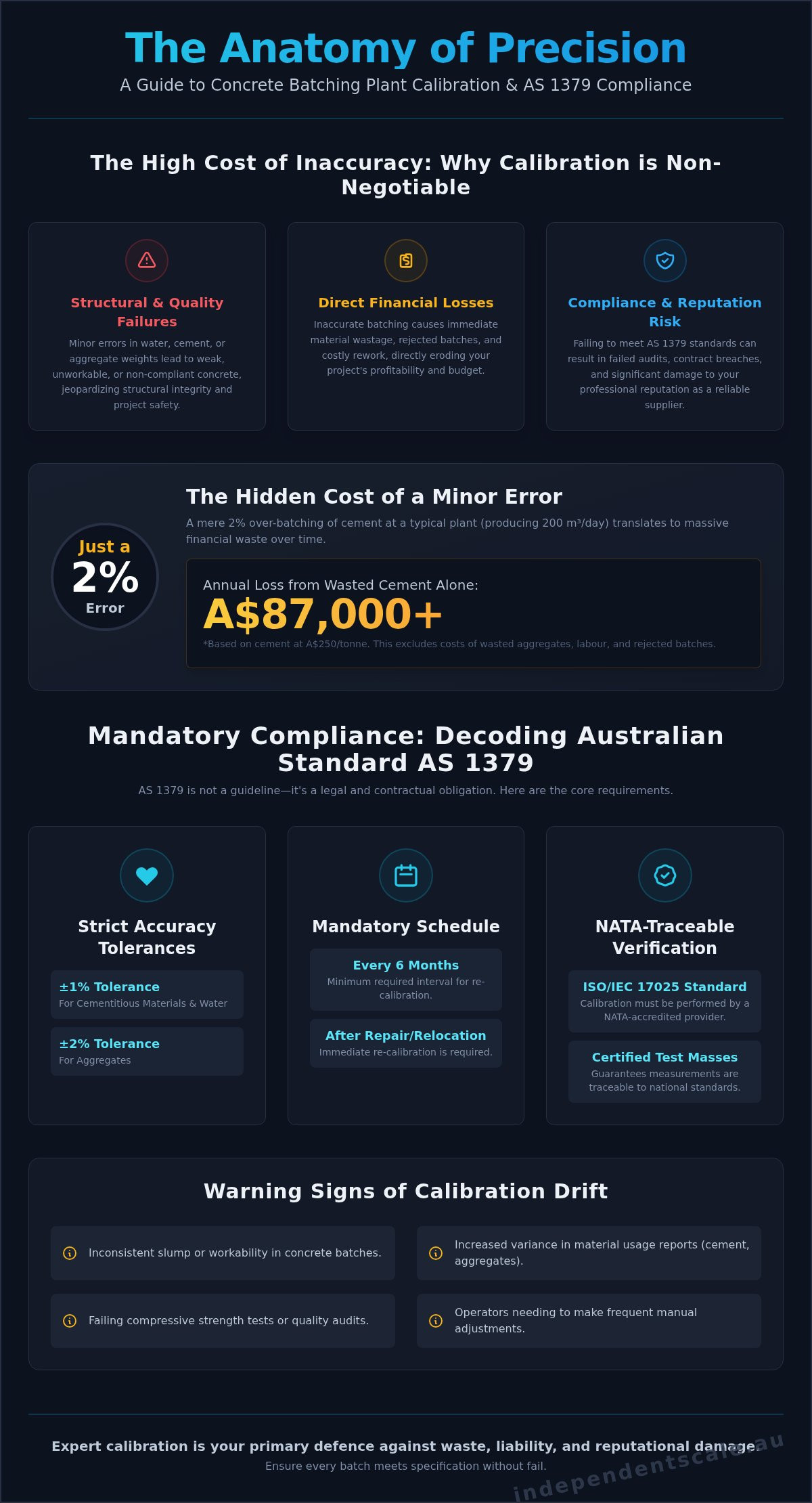
The financial impact of inaccurate batching is immediate and substantial. Consider the cost of a minor 2% over-batching of cement at a typical plant producing 200 m³ per day. With cement at A$250/tonne, this small error results in a waste of 1.4 tonnes of cement daily, costing over A$87,000 annually in lost material alone. This figure does not account for the hidden costs of rejected batches, wasted aggregates, and the labour required for rework, all of which erode your profit margins.
Meeting Project Specifications and Maintaining Your Reputation
In a competitive market, a reputation for reliability is invaluable. Proper concrete batching plant calibration provides the verifiable data to prove compliance and quality. This is essential for meeting the stringent requirements of standards like AS 1379. Without certified calibration records, your operation is exposed to significant risk, including contract breaches and liability for structural failures. Consistently delivering compliant, high-quality concrete builds client trust and secures your position as a precise and dependable supplier.
The Core Standards: AS 1379 Compliance and NATA Accreditation
In the Australian construction industry, precision is not optional-it is mandated by law and required by contract. For ready-mixed concrete producers, two frameworks are central to operational integrity: Australian Standard AS 1379 and NATA accreditation. Understanding these standards is the first step in ensuring your concrete batching plant calibration is accurate, compliant, and legally defensible. Failure to comply exposes your operation to significant contractual, financial, and legal risks.
What is Australian Standard AS 1379?
AS 1379, The Specification and Supply of Concrete, is the definitive Australian standard governing the production and delivery of ready-mixed concrete. It sets strict requirements for batching accuracy, mandating specific tolerances for each constituent material (e.g., ±1% for cementitious materials and water, ±2% for aggregates). The standard also dictates that weighing systems must be calibrated at least every six months, or following any repair or relocation. Meticulous documentation of these calibrations is required to provide a clear audit trail and prove ongoing compliance.
The Role of NATA Accreditation (ISO/IEC 17025)
The National Association of Testing Authorities (NATA) is Australia's foremost authority for the accreditation of laboratories and technical facilities. NATA accreditation signifies that a calibration provider operates in accordance with the international standard ISO/IEC 17025. This involves a rigorous assessment of the provider's quality management systems, technician competency, equipment accuracy, and calibration procedures. Crucially, it guarantees that all measurements are traceable to national standards, providing the highest level of confidence. This is verified through public records of NATA Accreditation for AS 1379 compliance.
Risks of Using Non-Accredited Calibration Services
Opting for a non-accredited service for your concrete batching plant calibration introduces unacceptable business risks. Without the assurance of NATA accreditation, you have no guarantee of competence or accuracy, leading to severe consequences:
- Rejected Reports: Calibration certificates from non-accredited providers may be rejected during audits by major contractors, government bodies, or regulatory authorities.
- Lack of Legal Standing: In the event of a concrete failure investigation, a non-NATA calibration report holds little to no legal weight, leaving your business liable.
- No Guarantee of Competence: There is no verified proof that the technicians are properly trained or that their test equipment is accurate and traceable.
Ensure your plant is fully compliant with our NATA Accredited services.
The Concrete Batching Plant Calibration Process: A Detailed Breakdown
A professional concrete batching plant calibration is a systematic, evidence-based procedure executed by certified technicians. The entire process is benchmarked against certified test masses-weights of a known, verified mass traceable to national standards through NATA accreditation. This use of verified test masses is non-negotiable for achieving the accuracy and legal traceability required for compliance with Australian Standard AS 1379 and other quality assurance schemes.
The process involves testing each weighing and metering system independently to ensure every component of the batch design is dosed with precision.
Calibrating Aggregate Bins and Weigh Hoppers
This critical stage begins with a thorough inspection of the weigh hopper's mechanical and electrical systems. Technicians check load cells, wiring, and mounting hardware for wear, damage, or debris that could impede free movement. Certified test weights are then applied directly to the hopper in incremental stages. Testing is performed at multiple points through the weighing range (e.g., 25%, 50%, 75%, and 100% of capacity) to confirm linearity and repeatability, ensuring the system is accurate for any batch size.
Verifying Cement and Fly Ash Silo Weighing Systems
Due to their immense scale, silo weighing systems require specialised calibration methods. The process involves simulating a material load on the silo’s load cells, often by hanging certified test masses from the silo structure or using calibrated hydraulic jacking systems. A key focus is identifying and rectifying any mechanical binding or friction from attached pipework, access ladders, or dust collection systems that could interfere with the load cells and produce inaccurate readings.
Testing Water Meters and Admixture Dispensers
The accuracy of liquid components is verified using the gravimetric method. This procedure involves dispensing a specified volume of water or admixture into a container resting on a separate, highly accurate, and recently calibrated scale. The actual weight of the dispensed liquid is compared to the target volume displayed by the batching system. This method confirms the accuracy of both the flow rate and the total dispensed volume, which is especially critical for low-dose chemical admixtures where small errors can significantly impact concrete performance.
This comprehensive approach ensures every input is precisely measured, providing the foundation for consistent, high-quality concrete production. A meticulous concrete batching plant calibration is the only way to guarantee your final product meets engineering specifications and regulatory standards.
Calibration Frequency and Identifying Common Accuracy Issues
Maintaining a consistent schedule for professional concrete batching plant calibration is not just a matter of compliance; it is fundamental to operational integrity, product quality, and cost control. Proactive monitoring and scheduled servicing prevent costly errors and ensure every batch meets specification.
How Often Should You Calibrate Your Plant?
For most concrete plants in Australia, the standard is clear. AS 1379 - Specification and supply of concrete mandates that weighing systems be calibrated at least every six months. However, plants operating in harsh environments or with exceptionally high production volumes should consider a more frequent, quarterly schedule. It is essential to distinguish between daily operator checks (like zeroing scales) and a full, NATA-accredited calibration performed by a certified technician using verified test masses.
Warning Signs: When to Schedule an Unplanned Check
Your plant's performance provides critical data. Any deviation from the norm can indicate a calibration issue that requires immediate attention to prevent material waste and non-compliant batches. Schedule an immediate service if you observe:
- Inconsistent Concrete Quality: Frequent variations in slump test results or unexpected failures in concrete strength tests are primary indicators of inaccurate batching.
- "Ghost" Weight Readings: The batch controller displays a weight value even when weigh hoppers are confirmed to be empty.
- Material Discrepancies: A noticeable increase in aggregate, cement, or admixture consumption that does not align with production output.
- After Major Events: An unscheduled check is essential after any major repair, load cell replacement, plant relocation, or a significant event like a lightning strike near the plant.
Preparing Your Plant for a Calibration Service
To ensure an efficient and effective calibration service with minimal disruption to your operations, proper preparation is key. Before the technician arrives, your team should:
- Ensure Safe Access: Provide clear and safe access to all weigh hoppers, silos, and control panels.
- Clean Hoppers and Bins: Thoroughly empty and clean all aggregate, cement, and admixture bins to allow for accurate empty-weight testing.
- Have Operators Available: Ensure a competent plant operator is on-site to run the batch controller as required by the technician.
Proactive maintenance and prompt attention to warning signs are critical for any concrete production facility. Experiencing issues? Schedule an urgent calibration check today.
Ensure Compliance and Precision with Expert Calibration
Maintaining the accuracy of your plant is not merely a best practice-it is a mandatory requirement for AS 1379 compliance. From preventing costly material waste to ensuring the structural integrity of the final product, professional concrete batching plant calibration is a critical investment in your operational integrity. Regular, expert verification is the only way to guarantee your weighing systems perform within the required tolerances and safeguard your business against non-compliance.
With over 30 years of industrial weighing experience, Independent Scale Service provides the expertise you need. We are fully NATA Accredited to ISO/IEC 17025 and possess deep expertise in AS 1379 compliance, ensuring your facility meets all regulatory demands. Don't leave your certification to chance. Secure the accuracy and compliance of your operations today.
Contact us for a NATA Accredited Concrete Plant Calibration Quote.
Frequently Asked Questions About Concrete Batching Plant Calibration
What is the difference between calibration and verification?
Calibration is the process of comparing the measurement values delivered by a weighing instrument against a standard of known accuracy, such as traceable test masses, and adjusting the instrument to minimise errors. Verification is the procedure of confirming that the instrument meets specified requirements and tolerances as defined by standards like AS 1379. In essence, calibration is an adjustment process, while verification is a confirmation of compliance.
Can we perform our own internal calibration checks between accredited services?
Yes, performing internal checks is a highly recommended quality control practice. Using known check weights, plant operators can monitor scale performance between accredited services to identify potential drift early. However, these checks are supplementary and do not replace the formal requirement for a NATA-accredited calibration performed by a certified technician. This formal service is essential for maintaining compliance with Australian Standards and project specifications.
How long does a full concrete batching plant calibration take?
A comprehensive calibration for a standard concrete batching plant typically requires two to four hours to complete. The exact duration depends on several factors, including the number of individual weighers (aggregate, cement, water, admix), the accessibility of the equipment, and whether any significant adjustments or minor repairs are required to bring the system back into tolerance. Our technicians work efficiently to minimise your operational downtime during the service.
What documentation should I receive after a NATA accredited calibration?
Following a NATA accredited service, you must receive an official NATA-endorsed calibration report for each weighing instrument tested. This document is your formal record of compliance and traceability. It will detail the "as found" and "as left" readings, the uncertainty of measurement, a list of the traceable test masses used for the procedure, and a clear statement of compliance with the relevant standard, such as AS 1379.
What are the most common causes of calibration drift in a batch plant?
Calibration drift is most commonly caused by mechanical wear on load cells and mounting hardware, material build-up on weigh hoppers affecting true weight, and harsh environmental conditions like temperature shifts or moisture ingress. Electrical issues, such as power surges or damaged cabling, can also impact accuracy. Regular, professional concrete batching plant calibration is essential to identify and correct for drift caused by these operational realities.
How much does professional concrete batching plant calibration cost in Australia?
In Australia, the cost for a NATA accredited calibration service typically ranges from A$900 to A$2,200 plus GST per plant. The final price is determined by the number of weigh hoppers (e.g., aggregate, cement, water) that require calibration, the plant's geographical location which affects travel time, and whether the service is a scheduled appointment or an emergency call-out. We provide a detailed quote prior to commencing any work.
