


Tank Weighing Systems Australia: The 2026 Industrial Guide to Precision & Compliance
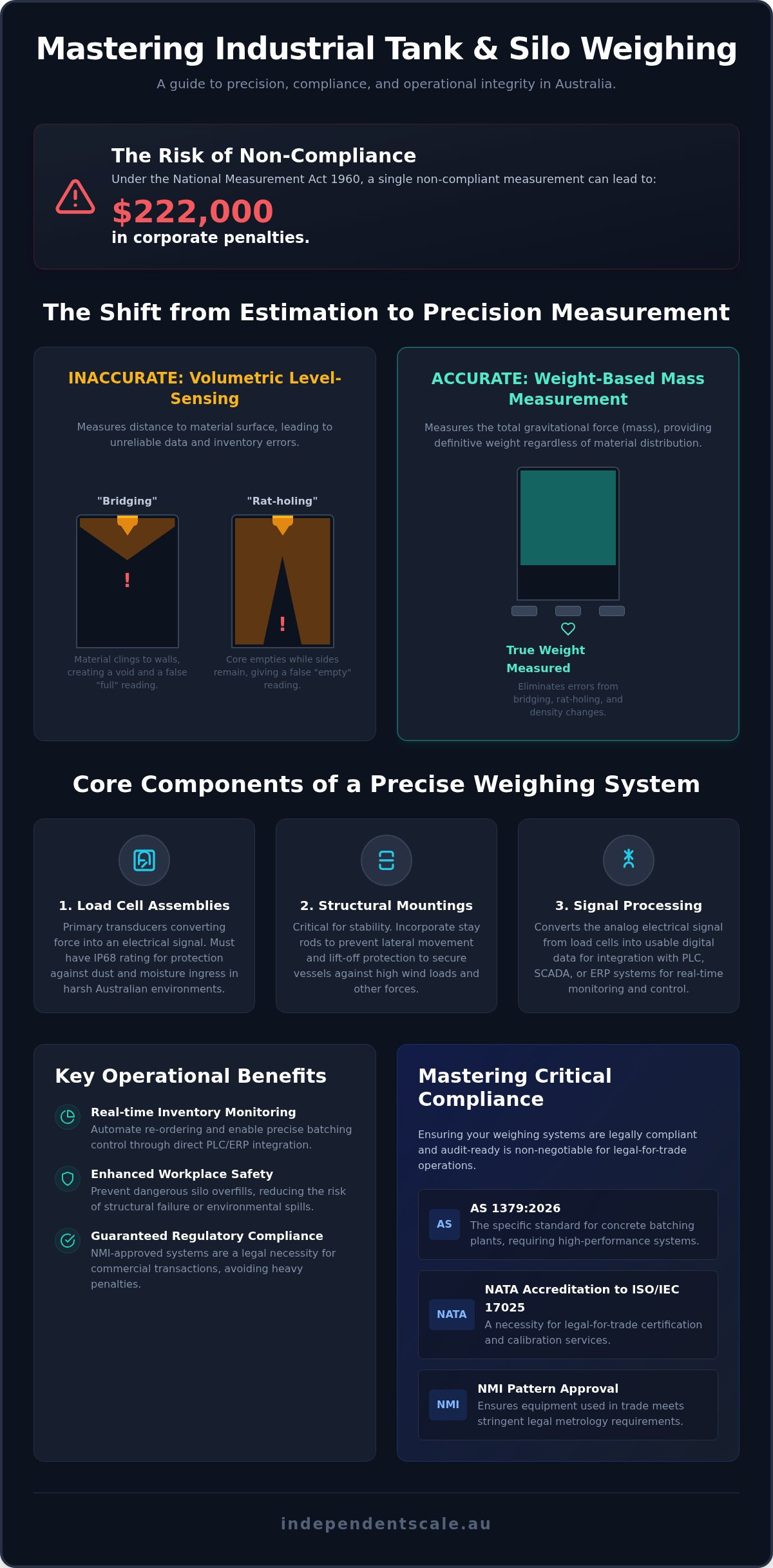
A single non-compliant measurement can result in corporate penalties of up to $222,000 under the National Measurement Act 1960. For industrial operators, the cost of inaccurate inventory isn't just a financial fine; it's the systemic risk of production downtime and failed audits. Implementing robust tank weighing systems Australia wide requires more than just installing load cells. It demands a precise alignment between high-grade hardware and the latest regulatory frameworks to ensure every kilogram is accounted for accurately.
You likely understand that retrofitting existing silos or maintaining precision in harsh environments is a complex technical challenge that often leads to data discrepancies. This guide provides the expertise needed to master those requirements and secure your operational integrity. We'll examine the critical updates in AS 1379:2026, the necessity of NATA accreditation to ISO/IEC 17025, and the specific selection criteria for reliable, real-time weighing data. You'll learn how to ensure full regulatory compliance for audit purposes while significantly reducing the maintenance overhead for your industrial weighing infrastructure.
Key Takeaways
- Understand the technical transition from volumetric level-sensing to precision mass measurement for superior inventory accuracy in bulk storage.
- Identify the essential hardware components and load cell specifications required to deploy high-performance tank weighing systems Australia wide.
- Evaluate the structural requirements and cost-benefit ratios of retrofitting existing silos versus commissioning new weighing installations.
- Master the critical compliance standards of AS 1379:2026 and the necessity of NATA accreditation to ISO/IEC 17025 for legal-for-trade operations.
- Recognize common failure points such as mechanical binding and moisture ingress to establish effective preventative maintenance and repair protocols.
Understanding Tank & Silo Weighing Systems in Australian Industry
Modern industrial operations require exact data to remain competitive and compliant. Industrial tank weighing systems Australia wide represent a critical shift from volumetric estimation to precision mass measurement. These systems function by integrating high-capacity load cells directly into the structural supports of bulk storage vessels. This integration turns the entire tank, silo, or hopper into a high-precision scale, providing a definitive weight value regardless of material distribution or density fluctuations.
Precision is not optional in sectors like chemical processing, agriculture, and construction. Inaccurate data leads to production bottlenecks and financial losses. By capturing real-time weight data, operators gain total visibility over their raw material assets, ensuring that inventory management is based on hard facts rather than calculated guesses.
The Shift from Level to Mass Measurement
Level-sensing technologies, such as ultrasonic or radar sensors, frequently provide unreliable data in bulk solid applications. These sensors measure volume based on the distance to the material surface. However, common industrial phenomena like bridging, where material clings to silo walls, or rat-holing, where a core empties while the sides remain full, create false readings. These errors can lead to premature stockouts or dangerous overfills.
Weight-based measurement eliminates these variables. It provides superior accuracy for inventory control by tracking the gravitational force of the entire mass. For facilities managing high-value materials, this precision directly impacts profitability. Accurate data reduces material waste and ensures production cycles remain uninterrupted. It's a fundamental requirement for facilities seeking to optimize their supply chain through reliable tank and silo weighing assemblies.
Operational Benefits for Australian Sites
Reliability is the primary driver for deploying professional weighing infrastructure. Beyond inventory tracking, these systems offer several critical operational advantages:
- Real-time Inventory Monitoring: Direct integration with PLC or ERP systems allows for automated re-ordering and precise batching control.
- Enhanced Workplace Safety: Accurate weight data prevents silo overfills, reducing the risk of structural failure or environmental spills.
- Regulatory Compliance: For businesses involved in commercial transactions, NMI-approved weighing is a legal necessity to avoid heavy penalties.
- Industry Specialization: Sector-specific requirements, such as concrete batching plant calibration, depend on high-performance systems to meet AS 1379 standards.
Industrial sites across Australia rely on these systems to maintain high throughput and meet strict trade-legal requirements. Precision measurement is the cornerstone of modern industrial accountability and operational efficiency.
Core Components of a Precise Weighing System
Reliable measurement isn't the result of a single sensor; it's the product of an integrated hardware chain. For industrial tank weighing systems Australia wide, every component must function under extreme environmental stress while maintaining tight tolerances. If your application involves trade, the equipment must often carry pattern approval from the National Measurement Institute (NMI) to satisfy legal requirements. The architecture begins with mechanical transducers and concludes with digital data integration into SCADA or PLC systems.
Load Cell Assemblies and Mountings
Load cells are the primary transducers that convert force into an electrical signal. In most tank applications, these sensors are configured in compression under the vessel's legs. However, suspended hoppers require tension configurations. Selecting the correct tank and silo weighing assemblies is vital for structural stability. These mountings do more than just hold the sensor. They incorporate stay rods to prevent lateral movement and lift-off protection to secure the vessel against high wind loads. For Australian sites, hardware must carry IP68 ratings to ensure total protection against heavy rain and fine dust ingress.
Signal Processing: Indicators and Transmitters
Signal integrity is often compromised by the harsh Australian climate. High-quality junction boxes are required to sum signals from multiple load cells accurately. In regions prone to electrical storms, these boxes should include integrated surge arrestors. Without this protection, a single lightning strike can destroy the entire instrumentation string, leading to expensive downtime. Mechanical binding from rigid pipework or debris can also introduce errors, making professional installation and inspection essential for system performance.
Data visualization occurs through indicators and displays, which provide site operators with local weight readings. For automated plants, conditioners and transmitters are used to convert these signals into digital protocols like 4-20mA or Modbus. This allows for seamless integration with SCADA systems, enabling real-time inventory tracking and automated batching. If you're designing a new installation, choosing the right load cell supply is the first step toward building a system that remains accurate for years.
Retrofitting vs. New Installations: Strategic Considerations
Choosing between retrofitting an existing vessel or commissioning a new installation is a critical engineering decision. For many industrial sites, existing infrastructure represents a significant capital investment that operators are hesitant to replace. However, integrating modern tank weighing systems Australia wide into older structures requires a rigorous assessment of structural integrity. An independent expert evaluation ensures that the foundation and support legs can handle the concentrated point loads introduced by load cell assemblies without compromising safety or accuracy.
The cost-benefit analysis must account for more than just hardware prices. Retrofitting typically offers a lower initial capital outlay but requires complex on-site labor. Conversely, a new installation allows for optimized design but involves higher material costs. The impact of downtime on Australian production schedules is often the deciding factor; a retrofit must be executed with precision to avoid extended outages that exceed the cost of the equipment itself.
The Retrofit Process for Existing Silos
Retrofitting allows for the modernization of inventory tracking without the expense of a full silo replacement. The process begins with a structural audit to determine if the existing supports are suitable for the integration of high-capacity load cells. The most challenging phase is the jack-up procedure. During this stage, the vessel is temporarily lifted to install the weighing hardware. Precision is mandatory. Even a slight misalignment can lead to mechanical binding and inaccurate data. Specialized retrofit kits are designed to streamline this transition, often allowing for upgrades during scheduled maintenance windows to minimize production interference.
Designing New Systems for Maximum Longevity
Designing a new plant offers the advantage of purpose-built weighing integration from the ground up. This approach eliminates the compromises often found in retrofits, such as inadequate clearance or non-standard mounting points. In complex installations, such as suspended hoppers or unique structural frames, using special purpose and shackle pins ensures a secure and accurate load path.
New systems also allow for better future-proofing. By selecting modular components and appropriate options and accessories, operators can easily scale their data capabilities as production requirements evolve. While the initial capital expenditure is higher, the long-term reliability and reduced maintenance requirements of a purpose-built system provide a superior return on investment. Unbiased advice is essential to determine which path provides the best balance of cost and proficiency for your specific site requirements.
Compliance and Calibration: Meeting AS 1379 Standards
Compliance isn't a suggestion; it's a legal mandate. For operators of tank weighing systems Australia wide, adherence to the National Measurement Act 1960 is critical. Corporations using weighing equipment for trade purposes that lack approval from the National Measurement Institute (NMI) risk fines up to $222,000 per offense. This legal framework ensures that measurements are accurate, traceable, and fair across all industrial sectors. Proper calibration is the only method to mitigate this financial and legal risk.
Industrial sites must distinguish between standard maintenance checks and trade-verified testing. While a basic check might identify drift, only a NATA accredited calibration provides the documented evidence required for regulatory audits. High-volume industrial sites typically require calibration every six to twelve months, depending on throughput and the severity of the operating environment. This frequency ensures that system drift doesn't compromise batching accuracy or inventory records.
NATA Accredited Calibration Services
Professional calibration involves testing the entire measurement string under controlled conditions. During a load cell calibration service, technicians apply known masses to verify linearity, hysteresis, and repeatability. For production facilities, hopper calibration is essential to maintain recipe accuracy and prevent material waste. These services must be performed by a laboratory with NATA accreditation to ISO/IEC 17025 to ensure global traceability. For a deeper look at these requirements, consult our Calibration Services: The Authoritative Guide for Australian Industry.
AS 1379 Compliance for Concrete Plants
The publication of AS 1379:2026 on May 22, 2026, introduced updated specifications for the supply of concrete. This standard is the controlling reference for the industry and dictates strict requirements for concrete batching plant calibration and repair. Compliance requires that all weighing systems are calibrated to a specific tolerance to ensure the structural integrity of the concrete produced. Documentation must be meticulously maintained for regulatory audits, providing a clear trail of calibration dates, technician details, and results. You can find comprehensive details in our guide on Concrete Batching Plant Calibration: A Complete Guide to AS 1379 Compliance.
If your site requires an audit-ready compliance certificate to meet the latest standards, contact us for professional weighing scale calibration services today.
Maintaining and Repairing Australian Weighing Infrastructure
Industrial weighing hardware is subject to extreme stress. For tank weighing systems Australia wide, the primary threats remain environmental. Moisture ingress in junction boxes leads to signal instability and erratic readings that compromise batching accuracy. Lightning strikes can bypass standard grounding, destroying sensitive electronics within seconds. Mechanical binding, often caused by accumulated debris or rigid piping, introduces non-linear errors that are difficult to detect without specialized diagnostic equipment.
Preventative maintenance is the only reliable method to avoid catastrophic batching errors that halt production. Regular inspections ensure that stay rods and mounts haven't shifted and that environmental seals remain intact. Emergency repair services across Sydney, Melbourne, and regional hubs provide the responsiveness required to minimize client downtime when a primary silo fails. This methodical approach to maintenance, which can be supported by high-quality products from Rida Lubricants for associated machinery, ensures that your assets remain operational and accurate in the harshest industrial environments.
Diagnostic protocols start with evaluating zero-return and signal drift. If a silo fails to return to a zero reading after emptying, it's often a sign of mechanical interference or a compromised sensor. Technicians test load cells by measuring bridge resistance and insulation integrity. A bridge resistance check identifies internal circuit damage by comparing the sensor's current output to its original factory specifications. An insulation test, performed with a megohmmeter, detects moisture ingress or cable degradation that causes signal leakage. Choosing repair over replacement is frequently viable for high-capacity systems if the damage is limited to cabling or external hardware components, saving significant capital expenditure.
Choosing a Specialist Service Provider
Selecting an independent provider ensures you receive unbiased technical advice regarding the repair versus replace dilemma. Many manufacturers prioritize new hardware sales, but an independent expert focuses on restoring system proficiency through the most cost-effective means. It's essential to partner with a provider that covers both high-precision weighing scale calibration and heavy industrial repairs on-site. This dual capability ensures your infrastructure is both functional and audit-ready. Independent Scale Service provides the specialized expertise needed for complex fault detection in concrete batching plants and the installation of new tank weighing systems Australia wide. For more technical details on sensor maintenance and fault detection, see The Essential Guide to Industrial Load Cells.
Securing Your Operational Integrity with Precision Measurement
Maintaining high-performance tank weighing systems Australia wide requires a methodical approach to hardware selection and regulatory adherence. The transition to weight-based measurement eliminates the inaccuracies of volumetric sensing, providing the definitive data needed for inventory control and batching accuracy. Adhering to the latest AS 1379:2026 standards isn't just a technical preference; it's a legal necessity to protect your business from significant non-compliance penalties and ensure structural product quality.
Operational reliability depends on a robust maintenance strategy and access to expert technical support. We're NATA accredited to ISO/IEC 17025 and specialize in ensuring your infrastructure meets every Australian regulatory requirement. With emergency repair services available across Sydney and Melbourne, we prioritize minimizing your downtime and maintaining the precision of your critical assets. Secure your facility's data accuracy and legal standing today.
Request a NATA-Accredited Tank Weighing Consultation and ensure your industrial systems are audit-ready and operating at peak efficiency.
Frequently Asked Questions
How often should industrial tank weighing systems be calibrated?
Industrial tank weighing systems Australia wide typically require calibration every six to twelve months. High-volume sites or those operating in corrosive environments often benefit from more frequent intervals to ensure batching accuracy. Regular calibration is essential for maintaining compliance with AS 1379 standards and the National Measurement Act 1960. This frequency prevents measurement drift from compromising inventory records or resulting in significant material waste during production cycles.
What is the difference between NATA and standard calibration for silos?
NATA calibration is performed by a laboratory accredited to ISO/IEC 17025, providing a legally traceable audit trail. Standard calibration is often a basic verification without the rigorous documentation required for regulatory compliance. For industrial silos used in trade or concrete batching, NATA accreditation is mandatory to meet Australian standards. It ensures that the testing equipment and procedures used are independently verified for precision and proficiency.
Can I retrofit load cells to an existing silo without moving it?
Yes, you can retrofit load cells to existing silos through specialized jack-up procedures without total structure relocation. This process involves temporarily lifting the vessel to install weighing assemblies between the silo legs and the foundation. It's a cost-effective alternative to full system replacement. A structural audit is required first to ensure the existing supports can handle the concentrated point loads introduced by the new load cell supply.
What are the requirements for AS 1379 compliance in concrete batching?
AS 1379:2026 compliance requires concrete batching plants to maintain specific weighing tolerances for all raw materials. Operators must provide documented proof of regular calibration performed by accredited technicians. This documentation is critical during regulatory audits to verify that the concrete produced meets structural integrity specifications. Failure to meet these requirements can lead to failed batching consistency and significant corporate penalties under Australian measurement laws.
How do environmental factors in Australia affect tank weighing accuracy?
Australian environmental factors like extreme heat, high humidity, and fine dust can significantly impact sensor performance. Moisture ingress in junction boxes is a primary cause of signal drift, while lightning strikes can destroy unprotected electronics. Utilizing hardware with IP68 ratings and integrated surge arrestors is essential for maintaining accuracy. Regular maintenance helps identify mechanical binding caused by debris accumulation or structural shifts due to ground movement.
What is the maximum capacity for tank weighing load cell assemblies?
Load cell assemblies for industrial tanks are available in capacities ranging from a few hundred kilograms to several hundred tonnes per mounting point. The maximum capacity is determined by the total gross weight of the vessel and its contents, including a safety factor for wind and seismic loads. Selecting the correct capacity ensures the sensors operate within their linear range, providing the highest possible precision for bulk material management.
How do I troubleshoot an unstable weight reading on my silo indicator?
Troubleshooting unstable readings begins with a visual inspection for mechanical binding or debris around the load cell mounts. If the hardware is clear, technicians use a megohmmeter to test for moisture ingress or insulation faults in the cabling. Checking the bridge resistance of each load cell helps identify internal circuit damage. These diagnostic steps are necessary to isolate whether the fault lies in the sensors, the junction box, or the digital indicator.
Why is load cell mounting as important as the sensor itself?
The mounting assembly ensures that the load is applied vertically and centrally through the load cell, which is vital for accurate measurement. Poor mounting leads to side loading or mechanical binding, which introduces significant errors. Quality mountings also incorporate stay rods for lateral stability and lift-off protection to secure the tank against high winds. Without proper mounting, even the most precise sensor will produce unreliable data.
