


Professional Load Cell Repair Sydney: Expert Diagnostics & Service
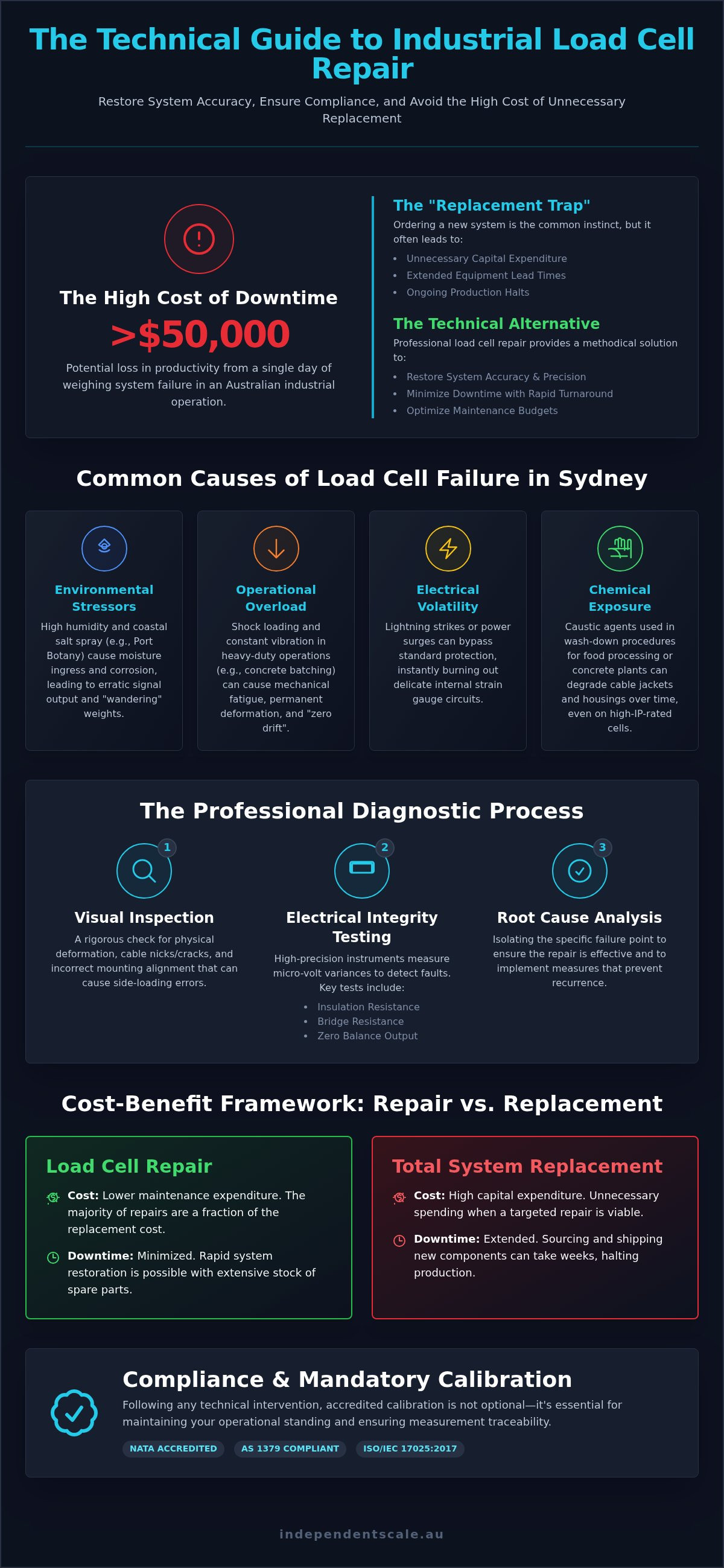
A single day of instrument downtime can cost an Australian industrial operation more than $50,000 in lost productivity. When a weighing system fails, the immediate instinct is often to order a replacement, yet this frequently leads to unnecessary capital expenditure and extended lead times. Professional load cell repair Sydney provides a technical alternative that restores system accuracy while avoiding the "replacement trap." It's a methodical approach designed for serious industrial clients who require precision and technical reliability above all else.
You understand that inaccurate batching results in wasted materials and that compliance anxiety regarding AS 1379 or NATA standards is a constant pressure during production peaks. This guide details the technical forensic process of diagnosing and repairing industrial load cells to minimize downtime and ensure full NATA compliance through 2026. We'll examine the specific diagnostic steps required to identify root causes of failure, the requirements for ISO/IEC 17025:2017 accreditation, and how to secure a valid calibration certificate to maintain your operational standing. By the end, you'll have a clear framework for restoring system integrity and preventing the recurrence of measurement errors.
Key Takeaways
- Identify environmental stressors like high humidity and coastal salt spray in Sydney Port regions that cause premature load cell degradation.
- Understand technical diagnostic processes, including bridge resistance testing and visual inspections, to pinpoint specific component failures.
- Evaluate the cost-benefit framework for load cell repair Sydney versus total system replacement to optimize maintenance budgets.
- Ensure adherence to NATA and AS 1379 standards through mandatory accredited calibration following any technical intervention.
- Minimize production downtime by utilizing an extensive stock of spare parts, such as junction boxes and surge arrestors, for rapid system restoration.
Common Causes of Load Cell Failure in Sydney Industrial Environments
Sydney's industrial infrastructure operates under specific geographic and environmental pressures that directly impact weighing accuracy. From the heavy manufacturing corridors in Western Sydney to the maritime logistics hubs, equipment is exposed to stressors that lead to premature failure. Identifying these causes early allows for targeted load cell repair Sydney and prevents the high productivity losses associated with system downtime. Before diagnosing a fault, it's useful to understand the technical foundation of What is a Load Cell? and how its internal strain gauges respond to force.
Environmental Impact on NSW Weighing Systems
Sydney’s variable climate, characterized by high humidity and coastal salt spray, is a primary driver of cable integrity issues. In regions like Port Botany, salt air accelerates the corrosion of alloy steel cells. Moisture ingress is the most common cause of erratic signal output. It compromises the internal bridge circuit, leading to fluctuations that a standard calibration cannot fix. While stainless steel cells offer higher resistance, the entry points for cables remain vulnerable. If the hermetic seal fails, the resulting internal oxidation often necessitates a full component replacement rather than a simple recalibration. You'll often see this manifest as "wandering" weights that never stabilize.
Operational Overload and Mechanical Fatigue
Physical damage often occurs during heavy-duty hopper and silo operations. Shock loading, where weight is dropped suddenly onto the scale, can permanently deform the metal element. This damage is often invisible to the naked eye but catastrophic for precision. In concrete batching plants, constant vibration from mixers and conveyors loosens mounting hardware and stresses internal wiring, leading to intermittent signal loss.
- Zero Drift: if the scale doesn't return to zero after unloading, mechanical fatigue or a "set" in the metal is likely. This is a primary indicator that the cell has been stressed beyond its rated capacity.
- Chemical Exposure: wash-down procedures in food processing or concrete batching often involve caustic agents. These chemicals can degrade even high-IP-rated housings over time.
- Electrical Volatility: lightning strikes or power surges in Sydney’s industrial zones can bypass standard junction boxes and surge arrestors, burning out the delicate strain gauge circuits instantly.
Maintaining AS 1379 compliance requires these mechanical and electrical factors to be addressed during every service interval. When a system fails to meet accuracy standards, it's rarely a software glitch; it's almost always a physical response to these harsh operational realities. Professional diagnostics focus on isolating which of these stressors caused the failure to prevent it from happening again after the repair is complete.
Technical Diagnostics: How Professionals Test for Load Cell Faults
Before initiating any load cell repair Sydney, a methodical diagnostic sequence is required to isolate the point of failure. Unlike general electrical troubleshooting, load cell testing requires high-precision instrumentation to detect micro-volt variances. The process begins with a rigorous visual inspection. Technicians examine the load cell body for physical deformation and the cabling for nicks, cracks, or chemical degradation. Mounting alignment is also verified, as even a minor shift in the load path can induce side-loading errors that mimic electrical faults.
Electrical integrity is assessed through a series of quantitative tests. Technicians measure insulation resistance to detect "leakage" between the bridge circuit and the metal cell body, often caused by moisture ingress. A zero balance check follows, where the output voltage is measured under no-load conditions. If the output exceeds manufacturer tolerances, the strain gauges have likely suffered permanent mechanical deformation. These procedures ensure equipment aligns with international manufacturing standards for metrological accuracy.
The Multimeter Test: First Line of Diagnosis
Bridge resistance is the electrical equilibrium within the load cell strain gauges. Technicians use a high-resolution multimeter to verify input and output resistance against the original calibration certificate. A "shorted" bridge or a significant deviation in ohms indicates internal circuit damage. The diagnostic sequence includes:
- Excitation Voltage: Verifying the stable power supply from the indicator to the cell.
- Signal Return: Measuring the millivolt output to ensure it responds linearly to applied force.
- Continuity: Checking for breaks in the shielding or individual wire cores.
Advanced Signal Conditioning and Indicators
When a weighing system fails, the fault isn't always the sensor. Technicians must differentiate between issues in the indicators and displays and the load cell itself. Using a load cell simulator allows the technician to bypass the sensor and feed a known signal directly into the instrument. This isolates whether the error originates in the conditioners and transmitters or the physical weighing assembly. If the display remains erratic while connected to the simulator, the electronics require service. If the signal stabilizes, the load cell is the confirmed point of failure. If you suspect a component fault, our team can provide a professional diagnostic assessment to confirm the exact cause.
Load Cell Repair vs. Replacement: A Cost-Benefit Framework
Determining whether to proceed with load cell repair Sydney or invest in a full system replacement requires a structured technical evaluation. This decision matrix balances the immediate cost of components against the long-term reliability of the weighing system. For many industrial sites, the "Downtime Factor" is the most significant variable. A Sydney-based technician can often perform onsite diagnostics and minor repairs within hours, whereas sourcing specialized replacements may involve lead times that halt production for days. When evaluating the financial impact, compare the repair quote against the purchase price of new load cells, factoring in the cost of labor for installation and the subsequent NATA-accredited calibration required for both options.
The criticality of the application also dictates the path forward. In high-stakes environments like concrete batching or chemical processing, compliance with AS 1379 or ISO/IEC 17025 is non-negotiable. If a repair cannot guarantee the restoration of the unit’s original accuracy class, replacement becomes the only compliant choice. Understanding the Common Causes of Load Cell Failure is essential for this assessment; specifically, if the failure is due to external factors like moisture ingress in a junction box, a repair is highly viable.
When Repair is the Logical Choice
Repairing an existing unit is often the most efficient path for non-destructive faults. Minor cable damage, such as nicks or insulation wear, can be professionally spliced and sealed without compromising signal integrity. Moisture issues within junction boxes are frequently resolvable through component cleaning and resealing. This is particularly relevant for tank and silo weighing assemblies, where the physical removal of a load cell is a complex engineering task involving jacks and temporary supports. If the internal strain gauge bridge remains within electrical tolerances, recalibration can restore the system to its required accuracy level.
Indicators That Replacement is Mandatory
Replacement is the only safe option when the load cell’s physical structure has reached its elastic limit. Permanent deformation, also known as yielding, occurs when the metal element is stressed beyond its rated capacity, rendering the sensor incapable of linear measurement. Severe lightning strikes often fuse the internal strain gauges to the cell body, causing irreparable electrical failure. In these cases, modern load cell supply options often provide a better return on investment. Newer models may feature improved IP ratings or integrated surge protection, reducing the likelihood of future failures in Sydney’s demanding industrial environments.
Compliance and Calibration: Meeting NATA and AS 1379 Standards
In the Australian industrial sector, a technical repair is only half the solution. Any major load cell repair Sydney must be followed by a formal calibration process to validate that the equipment meets its original accuracy specifications. Without this validation, the repair lacks the legal and technical standing required for industrial weighing audits or commercial transactions. Compliance isn't a suggestion; it's a regulatory requirement that ensures your weighing data is traceable to national standards. This traceability is vital if your documentation is ever scrutinized during a safety audit or legal dispute.
Maintaining ISO/IEC 17025:2017 compliance is the benchmark for laboratory technical competence in Australia. This standard ensures that the calibration process itself is rigorous, repeatable, and performed by qualified technicians using NATA-certified reference masses. For Sydney operations, this level of accreditation provides a non-negotiable layer of risk mitigation, ensuring that production batches remain within tolerance and that material waste is minimized through verified precision.
NATA Accredited Load Cell Calibration
There's a critical distinction between a routine scale check and a NATA-certified calibration. A check merely confirms the scale is functioning, whereas a NATA calibration involves a series of technical tests that quantify uncertainty and verify linearity, hysteresis, and repeatability. Sydney businesses prioritize NATA-accredited services because they provide a valid calibration certificate that is recognized by regulatory bodies and international partners. For a deeper understanding of these requirements, refer to Calibration Services: The Authoritative Guide.
AS 1379 Compliance for Concrete Batching
The construction industry in New South Wales operates under the strict mandate of AS 1379-2007, which was reconfirmed in 2017. This standard specifies that all weighing and liquid-dispensing equipment in a concrete batching plant must be calibrated at least every six months to ensure structural integrity in high-volume projects. Accuracy is paramount; even a 1% deviation in cement or water ratios can compromise the strength of a concrete pour. Our specialized concrete batching plant calibration and repair services ensure your site remains compliant with these mandatory accuracy limits. If your plant is approaching its six-month interval or has recently undergone a component swap, you can book a NATA-accredited calibration to secure your compliance status for 2026.
Sydney’s Industrial Load Cell Experts: Why Choose Independent Scale Service
Independent Scale Service operates with a specialized focus on the technical requirements of the New South Wales industrial sector. With over 33 years of expert calibration experience, our approach to load cell repair Sydney centers on technical precision and the immediate restoration of system accuracy. We maintain an extensive inventory of critical components, including junction boxes and surge arrestors, to ensure that repairs aren't delayed by international supply chain issues. This availability is a key differentiator for Sydney businesses that can't afford prolonged operational pauses during production peaks.
Our engineering team is trained to handle complex onsite fault diagnosis across Sydney and Melbourne metro areas. We don't just provide a temporary fix; we conduct a forensic analysis to understand the failure's root cause, whether it's electrical volatility or mechanical fatigue. This comprehensive service model extends from professional load cell calibration to the supply of entire weighing systems, ensuring a single point of accountability for your technical compliance.
Onsite vs. Laboratory Repair Capabilities
We utilize mobile testing units equipped with high-resolution diagnostic tools for immediate onsite assessment. These units allow our technicians to perform bridge resistance testing and signal conditioning checks directly at your facility, which is essential for large-scale installations like silos or hoppers. For more complex electronic failures or delicate sensor repairs, our NATA-accredited laboratory provides a controlled environment for precision testing. This dual-capability model ensures we achieve "first-time" fixes, significantly reducing the total cost of ownership for your weighing assets.
Proven Track Record with Major Australian Clients
Our portfolio includes long-standing partnerships with concrete batching plants, mining sites, and maritime logistics hubs throughout Australia. We provide reliable support for complex industrial weighing scales, ensuring they remain within the strict tolerances required for commercial trade and safety compliance. This experience allows us to navigate the specific challenges of high-volume NSW construction projects where accuracy is a legal mandate under AS 1379. If your system shows signs of drift or signal loss, contact our team for an urgent load cell inspection in Sydney today. We prioritize responsiveness to keep your operations compliant and productive.
Restore Operational Precision and Compliance
Maintaining industrial weighing accuracy is a continuous technical requirement. Environmental stressors and mechanical fatigue in Sydney's industrial hubs demand a methodical approach to system maintenance. By prioritizing expert diagnostics over immediate replacement, you protect your capital budget while ensuring your equipment meets the rigorous demands of AS 1379 and ISO/IEC 17025. Professional load cell repair Sydney provides the forensic analysis necessary to identify root causes and prevent the recurrence of costly measurement errors.
Independent Scale Service leverages 33+ years of industrial experience to deliver NATA-accredited solutions that minimize downtime. We are AS 1379 compliance specialists dedicated to restoring your system's integrity with speed and technical proficiency. Whether you are managing a concrete batching plant or a high-volume logistics center, our NATA accreditation to ISO/IEC 17025 serves as your guarantee of quality and traceability. Don't let inaccurate data compromise your production standards or regulatory standing. Request an Urgent Load Cell Diagnostic or Repair in Sydney to ensure your facility remains precise and fully compliant through 2026. We look forward to securing your system accuracy.
Frequently Asked Questions
Can a load cell be repaired if the cable is cut?
Yes, a load cell can often be repaired if the cable is cut, provided the damage is external and moisture hasn't penetrated the hermetic seal. Technicians perform a professional splice using moisture-proof heat shrink and shielding to maintain signal integrity. However, if the cut occurred while the system was powered, a surge may have damaged the internal bridge. We conduct an insulation resistance test to confirm the sensor remains viable before proceeding with the cable repair.
How do I know if my load cell in Sydney is failing?
Failure typically manifests as erratic weight displays, "wandering" zero points, or non-linear readings during batching. You might notice the scale fails to return to zero after a load is removed, indicating mechanical yielding. In Sydney’s coastal environments, check for visible corrosion on the housing or cable entry points. If your system consistently produces different weights for the same known load, it's time for a professional load cell repair Sydney diagnostic to isolate the fault.
What is the difference between calibration and repair?
Repair involves fixing a physical or electrical fault, such as a damaged cable or a faulty junction box component. Calibration is the technical process of comparing the load cell's output against a known reference standard, such as NATA-certified test weights. While a repair restores the device to a functional state, calibration verifies its accuracy and ensures it operates within specified tolerances. Both are necessary to maintain system integrity after a component failure or mechanical stress.
Is NATA accreditation required for all industrial load cell repairs?
NATA accreditation is not strictly mandatory for the physical repair itself, but it is essential for the calibration that follows the repair. For any application involving commercial trade, safety-critical measurements, or AS 1379 compliance, the weighing system must be validated by a NATA-accredited laboratory. This ensures the results are traceable to national standards. Without a NATA-certified calibration after a major repair, your equipment may not meet the legal requirements for industrial audits.
How long does a typical load cell repair take?
Onsite diagnostics and minor repairs, such as cable splicing or junction box replacements, typically take between two and four hours. If the load cell requires laboratory-based testing or specialized component replacement, the timeframe depends on part availability. We maintain an extensive stock of standard spare parts to ensure the fastest possible turnaround. Our priority is to minimize your production downtime by achieving a definitive fix during the initial service visit whenever technically possible.
What happens if my concrete plant fails an AS 1379 audit?
Failing an AS 1379 audit means your concrete batching plant cannot legally supply concrete for structural use until the issue is rectified. This usually results in an immediate halt to production, leading to significant financial losses. You must engage a specialist to perform a load cell repair Sydney and a subsequent NATA-accredited calibration. Once the equipment is verified to meet the required accuracy limits, you can resume operations with a valid compliance certificate.
Can you calibrate load cells from other manufacturers?
Yes, we can calibrate and repair load cells from almost any manufacturer. Most industrial load cells operate on standardized millivolt-per-volt (mV/V) output signals, allowing our diagnostic equipment to interface with various brands and models. Whether you utilize shear beams, canisters, or S-type cells, our technicians have the technical expertise to verify their performance. We provide comprehensive support for your entire weighing infrastructure, regardless of the original equipment manufacturer or the age of the system.
Do you offer emergency load cell repair in Sydney?
We provide responsive service to address urgent equipment failures across the Sydney metro area. Our team understands that a single day of downtime can cost an industrial operation over $50,000 in lost productivity. We prioritize emergency requests for concrete plants, silos, and logistics hubs to restore system accuracy quickly. By carrying critical spare parts in our mobile service units, we can often diagnose and resolve faults onsite, ensuring your facility returns to full operational capacity.
