


Industrial Weighing Services Sydney: The 2026 Guide to Compliance and Precision
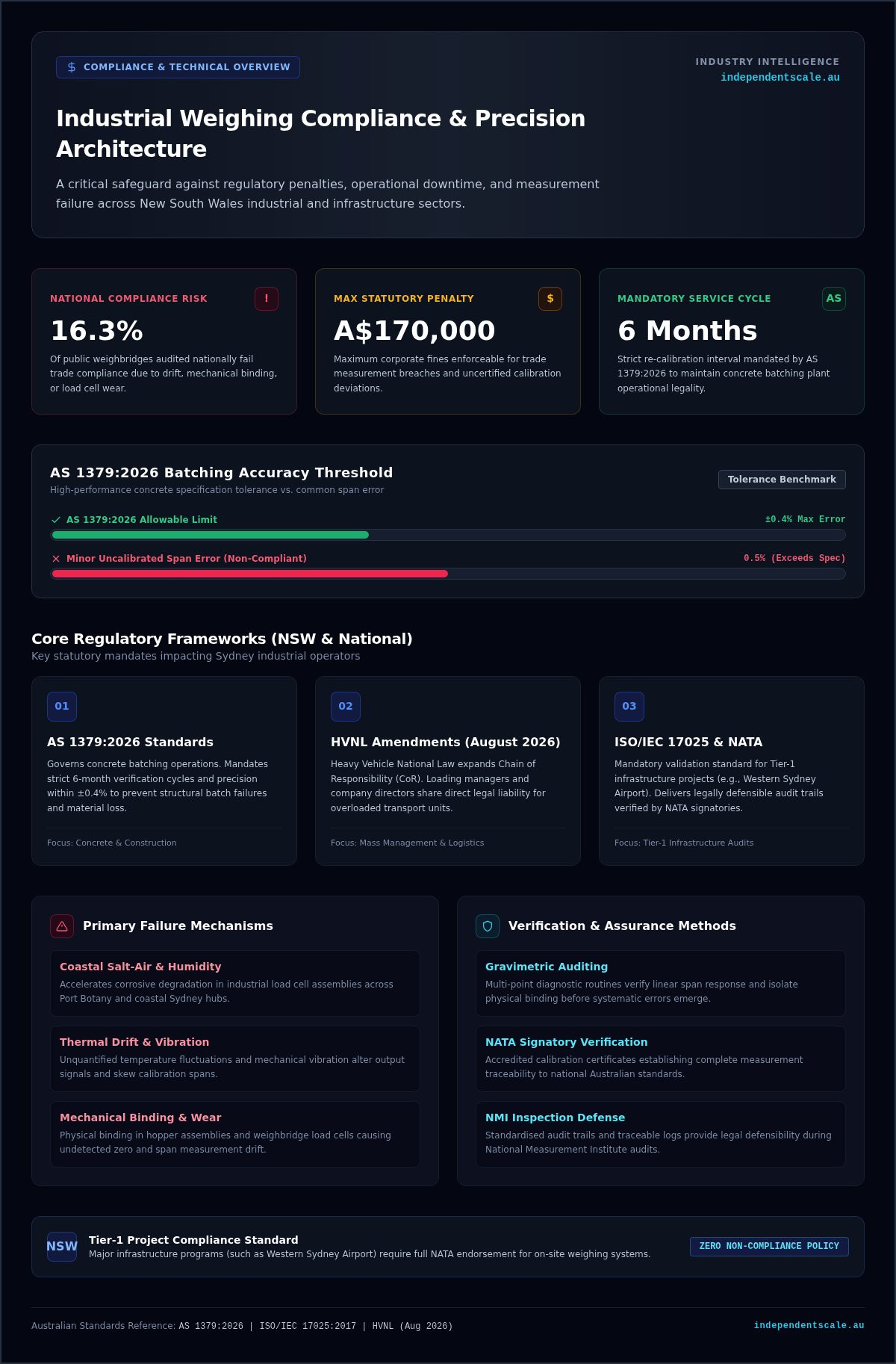
16.3% of public weighbridges audited nationally fail trade compliance standards due to calibration drift, mechanical binding, or load cell wear. In the high-pressure environments of Western Sydney’s construction and logistics hubs, even a minor deviation can trigger corporate fines reaching up to A$170,000. Securing reliable industrial weighing services Sydney businesses can trust isn't just about technical maintenance; it's a critical safeguard against regulatory risk and operational failure.
You likely understand the frustration of a production halt during a routine inspection or the sudden failure of a load cell in a concrete batching plant. It's a costly disruption that threatens your project timelines and compliance status. This guide details how to maintain NATA-accredited precision while minimizing equipment downtime. We'll examine the 2026 updates to AS 1379 standards, explore rapid emergency repair strategies for the Sydney metro area, and show you how to achieve a seamless calibration lifecycle that protects your bottom line. Precision is a requirement, not an option.
Key Takeaways
- Understand the six-month calibration mandate required by AS 1379:2026 to ensure concrete batching plant compliance and avoid corporate penalties of up to A$170,000.
- Learn why ISO/IEC 17025 and NATA-endorsed certification are mandatory for Tier-1 infrastructure projects and government audit frameworks across New South Wales.
- Identify the critical failure points in load cells and hopper assemblies that lead to measurement drift and unplanned production halts in harsh industrial environments.
- Discover how specialized industrial weighing services Sydney teams utilize gravimetric auditing and multi-point diagnostics to maintain equipment precision and reliability.
- Align your mass management systems with the August 2026 Heavy Vehicle National Law (HVNL) amendments to mitigate Chain of Responsibility risks and legal liabilities.
Industrial Weighing Services in Sydney: Navigating Compliance and Precision
Sydney’s industrial landscape is defined by high-volume output and stringent regulatory oversight. From the rapid infrastructure development in Western Sydney to the logistics hubs surrounding Port Botany, precision measurement is the bedrock of operational integrity. Reliable industrial weighing services Sydney providers offer aren't just a maintenance line item; they're a critical component of risk management. Sectors like construction, manufacturing, and mining rely on exact data to manage inventory, ensure structural safety, and maintain legal compliance. When measurement accuracy fails, profitability erodes through material loss and potential litigation.
Sydney businesses must prioritize local service providers who understand the specific environmental stresses of the region. A responsive, Sydney-based technician minimizes downtime by providing rapid fault diagnosis and on-site repair; this prevents the compounding costs of a production halt. Local expertise ensures that equipment is calibrated to handle the unique throughput demands of the New South Wales market while remaining compliant with national standards.
The High Cost of Inaccurate Industrial Weighing
Inaccuracy in industrial weighing carries a heavy financial burden. In large-scale production, even a minor span error leads to significant material wastage over time. For example, a 0.5% error in a concrete batching plant exceeds the ±0.4% limit set by AS 1379:2026, directly impacting high-performance concrete specifications. Beyond wastage, Sydney businesses face severe legal risks. Under the August 2026 Heavy Vehicle National Law (HVNL) amendments, loading managers and directors share liability for overloaded vehicles.
Environmental factors in Sydney, particularly the salt-rich air and high humidity of coastal industrial zones, accelerate the degradation of industrial load cell components. This leads to measurement drift that often goes undetected without regular, professional calibration. Without a precise weighing system, you risk corporate fines reaching up to A$170,000 for trade measurement breaches, making technical proficiency a financial necessity.
Regulatory Landscape for Sydney Businesses
Compliance in New South Wales is governed by strict Australian Standards and Commonwealth trade measurement laws. Adhering to these standards requires more than a simple zero-check; it demands a comprehensive audit trail. Traceable records are essential for passing NATA audits and maintaining ISO/IEC 17025 accreditation. For many Tier-1 infrastructure projects, such as the Western Sydney Airport, contractors won't accept anything less than NATA-endorsed certificates.
Maintaining these records ensures your business is legally defensible during a National Measurement Institute (NMI) inspection. Consistent documentation proves that your equipment meets the required accuracy tolerances and has been verified by qualified signatories. For a deeper understanding of these requirements, consult Calibration Services: The Authoritative Guide for Australian industry.
Understanding NATA Accreditation and ISO/IEC 17025 Standards
NATA accreditation represents the highest tier of technical validation in the Australian measurement industry. It isn't a simple membership; it's a rigorous assessment of a laboratory's ability to produce accurate, reliable data. When sourcing industrial weighing services Sydney companies must verify NATA signatory status to ensure all calibrations are traceable to national standards. This accreditation confirms that the personnel, equipment, and environment meet the strict criteria necessary for high-precision industrial applications. Without this oversight, measurement results lack the legal defensibility required for commercial trade and safety-critical operations.
ISO/IEC 17025: The Gold Standard for Laboratories
ISO/IEC 17025:2017 is the global benchmark for calibration laboratories. Technical competence under these guidelines involves more than just reading an indicator. It requires a comprehensive evaluation of measurement uncertainty and strict environmental controls. Factors like thermal drift or mechanical vibration must be quantified to ensure the final result is accurate. Standard equipment checks often overlook these variables, whereas a NATA-certified calibration accounts for every potential error source. If you require verified accuracy for critical systems, consider booking a NATA-endorsed load cell calibration to ensure full compliance.
AS 1379 Compliance for Concrete Production
The publication of AS 1379:2026 on May 22, 2026, set new benchmarks for concrete batching plant accuracy across Australia. Under this standard, weighing equipment for cementitious materials and aggregates must maintain a static load accuracy of ±0.4% of the maximum scale capacity. These tolerances are tight. A 5,000 kg batch hopper only allows for a 20 kg drift before it falls out of compliance. Regular calibration intervals, mandated at least every six months, are essential to prevent the production of non-conforming batches that could lead to structural failure or contract penalties.
Sydney’s Tier-1 infrastructure projects, including the Western Sydney Airport and major Transport for NSW contracts, strictly require NATA-endorsed certificates. These documents prove traceability to National Measurement Institute (NMI) trade measurement standards. Relying on a standard factory slip isn't enough to pass a government audit. Securing professional industrial weighing services Sydney expertise ensures that your facility meets these rigorous 2026 requirements, protecting your business from the A$170,000 fines associated with trade measurement breaches.
Critical Weighing Components: Load Cells, Hoppers, and Silo Systems
The reliability of an industrial weighing system depends on the synergy between the load cell and the digital indicator. Load cells act as the primary transducer, converting mechanical force into a measurable electrical signal, while the indicator processes this data for the user. In Sydney’s industrial hubs, these systems often face extreme vibration and abrasive dust, which are primary drivers of signal instability. Most failures in hopper and silo assemblies originate from mechanical binding, where the vessel contacts surrounding structures, or moisture ingress within the summing junction box. Expert industrial weighing services Sydney technicians use millivolt output testing and insulation resistance checks to isolate these faults without unnecessary hardware replacement. For a comprehensive range of replacement sensors, explore our Load Cells Collection.
Load Cell Selection and Maintenance
Choosing the correct sensor geometry is vital for system longevity. Compression load cells are standard for silos and heavy-duty hoppers, while tension cells suit suspended vessels. Beam load cells are typically reserved for platform scales and conveyors. Deciding between repair and replacement requires a technical assessment of the internal strain gauge. While damaged cables or connectors are often repairable on-site, internal failures or physical deformation caused by an overload event necessitate a full replacement to maintain accuracy. Consult our Essential Guide to Industrial Load Cells for detailed selection criteria.
Hopper and Silo Calibration Techniques
Calibrating high-capacity vessels on Sydney industrial sites presents unique challenges, particularly regarding wind loading and thermal expansion. Static calibration using NATA-traceable test weights remains the most accurate method for verifying linearity and repeatability. However, when physical weight placement is restricted by site infrastructure, technicians may use hydraulic force simulation. This method applies a controlled load to the assembly to verify the system’s response under pressure. Ensuring these assemblies are correctly mounted is critical; you can find specialized hardware in our Tank & Silo Weighing Assemblies range to prevent side-loading errors. Regular maintenance must include a visual inspection of flexure plates and mounting bolts to ensure no mechanical interference compromises the ±0.4% accuracy required for compliant production.
Specialized Services for Sydney’s Construction and Concrete Sectors
Sydney’s construction sector is expanding at an unprecedented rate, driven by major infrastructure projects like the Western Sydney Airport and the Sydney Metro expansion. Managing this growth requires technical precision that standard maintenance cannot provide. Expert industrial weighing services Sydney teams provide the necessary oversight for concrete batching plants to meet the rigorous AS 1379:2026 standards. Compliance is not merely a legal hurdle; it is a prerequisite for participating in Tier-1 government contracts where material integrity is scrutinized at every stage of the supply chain.
One critical yet often overlooked area is admixture flowmeter calibration. While many plants rely on volumetric checks, using the gravimetric or weighing method provides a significantly higher degree of certainty for high-performance concrete mixes. This process involves weighing the liquid output against a NATA-certified scale to verify the dispenser's accuracy. By integrating these specialized audits into your scheduled maintenance, you minimize the risk of non-conforming product batches and avoid the compounding costs of project delays. For immediate compliance support, book our AS 1379 concrete batching plant calibration services today.
On-Site Field Services Across the Sydney Basin
Logistics are a primary challenge for industrial sites located in Western Sydney industrial hubs or regional New South Wales. Mobile calibration units are essential for providing on-site industrial testing without requiring the removal of heavy equipment. These units are equipped to handle everything from mechanical fault diagnosis to repairing indicators and displays on the plant floor. Ensuring visibility and high-contrast readouts in harsh, dusty environments is vital for operator safety and batching accuracy. For companies aiming to integrate measurement data into a wider automated framework, you can discover EdNex Automation and their advanced robotic solutions for the industrial sector. Our technical teams prioritize rapid response times to resolve equipment failures before they result in significant production losses.
Structural integrity testing relies heavily on accurate force measurement. Whether you are testing the tension of structural cables or the torque of critical industrial fastenings, measurement drift can compromise the safety of a build. Maintaining accuracy in these instruments is essential for meeting Australian engineering standards and ensuring that structural components perform as designed under load. For a detailed breakdown of how to maintain these instruments, consult our Force Gauge Calibration Guide. Regular verification of these tools ensures your site remains compliant with both safety regulations and quality assurance protocols.
Independent Scale Service: Your Partner for Industrial Weighing in Sydney
Independent Scale Service operates as a definitive technical authority for Sydney’s industrial sector. Our NATA accreditation (Site No. 3713) ensures every calibration we perform adheres strictly to the ISO/IEC 17025 standard. We don't just provide equipment; we deliver a continuous compliance lifecycle designed for clients who cannot afford production halts or regulatory failures. This no-nonsense approach focuses exclusively on technical proficiency and responsiveness, making us the primary choice for industrial weighing services Sydney businesses rely on to manage operational risk.
We provide full lifecycle support, managing everything from the initial supply of high-precision load cells to rapid emergency repairs across the Sydney metro area. By maintaining a comprehensive inventory of components and utilizing mobile calibration units, we ensure that faulty systems are restored to full operational capacity with minimal delay. This commitment to reducing client downtime is backed by decades of experience in the New South Wales industrial landscape. We understand that in sectors like mining and logistics, equipment reliability is directly linked to your bottom line.
Comprehensive Weighing Solutions
Reliability on the plant floor requires more than just a functioning scale; it requires high-visibility data and robust hardware. Our selection of Indicators and Displays provides the clarity needed for accurate batching in harsh, dusty environments. For specialized lifting and tension monitoring, we supply shackle pins and custom industrial solutions tailored to specific project requirements. Our technical teams possess the specialized expertise required for both mechanical and electrical fault diagnosis, allowing us to identify whether a measurement error stems from a physical binding issue or a sensor circuitry failure.
Get Started with a Compliance Audit
Protecting your facility from the A$170,000 corporate fines associated with trade measurement breaches begins with a comprehensive compliance audit. Booking a NATA-accredited calibration ensures your equipment remains within the ±0.4% tolerances required by AS 1379:2026. Our technicians are available to consult on equipment upgrades and modernization projects, helping you transition from legacy systems to high-precision digital weighing assemblies. This proactive strategy reduces long-term operational risk and ensures your site is ready for the next government audit or Tier-1 project inspection. To secure your facility's accuracy and maintain industrial weighing services Sydney standards, Contact Independent Scale Service for expert Sydney weighing solutions.
Securing Your Industrial Compliance and Precision
Maintaining precision in high-capacity weighing systems is a continuous requirement for the local industrial sector. As regulatory standards like AS 1379:2026 become more stringent, the risk of non-compliance and associated corporate penalties increases. Relying on professional industrial weighing services Sydney experts ensures that your equipment remains within tolerance and your certification remains current. By prioritizing NATA-accredited calibrations and proactive load cell maintenance, you mitigate the risk of costly production halts and legal liabilities under the Heavy Vehicle National Law.
Independent Scale Service provides the technical authority needed to navigate these complex requirements. With over 30 years of industrial expertise, we specialize in delivering NATA-accredited calibrations to ISO/IEC 17025 standards. Our teams focus on ensuring your site remains AS 1379 compliant while providing the rapid response needed for emergency repairs and equipment upgrades. It's time to protect your operational integrity with a partner that understands the demands of the New South Wales infrastructure landscape.
Request a NATA-Accredited Calibration Service to secure your facility's accuracy today.
Frequently Asked Questions
How often should industrial scales be calibrated in Sydney?
Frequency depends on your specific application and operating environment. For concrete batching plants, AS 1379:2026 mandates professional inspection and verification at least once every six months. Legal-for-trade weighbridges require annual verification by an NMI-licensed licensee. High-use industrial scales in harsh Western Sydney environments may require quarterly checks to prevent measurement drift. Regular intervals ensure compliance with ISO/IEC 17025 standards and prevent costly material wastage.
What is the difference between NATA and non-NATA calibration?
NATA calibration is performed by a laboratory accredited to ISO/IEC 17025, ensuring technical competence and traceability to national standards. It provides a NATA-endorsed certificate, which is essential for Tier-1 infrastructure projects and government audits. Non-NATA calibration, often called a "traceable check," lacks the same level of formal oversight and measurement uncertainty evaluation. For industrial weighing services Sydney clients, NATA certification is the only way to ensure full legal and technical defensibility.
Can you calibrate a concrete batching plant to AS 1379 on-site?
Professional technicians perform on-site gravimetric calibration to ensure full compliance with AS 1379:2026. This process involves using NATA-traceable test weights to verify the accuracy of cementitious, aggregate, and water scales. The standard requires solid-weighing hoppers to maintain an accuracy of ±0.4% of maximum capacity. On-site verification is the most effective method for identifying mechanical binding or environmental factors that impact real-world plant performance and batching integrity.
How do I know if my load cell needs repair or replacement?
Visible physical deformation, erratic readings, or a failure to return to zero often indicate internal damage. Technicians use millivolt output tests and insulation resistance checks to diagnose the fault accurately. While damaged cables or junction box moisture ingress are often repairable on-site, a failed strain gauge or structural compromise usually necessitates a full replacement. Timely diagnosis prevents prolonged downtime and ensures the continued precision of your industrial weighing system.
What industries in Sydney require NATA-accredited weighing services?
Sectors such as construction, logistics, mining, and manufacturing require NATA-accredited industrial weighing services Sydney to meet regulatory and quality benchmarks. Specifically, any project under Transport for NSW or major infrastructure contracts like the Western Sydney Airport mandates ISO/IEC 17025 endorsed certification. This level of accreditation is also necessary for businesses operating under strict quality management systems where measurement uncertainty must be quantified for audit compliance and risk management.
Do you provide emergency weighing equipment repair in Sydney?
Independent Scale Service offers rapid response field services across the Sydney metro area to resolve critical equipment failures. Our technicians specialize in both mechanical and electrical fault diagnosis, allowing for immediate on-site repairs of load cells, indicators, and batching systems. Minimizing client downtime is a priority; we maintain a comprehensive supply of replacement components to ensure your production line or batching plant is restored to full operational capacity efficiently.
What standards apply to silo and hopper weighing in Australia?
Silo and hopper weighing systems are primarily governed by AS 1379 for concrete production and the National Measurement Act for trade-use applications. AS 1379:2026 sets specific accuracy tolerances, such as ±0.4% for cement and aggregates. Additionally, ISO/IEC 17025 provides the framework for the calibration laboratories performing the work. Ensuring compliance involves regular inspections of mounting assemblies, flexure plates, and load cell alignment to prevent mechanical interference that compromises accuracy.
How long does a typical industrial scale calibration take?
A standard industrial scale calibration usually takes between one and three hours, depending on the equipment's capacity and complexity. Calibrating a multi-hopper concrete batching plant or a high-capacity silo system requires more time due to the logistics of handling large test weights and performing multi-point linearity checks. We schedule these services to align with your production windows, ensuring that NATA-accredited verification is completed efficiently without causing significant operational disruptions.
