


Industrial Scales for Sale Sydney: The Professional Buyer’s Guide 2026
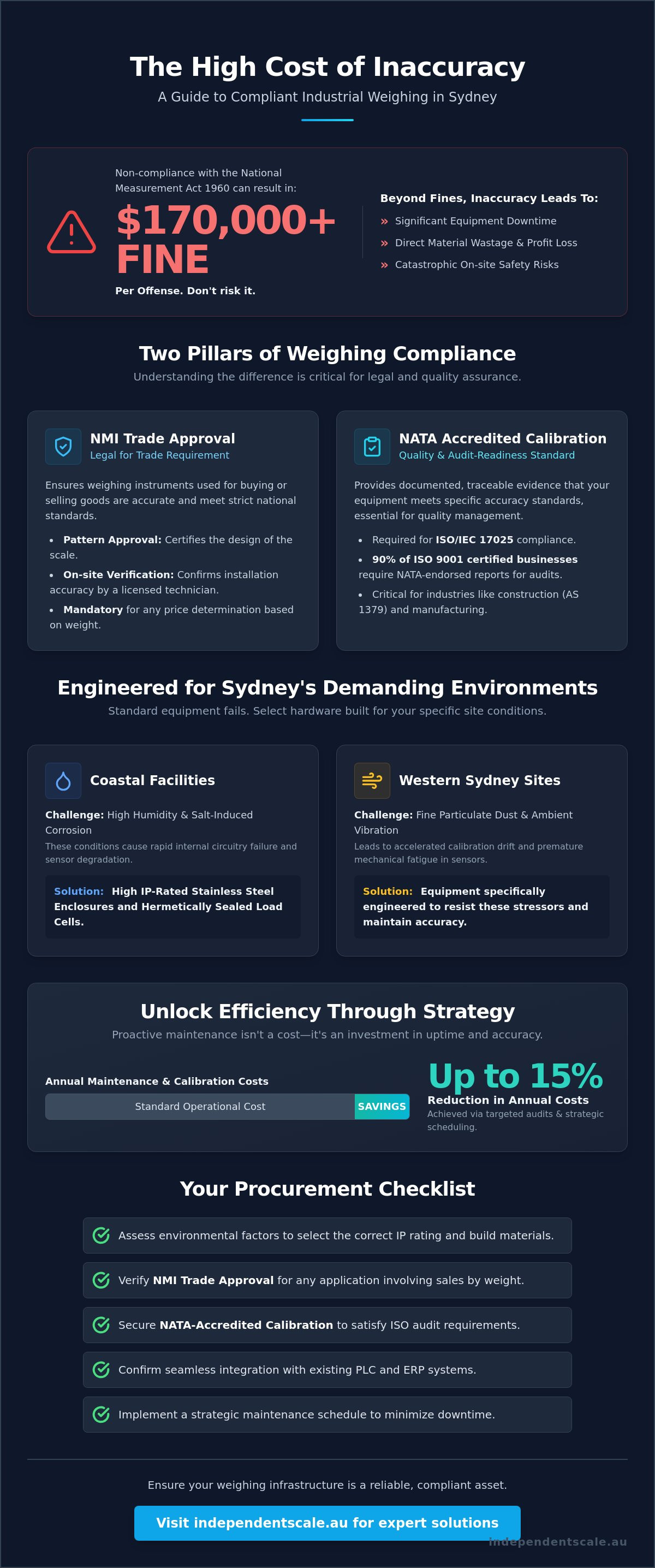
A single non-compliance error under the National Measurement Act 1960 can result in fines as high as $170,000 per offense. For Sydney operations, equipment downtime caused by failing load cells or inaccurate measurements isn't just a technical hurdle. It's a significant risk to your bottom line and regulatory standing. You need hardware that withstands heavy-duty use while meeting strict Australian standards without fail.
This guide provides the technical expertise required to evaluate industrial scales for sale Sydney, ensuring your procurement aligns with the National Measurement Guidelines 2026 and NMI trade regulations. Mastering these requirements allows you to secure a high-precision weighing system that eliminates material waste and safety risks. Our objective is to provide a clear roadmap for procuring durable equipment that maintains 100% compliance.
We will examine the critical distinctions between NMI pattern approval and on-site verification. We also outline strategies to reduce maintenance costs by approximately 15% through targeted inventory audits and the necessity of NATA-accredited calibration for ISO/IEC 17025 compliance. This professional framework ensures your weighing infrastructure remains a reliable, compliant asset for your specific industrial application.
Key Takeaways
- Identify the critical differences between NMI pattern approval and NATA-accredited calibration to ensure legal compliance and audit readiness.
- Assess environmental factors like dust and vibration to select hardware with appropriate IP ratings for Sydney industrial sites.
- Evaluate technical specifications for industrial scales for sale Sydney to ensure seamless integration with existing PLC and ERP systems.
- Implement a strategic maintenance schedule to minimize equipment downtime and reduce annual calibration costs by up to 15%.
- Understand how the updated National Measurement Guidelines 2026 impact your weighing infrastructure and procurement strategy.
Understanding Industrial Weighing Requirements in Sydney
The Sydney industrial corridor, extending from the high-capacity logistics infrastructure of Port Botany to the heavy manufacturing and recycling zones of Western Sydney, requires high-performance measurement solutions. Sourcing industrial scales for sale Sydney is not merely a procurement task; it's a critical decision that impacts operational uptime and data integrity. Reliability in these demanding environments depends on the technical synergy between robust hardware and precise calibration. Modern weighing scale technology provides the foundation for accuracy, but the hardware must be suited to the physical demands of the site to ensure long-term performance.
Environmental variables across Greater Sydney dictate equipment specifications. Coastal facilities face constant humidity and salt-induced corrosion, requiring high IP-rated stainless steel enclosures and hermetically sealed load cells to prevent internal circuitry failure. Conversely, Western Sydney sites often deal with fine particulate dust and significant ambient vibration from heavy machinery or adjacent transport routes. These factors cause rapid calibration drift and mechanical fatigue in lower-quality sensors. Without equipment specifically engineered for these stressors, your operation faces frequent downtime and inaccurate data that compromises production quality, inventory control, and site safety. Beyond industrial hardware, maintaining high-quality facility infrastructure is essential; for those in Western Sydney looking to upgrade amenities or explore residential additions, Bigcs Renos provides local expertise on construction and renovation projects in Colyton.
The High Cost of Inaccurate Industrial Measurements
Measurement errors carry severe financial and legal consequences. Under the National Measurement Act 1960, unverified scales for trade can result in penalties of $170,000 per offense, with some exceeding $220,000. Beyond legal risk, material wastage in chemical processing directly erodes profit margins. Safety is equally vital; overloaded vehicles or miscalculated crane lifts create catastrophic on-site risks. High-precision weighing is the primary defense against these liabilities, ensuring every tonne is accounted for with absolute certainty.
Sydney Industry Focus: Concrete and Construction
Sydney's construction sector operates under strict AS 1379 standards. This mandate necessitates specialized concrete batching plant calibration to maintain product integrity. Contractors prioritise NATA-accredited service providers because 90% of ISO 9001 certified businesses require NATA-endorsed documentation for audits. When selecting industrial scales for sale Sydney, verify that your supplier can support the technical and regulatory demands of the updated National Measurement Guidelines 2026.
Essential Types of Industrial Scales for Sydney Businesses
Selecting the right industrial scales for sale Sydney requires a precise understanding of your operational capacity and the required measurement increments. In logistics and warehousing, platform and floor scales are the standard for pallet weighing and inventory processing. These units typically range from portable digital models to high-capacity 1500kg floor scales. Choosing the correct increment size is critical. A scale with a high maximum capacity often has larger increments, which could lead to measurement errors if you're processing smaller batches. Balance your need for heavy-duty capacity with the resolution required for your specific material types.
When evaluating industrial scales for sale Sydney, remember that compliance is non-negotiable for commercial operations. Any weighing instrument used to determine price based on weight must meet the standards set by the National Measurement Institute (NMI). This includes both pattern approval for the design and mandatory on-site verification by a licensed technician. If your business involves shipping or receiving bulk goods, ensure your hardware is trade-approved to avoid the significant penalties associated with the National Measurement Act 1960. For technical advice on choosing a compliant system, you can view our full range of industrial weighing equipment.
Custom Weighing Assemblies for Silos and Hoppers
Bulk material management requires more than a standalone scale. It involves integrating high-precision load cells directly into existing structures. By using specialized tank and silo weighing assemblies, Sydney businesses can transform static storage units into active inventory management systems. This integration is vital for chemical processing and concrete batching where real-time material tracking prevents overfilling and ensures batch consistency. In harsh environments, stainless steel components with high IP ratings are necessary to resist chemical corrosion and moisture ingress. These engineered solutions provide a level of accuracy that off-the-shelf products can't match.
Advanced Tension and Lifting Measurement
Lifting operations in construction and marine sectors require specialized force measurement tools. Integrating crane scales into your lifting workflow ensures safety and compliance during heavy lifts. For more complex applications where a traditional scale isn't feasible, using special purpose and shackle pins allows for accurate tension monitoring within the load path itself. These components are essential for monitoring force in real-time, providing critical data that prevents equipment failure and ensures site safety across Sydney's high-risk industrial projects. Don't risk hardware failure by using underspecified components for these critical lifting tasks.
Trade Approval and NATA Calibration: Why Compliance Matters
Sydney businesses must distinguish between trade approval and technical calibration to maintain legal and operational integrity. When searching for industrial scales for sale Sydney, you must first identify if the equipment will be used for "legal for trade" transactions. Under Australian trade measurement laws, any scale used to determine a price based on weight requires National Measurement Institute (NMI) pattern approval and subsequent on-site verification. This is a two-stage legal requirement. Pattern approval confirms the design's accuracy, while on-site verification, performed by a licensed technician, ensures the specific unit performs correctly in its operational environment.
NATA accreditation serves a different, equally critical purpose. While NMI approval satisfies legal trade requirements, NATA-endorsed calibration provides the technical assurance required for quality management systems like ISO 9001 and ISO/IEC 17025. Approximately 90% of businesses with these certifications require NATA-endorsed documentation to satisfy external auditors and safety regulators. This accreditation proves that your measurements are traceable to national standards, protecting your operation from liability and audit failure. Failure to meet these standards can result in fines as high as $170,000 per offense under the National Measurement Act 1960.
NATA Accredited Calibration vs. Standard Calibration
The primary difference lies in the rigor of the testing protocols and the depth of documentation. Standard traceable calibration verifies that a scale is accurate against a known weight. However, NATA-accredited service involves a comprehensive evaluation of measurement uncertainty, repeatability, and environmental factors. This level of detail is essential for high-precision sectors like aerospace and medical manufacturing. Understanding the calibration services lifecycle helps you determine which equipment requires full NATA endorsement and which only needs standard verification. Many businesses save up to 15% on annual maintenance by correctly auditing their inventory to apply the appropriate calibration level to each asset.
Regulatory Standards for Sydney Construction
For the Sydney construction sector, compliance with AS 1379 is the benchmark for concrete production. This standard dictates strict accuracy requirements for batching plants to ensure structural integrity. Regular concrete batching plant calibration is mandatory to meet these specifications. High-output sites typically require more frequent testing to account for the wear and tear on load cells and mechanical components. With the introduction of the National Measurement Guidelines 2026 on April 1, 2026, staying ahead of these regulatory updates is vital to avoid the significant financial penalties associated with non-compliance.
Selecting the Right Industrial Scale for Your Operation
Selecting the optimal industrial scales for sale Sydney involves a rigorous assessment of your facility's physical environment. Ingress Protection (IP) ratings are the primary indicator of a scale's durability against dust and moisture. For Sydney sites exposed to wash-down procedures or high humidity, an IP67 or IP68 rating is mandatory. These ratings ensure the internal electronics remain hermetically sealed against contaminants that cause signal drift or total component failure. Chemical resistance is another critical factor; if your operation involves corrosive substances, choosing hardware with 316-grade stainless steel construction prevents premature degradation of the weighing platform.
Modern industrial operations require seamless data integration. Connectivity options such as RS232, USB, and Ethernet allow for direct communication between your weighing hardware and existing PLC systems or ERP software. This automation eliminates manual data entry errors and provides real-time inventory visibility. When evaluating industrial scales for sale Sydney, consider whether the system supports wireless data transmission for mobile applications or if a hardwired fixed installation is more suitable for your power requirements. Fixed installations typically rely on mains power for constant uptime, while portable units require high-capacity rechargeable batteries to maintain performance throughout long shifts.
Future-proofing your investment requires a modular approach to hardware. By selecting systems with interchangeable components, you can upgrade specific parts—such as high-resolution indicators or advanced signal conditioners—without replacing the entire weighing structure. This strategy reduces long-term capital expenditure and ensures your equipment can adapt to evolving regulatory standards or production requirements. For those looking to future-proof their entire facility, A1 Precision Solutions provides a definitive guide on industrial space optimisation and turnkey warehouse fitouts that helps businesses across Australia maximize their operational efficiency.
Indicators, Displays, and Signal Conditioning
The accuracy of your weighing system depends heavily on the quality of the signal processing components. High-visibility indicators and displays are essential for clear data visualisation in busy warehouse environments. To maintain signal integrity over long cable runs or in areas with high electromagnetic interference, the use of conditioners and transmitters is necessary. For outdoor installations, protecting your equipment with robust junction boxes and surge arrestors is a vital risk management step to prevent damage from lightning strikes or power surges.
Load Cell Selection Criteria
The load cell is the heart of any weighing system. Understanding the different types of industrial load cells—such as shear beam, canister, or S-type—is critical for matching the sensor to the application. You must calculate the maximum expected load and apply a safety factor, typically 25% to 50%, to account for shock loading or uneven weight distribution. While alloy steel is suitable for dry, indoor environments, stainless steel is the professional choice for corrosion resistance in Sydney's coastal or chemical processing zones. Ensuring your load cells are correctly specified minimizes the risk of mechanical failure and extends the equipment's service life.
Upgrade your facility with high-precision hardware by choosing from our range of industrial scales for sale Sydney.
Industrial Weighing Solutions from Independent Scale Service
Independent Scale Service manages the complete lifecycle of heavy-duty weighing equipment. From the initial supply of industrial scales for sale Sydney to professional installation and commissioning, we ensure every system is configured for maximum accuracy. Our engineering team provides custom solutions for specialized industrial weighing challenges, such as retrofitting existing hoppers or designing high-capacity silo weighing assemblies. This technical expertise extends to comprehensive diagnostic services designed to minimize site downtime. We identify critical failure points—such as load cell fatigue or signal interference—before they cause production stoppages. Professional installation ensures that your hardware is correctly leveled and calibrated to perform within specified tolerances from day one.
Technical proficiency is the foundation of our service delivery. We provide a structured approach to equipment maintenance that includes both preventative and reactive support. Our diagnostic capabilities include testing for load cell drift, junction box moisture ingress, and cabling integrity. Custom engineering allows for the seamless integration of signal conditioners and transmitters into your existing PLC architectures. By choosing a partner with deep technical knowledge, you ensure that your weighing infrastructure remains a reliable asset rather than a source of operational risk. We focus exclusively on solving complex measurement problems for serious industrial clients who cannot afford inaccuracies.
Sydney-Based Support and Fast Response
Operational continuity relies on rapid technical intervention. We provide on-site calibration and repair services across the Sydney metropolitan area, ensuring that critical batching and production lines remain functional. Our technicians are equipped for emergency fault diagnosis, allowing for the immediate identification of mechanical or electronic failures. To facilitate rapid hardware restoration, we maintain a comprehensive inventory of options and accessories for immediate replacement. This localized support model is designed to reduce the lead time for essential components and minimize the financial impact of equipment failure on your operation.
Your Partner in Compliance and Accuracy
Precision is the baseline for all industrial weighing. Top-tier Sydney firms trust Independent Scale Service for weighing scale calibration because our processes meet the rigorous requirements of NATA accreditation. We operate in strict accordance with ISO/IEC 17025 and AS 1379, providing the documented traceability required for external audits and regulatory compliance. Beyond standard platform hardware, our technical proficiency includes force gauge calibration and specialized tension testing for shackle pins and crane scales. To ensure your facility remains compliant with the National Measurement Guidelines 2026, request a quote for your specific industrial scale requirements. Our focus remains on delivering the technical certainty your business demands.
Securing Long-Term Accuracy and Compliance
Managing industrial weighing requirements in Sydney demands a precise alignment between hardware specifications and regulatory mandates. Selecting the right industrial scales for sale Sydney involves more than comparing load capacities; it requires verifying NMI pattern approval and ensuring on-site verification to meet National Measurement Act standards. By auditing your inventory and distinguishing between standard and NATA-endorsed calibration, you can reduce maintenance costs while maintaining audit readiness across your entire facility.
Independent Scale Service provides the technical expertise necessary to navigate these complexities. We remain NATA Accredited to ISO/IEC 17025 and offer AS 1379 compliant services to support the rigorous demands of the local construction and manufacturing sectors. Our specialized expertise in concrete batching plant calibration ensures your operations remain productive and legally protected against the risks of non-compliance. These standards are vital for maintaining structural integrity and operational safety in high-output environments.
Browse our full range of industrial weighing equipment or request a Sydney service call to secure your facility's measurement integrity. We're ready to support your operational goals with reliable, high-precision weighing solutions that withstand the most demanding industrial conditions.
Frequently Asked Questions
What is the difference between NMI and NATA for industrial scales?
NMI pattern approval and verification are mandatory for any scale used in trade transactions where price is determined by weight. This is a legal requirement under the National Measurement Act. Conversely, NATA accreditation signifies a laboratory's technical competence and ensures that your equipment's calibration is traceable to national standards. While NMI compliance is a legal necessity for trade, NATA-endorsed documentation is a requirement for many quality management systems and external audits.
How often should I calibrate my industrial scales in Sydney?
Calibration frequency depends on your operational risk and usage volume. While annual testing is a standard baseline for many industries, high-output sites or those in harsh environments often require six-monthly intervals to maintain accuracy. You should also schedule a calibration after any major repair, equipment relocation, or if you notice consistent weight discrepancies. Proactive testing prevents material wastage and ensures your system remains compliant with the National Measurement Guidelines 2026.
Do I need a trade-approved scale if I am not selling by weight?
You don't legally require a trade-approved scale if the weight is only used for internal inventory, process control, or safety monitoring. However, you still need regular calibration to ensure accuracy and prevent material wastage. If there's any possibility that the weight measurement will be used to determine a commercial transaction price, you must use an NMI pattern-approved scale that has been verified on-site by a licensed technician.
Can you repair load cells on-site at my Sydney facility?
We provide on-site diagnostics and repair for industrial scales for sale Sydney to minimize equipment downtime. Most load cell issues, signal interference, or indicator faults can be resolved without removing the hardware from your facility. This on-site approach eliminates the risks of transporting sensitive instruments and significantly reduces the window of operational disruption. Our technicians arrive with certified test weights to perform immediate verification after the repair is complete.
What is AS 1379 and why is it important for my concrete plant?
AS 1379 is the Australian Standard governing the specification and supply of concrete. It is critical because it mandates specific accuracy tolerances for the weighing of cement, water, and aggregates during the batching process. Non-compliance can lead to structural failures and significant legal liability. Regular calibration by an accredited provider ensures that your plant consistently meets these requirements, protecting both your product quality and your commercial standing in the construction industry.
How do I choose between a platform scale and a pallet scale?
Platform scales are versatile, fixed units that can be installed above-ground or in-floor pits. They're ideal for weighing a wide range of goods and containers. Pallet scales, such as U-frame models, are specifically designed for logistics environments where speed is essential. They allow pallet jacks to roll directly into the weighing area without ramps. Your choice should depend on your available floor space, typical load types, and how frequently you need to move the scale.
What are the benefits of stainless steel load cells for industrial use?
Stainless steel load cells provide superior resistance to corrosion and chemical ingress compared to alloy steel alternatives. This is essential for Sydney operations involving frequent wash-downs, high humidity, or exposure to salt and corrosive materials. Most high-quality stainless steel sensors are hermetically sealed to an IP68 or IP69K rating. This level of protection prevents moisture from damaging the internal strain gauges, ensuring a longer service life and better signal stability in demanding environments.
What technical documentation should I receive after a NATA calibration?
A professional NATA calibration concludes with the issuance of a formal certificate bearing the NATA emblem. This document provides detailed data on measurement uncertainty, repeatability, and linearity, along with a clear statement of traceability to national primary standards. It also records the environmental conditions present during the test. This comprehensive technical record is essential for businesses maintaining ISO/IEC 17025 or ISO 9001 certifications, as it provides the evidence required by external auditors.
