


Concrete Batching Plant Calibration Sydney: The 2026 Guide to AS 1379 Compliance
With the release of AS 1379:2026 on May 22, any Sydney concrete producer relying on the outdated 2007 standard is now facing a significant compliance gap. You know that in a market where cement prices have risen by 15% and fuel surcharges are climbing, there's no margin for batching errors or wasted materials. Inaccurate scales lead to failed strength tests and rejected loads, which can derail Tier-1 infrastructure projects instantly. Securing professional concrete batching plant calibration Sydney is the only way to safeguard your operations against these technical and regulatory risks.
This guide outlines the essential steps to meet the rigorous new AS 1379 requirements through NATA-accredited testing and maintenance. You'll learn how to implement the mandatory six-month calibration cycle and use ISO/IEC 17025 standards to ensure total batching accuracy. We also provide strategies for minimizing downtime with 24-hour breakdown support and critical spare parts management. By following this technical framework, your plant will maintain full regulatory compliance while optimizing material usage for maximum profitability in an increasingly competitive landscape.
Key Takeaways
- Understand why NATA accreditation to ISO/IEC 17025 is the mandatory benchmark for meeting AS 1379:2026 standards on Tier-1 Sydney infrastructure projects.
- Learn the technical requirements for calibrating the entire weighing chain, including load cells, indicators, and specialized liquid flowmeter weighing methods.
- Discover the systematic step-by-step process for professional concrete batching plant calibration Sydney, from pre-calibration mechanical inspections to certified weight testing.
- Identify how to minimize operational disruptions through 24-hour emergency support and on-site calibration capabilities that bring the laboratory to your facility.
- Gain insights into optimizing material usage and reducing costly waste by ensuring precision and repeatability in every batching cycle.
Why Precise Concrete Batching Plant Calibration is Critical in Sydney
Sydney's infrastructure sector is currently defined by high-value, high-risk projects like the Sydney Metro and the Western Sydney International Airport. For Tier-1 contractors, compliance isn't a suggestion; it's a prerequisite for site access. The backbone of these projects is the supply of concrete that meets exact structural specifications. Maintaining concrete batching plant calibration Sydney ensures that every cubic metre of concrete poured aligns with the engineering requirements of the contract and the safety of the public.
Accuracy is under constant threat from the 'Sydney Factor'. Coastal humidity, salt air, and the high-vibration environments of urban construction sites can cause significant drift in weighing equipment. When load cells or digital indicators lose their precision, the structural integrity of the concrete is compromised. This technical drift leads to failed strength tests, which can result in the mandatory demolition of recently poured sections, costing millions in delays and remediation.
Understanding the AS 1379 Standard
The Australian Standard AS 1379:2026, published on May 22, 2026, dictates the specification and supply of concrete. It mandates that all weighing and measuring equipment in a concrete plant must be checked for accuracy at least every six months. This rigorous cycle ensures that the proportions of cement, aggregate, and water remain within strict tolerances. What is a Concrete Batching Plant? At its core, it's a precision instrument designed to convert raw materials into a structural product; if the instrument isn't calibrated, the product is unverified. Failure to adhere to these 2026 updates puts Sydney operators at risk of losing their accreditation and their place on major government panels.
The Risks of Inaccurate Measurement
The financial stakes have never been higher. With cement prices increasing by 15% in 2026, even a 1% error in batching leads to significant 'cement giveaway'. Over a year of high-volume production, this wasted material erodes profit margins. Conversely, under-batching cement leads to failed compressive strength results. In the legal landscape of NSW, the liability for structural failure rests heavily on the supplier. Inaccurate scales don't just waste money; they create legal exposure. Precise calibration ensures that admixtures and moisture content are accounted for, producing a repeatable, high-quality product that stands up to both laboratory testing and long-term structural demands.
Technical Components of a Batching Plant Calibration Service
A professional concrete batching plant calibration Sydney service must evaluate the entire measurement loop rather than just isolated sensors. It isn't a simple zero-adjustment. It's a comprehensive technical audit of sensors, cabling, and software logic. This process ensures that the signal generated at the hopper is exactly what the operator sees and what the automation system records. For plants requiring immediate verification of their weighing systems, reviewing our range of industrial weighing solutions can help identify necessary hardware upgrades before a scheduled audit.
Weighing Systems and Load Cell Accuracy
Aggregate and cement hoppers are the primary points of measurement. Testing these systems requires the application of NATA-certified test masses across the full scale range to ensure linear accuracy from minimum to maximum capacity. Our technicians look for load cell fatigue or mechanical binding, which are common issues in Sydney's high-dust industrial zones. Mechanical binding occurs when debris accumulates around hopper mounts, creating a 'shunt' that bypasses the load cell and leads to under-recording material weights. We also verify the performance of digital indicators and displays to ensure real-time operator feedback is precise. Integrating tank and silo weighing assemblies directly into the plant's control system allows for automated inventory management and repeatable batching cycles.
Flowmeter and Admixture Calibration
Water and chemical admixtures are critical to concrete workability and long-term durability. While some services use a 'master meter' approach, the weighing method is the most accurate technique for liquid flowmeters. This involves dispensing a specific volume of liquid into a calibrated vessel on a high-precision scale to verify the flowmeter's pulse output. AS 1379 mandates that admixture dispensing must stay within a ±3% tolerance. To maintain this level of precision, we check the signal integrity of conditioners and transmitters that interface with the plant PLC. Compliance with NATA Accreditation Standards ensures these tests are traceable and legally defensible. Accurate admixture dosing is essential; even a slight over-dosage can prevent concrete from reaching its specified set time or structural strength. Key technical checks include:
- Verification of pulse-to-volume ratios in the automation software.
- Inspection of solenoid valves for leakage or delayed response.
- Testing of signal conditioners to eliminate electrical noise interference.
- Calibration of moisture probes to adjust water-to-cement ratios in real-time.
Navigating NATA Accreditation and ISO 17025 Standards
Sydney's construction landscape is unforgiving regarding quality control. For a concrete supplier, the choice between standard testing and NATA-accredited certification is often the difference between winning or losing a Tier-1 contract. While standard testing might verify a scale's basic function, it lacks the formal recognition of technical competence required by AS 1379:2026. NATA certificates aren't just paperwork; they're the gold standard for structural reliability in the Australian market. They provide a legally defensible audit trail that satisfies the most stringent project auditors.
ISO/IEC 17025 is the international benchmark that specifies the requirements for the competence of testing and calibration laboratories. In Australia, NATA is the sole body responsible for accrediting laboratories to this standard. This accreditation ensures that every concrete batching plant calibration Sydney is performed using equipment traceable to primary standards maintained by Australia's National Measurement Institute. This traceability provides a technical bridge from your plant's sensors to the national peak measurement body, ensuring the numbers on your display are objectively accurate.
NATA Accreditation vs. Standard Testing
Standard calibration often relies on "house" weights that haven't been verified recently. In contrast, NATA-accredited services require technicians to prove their competency through regular assessments and to use test masses with a documented chain of custody. Most major Sydney infrastructure contracts, such as the Sydney Metro or Western Sydney Airport, explicitly demand NATA-endorsed certificates to mitigate structural risks. Using unaccredited services on these sites can lead to immediate work stoppages. To understand the full scope of these technical requirements, read our Authoritative Guide to Calibration Services.
Compliance and Audit Readiness
During a site audit or quality inspection, the clarity of your data presentation is vital. A NATA certificate includes a specific "Uncertainty of Measurement" statement. This value quantifies the potential margin of error in the calibration, allowing engineers to factor in precise tolerances for high-performance concrete mixes. It's a critical data point that auditors look for to verify the reliability of your batching process. Maintaining a centralized calibration register is essential for multi-site Sydney operations, ensuring that no plant falls outside the mandatory six-month AS 1379 window. This proactive approach doesn't just satisfy regulators; it creates a robust defense against any future claims of non-compliant material supply.
The Step-by-Step Calibration Process for Sydney Batch Plants
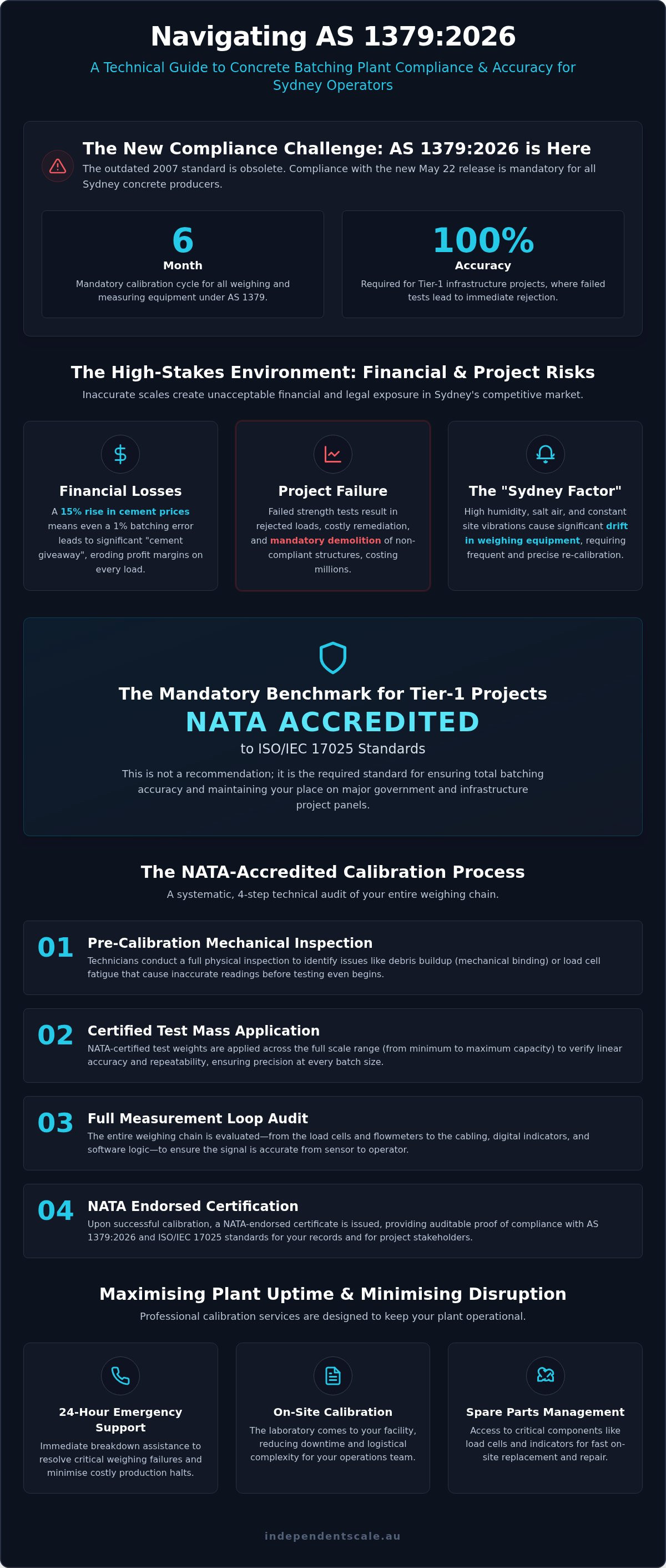
Executing a concrete batching plant calibration Sydney requires a methodical, five-step technical process to ensure compliance with the May 2026 updates to AS 1379. It isn't enough to simply check the zero point; we must verify the entire weighing and dispensing cycle under load. Our technicians follow a structured protocol designed to identify hidden errors before they manifest as failed strength tests on-site.
- Step 1: Pre-calibration inspection. We identify mechanical binding, rust on mounts, or debris build-up under hoppers that can ghost weight readings.
- Step 2: Systematic scale testing. Using NATA-certified test masses, we perform a multi-point linearity check on all aggregate, cement, and water scales.
- Step 3: Admixture verification. We use the weighing method to verify that chemical dispensers meet the ±3% tolerance required for high-performance mixes.
- Step 4: Control system logic check. We verify that the digital signal from the load cells matches the PLC data and trial-batch a small load to test auto-tare functions.
- Step 5: Certification. We issue a formal NATA-accredited report and compliance certificate, providing the traceable audit trail required for Sydney infrastructure projects.
Preparation and Pre-Calibration Checklist
Before our team arrives, your staff should clear all hoppers and bins of residual material to ensure a true zero tare weight. Our technicians will then perform a deep-level check of the electronic components, specifically looking for moisture ingress in junction boxes or frayed cabling that could cause signal instability. For a deeper look at the specific requirements for NSW sites, consult our Concrete Batching Plant Calibration: A Complete Guide to AS 1379 Compliance. Proper preparation reduces on-site testing time and allows us to focus on precision adjustments rather than basic cleaning.
Early Warning Signs of Calibration Drift
Waiting for a failed laboratory test is a costly way to manage a plant. You can often spot calibration drift early by monitoring slump consistency; if your water dosing is correct but the slump varies, your cement scale is likely drifting. Another red flag is yield variation. If a standard 5m³ order consistently under-fills or over-fills a truck, your aggregate scales are no longer linear. Erratic display readings or a scale that doesn't return to zero after discharge indicate mechanical binding or load cell fatigue. If you notice these symptoms, our 24-hour breakdown service is available to perform an emergency concrete batching plant calibration Sydney to prevent a total operational shutdown. Don't risk a project rejection; book your next AS 1379 compliance audit today to maintain peak accuracy.
Maximising Plant Uptime with Independent Scale Service Sydney
Operational continuity is the primary metric for any high-volume concrete producer. In Sydney's metropolitan area, where major pours often occur overnight or over 48-hour windows, an equipment failure can halt a multi-million dollar project. Independent Scale Service addresses this risk by providing a comprehensive concrete batching plant calibration Sydney service backed by 33 years of industry experience. Since 1992, we've developed the technical infrastructure to support local plants with both scheduled NATA-accredited audits and reactive emergency repairs.
Our service model focuses on technical proficiency and rapid response. We resolve faults on-site rather than just identifying them. By bringing our NATA-accredited laboratory capabilities directly to your location, we eliminate the need for off-site testing of critical weighing components. This mobile capability ensures your plant returns to AS 1379 compliance with minimal disruption to your production schedule. Our methodical approach to precision measurement is why Tier-1 contractors rely on us for their most sensitive infrastructure projects.
24/7 Support and Emergency Repairs
Downtime during a critical project phase, such as a major bridge deck pour or tunnel lining, is unacceptable. We offer a 24-hour breakdown service specifically designed for Sydney's round-the-clock industrial demands. Our technicians possess the diagnostic expertise to solve complex electrical interference issues and mechanical weighing faults that often baffle generalist contractors. Whether it's a failed signal conditioner or a compromised cable, our goal is the immediate restoration of accuracy through expert concrete batching plant calibration Sydney. Our responsiveness communicates a commitment to your project's success and your plant's structural reputation. For a deeper understanding of the hardware involved in these repairs, refer to The Essential Guide to Industrial Load Cells.
Custom Solutions and Spare Parts
A significant advantage of partnering with a specialized provider is access to an extensive local inventory. We stock critical spare parts, including load cells, digital indicators, and transmitters, specifically to prevent long lead times from overseas suppliers. This inventory includes specialized components like shackle pins for unique tension-weighing setups. For operators running older facilities, we provide paths to modernize legacy systems by upgrading to high-resolution digital indicators that offer better signal stability and PLC integration. These modernizations often pay for themselves through improved batching speed and reduced material waste. To secure your plant's compliance and operational reliability, Request a Concrete Plant Calibration Quote from our technical team today.
Secure Your Plant’s Regulatory and Operational Future
Maintaining full AS 1379:2026 compliance is a technical requirement for any operator supporting Sydney’s infrastructure growth. By implementing a rigorous six-month cycle for concrete batching plant calibration Sydney, you eliminate the legal and structural risks associated with measurement drift. This methodical oversight ensures your weighing systems, from load cells to admixture dispensers, operate within the precise tolerances demanded by Tier-1 contractors. It’s the most effective way to prevent costly material waste and project rejections.
Independent Scale Service brings 33 years of specialized experience and NATA-accredited (ISO/IEC 17025) authority to every site visit. We don't just identify errors; we resolve them. With our 24-hour emergency breakdown support and an extensive local inventory of critical spare parts, we're committed to minimizing your plant's downtime. Protect your structural reputation and maximize your profitability with verified measurement accuracy.
Request Your AS 1379 Compliant Calibration Service Today and ensure your facility remains at the forefront of industry standards.
Frequently Asked Questions
How often does a concrete batching plant need calibration under AS 1379?
AS 1379:2026 mandates that all weighing and liquid-dispensing equipment must be checked for accuracy at least every six months. This biannual frequency ensures that technical drift is identified before it impacts concrete strength results. Maintaining this schedule is a legal requirement for any facility supplying material to NSW construction sites, especially those involved in high-stakes structural projects.
What is the difference between NATA and non-NATA calibration for Sydney sites?
NATA accreditation to ISO/IEC 17025 confirms a laboratory’s technical competence and the traceability of its equipment to national standards. Non-NATA testing lacks this formal verification and is frequently rejected by Tier-1 project auditors in the Sydney basin. For projects like the Sydney Metro, NATA-endorsed certificates are the only acceptable proof of compliance for weighing systems.
Can you calibrate mobile batching plants on-site in Sydney?
Our technicians perform on-site concrete batching plant calibration Sydney for both stationary and mobile facilities. We bring NATA-certified test masses and specialized weighing equipment directly to your project location. This mobile service eliminates the logistical challenges of moving equipment and ensures your mobile plant meets AS 1379 standards without leaving the site; it's a far more efficient solution for remote projects, similar to the logistical convenience provided by Ladbrokes Hire for on-site excavator rentals.
What happens if my batching plant fails a calibration test?
If a system fails to meet the required ±0.5% or ±3% tolerances, we'll immediately pivot to diagnostic troubleshooting. We check for mechanical binding, load cell fatigue, or signal interference in the junction boxes. Because we stock critical spare parts, we can often perform the necessary repairs and re-calibrate the system during the same site visit to restore full compliance.
Do you provide spare parts like load cells if a fault is found during calibration?
We maintain an extensive inventory of load cells, digital indicators, and signal conditioners to minimize client downtime during the audit process. If a fault is identified during the calibration, we can supply and install replacement components immediately. This integrated approach prevents the delays associated with sourcing specialized parts from overseas, so you don't have to wait for third-party deliveries.
How long does a typical full plant calibration take?
A standard concrete batching plant calibration Sydney for a multi-hopper facility typically takes between four and eight hours to complete. This timeframe includes the pre-calibration mechanical inspection, systematic testing of aggregate and cement scales, and verification of admixture dispensers. We coordinate with your production team to schedule these works during planned maintenance windows to avoid disrupting active pours.
Is ISO 17025 accreditation required for Sydney infrastructure projects?
ISO/IEC 17025 is the global standard for testing and calibration laboratories and is a mandatory requirement for most Sydney infrastructure projects. Contractors managing large-scale government works require this accreditation to ensure the structural integrity of the concrete supplied. It provides the necessary technical assurance that the calibration data is accurate, traceable, and repeatable under site conditions.
Can you calibrate water and admixture flowmeters using the weighing method?
We utilize the weighing method for liquid flowmeter calibration as it provides superior accuracy compared to the master-meter approach. This involves dispensing liquid into a vessel on a high-precision NATA-certified scale to verify the flowmeter's pulse output. This technique is essential for ensuring admixtures remain within the strict ±3% tolerance mandated by AS 1379; it's the only way to guarantee exact chemical dosing.
