


What is AS 1379 for Concrete? The Definitive Guide to Compliance
A single batch of non-compliant concrete can halt a multi-million dollar project and trigger a costly legal dispute. For batching plant operators, understanding what is AS 1379 for concrete isn't just a regulatory checkbox; it's a precision mandate that dictates the structural integrity of every pour. You know that inconsistent concrete strength leads to rejected loads and that confusion over calibration intervals puts you at risk of audit failure. It's a serious business where the margin for error is razor-thin.
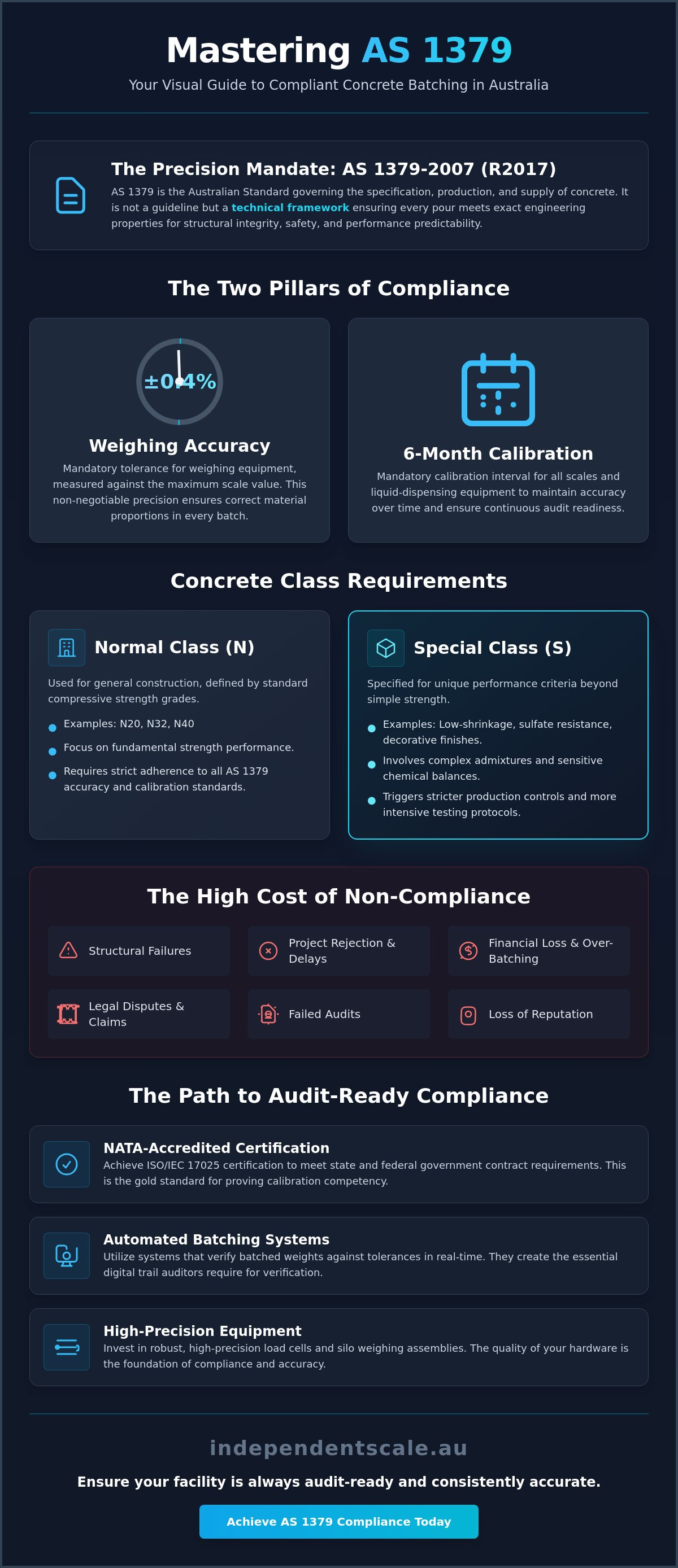
This definitive guide provides the technical clarity you need to ensure your plant remains compliant with AS 1379-2007 (R2017). You'll discover how to achieve the mandatory ±0.4% weighing accuracy and maintain the required six-month calibration schedule. We'll also detail the documentation necessary to prove your equipment meets NATA-accredited standards, giving you the confidence that your facility is always audit-ready and your batching is consistently accurate.
Key Takeaways
- Define the regulatory scope of AS 1379, covering materials and equipment requirements for both normal and special-class concrete production.
- Master the specific accuracy mandates, such as the ±0.4% weighing tolerance, to understand exactly what is AS 1379 for concrete batching.
- Determine the mandatory six-month calibration intervals for scales and liquid-dispensing equipment to maintain continuous audit readiness.
- Assess the critical risks of non-compliance, including structural failure, project rejection, and the profit-draining effects of over-batching.
- Recognize why NATA-accredited certification to ISO/IEC 17025 is essential for meeting state and federal government contract requirements.
Understanding AS 1379: The Australian Standard for Concrete Production
AS 1379-2007 (R2017) is the primary document governing the specification and supply of concrete across Australia. It establishes a technical framework for every stage of production; from the selection of constituent materials to the final discharge of the mix. Understanding what is AS 1379 for concrete requires looking beyond the document as a mere guideline. It's a precision mandate. It ensures that every cubic meter of concrete delivered to a site possesses the exact properties requested by the engineer. The standard covers the materials used, the batching plant equipment, and the operational procedures required for production. It superseded the 1997 version, introducing more rigorous controls on batching accuracy and quality verification. By adhering to these production controls, plants ensure performance predictability, which is the cornerstone of structural safety.
Why AS 1379 is Critical for Australian Infrastructure
AS 1379 serves as the technical backbone for the Australian Building code and infrastructure contracts. Whether you're operating in Sydney or Melbourne, compliance is a legal requirement for most civil and commercial projects. For batching plant operators, the standard acts as a critical risk mitigation tool. It provides a defensible methodology for production that protects the business against claims of structural failure or non-conformance. When projects involve major government bodies, NATA-accredited documentation is non-negotiable. Using AS 1379 compliant calibration services ensures your plant meets these high-stakes contractual obligations and avoids the risk of project rejection.
Normal Class vs. Special Class Concrete Requirements
The standard differentiates between two primary categories of concrete. Normal Class (N) concrete is defined by standard compressive strength grades, such as N20 or N32, and is used for general construction. Special Class (S) concrete is specified when requirements go beyond simple strength, such as low-shrinkage, sulfate resistance, or specific decorative properties. While both classes require high levels of precision, Special Class mixes often trigger stricter production controls and more intensive testing protocols. As the complexity of the mix increases, the margin for error in your weighing equipment decreases. Maintaining the ±0.4% accuracy mandated by the standard becomes even more vital when handling the sensitive chemical balances found in S-class admixtures and supplementary cementitious materials. Failure to meet these accuracy levels can lead to inconsistent concrete strength, which is a primary cause of audit failure and project delays.
Accuracy Requirements for Batching Equipment under AS 1379
AS 1379 prioritizes gravimetric measurement because weight provides a more reliable metric than volume. Volume fluctuates based on material density and compaction; weight remains constant regardless of these variables. To understand what is AS 1379 for concrete batching, you must look at the specific tolerances mandated for every ingredient. According to Standards Australia, weighing equipment must achieve an accuracy of ±0.4% of the maximum scale value when statically loaded. This level of precision is essential for maintaining the strength grades required by engineering specifications. Modern plants rely on high-precision load cells to achieve these results. These components convert physical force into a digital signal that automated batching systems then record and verify for every mix.
Automated batching systems don't just control the valves; they act as the primary record-keeper for compliance. AS 1379 requires these systems to verify that the actual batched weights fall within the allowable tolerances before the mix is discharged. If a cement scale hangs or an aggregate gate sticks, the system must flag the error. This digital trail is what auditors look for when verifying your plant's operational history. Without automated verification, proving compliance during a retrospective audit becomes nearly impossible.
Weighing Hopper and Silo Precision
Scale resolution and repeatability are fundamental to plant compliance. A scale might be accurate once, but AS 1379 requires it to be accurate every time. Using robust tank and silo weighing assemblies helps isolate the load from environmental interference. Factors like wind loading on outdoor silos or vibration from nearby machinery can easily throw a system out of its ±0.4% tolerance. High-quality mounting hardware ensures the weight is applied vertically to the load cell, which is critical for repeatable data and long-term reliability. If your mounting assemblies are corroded or misaligned, your accuracy will drift, leading to inconsistent concrete strength and potential project rejection.
Admixture and Water Measurement Standards
Liquid components have their own set of mandates under the standard. Water must be weighed or metered to an accuracy of at least ±2.0%. Chemical admixtures, which are often used in smaller, more potent quantities, require an accuracy of ±5.0% of the indicated value. Achieving this usually involves liquid flowmeter calibration using the gravimetric method. Modern automated plants use pulse-output verification to ensure the volume dispensed matches the digital command. If your flowmeters aren't verified against a calibrated scale, you risk over-dosing or under-dosing, both of which compromise the concrete's chemical properties. Ensuring these systems are precisely tuned is a core part of professional concrete batching plant calibration.
Calibration Intervals and NATA Accreditation Requirements
Section 4 of the standard establishes the mandatory timeline for equipment verification. To maintain compliance, weighing and liquid-dispensing equipment must be checked for accuracy at least every six months. This semi-annual requirement ensures that the mechanical and electronic components of your batching plant haven't drifted beyond the mandated ±0.4% tolerance. While daily or weekly "check" calibrations are excellent for internal quality control, they don't replace the formal, certified calibrations required by the standard. Auditors specifically look for documentation that proves your equipment has been verified by a competent authority within the last 180 days. Understanding what is AS 1379 for concrete compliance means recognizing that these intervals are a minimum requirement; high-volume plants or those experiencing significant environmental shifts may require more frequent testing to ensure continuous accuracy.
Documentation is the only valid proof of compliance during a site audit. A professional calibration report must detail the "as-found" and "as-left" data, the traceability of the test weights used, and the specific environmental conditions during the test. If your documentation lacks a NATA endorsement, it may be rejected by state or federal government contractors. For serious industrial operators, ISO/IEC 17025 accreditation is the gold standard. It provides an extra layer of assurance that the concrete batching plant calibration was performed using methods that are internationally recognized and technically rigorous.
The Gravimetric Method: The Industry Standard
Static weight testing, while useful for simple scales, is often insufficient for high-volume concrete plants where material is in constant motion. The gravimetric method is the preferred industry standard for achieving maximum accuracy in complex batching environments. Gravimetric calibration is the comparison of a known mass against the scale's output. By using this method, technicians can account for the dynamic forces and mechanical nuances of the hopper or silo. This approach ensures that the digital reading on your controller perfectly matches the physical mass of the cement or aggregate being discharged into the mix.
NATA Accreditation: Why It Isn't Optional
The link between AS 1379 and NATA-accredited calibration services is a matter of legal and technical necessity. NATA accreditation ensures that every measurement is traceable to national standards, providing a clear chain of evidence for your quality assurance system. Using non-accredited technicians for compliance-critical weighing introduces significant risk. If a structural issue arises, the first thing investigators examine is the calibration history of the plant. Without the stamp of a NATA-accredited laboratory, your compliance claims lack the necessary authority to withstand legal or technical scrutiny. Professional weighing scale calibration is an investment in risk mitigation that protects your reputation and your bottom line.
The Impact of Non-Compliance: Quality, Safety, and Legal Risks
Non-compliance with AS 1379 isn't a theoretical risk; it's a direct threat to your plant's profitability and legal standing. When concrete fails to meet specified strength grades, the producer is often liable for the cost of structural remediation. This includes the expensive process of jackhammering out non-compliant slabs and the associated project delays. Understanding what is AS 1379 for concrete is essential because it defines the boundary between a successful delivery and a catastrophic liability. If a batch exceeds the 90-minute discharge limit or falls outside the 5°C to 35°C temperature range mandated by the standard, it can be rejected on-site. For government infrastructure projects, even a minor documentation error can lead to the suspension of your supply rights, as these contracts mandate strict NATA-accredited verification.
Over-batching vs. Under-batching
The economic impact of poor calibration is often hidden in "over-batching." If your scales drift by just 2%, you're effectively giving away 20kg of cement for every tonne batched. Over a year of high-volume production, this "silent" waste erodes hundreds of thousands of dollars in profit. Under-batching is even more critical; it compromises the structural integrity of the build by reducing the necessary binders. To maintain signal stability and prevent drift, plants should invest in high-quality junction boxes and surge arrestors. These components shield your weighing system from electrical interference and surge damage, ensuring your load cells provide a consistent, accurate signal to the batching computer. If your plant is suffering from inconsistent results, you should book a professional calibration audit to identify the source of the error.
Managing Audits and Compliance Records
Preparing for surprise inspections from major contractors like Boral or Holcim requires meticulous record-keeping. Your compliance folder must contain up-to-date NATA-accredited certificates for every scale and flowmeter in the facility. Utilizing modern digital indicators and displays can significantly simplify this process. These units often feature advanced data logging and communication protocols that feed directly into your quality management system. By automating the capture of batch data, you create an immutable record of compliance that satisfies even the most rigorous auditor. This proactive approach transforms compliance from a stressful event into a standard, audit-ready operational procedure.
Achieving AS 1379 Compliance with Independent Scale Service
Independent Scale Service (ISS) brings over 30 years of specialized experience to the industrial weighing sector. Maintaining continuous compliance with AS 1379-2007 (R2017) requires more than just a standard check; it demands technical expertise and NATA-accredited precision. For plant managers, the central concern isn't just understanding what is AS 1379 for concrete, but how to ensure every batch meets this rigorous standard without fail. Our accreditation to ISO/IEC 17025 serves as a guarantee that our calibration methods are traceable and technically sound. With a service footprint covering Sydney, Melbourne, and regional Australia, we provide the authoritative support necessary for high-stakes construction projects.
Critical production runs don't wait for business hours. This is why ISS provides emergency 24x7 support to minimize client downtime. If a load cell fails or an indicator malfunctions during a major pour, our technicians are available to restore your plant to full operational capacity. This responsiveness is a core component of our commitment to servicing 98% of concrete plants across Sydney, including industry leaders like Boral, Hanson, and Holcim. We focus on solving critical business problems with methodical precision and established reliability.
Our Comprehensive Compliance Audit
A professional compliance audit involves a methodical assessment of your entire batching infrastructure. Our technicians evaluate the mechanical and electronic health of the plant to ensure no component is compromising your ±0.4% weighing tolerance. Our assessment includes:
- Load cell health and signal integrity.
- Weighing hopper and silo assembly alignment.
- Liquid flowmeter accuracy via the gravimetric method.
- Summing circuits and junction box stability.
Following the assessment, you receive detailed NATA-endorsed reports for every piece of weighing equipment. These documents are essential for your audit-ready folders. We also implement proactive maintenance scheduling, ensuring your next concrete batching plant calibration occurs before your six-month compliance window expires.
Upgrading Your Plant for Future Standards
Precision is often limited by the quality of your signal processing. Integrating modern conditioners and transmitters significantly improves data accuracy and reduces susceptibility to electrical noise. We also supply and install high-precision weighing assemblies designed for the harsh environments of a concrete plant. Upgrading your hardware today prevents the costly drift that leads to over-batching and profit loss. Don't risk your supply rights with non-accredited services. Book your AS 1379 compliance calibration today to secure your facility's operational future.
Securing Your Batching Plant’s Operational Future
Maintaining compliance with AS 1379 is a continuous requirement that protects your plant from legal liability and financial waste. By now, you understand that what is AS 1379 for concrete involves more than just meeting strength grades; it's about the technical precision of your weighing and dispensing systems. You've seen how the mandated ±0.4% weighing accuracy and six-month calibration intervals prevent the "silent" costs of over-batching while ensuring your facility is always audit-ready for major contractors.
Independent Scale Service provides the authoritative expertise needed to navigate these complex requirements. With over 30 years of experience and NATA accreditation to ISO/IEC 17025, we currently service 98% of concrete plants across Sydney. We ensure your documentation is beyond reproach and your equipment operates at peak performance. Don't leave your compliance to chance or non-accredited providers.
Contact Independent Scale Service for NATA-Accredited AS 1379 Calibration to secure your plant’s standing in the industry. We're ready to help you optimize your batching accuracy today.
Frequently Asked Questions
What is the primary purpose of AS 1379 for concrete producers?
The primary purpose of AS 1379 is to provide a uniform standard for the specification and supply of concrete across Australia. It establishes the technical requirements for constituent materials, batching plant equipment, and production methods to ensure consistent performance. By following these mandates, producers guarantee that the final product meets the structural and chemical properties required by engineering specifications.
How often does AS 1379 require concrete batching plant calibration?
AS 1379 requires all weighing and liquid-dispensing equipment to be checked for accuracy at least every six months. This semi-annual interval is a minimum mandate. High-volume plants or those operating in harsh environments may require more frequent verification to maintain the required ±0.4% weighing tolerance and avoid production errors that compromise concrete strength.
Can I perform my own calibrations to satisfy AS 1379?
You cannot perform your own calibrations to satisfy formal compliance requirements. While internal checks are useful for daily quality control, the standard requires verification by a competent person using traceable equipment. For government and major infrastructure projects, this verification must be conducted by a NATA-accredited laboratory to ensure technical validity and national traceability.
What are the weighing accuracy tolerances for cement under AS 1379?
Weighing equipment used for cement and other binders must be accurate to ±0.4% of the maximum scale value when statically loaded. This strict tolerance is vital because binders are the most critical component for structural strength. Ensuring your hoppers and silos are calibrated to this precision prevents the safety risks of under-batching and the financial waste of over-batching.
Does AS 1379 apply to mobile or on-site concrete batching plants?
AS 1379 applies to all concrete production facilities, including mobile and on-site batching plants. Any equipment used to supply concrete for structural use must meet the same accuracy and calibration standards as a permanent central batching plant. This ensures that concrete quality remains consistent regardless of the production location or the specific project scale.
What documentation is required to prove AS 1379 equipment compliance?
To prove compliance, you must maintain a folder containing current calibration certificates for every scale and flowmeter. These reports must detail the "as-found" and "as-left" accuracy data and confirm the use of traceable test weights. For assistance with organizing your compliance documentation or choosing the right labeling tools, DymoOnline provides helpful support and resources for industrial users. NATA-endorsed documentation is the industry standard for verifying what is AS 1379 for concrete equipment compliance during a site audit.
What happens if my concrete plant fails an AS 1379 audit?
Failing an AS 1379 audit can result in the immediate suspension of supply rights to major projects and government contracts. It may also lead to the rejection of already-poured concrete, requiring expensive structural remediation and jackhammering. Maintaining accurate records and regular calibration intervals is the only way to mitigate these legal and financial risks effectively.
Is NATA accreditation mandatory for AS 1379 calibration?
While the standard mentions verification by a competent person, NATA accreditation is effectively mandatory for all state and federal government contracts. Most major construction firms also require NATA-endorsed certificates to ISO/IEC 17025. Using an accredited service provider ensures your plant’s data is technically defensible and meets the highest industry benchmarks for what is AS 1379 for concrete production.
