


Truck Scale Installation Cost: 2026 Guide to Weighbridge Investment
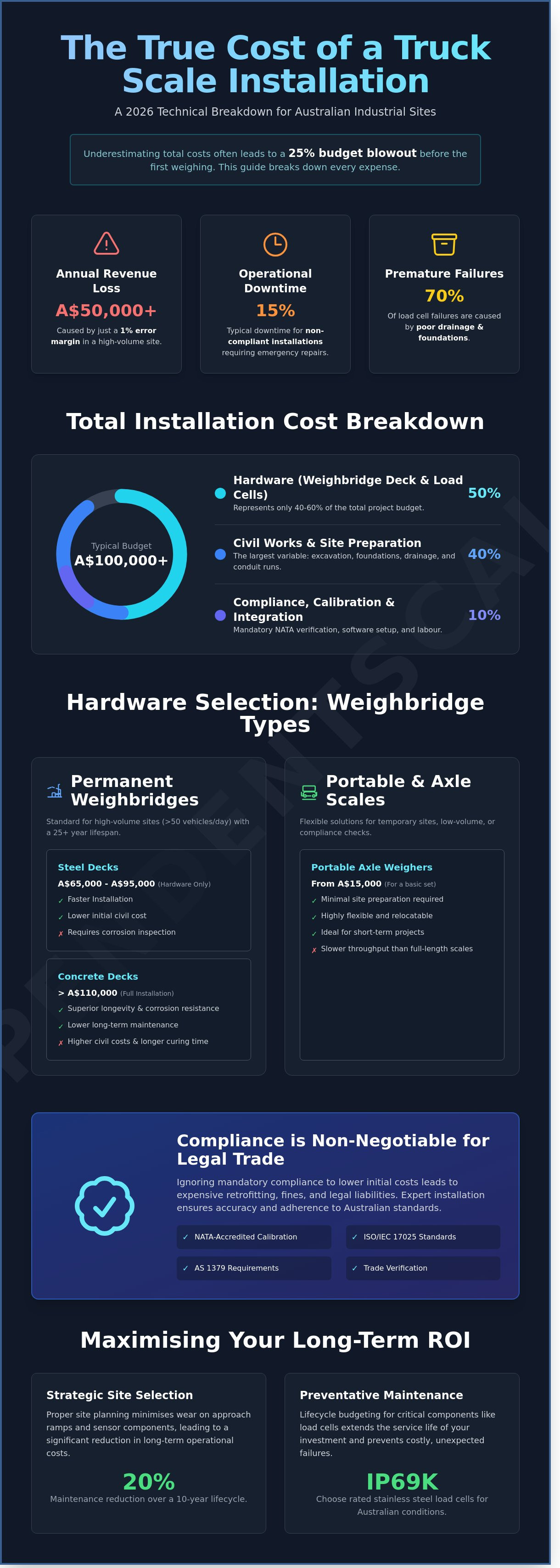
Underestimating the total truck scale installation cost often leads to a 25% budget blowout before the first vehicle even crosses the platform. While the hardware remains a fixed asset, the variables in civil engineering and site preparation represent the highest risk to your capital expenditure. Most industrial operators find that hidden costs in drainage, foundation depth, and conduit runs account for nearly 40% of the initial investment.
You understand that a weighbridge is the financial heart of your operation, where a 1% error margin can cost a high-volume site over A$50,000 in lost revenue annually. This 2026 guide provides a technical breakdown of every expense, from load cell integration to NATA-accredited compliance for Australian industrial sites. We'll examine how to navigate AS 1379 requirements and calculate a precise ROI, ensuring your investment remains accurate and operational without the 15% downtime typical of non-compliant installations. We'll move through hardware selection, civil works, and the final verification process required for trade-legal weighing.
Key Takeaways
- Analyse the full breakdown of truck scale installation cost, which ranges from A$15,000 for portable units to over A$150,000 for permanent, high-volume weighbridges.
- Select the appropriate hardware by evaluating the operational trade-offs between permanent full-length installations and flexible portable scale solutions.
- Identify and budget for "hidden" civil work expenses, including excavation, foundation engineering, and critical drainage systems to prevent site flooding.
- Ensure legal trade compliance by understanding the mandatory requirements for NATA-accredited calibration to ISO/IEC 17025 and AS 1379 standards.
- Maximise long-term ROI through strategic preventative maintenance and lifecycle budgeting for load cells to extend the service life of your investment.
Understanding the Components of Truck Scale Installation Cost
Investing in a weighbridge requires a calculated approach to capital expenditure. In the Australian market, the total truck scale installation cost typically starts at A$15,000 for basic portable units and exceeds A$150,000 for high-capacity permanent installations. This variance depends on hardware selection, site preparation, and mandatory compliance testing. Hardware costs generally represent only 40% to 60% of the total project budget for permanent sites. Strategic site selection reduces maintenance by 20% over a ten-year lifecycle by minimising wear on approach ramps and sensor components.
Hardware vs. Infrastructure: The Cost Split
A common industry oversight involves budgeting only for the steel and electronics. A A$50,000 weighbridge deck frequently requires a total A$100,000 budget once civil works are finalised. Most projects require significant excavation, reinforced concrete foundations, and electrical conduits. The price point is heavily influenced by the quality of load cells used. High-quality stainless steel cells with IP69K ratings are essential for Australian conditions to prevent moisture ingress. Consider these hardware and infrastructure factors:
- Digital vs. Analogue: Digital systems generally cost 15% more than analogue ones but offer superior diagnostic capabilities and faster repairs.
- Foundation Type: Pit-mounted scales require more intensive excavation and drainage work compared to above-ground installations.
- Steel vs. Concrete Decks: Steel decks are faster to install, while concrete decks offer better longevity in corrosive environments but require longer curing times.
Why 'Cheap' Installations Often Cost More
Selecting unaccredited installers or non-compliant components leads to significant financial risk. Poor drainage and substandard foundation work cause 70% of premature load cell failures in Australian industrial sites. If a foundation settles by even 5mm, the accuracy of the entire system is compromised, leading to weight discrepancies and potential fines. For a detailed breakdown of component quality, refer to The Essential Guide to Industrial Load Cells.
Compliance with NATA standards and trade verification is mandatory for any scale used in commercial transactions. Ignoring these standards to lower the initial truck scale installation cost results in expensive retrofitting and legal liabilities. Installations that don't meet AS 1379 or ISO/IEC 17025 standards often require emergency repairs that exceed the original savings within the first 36 months of operation. Expert installation ensures the system remains accurate under the heavy duty cycles typical of Sydney concrete plants and regional quarries.
Hardware Selection: Choosing the Right Weighbridge Type
Hardware selection is the primary driver of the total truck scale installation cost. Choosing the wrong weighbridge type for your site's traffic volume or environmental conditions leads to premature structural failure and non-compliance under the Heavy Vehicle National Law (HVNL). For 2026, Australian industrial sites must balance initial capital expenditure with long-term durability and NATA-accredited accuracy standards.
Permanent Concrete and Steel Deck Weighbridges
Permanent weighbridges are the standard for high-volume sites processing over 50 vehicles per day. The choice between concrete and steel decks significantly impacts your budget. Concrete decks involve higher civil costs due to the extensive rebar and curing time required; however, they offer lower maintenance and a lifespan exceeding 25 years. Steel decks provide a lower civil cost and faster installation, but they require regular inspection for corrosion and paint degradation.
- Standard 18m to 24m Steel Decks: Typically range from A$65,000 to A$95,000 for the hardware alone.
- Full Concrete Deck Installations: Often exceed A$110,000 once professional concrete pouring and curing are factored into the project.
Industrial sites often require integrated systems. Many facilities are now incorporating tank and silo weighing assemblies alongside their weighbridges to manage bulk inventory and outbound logistics from a single data point. This integration ensures compliance with AS 1379 standards for concrete production and general manufacturing.
Portable and Semi-Permanent Solutions
Portable weighbridges and axle weighers serve projects with limited durations or sites where permanent civil works are restricted. Portable weighpads are the most cost-effective, starting as low as A$12,000; however, they sacrifice the throughput and precision of a full-length bridge. A full-length portable steel bridge uses a sub-frame that sits on a reinforced concrete pad, allowing the entire unit to be relocated via crane as project locations change.
These mobile systems often utilise special purpose and shackle pins to ensure structural integrity during frequent moves. While the initial truck scale installation cost is lower for portable units, the trade-off is a higher frequency of calibration. Mobile units are more susceptible to ground shift, which can compromise the gravimetric accuracy required for legal-for-trade transactions. If your site requires high-precision data for 98% of its operations, a permanent installation is usually the more reliable investment. For advice on maintaining these systems, you can view our weighing scale calibration services to ensure your equipment remains compliant with Australian standards.
Axle weighers remain a vital tool for transport fleets focusing on overload prevention rather than trade-based weighing. These units are compact and can be installed for approximately A$20,000 to A$35,000, providing an essential safeguard against heavy vehicle fines without the footprint of a full 24m bridge.
The 'Hidden' Costs: Civil Works and Site Preparation
Civil works represent the most volatile variable in the total truck scale installation cost. While the steel or concrete deck has a fixed price, the ground beneath it does not. Site preparation typically accounts for 40% to 60% of the total project budget. Excavation and foundation work must address local geology; for instance, reactive clay soils in parts of Western Sydney or Queensland require deeper piering and reinforced concrete to prevent shifting. A foundation that moves by even a few millimetres can cause weighing errors that breach National Measurement Institute (NMI) trade regulations.
Environmental management is equally critical. Pit-mounted scales require sophisticated drainage systems, including silt traps and automated sump pumps, to prevent water ingress. Standing water destroys load cells and corrodes structural steel. Effective site design also includes approach and departure ramps. Australian standards require these to be level and clear for a distance often equal to the scale length to ensure the vehicle suspension settles before weighing. Skipping these steps leads to inaccurate readings and premature equipment failure.
Electrical infrastructure requires dedicated circuits to provide clean power to indicators and displays. Voltage fluctuations or "dirty" power from heavy machinery can cause digital drift in weighing results. All cabling must be housed in heavy-duty conduits to protect against vermin and mechanical damage.
Foundation Engineering and Earthworks
Soil stability tests are the first step in any professional installation. These tests, costing between A$2,000 and A$4,500, determine if the soil can support a 40-tonne or 60-tonne concentrated load. Inadequate soil bearing capacity necessitates thicker concrete slabs and increased rebar density, which can add A$15,000 to the concrete bill. Protecting this investment requires the installation of junction boxes and surge arrestors. These components are essential in Australia's storm-prone regions; lightning strikes account for nearly 15% of all weighbridge service calls. Labour costs for specialized civil contractors currently range from A$120 to A$190 per hour, depending on the site's remoteness.
Site Utilities and Integration
Modern weighbridges are data hubs. Budgeting for high-speed data cabling is necessary for real-time software integration. Technicians often install conditioners and transmitters to convert analog load cell signals into digital formats for remote monitoring or PLC control. Automation hardware adds further to the truck scale installation cost. You should allocate approximately A$10,000 to A$25,000 for peripheral equipment, including:
- Traffic control boom gates and industrial traffic lights.
- Driver self-service kiosks for paperless ticketing.
- NMI-compliant safety signage and line marking.
- CCTV systems for axle position verification.
Integrating these systems during the initial build is 30% cheaper than retrofitting them later. Professional project management ensures that data conduits and power lines are laid before the concrete is poured, avoiding the need for expensive saw-cutting and patching.
Compliance and NATA-Accredited Calibration Costs
Compliance isn't an optional extra; it's a legal necessity that dictates a significant portion of the total truck scale installation cost. In Australia, any scale used for trade must meet National Measurement Institute (NMI) requirements. NATA accreditation to ISO/IEC 17025 ensures your equipment delivers technically valid results. This accreditation isn't just a badge. It's a technical safeguard that protects your business from legal liability and expensive weight disputes. Without a NATA-certified report, your weighbridge weights aren't legally binding for trade transactions under the National Measurement Act 1960.
NATA Accreditation and Trade Measurement
Achieving trade-legal status requires a NATA-certified technician to perform an initial verification. It's vital to understand the difference between 'calibration' and 'verification' in the Australian regulatory framework. While weighing scale calibration measures the accuracy of the device against a known standard, verification is a legal process that confirms the scale complies with its NMI-approved pattern.
You should budget for specific fees including NATA technician labor and the hire of a specialized test truck. A heavy test truck carrying certified masses is essential for weighbridges to test the scale at its full capacity. Hire rates for these vehicles typically range from A$800 to A$1,500 per day. For a deeper look at these requirements, refer to our Calibration Services: The Authoritative Guide. Initial verification and certification costs usually sit between A$1,800 and A$4,000 depending on the scale's capacity and site location.
AS 1379 Standards for Concrete Plants
AS 1379 is the mandatory standard for concrete production accuracy in Australia. For operators in the construction sector, the truck scale installation cost must account for the strict tolerances required by this standard. Compliance isn't limited to the weighbridge alone. You'll need to coordinate concrete batching plant calibration for the entire facility to ensure the final product meets engineering specifications.
- Regular silo calibration and hopper checks must be budgeted alongside the main truck scale.
- AS 1379 requires accuracy within 1% to 2% for various raw materials.
- Non-compliance can lead to the immediate shutdown of supply to major infrastructure projects.
Most Tier 1 contractors won't accept delivery from a plant that hasn't undergone NATA-accredited testing within the last 6 to 12 months. This makes ongoing maintenance a fixed operational cost rather than a variable one.
Maximising ROI: Maintenance and Long-Term Value
The initial truck scale installation cost represents approximately 60% of the total lifecycle expenditure over a 15 to 20 year period. To protect this investment, site managers must shift focus from capital expenditure to the total cost of ownership (TCO). A weighbridge operating in high-volume Australian environments, such as a quarry or a concrete plant, remains a precision instrument despite its massive scale. Neglecting routine care leads to compounding errors that can cost a business thousands in lost product or regulatory fines.
Preventative maintenance schedules are the most effective way to reduce TCO. Statistics from 30 years of field service show that quarterly inspections reduce the likelihood of major structural failure by 40%. These visits allow technicians to identify debris build-up, check for structural corrosion, and verify that the load cells are performing within the required tolerances. Regular calibration isn't just a compliance box-ticking exercise; it's a financial safeguard for your operational accuracy.
This holistic view of operational efficiency extends beyond just the weighbridge. For many industrial and mining operations, optimising energy consumption is another critical component of reducing TCO and meeting sustainability goals. Consultancies like Super Smart Energy specialise in developing these strategies, ensuring that large-scale facilities are not only accurate but also energy-efficient.
Preventative Maintenance vs. Emergency Repair
Waiting for a total breakdown is a high-risk strategy. Emergency repairs often carry premium labour rates and cause unplanned downtime that can cost a busy site upwards of A$600 per hour in lost throughput. By contrast, scheduled maintenance identifies wearing parts before they fail. You can significantly extend the life of your bridge by utilising specific options and accessories like T-section rubber. This simple addition prevents stones and debris from entering the gap between the deck and the pit wall, which is a leading cause of binding and inaccurate readings. For detailed maintenance checklists, refer to the Weighbridge: The Complete Guide for Australian Industry to ensure your staff are performing daily inspections correctly.
This preventative mindset extends to all heavy machinery on site. For example, unexpected hydraulic failures in loaders or trucks can halt operations just as effectively as a scale malfunction. As part of a holistic approach to asset management, it's beneficial to explore Hydraulic Cylinder Rebuilds as a cost-effective alternative to full component replacement.
- Load Cell Budgeting: Budget for the eventual failure of electronic components. Load cells typically have a lifespan of 5 to 7 years in harsh conditions. Replacement costs for high-quality digital cells range from A$1,500 to A$3,000 per unit, including calibration.
- Software Integration: Modern indicators turn raw weighing data into operational intelligence. Upgrading your data management software allows for real-time inventory tracking and seamless integration with ERP systems.
- Environmental Protection: Australia's climate is brutal. Ensure your maintenance plan includes checking surge arrestors and earthing systems to protect against lightning strikes and power surges.
Selecting the Right Installation Partner
Your choice of installer dictates the long-term reliability of the scale. A lower upfront truck scale installation cost often masks a lack of technical depth or poor civil engineering. When vetting a partner, confirm their NATA accreditation to ISO/IEC 17025. This ensures their calibration methods meet the highest Australian standards. Ask whether they provide a 'turnkey' solution. Managing separate concrete contractors, electricians, and scale technicians often leads to finger-pointing when levels aren't perfect or drainage fails. A single-source provider takes full accountability for the pit construction and the final accuracy of the bridge.
Independent Scale Service provides 24/7 emergency support to minimise downtime for critical industrial operations across Sydney and regional New South Wales. Contact Independent Scale Service for a comprehensive truck scale installation quote.
Future-Proof Your Weighbridge Investment for 2026
Calculating your truck scale installation cost requires a precise assessment of civil works, hardware selection, and NATA-accredited calibration. Site preparation and concrete foundations typically represent 35% to 45% of the total project budget, so don't underestimate these initial requirements. Selecting the right hardware and maintaining a strict calibration schedule ensures your equipment stays compliant with Australian trade regulations for its 20-year lifespan.
Independent Scale Service (ISS) delivers technical expertise backed by over 30 years of Australian industrial experience. We're NATA Accredited to ISO/IEC 17025, providing the accuracy required for high-volume sites like the 98% of concrete plants we service across Sydney. With 24/7 emergency support available in Sydney and Melbourne, we minimise operational downtime and protect your bottom line. Our methodical approach ensures every installation meets AS 1379 standards from day one.
Request a Professional Truck Scale Installation Quote
Expert planning today secures your facility's operational efficiency and compliance for the decades ahead.
Frequently Asked Questions
How much does a basic truck scale cost in Australia?
A basic truck scale installation cost in Australia typically ranges from A$45,000 to A$120,000 for the hardware and electronics. This price varies based on the weighbridge length, which standardises at 18 metres or 26 metres for B-double configurations. You should budget an additional A$30,000 to A$60,000 for civil works and concrete foundations to ensure the site meets industrial load requirements.
What is the difference between a pit and pitless weighbridge installation?
A pit weighbridge is installed flush with the ground, requiring deep excavation and complex drainage systems. This design saves yard space but increases initial civil costs by 40 percent. Pitless installations sit above ground on a concrete slab and require entry and exit ramps. Pitless models are easier to maintain because load cells and summing circuits remain accessible above the ground surface.
Do I legally need NATA-accredited calibration for my truck scale?
You legally require NATA-accredited calibration if the truck scale is used for trade purposes under the National Measurement Act 1960. If you're selling or buying goods based on weight, your device must be verified by a licensed technician and issued a Regulation 13 certificate. ISS provides ISO/IEC 17025 accredited testing to ensure your equipment meets all Australian legal metrology standards and avoids heavy fines.
How long does a typical truck scale installation take from start to finish?
A typical truck scale installation takes 6 to 10 weeks from the initial site survey to final commissioning. The civil works phase, including excavation and concrete curing, accounts for 28 days of this timeline to ensure structural integrity. Once the concrete reaches full strength, the mechanical installation and NATA-accredited calibration usually take 3 to 5 business days to complete.
What civil works are required for a permanent weighbridge?
Permanent weighbridges require reinforced concrete foundations designed to withstand 80 to 100 tonnes of concentrated loading. For pitless designs, this involves a flat concrete approach slab of at least 5 metres at each end. Pit installations require a reinforced concrete vault with integrated drainage, sump pumps, and conduits for load cell cabling to prevent water ingress and electrical failure.
Can I install a truck scale myself to save on costs?
You can't install a truck scale yourself if you require legal-for-trade certification. While you might manage basic excavation, the mounting of load cells and the balancing of summing circuits require specialised hydraulic jacks and electronic test equipment. Incorrect DIY installation leads to structural failure or weight discrepancies, which voids your warranty and fails mandatory NATA inspections.
What are the ongoing maintenance costs for a heavy-duty truck scale?
Ongoing maintenance costs for a heavy-duty weighbridge average A$2,500 to A$5,000 per year. This budget covers bi-annual inspections, cleaning of the pit or ramps, and routine calibration. You should also set aside a contingency fund for load cell replacements. Surge arrestors can't prevent 100 percent of lightning or power surge damage over a 10-year equipment lifespan.
How does AS 1379 compliance affect the cost of concrete plant scales?
AS 1379 compliance increases the cost of concrete plant scales by requiring higher precision load cells and specific gravimetric method calibration. For the 98 percent of Sydney concrete plants we service, adhering to these standards ensures batching accuracy for structural concrete. This compliance adds 15 percent to the initial truck scale installation cost but prevents batch rejections and legal penalties.
