


Truck Scale Calibration Services: Ensuring Accuracy and Regulatory Compliance
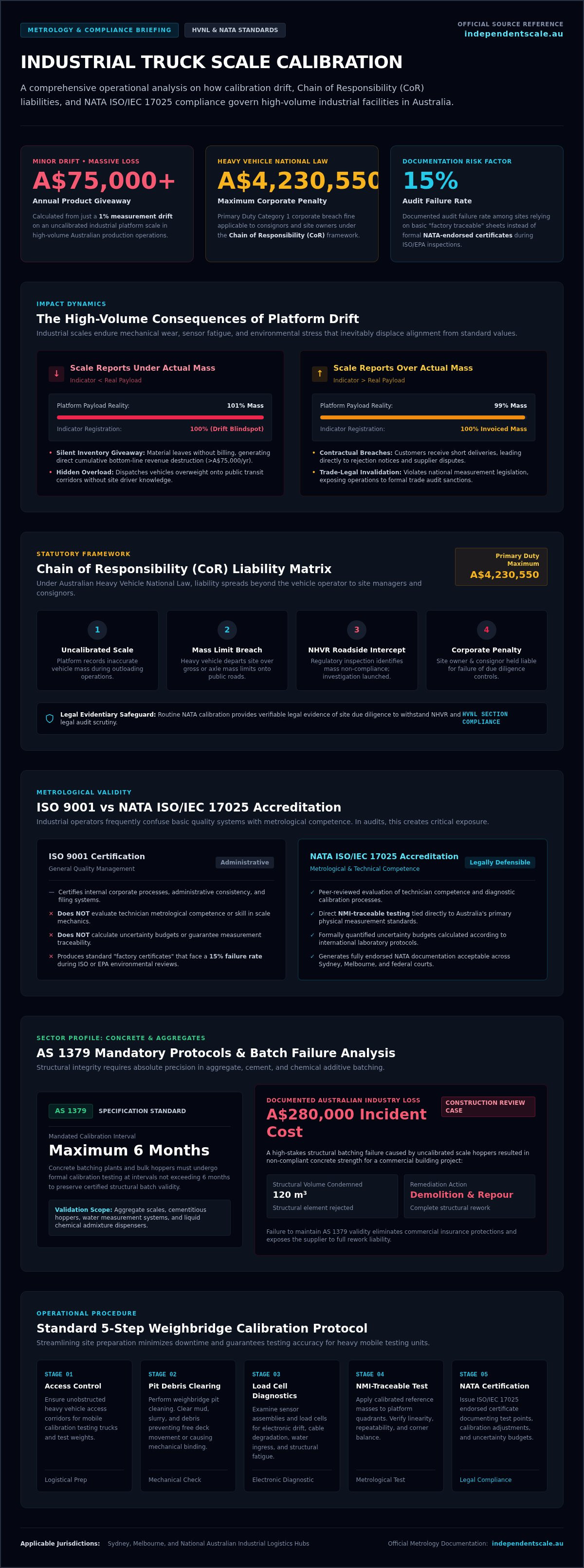
A calibration drift of just 1% on an industrial scale can result in over A$75,000 in product giveaway annually for high-volume Australian production plants. You're likely aware that maintaining precise measurements isn't just about technical accuracy; it's a critical financial safeguard. Managing a busy site in Sydney or Melbourne is demanding enough without the added risk of an uncalibrated weighbridge exposing your company to Heavy Vehicle National Law penalties that can exceed A$4.23 million for corporate breaches.
Securing professional truck scale calibration services is the only way to ensure your equipment remains trade-legal and technically sound. This article explains how NATA-accredited calibration to ISO/IEC 17025 standards protects your revenue, maintains legal compliance, and prevents the costly downtime associated with equipment failure or regulatory audits. We'll cover the necessity of NMI-traceable testing, the specific calibration intervals required under AS 1379, and the logistical advantages of using specialized mobile testing units to maintain vehicle flow.
Key Takeaways
- Understand how measurement drift leads to significant financial loss and severe NHVR mass breach penalties under the Chain of Responsibility framework.
- Learn the technical requirements for NATA-accredited truck scale calibration services to ensure all documentation meets ISO/IEC 17025 legal standards.
- Identify essential site preparation steps, including pit cleaning and heavy vehicle access, to streamline the calibration process and minimize operational downtime.
- Review the mandatory testing protocols under AS 1379 that are required to maintain the structural batch validity of concrete batching plants and hoppers.
- Access professional diagnostic and repair solutions for load cells and industrial scales when calibration identifies mechanical or electronic inaccuracies.
Why Truck Scale Calibration is Critical for Industrial Operations
Truck scale calibration is the technical process of aligning a scale's weighing outputs with known, traceable standards. It's a foundational requirement for any industrial facility managing bulk materials. Without regular truck scale calibration services, the precision of these heavy-duty systems inevitably degrades due to environmental stress, mechanical wear, and sensor fatigue. This degradation isn't just a technical glitch; it's a direct threat to your bottom line and legal standing. Professional calibration ensures that the measurement recorded on the indicator matches the physical mass on the platform, maintaining the integrity of every load that leaves your site.
Revenue Protection and Load Accuracy
Precision measurement is the bedrock of profitability in logistics and manufacturing. For high-volume production plants, a calibration drift of only 1% can result in over A$75,000 in product giveaway annually. If your scales report less weight than is actually present, you are essentially shipping free inventory. Conversely, over-reporting weight leads to customer disputes and potential contract breaches. Regular weighing scale calibration identifies these discrepancies before they compound into massive inventory losses. In trade-legal transactions, "close enough" is never acceptable. Accuracy must be certified to protect the financial interests of both the buyer and the seller.
Legal Compliance and Chain of Responsibility (CoR)
Operating uncalibrated equipment creates severe legal exposure under the Heavy Vehicle National Law (HVNL). Australia's Chain of Responsibility (CoR) framework holds everyone in the logistics chain accountable for mass breaches. If an uncalibrated scale allows an overweight vehicle onto public roads, the site owner and consignor face significant liability. Primary Duty Category 1 corporate penalties can reach A$4,230,550. Utilizing professional truck scale calibration services provides the evidentiary control needed to prove due diligence. For a deeper look at regulatory standards, see our Weighbridge: The Complete Guide for Australian Industry.
Beyond compliance, calibration acts as a preventative maintenance tool. Technicians evaluate the physical truck scale operation and design, checking for binding, debris buildup, or failing load cells. Identifying these issues during a routine service prevents the catastrophic failure of critical components and extends the operational lifespan of the weighbridge structure. This proactive approach minimizes the risk of unplanned downtime that can paralyze site logistics.
Australian Standards and NATA Accreditation Explained
Industrial operators often confuse general ISO 9001 quality management with technical calibration validity. While ISO 9001 certifies business processes, it doesn't prove the technical competence of a laboratory or the traceability of its measurements. For legally defensible results, you must engage truck scale calibration services that hold NATA accreditation. This accreditation ensures that the equipment, personnel, and testing methods meet the highest metrological standards. Industry audits indicate a 15% failure rate among sites that rely on basic "factory traceable" reports instead of formal NATA-endorsed certificates during ISO or EPA inspections.
The Role of NATA in Australian Industry
NATA serves as the national authority for laboratory accreditation, providing a guarantee that measurement data is accurate and repeatable. ISO/IEC 17025 is the international standard for testing and calibration laboratories. Achieving NATA ISO/IEC 17025 accreditation requires a laboratory to undergo rigorous peer review of its technical competence, including its uncertainty budgets and equipment traceability to Australia's primary standards. For businesses in Sydney and Melbourne, this level of certification is essential for high-stakes environments like concrete batching. Under AS 1379, concrete batching plants must adhere to maximum 6-month calibration intervals to maintain certified structural batch validity. Failure to meet this can result in catastrophic losses, such as the A$280,000 incident recorded in Australian construction reviews where batching errors forced the demolition and repour of a 120 m³ structural element.
Trade-Legal Requirements and the NMI
If your weighbridge is used for trade (buying, selling, or levying charges based on weight), it falls under the National Measurement Act 1960. These instruments must be pattern-approved by the National Measurement Institute (NMI) and verified by an NMI-licensed Servicing Licensee. It's vital to distinguish between calibration (the metrological comparison to a standard) and trade verification (the statutory inspection and sealing of the scale). Following any major overhaul or load cell replacement, re-verification is a legal necessity before the scale can return to trade use. For a deeper understanding of these requirements, consult our Calibration Services: The Authoritative Guide for Australian Industry.
Maintaining compliance with these standards protects your operational integrity. If you're unsure if your current certificates meet NMI or NATA requirements, our team can provide a professional load cell calibration assessment to ensure your site meets these rigorous standards.
The Process of Truck Scale Calibration and Testing
Professional truck scale calibration services follow a strict metrological sequence designed to eliminate measurement uncertainty. The process begins with a comprehensive physical inspection of the weighbridge structure. Technicians look for mechanical interference such as stone buildup, packed mud, or debris in the pit that can cause "binding." If the deck cannot move freely, the load cells won't receive the full force of the vehicle, leading to significant under-reporting. We also examine end-stops and T-bars to ensure they have the correct clearance for thermal expansion. Once the site is physically cleared, the metrological testing begins with zero-point adjustments and repeatability checks to confirm the scale returns to zero consistently after a load is removed.
Load Cell Inspection and Testing
The accuracy of any weighbridge depends entirely on the health of its sensors. During the service, we evaluate each load cell for signs of fatigue, moisture ingress, or lightning damage. We perform a detailed inspection of the junction box and cable integrity, as frayed shielding or corroded terminals often cause "drifting" readings that are difficult to diagnose without specialized equipment. If a sensor is found to be out of tolerance, we offer load cell repair or replacement to restore system accuracy. For a deeper look at sensor technology, see The Essential Guide to Industrial Load Cells.
Utilizing Heavy-Capacity Test Trucks
You can't verify a 60-tonne weighbridge using only hand-weights. Effective truck scale calibration services require the deployment of specialized heavy-capacity test trucks. These units carry up to 20 or 40 tonnes of certified test masses that are traceable to Australia's national standards. Using these vehicles, technicians perform two critical tests:
- Eccentricity (Shift) Testing: We place the test load over each individual section or "corner" of the scale. This ensures the weighbridge provides an identical reading regardless of where the truck is positioned on the deck.
- Linearity Testing: This involves step-loading the scale from zero to its maximum capacity. It identifies if the scale's error increases as the load gets heavier, which is vital for maintaining accuracy across different vehicle types.
Managing these logistics is particularly important for regional Australian sites where access for 3-axle or 4-axle calibration units must be carefully coordinated. After the testing is complete, we issue a NATA-endorsed calibration certificate and apply compliance labeling to the indicator. This documentation serves as your primary evidence of due diligence during regulatory audits or trade inspections in Sydney and Melbourne.
Preparing Your Site for a Calibration Service
Efficient site preparation is a critical factor in the success of truck scale calibration services. Because testing requires the deployment of heavy-capacity calibration units, you must ensure unhindered site access for 3-axle or 4-axle rigid or articulated testing trucks. These vehicles carry up to 40 tonnes of certified block weights and require a clear, unobstructed path to the weighbridge deck. Coordinating with site safety officers for inductions and access permits before the technician arrives prevents unnecessary delays at the gate and ensures the service window is used effectively.
Pre-service cleaning is equally vital for a successful metrological evaluation. Accumulated mud, slurry, or debris in the weighbridge pit often leads to mechanical binding, which invalidates calibration results by preventing the deck from moving freely. For pitless weighbridges, NMI specifications require a minimum ground clearance of 150 mm under the lowest live part of the deck. Ensuring this area is clear of dirt and water buildup allows the technician to focus on precision adjustments rather than basic site maintenance.
Minimizing Operational Downtime
To keep vehicle flow moving, schedule calibration during low-traffic windows or planned site maintenance shutdowns. Having previous calibration records and technical documentation ready for review allows the technician to identify historical drift patterns quickly. Proactive site preparation can reduce total service time by up to 20%. If your initial checks suggest a fault, utilizing a provider that offers combined repair and load cell calibration prevents the need for a second service visit and minimizes double-handling of heavy test masses.
Environmental and Mechanical Considerations
Environmental factors significantly impact measurement stability and equipment longevity. Check that foundation floors between load-cell supports are effectively drained to prevent water buildup around sensitive electronic components. Foundation concrete should be at least 75 mm thick and free of significant structural cracking. Additionally, assess the condition of approach ramps; they must be level and structurally sound to ensure the test truck can transition onto the deck without causing excessive vibration. For more information on maintaining your equipment, explore our Weighing Scale Calibration Services.
If you are ready to schedule your next compliance check, book your truck scale calibration service with our expert team today.
Independent Scale Service: Expert Truck Scale Calibration
Independent Scale Service delivers NATA-accredited truck scale calibration services across Sydney, Melbourne, and regional Australia. We operate with a technical proficiency that adheres strictly to the ISO/IEC 17025 standard, ensuring every measurement is legally defensible and metrologically sound. Our approach is built for industrial clients who demand absolute reliability. We don't just issue a certificate; we provide a thorough technical assessment of your weighing infrastructure to protect your revenue and ensure full regulatory compliance.
Full-Spectrum Industrial Weighing Solutions
Our expertise extends well beyond the weighbridge deck. We maintain a robust Load Cell Supply to ensure that if a calibration identifies sensor fatigue or failure, we can provide an immediate replacement or repair. This capability is supported by our inventory of high-precision Indicators and Displays designed for heavy industrial use. We specialize in high-stakes environments, particularly Concrete Batching Plant Calibration where adherence to AS 1379 is essential for structural integrity. Our technicians also deliver specialized hopper and silo calibration for tank weighing assemblies, ensuring that every measurement point in your facility remains within tolerance.
Why Industrial Leaders Trust Independent Scale Service
With more than 30 years of industry tenure, we're the authoritative voice in Australian metrology. We currently service approximately 98% of commercial concrete batching plants in the Sydney metropolitan market, providing the technical assurance required for serious industrial operations. We understand that equipment failure isn't just an inconvenience; it's a stop-work event that impacts your entire logistics chain. Our fleet of mobile calibration trucks is strategically positioned to provide urgent response capabilities for critical equipment breakdowns, focusing exclusively on minimizing client downtime.
We maintain an efficient, methodical service rhythm. Our technicians focus on identifying mechanical faults, verifying electronics, and restoring your equipment to peak performance without unnecessary narrative. This no-nonsense expertise is why Australia's largest industrial operators rely on us for their truck scale calibration services. We provide the hard data and NATA-endorsed documentation necessary to prove due diligence under the Chain of Responsibility framework. By choosing Independent Scale Service, you're investing in a partnership that prioritizes technical competence and operational uptime above all else.
Securing Your Operational Integrity and Compliance
Precise measurement is a fundamental requirement for industrial profitability and legal safety. A minor 1% calibration drift can result in over A$75,000 in annual product giveaway; while mass breaches under the Chain of Responsibility framework carry corporate penalties exceeding A$4.23 million. Utilizing professional truck scale calibration services is the only way to prove due diligence and protect your revenue from these avoidable financial risks.
Independent Scale Service provides the technical expertise required for high-stakes industrial weighing. We are NATA accredited to ISO/IEC 17025 and serve as AS 1379 compliance experts for concrete batching plants across Sydney, Melbourne, and regional Australia. Our methodical approach ensures your equipment remains trade-legal with minimal disruption to your site's vehicle flow. By prioritizing regular, traceable testing, you ensure that every load is accounted for and every transaction is protected.
Request a Professional Truck Scale Calibration Quote today to verify your system's accuracy. It's the most reliable way to maintain a compliant, efficient, and profitable industrial operation.
Frequently Asked Questions
How often should a truck scale be calibrated?
For trade-verified instruments under NMI guidelines, verification is conducted every 12 months, or every 6 months for heavy-throughput sites. Concrete batching plant scales and hoppers must follow AS 1379, which mandates maximum 6-month calibration intervals to maintain structural batch validity. Regular truck scale calibration services ensure your equipment remains within the Maximum Permissible Error (MPE) limits, preventing product giveaway and legal liability under the Heavy Vehicle National Law.
What is the difference between a standard calibration and a NATA accredited one?
Standard calibration often refers to ISO 9001 management processes, which don't prove technical competence. NATA accreditation against ISO/IEC 17025 confirms a laboratory's technical validity, traceable measurement uncertainty, and legal defensibility. Only NATA-endorsed certificates are recognized by Australian testing authorities during formal audits. Choosing NATA-accredited truck scale calibration services provides the evidentiary control needed to prove due diligence in a court of law or during EPA inspections.
Can you calibrate a truck scale on-site in regional areas?
Yes, Independent Scale Service operates a dedicated fleet of mobile calibration trucks capable of servicing regional Australia. These units carry traceable test masses up to 40 tonnes to perform on-site eccentricity and linearity testing. We coordinate logistics for 3-axle and 4-axle calibration vehicles to reach remote industrial sites, ensuring that regional operators have access to the same NATA-accredited precision as facilities in Sydney and Melbourne.
What happens if my truck scale fails the calibration test?
If an instrument fails to meet the required accuracy thresholds, our technicians perform a diagnostic assessment to identify the fault. Common issues include load cell fatigue, junction box corrosion, or mechanical binding in the weighbridge pit. As we offer load cell supply and repair services, we can often address these faults on-site during the same visit. After repairs are completed, the scale is re-tested to ensure it meets metrological standards before we issue the compliance certificate.
Is a calibration certificate the same as a trade-legal verification?
No, they serve different purposes. Calibration is a metrological comparison against a traceable standard to document scale error and uncertainty. Trade verification is a statutory inspection and physical stamping by an NMI-licensed Servicing Licensee, required under the National Measurement Act 1960 for instruments used in buying or selling by weight. While calibration proves accuracy, verification is the legal requirement for commercial trade. We provide both services to ensure full compliance.
How long does a typical truck scale calibration service take?
A typical service generally takes three to five hours, depending on the weighbridge capacity and site conditions. This includes the initial physical inspection, zero-point adjustment, eccentricity testing, and full linearity step-loading up to the maximum capacity. You can reduce this window by ensuring the weighbridge is clean and that the technician has unhindered access for the heavy calibration truck. Minimizing downtime is our priority during every industrial engagement.
Do I need to clean my weighbridge before the technician arrives?
Yes, pre-service cleaning is essential. You must remove all accumulated dirt, debris, and slurry from underneath the deck and around end-stops to eliminate mechanical binding. For pitless weighbridges, ensure a minimum ground clearance of 150 mm under the lowest live part of the deck. Effective drainage must be maintained to keep load cell supports clear of water. Proper site preparation can reduce service time by up to 20% and ensures accurate readings.
What standards govern truck scale calibration in Australia?
Australian truck scale calibration is governed by the National Measurement Act 1960 and the National Trade Measurement Regulations 2009. Technical testing procedures follow NMI NITP 6.1 to 6.4 for non-automatic weighing instruments. For concrete production, AS 1379 dictates specific calibration intervals for batching plants. Additionally, the technical competence of the testing laboratory is benchmarked against ISO/IEC 17025, which is the standard required for NATA accreditation in the industrial sector.
