


Traceable Calibration in Australia: The 2026 Industrial Compliance Guide
An inaccurate measurement in a high-volume industrial facility isn't just a technical error; it's a liability that can trigger fines exceeding A$55,000 under current Australian trade measurement laws. If you're managing a concrete batching plant or a manufacturing site, you've likely felt the pressure of ensuring every component is verified. However, navigating the distinction between "NATA traceable" and "NATA accredited" often leads to confusion that puts your operations at risk. Securing expert load cell calibration Melbourne services is no longer just about maintenance. It's about regulatory survival in a year where electronic record integrity is under intense scrutiny.
You know that precision is the foundation of your productivity, yet the shift to AS 1379:2026 has raised the stakes for technical compliance. This guide provides an unambiguous roadmap to mastering traceability chains and meeting ISO/IEC 17025 requirements. You'll learn how to build a defensible audit trail that protects your business from the catastrophic costs of measurement failure. We'll examine the specific reporting mandates of the Accreditation Matters 2026 update and the mandatory calibration cycles required to maintain your facility's accreditation and operational uptime.
Key Takeaways
- Understand the legal distinction between NATA-accredited calibration and the technically ambiguous term "NATA traceable" to avoid regulatory non-compliance.
- Identify the specific mandates of AS 1379:2026 and ISO/IEC 17025 necessary for the certification of concrete batching plants and heavy industrial weighing systems.
- Learn how professional load cell calibration Melbourne services maintain an unbroken traceability chain back to national standards while minimizing site downtime.
- Establish a defensible audit trail using NATA-endorsed reports to mitigate the risk of fines exceeding A$55,000 for inaccurate trade measurements.
- Master the technical requirements for calibrating high-capacity silos and hoppers to ensure long-term equipment reliability under harsh Australian environmental conditions.
What is Traceable Calibration in the Australian Industrial Context?
Traceability is more than a compliance checkbox; it's the scientific foundation of industrial accuracy. In the context of load cell calibration Melbourne, traceability refers to an unbroken chain of comparisons that links your on-site measurement back to the primary standards held by the Australian National Measurement Institute (NMI). This systematic link ensures that a kilogram measured in a Victorian concrete plant is identical to a kilogram measured anywhere else in the country.
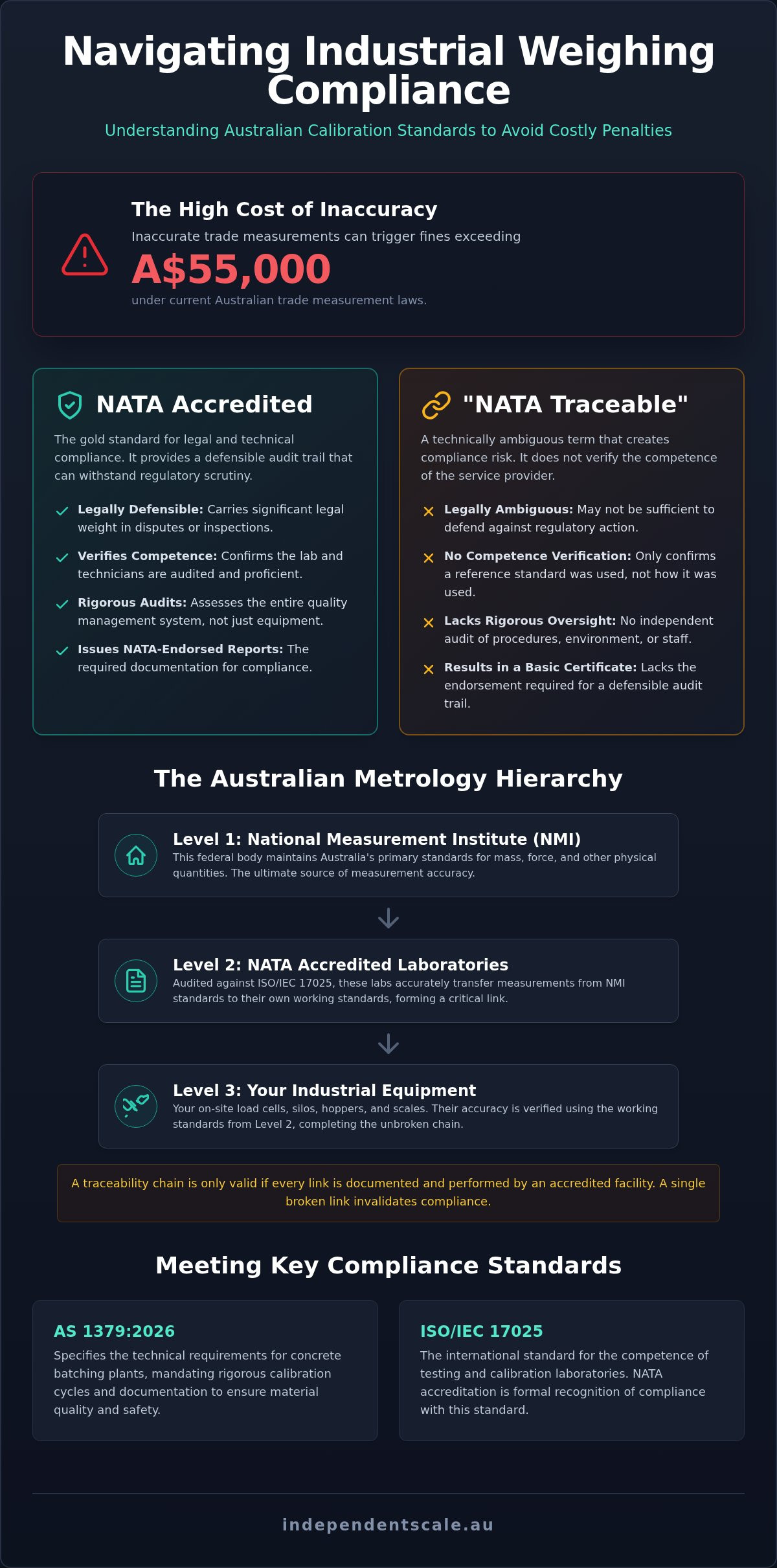
The National Measurement Act 1960 provides the legal framework for this system. It mandates that all measurements for trade must be traceable to national standards. You might encounter the term "NATA traceable" in some service quotes. This is a technically incorrect term. NATA doesn't provide traceability; it provides accreditation to laboratories to prove they have the technical competence to maintain that traceability chain. Without this formal oversight, measurement uniformity across different industrial sites would be impossible to verify.
The Australian Metrology Hierarchy
The science of Metrology in Australia operates through a three-tier hierarchy designed to eliminate measurement drift. Each level represents a transfer of accuracy from a higher standard to a practical application.
- Level 1: The National Measurement Institute (NMI). This federal body maintains the primary standards for mass, force, and other physical quantities.
- Level 2: NATA Accredited Laboratories. Facilities like Independent Scale Service are audited against ISO/IEC 17025 to ensure they can accurately transfer measurements from NMI standards to secondary working standards.
- Level 3: Working Standards and Industrial Equipment. These are the weights and instruments used during your load cell calibration Melbourne service to verify your silos, hoppers, or scales.
Unbroken Chains: Why Documentation Matters
A traceability chain is only as strong as its weakest link. If a single calibration event in the hierarchy lacks a valid certificate or was performed by an unaccredited facility, the entire chain is broken. This invalidates your compliance status and leaves your business exposed during an audit. Documentation is the only way to prove the chain remains intact.
Calibration certificates serve as the legal evidence of this chain. They must detail the specific standards used, the environmental conditions during testing, and the calculated measurement uncertainty. Relying on a "factory calibration" from an overseas manufacturer is often insufficient for Australian regulatory requirements. These certificates frequently lack the specific references to Australian national standards required by NATA assessors and AS 1379:2026 inspections. Ensuring your documentation is defensible requires a provider that understands the rigorous demands of the Australian metrological framework.
NATA Accredited vs. Traceable Calibration: The Technical Breakdown
Industrial facilities often confuse a "traceable" calibration certificate with a NATA-endorsed report. While both provide a link to national standards, only NATA accreditation verifies the technical competence of the personnel and the laboratory performing the work. A traceable certificate merely confirms that a reference weight was used during the process. In contrast, a NATA-endorsed report confirms the measurement was performed under strictly controlled conditions by a facility audited by the National Association of Testing Authorities (NATA). In Australian courts, this endorsement carries significant legal weight. It provides a defensible audit trail that can withstand scrutiny during legal disputes or regulatory inspections, particularly when businesses face potential fines for inaccurate trade measurements.
The audit process for an accredited laboratory is rigorous. Assessors don't just check the equipment; they examine the entire quality management system. They look for evidence of technician proficiency, equipment maintenance logs, and the environmental stability of the testing area. This level of oversight ensures that your load cell calibration Melbourne results are repeatable and scientifically sound, rather than just a one-off comparison against a test weight.
Technical Requirements of ISO/IEC 17025
Adherence to ISO/IEC 17025 is the benchmark for global metrological excellence. This standard requires more than just accurate tools; it demands a comprehensive approach to data integrity. Facilities must implement specific controls to maintain their accreditation status.
- Staff Proficiency: Technicians must undergo regular competency assessments to prove they can perform complex calibrations accurately and consistently.
- Environmental Stability: Factors such as temperature fluctuations and humidity levels are monitored. These variables can cause material expansion or contraction, which significantly impacts high-precision measurements.
- Measurement Uncertainty: Every NATA-endorsed report must include a calculation of uncertainty. This "margin of error" is essential for engineers to determine if a system meets the required tolerances for safety-critical applications.
Choosing the Right Standard for Your Industry
Deciding between basic traceability and full NATA accreditation depends on your operational risk and regulatory environment. If your weighing equipment is used for trade or high-stakes production, NATA endorsement is usually mandatory. In sectors like concrete production under AS 1379:2026 or large-scale mining operations, the cost of a measurement error far outweighs the investment in accredited service. For non-critical internal processes where measurements don't affect billing or safety-critical batching, basic traceable calibration might be sufficient. However, most Melbourne industrial sites choose accredited load cell calibration Melbourne to ensure their systems are fully defensible against the A$55,000 maximum fines for trade measurement inaccuracies.
Traceability for Industrial Load Cells and Heavy Weighing Systems
Industrial load cells in Melbourne face unique environmental challenges that threaten measurement integrity. Dust ingress in regional facilities and the extreme heat of the Australian summer cause thermal expansion in heavy steel structures. This physical change directly affects the load cell's output signal. To maintain a valid chain of custody to the National Measurement Institute, calibration must account for these local variables. While laboratory calibration offers a controlled environment, on-site load cell calibration Melbourne is the only practical way to verify high-capacity systems that cannot be dismantled without excessive downtime.
Neglecting calibration schedules accounts for 85% of industrial measurement errors. In harsh conditions, such as coastal salinity or the heat of the Pilbara, the typical 10 to 15 year lifespan of a sensor can drop to just 5 to 7 years. Regular verification ensures that drift is identified before it causes a system-wide failure or expensive product giveaway. Professional load cell calibration Melbourne identifies these performance shifts early; this protects the accuracy of the entire production line.
Calibrating Silos and Hoppers
Maintaining traceability for a 50-tonne silo requires specialized equipment and technical methodology. Our hopper calibration service utilizes mass substitution or reference load cell methods to verify accuracy under real-world loading conditions. These high-capacity systems are prone to mechanical binding and stray force paths. Technicians must identify these issues during the calibration process to ensure the resulting certificate is technically valid. 24/7 industrial operations require a structured schedule to manage load cell drift caused by continuous vibration and material impact.
Force and Tension Measurement
Safety-critical applications require rigorous force gauge calibration to meet Australian safety standards. This includes the verification of shackle pins and tension links used in lifting and material testing. Load cells used in safety-critical lifting must be calibrated by an accredited facility to verify they meet the specific force tolerances required for overhead load management. Ensuring these components are traceable prevents catastrophic mechanical failure and maintains compliance with workplace safety regulations.
Meeting Australian Standards: AS 1379:2026 and ISO/IEC 17025
AS 1379:2026 is the mandatory standard for the specification and supply of concrete in Australia. Compliance isn't optional for operators who want to maintain their certification. This standard requires that all batching equipment is verified by an accredited body. Without NATA-endorsed reports, your facility risks failing a third-party audit. Professional concrete batching plant calibration provides the technical evidence needed to prove your system delivers accurate mixes. This protects your business against litigation resulting from structural failures or out-of-spec deliveries.
A complete traceable system isn't just about the sensor. You must also consider the accuracy of your indicators and displays. These components translate the raw signal into readable data. If the display isn't calibrated as part of the total system, the traceability chain is compromised. Regular load cell calibration Melbourne services ensure that every part of the signal path, from the load cell to the digital readout, remains within the strict tolerances defined by Australian law.
Audit Preparation for Concrete Plants
Preparing for an AS 1379 compliance audit requires a methodical approach. Many plants rely on basic traceability, but these often fail during inspection because they lack the technical competence markers required by NATA. Use this checklist to secure your audit trail:
- Verify that all calibration certificates are current and NATA-endorsed.
- Maintain a clear log of any equipment repairs or adjustments made between calibration intervals.
- Ensure that working standards used by technicians were themselves calibrated by an accredited laboratory.
- Keep a defensible history of calibration records to demonstrate long-term system stability.
ISO/IEC 17025: The International Benchmark
ISO/IEC 17025 is the international standard that sets the requirements for the competence of testing and calibration laboratories. Australian standards align with these global metrology requirements to ensure international measurement consistency. A key component of this standard is measurement uncertainty. This value provides a statistical margin of error for every reading. Without this data, a calibration report is technically incomplete. For a deeper look at these requirements, refer to our Calibration Services: The Authoritative Guide.
If your plant is due for its annual inspection, ensure your documentation is defensible. You can schedule your AS 1379 compliant calibration today to minimize your audit risk and maintain operational uptime.
Building a Defensible Audit Trail with Independent Scale Service
Independent Scale Service utilizes a methodical approach to NATA-accredited calibration that prioritizes both regulatory compliance and operational efficiency. By maintaining accreditation to ISO/IEC 17025, we ensure that every load cell calibration Melbourne project results in a defensible audit trail. This documentation is critical for facilities that must comply with AS 1379:2026. Our technicians specialize in complex tank and silo weighing assemblies, ensuring that high-capacity systems maintain their accuracy under constant industrial load. Technical expertise acts as the final, vital link in the traceability chain. Without it, even the best equipment cannot guarantee an audit-ready facility. We focus on delivering precise data that stands up to the scrutiny of national regulators and third-party inspectors.
On-Site Calibration Capabilities
Minimizing plant downtime is a core objective of our service model. We deploy mobile calibration units equipped with NATA-traceable standards directly to your site. This on-site load cell calibration Melbourne capability eliminates the need to dismantle critical infrastructure for laboratory transport. We service major hubs in Melbourne and Sydney, as well as remote regional sites across Australia. Our responsiveness includes emergency repair and re-calibration services. If a sensor fails, our priority is to restore your system's accuracy and compliance quickly. This proactive approach prevents the accumulation of measurement errors that lead to financial loss or regulatory penalties. Our technicians are trained to handle the physical and technical challenges of calibrating large-scale industrial hardware in situ.
The Value of Expert Consultation
Our service extends beyond a simple "pass/fail" assessment. We provide technical consultation to help clients identify the root causes of measurement drift before they become systemic failures. For instance, integrating specialized signal conditioners can significantly improve the stability of your measurement data in high-vibration environments. Understanding these technical nuances is essential for long-term system reliability and reducing maintenance costs. For a comprehensive overview of how to optimize your weighing systems, read The Essential Guide to Industrial Load Cells. By combining high-precision equipment with seasoned expertise, we help industrial clients solve critical problems before they impact the bottom line. This methodical support ensures your facility remains compliant, productive, and protected against the legal risks of inaccurate measurement.
Securing Your Industrial Compliance for 2026 and Beyond
Maintaining a defensible audit trail is a continuous requirement that demands more than just basic equipment checks. You've learned that traceability requires an unbroken chain back to national standards and that NATA accreditation is the benchmark for technical competence under ISO/IEC 17025. With the implementation of AS 1379:2026, the risk of non-compliance has never been higher, especially given the potential for A$55,000 fines for inaccurate trade measurements.
Independent Scale Service provides the specialized expertise needed to protect your operations. As a NATA accredited laboratory, we offer comprehensive support for concrete batching plants, hoppers, and silos across Sydney and regional areas. Securing professional load cell calibration Melbourne ensures your weighing systems remain accurate and your documentation survives any third-party inspection. Don't leave your regulatory standing to chance.
Request a NATA-Accredited Calibration Service Today to verify your equipment and minimize plant downtime. Our team is ready to help you build a reliable measurement framework that supports your long-term industrial success.
Frequently Asked Questions
What is the difference between NATA and traceable calibration?
NATA accreditation verifies the technical competence of the facility and staff under ISO/IEC 17025. Traceable calibration only indicates that a comparison was made using a reference standard. NATA-endorsed reports provide essential legal defensibility in Australian courts. Traceable certificates lack the formal oversight required for high-risk industrial environments such as concrete batching or large-scale mining operations where precision is mandatory.
Is a factory calibration certificate sufficient for an Australian audit?
Factory certificates are generally insufficient for Australian regulatory audits. They often reference international standards like NIST that don't directly link to the Australian National Measurement Institute. For compliance with AS 1379:2026, you need a NATA-endorsed report issued by an Australian-accredited laboratory. This ensures the equipment meets local legal requirements for trade measurement and safety while providing a defensible audit trail.
How often should industrial weighing equipment be calibrated for traceability?
Industrial equipment typically requires calibration every 6 to 12 months. Harsh Australian conditions, such as high heat or dust ingress, can accelerate sensor drift. AS 1379:2026 mandates specific intervals for concrete plants to ensure mix accuracy. Regular load cell calibration Melbourne services prevent these physical inaccuracies from becoming expensive liabilities, audit failures, or safety hazards for your industrial facility.
Can any general electrician perform a traceable load cell calibration in Melbourne?
No, general electricians don't have the NATA accreditation or specialized mass standards required for legal traceability. load cell calibration Melbourne requires technicians trained in metrology and ISO/IEC 17025 protocols. While electricians can assist with basic wiring, only an accredited calibration specialist can issue the endorsed reports required for regulatory compliance and the creation of a defensible audit trail.
What are the penalties for using non-compliant weighing equipment in Australia?
Using non-compliant weighing equipment for trade can result in fines exceeding A$55,000 under the National Measurement Act. Beyond these financial penalties, businesses face the risk of total audit failure and potential litigation if structural failures occur due to inaccurate batching. Professional verification remains the only way to mitigate these significant legal risks and ensure your plant remains operational.
Does NATA accreditation cover all types of industrial weighing equipment?
NATA accreditation is specific to a laboratory's defined scope of work. It covers various industrial systems including load cells, force gauges, and hopper scales. You must verify that the provider's specific scope includes the capacity and equipment type you utilize. Independent Scale Service maintains accreditation for a wide range of heavy industrial weighing systems across Melbourne, Sydney, and regional Australia.
What is an "unbroken chain of traceability" in Australian metrology?
This is a documented series of comparisons linking your equipment back to national standards held by the National Measurement Institute. Each link in the chain must have its own valid calibration certificate and calculated measurement uncertainty. If any link is missing or was performed by an unaccredited facility, the entire traceability chain is legally invalidated during a regulatory inspection or audit.
How do I know if my load cell calibration is NATA-endorsed?
Look for the NATA emblem and the laboratory's unique accreditation number printed on the certificate. The report must also include a statement of compliance with ISO/IEC 17025. If these markers are missing, the calibration is likely only "traceable" and won't provide the same level of legal protection or technical assurance required during an AS 1379:2026 inspection or audit.
