


Tank Weighing Systems Australia: The 2026 Guide to Industrial Precision
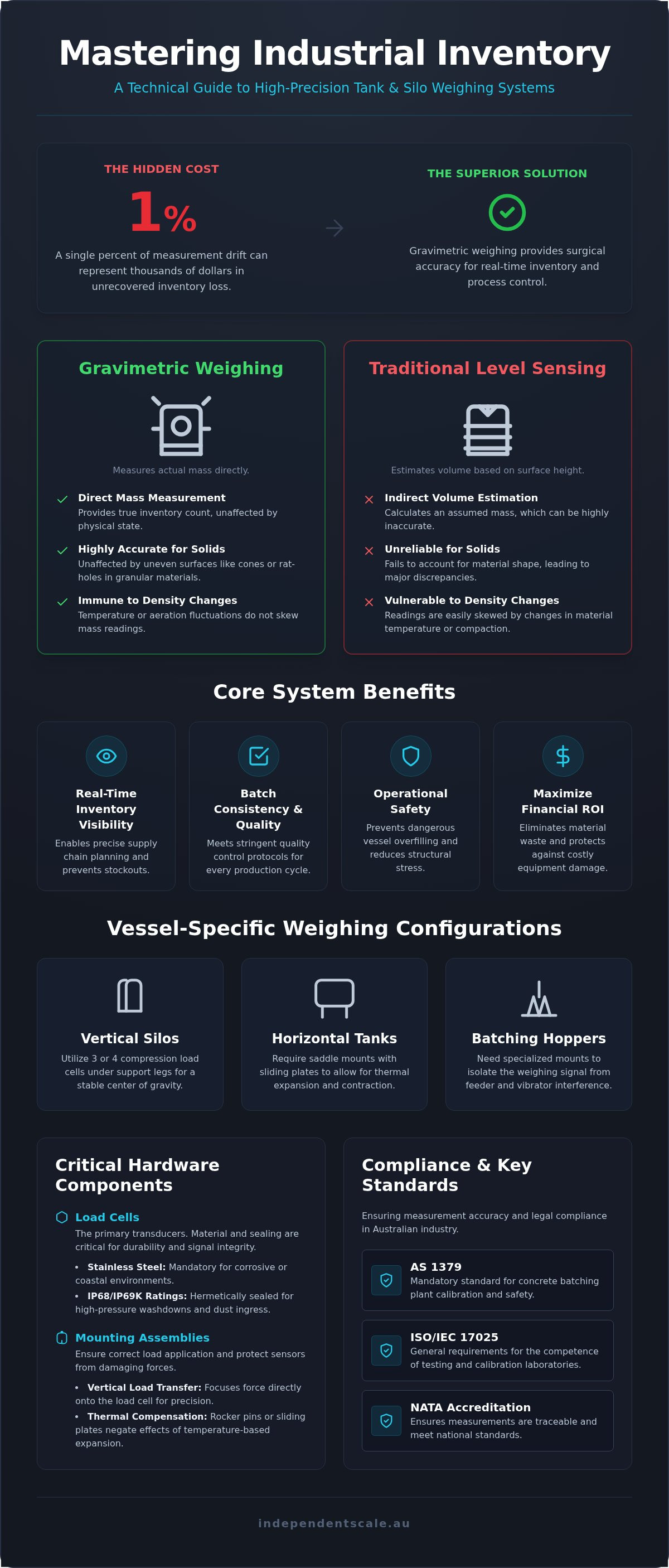
A single percent of measurement drift in a high-capacity silo doesn't just skew your annual audit; it represents thousands of dollars in unrecovered inventory loss. For modern industrial facilities, the reliability of tank weighing systems Australia depends on is no longer a secondary concern, it's a fundamental requirement for operational solvency. As material costs fluctuate and regulatory oversight tightens, the margin for error in bulk liquid or solid measurement has effectively vanished.
You're likely aware that maintaining precision across a complex network of hoppers and silos is a constant struggle against environmental interference and mechanical fatigue. This guide provides a technical framework for selecting, installing, and calibrating high-accuracy systems that meet AS 1379 and ISO/IEC 17025 standards. We'll detail how to eliminate measurement drift, integrate load cells with existing PLCs to minimize downtime, and establish real-time inventory visibility that reduces material waste in every batch.
Key Takeaways
- Evaluate why gravimetric weighing provides superior precision compared to traditional level sensors for industrial inventory management.
- Identify the technical requirements for AS 1379 and ISO/IEC 17025 compliance to ensure NATA-accredited measurement accuracy.
- Select appropriate hardware for tank weighing systems Australia, focusing on load cell durability and thermal expansion compensation in mounting assemblies.
- Streamline data management by integrating weighing electronics directly into existing PLC and SCADA automation frameworks via signal conditioners.
- Implement efficient system retrofits and maintenance protocols to minimize operational downtime while maintaining long-term measurement stability.
Understanding Tank Weighing Systems in Australian Industry
A tank weighing system is a high-precision assembly comprising transducers, junction boxes, and digital indicators. These systems utilize load cell technology to convert the physical force of a vessel's mass into an electrical signal. For industrial operators, tank weighing systems Australia provide the most reliable method for monitoring bulk materials in real-time, ensuring that inventory data matches physical stock levels with surgical accuracy.
Gravimetric weighing offers significant advantages over ultrasonic or radar level sensors. Level sensors measure the surface height of a material, which is often unreliable for solids that form cones or rat-holes. Density changes caused by temperature or aeration can also skew level readings. Weighing measures mass directly. Since mass is unaffected by physical state or volume changes, it remains the superior choice for both liquids and granular solids.
This technology is critical across several Australian sectors. In mining, it monitors ore processing; in agriculture, it manages grain and liquid fertilizer storage. For the construction industry, concrete batching plant calibration is a regulatory necessity. It ensures that every batch meets the strict AS 1379 standards required for structural safety.
Key benefits of integrated systems include:
- Real-time inventory visibility for better supply chain planning.
- Batch consistency that meets stringent quality control protocols.
- Safety mechanisms that prevent vessel overfilling and structural stress.
Vessel Types: Tanks, Silos, and Hoppers
The physical structure of the vessel dictates the configuration of the tank/silo weighing assemblies. Vertical silos typically use three or four compression load cells mounted under the support legs to ensure a stable center of gravity. Horizontal tanks require saddle mounts that allow for longitudinal movement. This movement is necessary because metal vessels expand and contract with the high ambient temperatures common in regional Australia. Hoppers used in active batching require specialized mounts to isolate the weighing signal from the mechanical vibrations of feeders and vibrators.
The Economic Impact of Accurate Weighing
Precision measurement directly correlates with the bottom line. Inaccurate systems lead to material waste that accumulates into significant financial losses over a production cycle. By preventing overfills, these systems also protect equipment from damage and reduce environmental spill risks. Reliable tank weighing systems Australia eliminate the hidden costs of inventory stockouts that can halt entire production lines. In 2026, precision weighing serves as the primary mechanism for maximizing operational ROI by ensuring total accountability for every kilogram of raw material processed.
Critical Components of a Reliable Weighing System
A high-performance weighing installation is an ecosystem of specialized hardware designed to withstand mechanical stress and environmental interference. For tank weighing systems Australia, selecting components isn't merely a matter of capacity; it's about ensuring long-term signal integrity under harsh industrial conditions. Systems used for commercial transactions must also align with Australia's trade measurement laws to maintain legal compliance and data transparency.
Selecting the Right Load Cells
The load cell is the primary transducer in the system. While alloy steel cells are suitable for controlled, dry environments, stainless steel variants are mandatory for coastal facilities in Sydney or Melbourne where salt-spray corrosion is a constant risk. For food processing or chemical storage, look for IP68 or IP69K ratings. These hermetically sealed units survive high-pressure washdowns and prevent fine dust ingress in regional silo sites. You can explore our range of load cells to identify the specific metallurgy required for your site's environmental profile.
Mounting Assemblies and Structural Integrity
Precision is impossible without proper load application. Mounting assemblies serve two critical roles: they ensure the load is transferred vertically and protect the sensor from lateral forces. In large outdoor silos, thermal expansion can cause the vessel to shift as temperatures fluctuate. High-quality tank and silo weighing assemblies utilize rocker pin designs or sliding plates to compensate for this movement without affecting the weight reading. For outdoor structures, these mounts must include anti-tipping hardware and stay rods to resist wind loads and prevent catastrophic vessel failure during storms.
The electronic interface is the final link in the chain. Digital indicators and transmitters take the raw millivolt signal from the load cells and convert it into actionable data for your PLC. In many Australian regions, electrical spikes and lightning strikes are frequent. Utilizing NEMA-rated junction boxes and surge arrestors is a necessary precaution to protect your investment from terminal electrical damage. If you're currently experiencing measurement drift, it's often a sign of component fatigue or environmental ingress. Our technical team provides specialized load cell calibration services to diagnose and rectify these hardware failures before they lead to total system downtime.
System Integration and Data Management
Industrial automation in 2026 requires more than just local weight readings; it demands a seamless flow of data from the vessel to the control room. Modern tank weighing systems Australia must interface directly with Programmable Logic Controllers (PLCs) or Supervisory Control and Data Acquisition (SCADA) systems. This connectivity enables automated material handling, precise batching, and remote inventory management. To maintain the integrity of these digital systems, ensuring your equipment meets NATA accreditation for calibration standards is essential for data auditability and regulatory reporting.
Signal Conditioners and Transmitters
Load cells produce a low-voltage millivolt signal that is susceptible to electromagnetic interference (EMI) and radio frequency interference (RFI). Transmitters serve as the bridge between the physical sensor and the digital network by amplifying and converting this raw data into standardized protocols like 4-20mA, Modbus, or Profibus. Utilizing high-quality conditioners and transmitters for industrial use ensures that the weight data remains stable even in environments with heavy electrical noise from motors and switchgear. Troubleshooting signal noise often involves checking shield grounding and ensuring that signal cables aren't run parallel to high-voltage power lines.
Indicators and Remote Displays
While the PLC handles the logic, local indicators provide critical visibility for on-site operators. Choosing professional indicators and displays with high-intensity LED or sunlight-readable LCD screens is mandatory for outdoor silos located in high-glare Australian environments. These devices do more than just show numbers. Modern indicators are programmable for setpoint control, allowing for automatic shut-off of fill valves or discharge gates when specific weight thresholds are reached. This local control loop provides a necessary fail-safe that operates independently of the primary SCADA system.
Effective data management also involves choosing between wired and wireless transmission methods. Wired connections remain the gold standard for high-speed batching plants where millisecond latency is unacceptable; however, wireless telemetry is increasingly viable for remote silo monitoring where trenching for cables is cost-prohibitive. In 2026, the shift toward cloud-based inventory reporting allows facility managers to monitor stock levels across multiple geographic sites from a single dashboard. This real-time visibility prevents costly stockouts and enables more efficient logistics planning for raw material deliveries.
Compliance, NATA Accreditation, and AS 1379 Standards
Compliance in the Australian industrial sector is defined by rigorous technical standards and third-party verification. For tank weighing systems Australia, NATA accreditation serves as the definitive marker of technical competence. While many providers offer general calibration, only NATA-accredited laboratories operating under ISO/IEC 17025 can provide the level of traceability required for legal-for-trade and high-risk applications. Generic calibration often lacks the documented uncertainty budgets and standardized procedures necessary to withstand a regulatory audit or a commercial dispute regarding inventory accuracy.
AS 1379 represents the gold standard specifically for the concrete industry. This standard mandates specific accuracy tolerances and calibration intervals for batching plants to ensure the structural integrity of the concrete produced. Failure to comply with AS 1379 doesn't just risk inventory loss; it exposes a business to significant legal liability and potential project rejection. Choosing a service provider with specific expertise in this standard is a necessity for any concrete production facility operating in Sydney, Melbourne, or regional hubs.
The Calibration Process for Tanks and Silos
Large-scale vessels present unique challenges for calibration due to the extreme weights involved. The "substitution method" is frequently employed for silos with capacities exceeding available physical test weights. This process involves using a known quantity of certified test weights to calibrate the first increment, then substituting material (such as water) to reach higher capacities while maintaining the established accuracy curve. For smaller systems, professional hopper calibration services utilize full-weight testing to ensure maximum precision. Most industrial systems require calibration every 6 to 12 months, though high-throughput environments or those with high vibration levels may necessitate quarterly inspections to prevent measurement drift.
NATA Documentation and Audit Readiness
A NATA-endorsed calibration certificate is a legal document that proves traceability to national measurement standards. These certificates include detailed data on environmental conditions, uncertainty of measurement, and the specific equipment used during the test. Independent Scale Service maintains a rigorous compliance framework to ensure your facility is always audit-ready. We provide the comprehensive documentation needed to satisfy both internal quality systems and external regulatory bodies. For a deeper understanding of these requirements, refer to our Authoritative Guide to Calibration Services.
Ensure your facility meets all regulatory requirements by booking an AS 1379 compliant calibration today.
Installation and Maintenance: Minimising Downtime
Routine maintenance is the primary defense against unexpected system failure. Industrial environments accumulate debris around load cell mounts, which can create "load shunts" that bypass the sensor and cause significant measurement errors. A standard maintenance checklist should include:
- Cleaning debris from under and around mounting assemblies.
- Visual inspection of cabling for signs of rodent damage or chemical degradation.
- Zero-balance checks to identify early signs of sensor drift.
- Tightening of stay rods and anti-tipping hardware to maintain structural safety.
Fault Diagnosis and Repair
When a system fails, rapid diagnosis is essential to prevent production bottlenecks. Our technical team utilizes a methodical approach to distinguish between terminal load cell failure and simple cabling issues. Cabling faults often manifest as erratic or fluctuating readings, while a failed sensor typically shows a fixed, out-of-range value. Mechanical binding is another common culprit; rigid piping or structural contact can physically prevent the tank from resting fully on the load cells. If you notice inconsistent data, review these 5 signs you need load cell repair to determine if a professional intervention is required.
Concrete Batching Plant Specialisation
Concrete production environments present extreme challenges due to high-frequency vibrations and constant dust exposure. Maintaining accuracy in these settings requires specialized concrete batching plant calibration and repair protocols that account for mechanical noise. In major metropolitan hubs like Sydney and Melbourne, strict adherence to AS 1379 is a non-negotiable requirement for all commercial concrete suppliers to ensure product quality and legal compliance. Independent Scale Service provides the technical expertise and NATA-accredited certification needed to keep these high-volume plants operational and compliant with all Australian standards. Our responsive repair service focuses on identifying and rectifying faults during scheduled downtime to ensure your facility maintains peak throughput without compromising on precision.
Optimising Industrial Precision and Regulatory Compliance
Precision in bulk material measurement is a technical necessity for maintaining operational ROI and legal standing. The reliability of tank weighing systems Australia depends on the synergy between high-performance load cells and robust mounting hardware. Seamless PLC integration is also critical for real-time visibility. Relying on generic calibration is a risk that leads to measurement drift and inventory discrepancies. Ensuring your facility remains audit-ready requires a methodical approach to maintenance and a commitment to rigorous standards.
Independent Scale Service provides the technical expertise needed to secure your production lines. We're NATA Accredited to ISO/IEC 17025 and specialize in AS 1379 compliance for the concrete industry. Our team serves Sydney, Melbourne, and regional Australia with rapid responsiveness to minimize your downtime. Maintaining accuracy is an ongoing commitment to quality that protects your bottom line and ensures structural safety across all projects.
Request a NATA-Accredited Calibration or Supply Quote to secure your facility's accuracy today.
Frequently Asked Questions
What is the most accurate way to weigh a large storage tank?
The most accurate method for weighing large storage tanks is gravimetric measurement using an integrated load cell system. Unlike level sensors that estimate volume, load cells measure mass directly by converting physical force into an electrical signal. This eliminates errors caused by material density changes or surface irregularities. For tank weighing systems Australia, using high-precision compression or shear beam load cells ensures that inventory data remains accurate within tight tolerances regardless of the material's physical state.
How do I know if my silo weighing system needs NATA calibration?
NATA calibration is essential if your weight data is used for commercial trade, legal reporting, or compliance with specific Australian Standards like AS 1379. Accreditation to ISO/IEC 17025 provides third-party verification that the calibration laboratory is technically competent. Without a NATA-endorsed certificate, your measurement data may not be legally defensible during an audit or commercial dispute. Most industrial facilities in Sydney and Melbourne require this level of traceability for risk management.
Can I install load cells on my existing tanks without structural modification?
You can often retrofit load cells onto existing tanks by integrating specialized mounting assemblies into the support legs or saddle mounts. This process usually requires temporary jacking of the vessel to insert the weighing hardware. While major structural modification isn't always necessary, a pre-installation assessment is mandatory to ensure the existing foundation and supports can handle the concentrated loads. Our team specializes in retrofitting tank weighing systems Australia to minimize site disruption and downtime.
What is the difference between AS 1379 and ISO 17025 in weighing?
AS 1379 is the Australian Standard specifically governing the specification and manufacture of concrete, which includes strict calibration tolerances for batching equipment. ISO/IEC 17025 is an international standard that specifies the general requirements for the competence of testing and calibration laboratories. In practice, a service provider must be NATA accredited to ISO/IEC 17025 to perform the legal calibrations required for a plant to claim AS 1379 compliance. Both standards are necessary for maintaining regulatory safety.
How often should concrete batching plants be calibrated in Australia?
Concrete batching plants in Australia must be calibrated at least every six months to remain compliant with AS 1379. Facilities experiencing high throughput or significant mechanical vibration may require more frequent quarterly inspections to prevent measurement drift. Regular calibration ensures that the proportions of cement, water, and aggregates remain within the structural design limits. This frequency protects the producer from the high costs of batch rejection and potential structural failures in construction projects.
What IP rating is required for outdoor tank weighing in Australia?
Outdoor tank weighing installations require load cells with a minimum rating of IP68, though IP69K is preferred for harsh industrial environments. These ratings ensure the sensors are hermetically sealed against high-pressure water jets and prolonged submersion. In regional Australian sites, dust ingress and extreme rainfall can quickly degrade lower-rated components. Using stainless steel sensors with superior ingress protection prevents internal corrosion and maintains signal integrity during the high-intensity washdown cycles common in food and chemical processing.
How do load cell mounting assemblies prevent tank tipping?
Outdoor tank weighing installations require load cells with a minimum rating of IP68, though IP69K is preferred for harsh industrial environments. These ratings ensure the sensors are hermetically sealed against high-pressure water jets and prolonged submersion. In regional Australian sites, dust ingress and extreme rainfall can quickly degrade lower-rated components. Using stainless steel sensors with superior ingress protection prevents internal corrosion and maintains signal integrity during the high-intensity washdown cycles common in food and chemical processing. If you're interested in equipment designed for even deeper submersion and specialized training for underwater environments, check out Simple Dive for SDI and TDI certified courses.
How do load cell mounting assemblies prevent tank tipping?
Measurement drift is typically caused by environmental interference, mechanical binding, or electrical degradation. In Australian industrial sites, temperature fluctuations can cause structural expansion that puts lateral stress on sensors, while dust accumulation can create physical bypasses known as load shunts. Additionally, moisture ingress into junction boxes or rodent damage to signal cables can lead to fluctuating millivolt signals. Routine maintenance and NATA-accredited calibration are the only effective methods for identifying and rectifying these drift issues before they impact inventory.
