


5 Signs You Need Load Cell Repair or Replacement
Inaccurate weighing data is not just an inconvenience; it is a direct threat to your operational efficiency, product quality, and regulatory compliance. When a critical system fails, every hour of unplanned downtime translates into significant financial loss. The source of these persistent errors often points to a single, essential component: the loadcell. However, correctly diagnosing the issue is crucial-is the fault with the loadcell itself, or another part of the system?
This guide provides the technical clarity required to make an informed diagnosis. We will detail five critical signs that indicate your loadcell requires expert repair or immediate replacement. By understanding these indicators, you can move from uncertainty to a decisive, cost-effective action plan. This knowledge is essential for minimising downtime, preventing compliance failures, and restoring the certified accuracy of your industrial weighing equipment.
Key Takeaways
- Recognise key performance indicators like signal drift and zero return errors, which often signal an impending loadcell failure.
- Understand how a routine visual inspection for physical damage or corrosion can identify a compromised unit and prevent costly operational downtime.
- Learn to interpret system error codes and distinguish between an intermittent signal and a complete output failure to assess fault severity.
- Evaluate the critical factors that determine if a load cell repair is a viable, cost-effective option over a complete replacement.
Sign 1: Inconsistent Readings and Signal Drift
The most common indicator of a developing load cell fault is the loss of stable and repeatable measurements. This issue manifests as inconsistent readings or signal drift, where the displayed weight value fluctuates with a static load or slowly creeps up or down without any change to the applied weight. The primary function of any industrial weighing system relies on the stability of its core components. For a deeper understanding of what is a load cell and its strain gauge technology, it is evident that consistent signal output is non-negotiable.
When a loadcell begins to fail in this manner, the consequences are immediate and severe. It directly compromises product quality, leads to inaccurate batching, and can result in costly material wastage. Furthermore, unreliable weight data can lead to non-compliance with industry regulations and quality assurance standards, placing your operation at significant risk. Identifying these symptoms early is critical to preventing production losses.
What Inconsistent Readings Look Like
In practice, signal instability presents clear, observable symptoms across your operational interface and production reports. Key indicators include:
- Unstable Display Values: The weight reading on the indicator constantly fluctuates and fails to settle on a final, stable number, even when the load is completely static.
- Inaccurate Batch Reports: Production data shows significant and inexplicable variations in material weights for identical batches, pointing to an unreliable measurement source.
- Spurious Errors: The system frequently triggers 'overload' or 'underload' alarms even when handling standard, known weights that are well within the system's capacity.
Common Causes of Signal Drift
Signal instability is not random; it is typically symptomatic of an underlying physical or environmental issue affecting the load cell or its associated wiring. Diagnosis often reveals one of the following root causes:
- Moisture Ingress: Water or condensation penetrating the load cell housing or a connected junction box is a primary cause of short-circuiting and signal degradation.
- Temperature Fluctuations: Extreme or rapid changes in ambient temperature can affect the sensitive strain gauges within the load cell, causing the output signal to drift.
- Internal Component Degradation: Over time, factors such as metal fatigue from cyclical loading or the general aging of electronic components can lead to a loss of performance and stability.
- Cable and Shielding Damage: Physical damage, abrasion, or corrosion to the signal cable or its electromagnetic shielding can introduce electrical noise and interfere with the signal transmission.
Sign 2: Zero Return Errors and Poor Repeatability
A fundamental characteristic of any accurate weighing system is its ability to return to a true zero after a load is removed. This function is essential for ensuring that each measurement is discrete and not influenced by previous loads. When a system fails to zero out or provides inconsistent readings for the same object-a condition known as poor repeatability-it indicates a critical failure in the weighing apparatus. These inconsistencies undermine operational integrity and often require professional diagnosis and load cell calibration to rectify. For industrial applications where precision is non-negotiable, these symptoms cannot be ignored.
Identifying a Zero Return Problem
A zero return error is typically straightforward to observe during routine operations. The issue compromises the baseline from which all measurements are taken, leading to cumulative errors and unreliable data. Key indicators of a zero return problem include:
- The indicator consistently displays a positive or negative value after the scale has been unloaded.
- Operators find they must manually re-zero the indicator frequently between weighing cycles.
- The zero point appears to "drift" or shift throughout the day, even with no load present.
What Causes Poor Repeatability?
Poor repeatability and zero drift are not random events; they are symptoms of underlying faults that can often be traced to specific mechanical or electrical issues. A thorough inspection is required to pinpoint the source of the inconsistency. The most common causes include:
- Mechanical Binding: Debris, dirt, or interference from surrounding structures can physically obstruct the free movement of the weighing platform or the loadcell itself, preventing it from settling at a true zero.
- Permanent Deformation: An overload or shock loading event can permanently deform the load cell's spring element. The internal strain gauges can no longer return to their original state, causing a permanent zero offset.
- Compromised Installation: Loose mounting bolts, a damaged foundation, or worn-out checking components can introduce instability into the system, preventing the load from being applied consistently.
- Internal Component Damage: Moisture ingress, corrosion, or electrical surges can damage the internal strain gauges or wiring, resulting in an unstable and unreliable output signal.
Sign 3: Visible Physical Damage or Corrosion
While electrical faults require diagnostic equipment, a thorough visual inspection is often the most direct method for identifying the root cause of a load cell failure. Physical damage not only compromises the structural integrity of the device but can also breach its hermetic seal, allowing moisture and contaminants to ingress and damage sensitive internal components. Never disregard visible damage, even if the weighing system appears to be functioning; it is a clear indicator of a current or impending failure that will affect accuracy and operational safety.
Key Areas to Inspect Visually
A systematic visual check is an essential first step in any diagnostic process. A detailed load cell troubleshooting guide will always prioritise a physical assessment before moving to electrical testing. Focus your inspection on these critical areas:
- Load Cell Body: Carefully examine the entire body for any cracks, deep gouges, dents, or deformation. Overloading events can cause bending or distortion, which permanently damages the strain gauges within the loadcell.
- Cabling: Inspect the full length of the cable for cuts, abrasions, pinch points, or signs of chemical degradation. Damaged cable sheathing exposes internal wires to moisture and electrical interference.
- Mounting Points & Connections: Look for signs of rust or corrosion, particularly where the load cell is mounted or where hardware connects. Corrosion can weaken the structure and lead to poor electrical connections.
- Seals and Potting: Verify that the protective potting or welded seals are intact. Any breach in this protective barrier can lead to moisture ingress, which is a primary cause of drift and eventual failure.
Impact of Environmental Factors
The operational environment is a significant contributor to physical damage. High-vibration settings can induce metal fatigue and loosen critical electrical connections over time. In facilities that utilise aggressive chemical wash-down procedures, seals can degrade, compromising the load cell's IP rating. Furthermore, nearby lightning strikes or significant power surges can cause catastrophic electrical damage, sometimes leaving visible burn marks on the casing or cable entry points. Addressing these environmental hazards is crucial for long-term system reliability.
If you have identified any physical damage or suspect environmental factors are impacting your equipment, immediate professional assessment is required. Request an on-site inspection from our expert technicians.
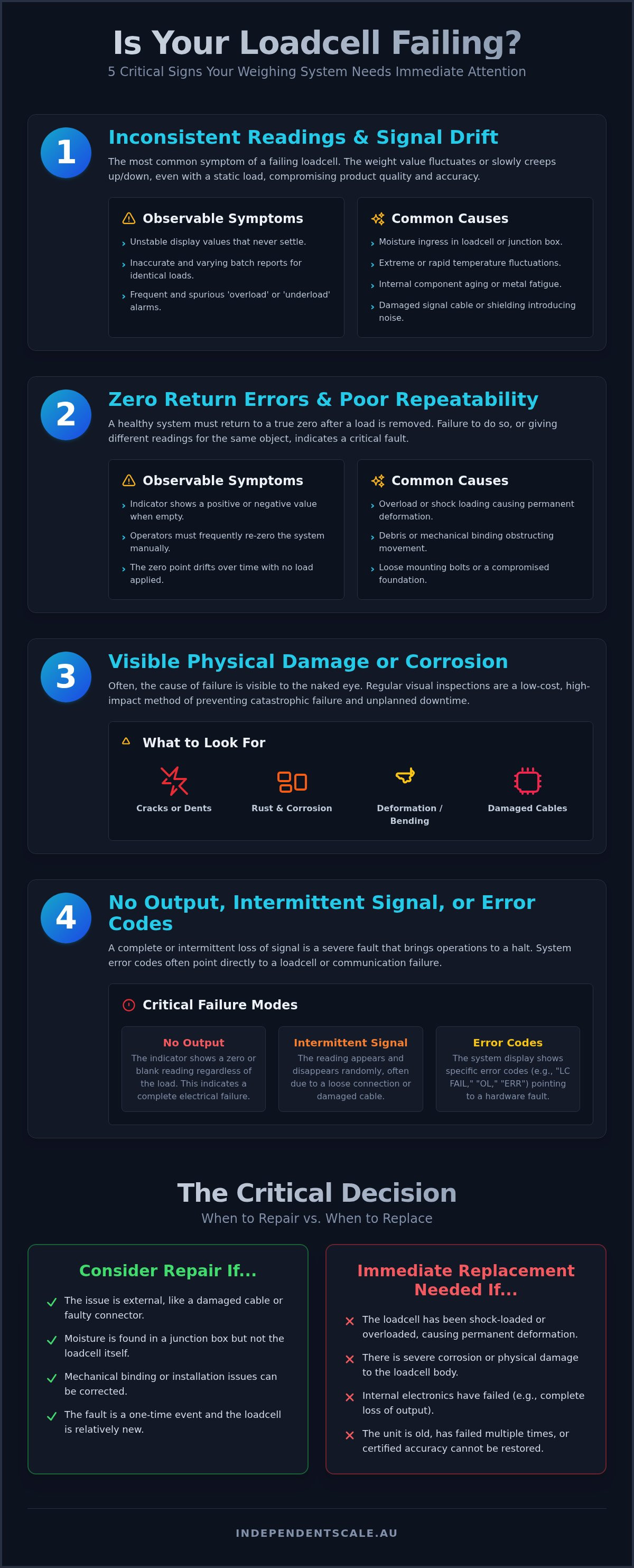
Sign 4: No Output, Intermittent Signal, or Error Codes
A complete absence of signal or an intermittent output is one of the most definitive signs of a critical weighing system failure. Unlike the gradual drifts in accuracy discussed previously, these symptoms indicate a significant electrical fault that can halt operations entirely. An intermittent signal may cause erratic and unpredictable readings, while a total loss of output renders the system useless. Modern weighing indicators will often display specific error codes, providing valuable diagnostic information to expedite repairs.
Diagnosing a 'No Output' Condition
A 'no output' condition typically presents as a blank indicator display, a static zero reading regardless of applied load, or a generic fault message. This often points to a catastrophic failure, such as a completely dead load cell or, more frequently, a severed or disconnected cable. Before assuming a major component failure, operators can perform essential preliminary checks to rule out simple issues.
- Check Power Supply: First, confirm the weighing indicator is receiving power and is switched on.
- Inspect Cabling: Visually inspect all accessible cables for physical damage like cuts, abrasions, or crushing from vehicle traffic or machinery.
- Verify Connections: Check that all connections within the summing junction box are secure and free from moisture or corrosion, which can interrupt the signal path.
Interpreting Error Codes
Modern digital indicators are designed to self-diagnose and will often display a specific error code when a fault is detected. Your first point of reference should always be the indicator's technical manual, which will define each code. These codes provide a direct path for efficient troubleshooting by a qualified technician.
Common codes often point to 'load cell mismatch,' which can identify a single faulty cell in a multi-cell system, or 'signal out of range,' indicating the signal is too high (overload) or too low (no signal). This information allows a technician to pinpoint the source of the problem with greater speed and precision, reducing diagnostic time on-site.
Whether your system displays a specific error or simply ceases to provide an output, the underlying cause is almost always an electrical fault requiring expert attention. For professional fault finding and repair of industrial weighing systems, the NATA-accredited technicians at Independent Scale Service are equipped to restore your system's operational integrity with minimal downtime.
The Critical Decision: When to Repair vs. Replace a Load Cell
Once a load cell fault has been identified, the next step is a critical cost-benefit analysis to determine the most commercially viable path forward. This decision requires weighing the initial expense of repair against the long-term reliability and speed of a full replacement. The optimal choice depends entirely on the nature of the fault, the type of load cell, and the operational cost of downtime.
Scenarios Favouring Load Cell Repair
Repair can be a highly cost-effective solution, particularly for high-value or specialised equipment. This option is most viable when the fault is external and does not compromise the core integrity of the cell. Consider repair when:
- The issue is with an external component like a damaged cable, connector, or a fault within an accessible summing box.
- The unit is a high-capacity (e.g., 50t+) or custom-designed loadcell where replacement costs are substantial.
- As a general guideline, if the total repair cost is significantly less than 50% of the price for a new, comparable unit.
When Replacement is the Best Option
In many situations, replacement provides greater certainty and minimises production delays. For common models, older units, or when structural integrity is in question, a new load cell is the superior choice. Replacement is strongly recommended if:
- There is clear physical evidence of overloading or shock loading (e.g., deformation), which can cause unseen metal fatigue.
- The hermetic seal has been breached, allowing moisture to enter and cause internal corrosion of sensitive strain gauges.
- The cost of system downtime during the repair assessment and process outweighs any potential savings.
- The load cell is an obsolete model, and certified replacement parts are no longer available.
The Role of Professional Diagnostics
An accurate diagnosis is essential to making the right financial decision. An experienced technician uses specialised diagnostic equipment to measure resistance and voltage outputs, definitively isolating the fault to the loadcell, cabling, or indicator. This expert analysis prevents the costly error of replacing a functional component. Before committing to a significant expense, ensure you have a clear understanding of the problem and all available options. Get a professional assessment and quote for your weighing system.
Your Next Step for Load Cell Integrity
Recognising the warning signs-from inconsistent readings and poor repeatability to visible physical damage-is the first step in preventing costly operational failures. A malfunctioning loadcell compromises not only accuracy but also safety and productivity, making a timely and informed decision between repair and replacement essential for your business continuity.
The expert team at Independent Scale Service brings over 30 years of industry experience to every diagnosis. As a NATA accredited facility to ISO/IEC 17025, we provide compliant, precise solutions designed to minimise your downtime. For immediate assistance, contact us for expert load cell diagnostics and emergency repair services. Our technicians provide 24/7 emergency support across Sydney and Melbourne.
Take decisive action today to maintain the integrity and compliance of your weighing systems.
Frequently Asked Questions About Load Cell Failures
What is the typical lifespan of an industrial load cell?
The operational lifespan of a high-quality industrial load cell is not fixed. While many can function for over a decade, longevity is determined by operating conditions. Factors such as consistent overloading, exposure to corrosive materials, shock loading, and moisture ingress significantly reduce service life. Regular inspection and adherence to the manufacturer's capacity ratings are essential for maximising the lifespan of your weighing equipment. Proper installation is the first critical step.
How often should my load cells be professionally calibrated?
For most industrial applications in Australia, professional calibration is recommended at least annually. However, for systems in high-use environments, critical process control, or subject to harsh conditions, a six-month interval is often necessary. Regular calibration by a NATA-accredited technician is not just for accuracy; it is a critical requirement for maintaining quality assurance standards and commercial compliance. It ensures your system performs to specification and identifies potential issues early.
Can a load cell be repaired on-site, or does it need to be sent away?
Minor external issues, such as damaged cabling or faulty connections at the summing box, can often be diagnosed and repaired on-site by a qualified technician to minimise downtime. However, internal damage to the strain gauge mechanism or a compromised hermetic seal cannot be repaired in the field. Such failures require the component to be sent to a specialised repair facility or, more commonly, replaced entirely to guarantee accurate and reliable performance.
What are the most common causes of premature load cell failure?
The most common causes of premature load cell failure are environmental and operational. These include electrical damage from power surges or lightning strikes, and mechanical overload from dropping weight onto the scale (shock loading). Other primary causes are moisture ingress due to seal failure, which corrodes internal components, and chemical damage in harsh processing environments. Incorrect installation, leading to non-axial loading, is also a significant factor in early failure.
If I replace a single load cell in a multi-cell system, do I need to recalibrate?
Yes, recalibration is absolutely essential. When you replace a single loadcell in a multi-cell system, the output characteristics of the new unit will differ slightly from the existing ones. This imbalance disrupts the entire system's accuracy. A full system calibration is required to properly corner-adjust the scale and ensure all cells are summed correctly. This procedure is critical for returning the weighing system to a compliant, accurate, and reliable state.
Is it possible for a load cell to be inaccurate without showing obvious signs?
Yes, a load cell can provide inaccurate readings without any obvious signs of failure. This phenomenon, known as 'drift,' occurs gradually over time due to factors like material fatigue, temperature fluctuations, or minor moisture ingress. The load cell continues to function but its output is no longer linear or repeatable. The only effective method to detect this degradation is through regular, precise calibration performed with certified test masses by an accredited technician.
