


Preventative Maintenance for Scales: A Technical Guide for Australian Industry
A single failed load cell due to moisture ingress can halt a high-volume concrete plant for over 4 hours, resulting in thousands of dollars in lost production and wasted materials. For Australian industrial operators, the margin for error is non-existent. You already know that accurate weighing is the backbone of your facility, yet reactive repairs continue to disrupt peak production cycles. Implementing a rigorous program of preventative maintenance for scales is the only way to shift from costly emergency fixes to predictable, high-performance output.
This technical guide provides the framework to eliminate unplanned outages and maintain strict AS 1379 compliance through a methodical approach. You'll learn how to protect your investment in expensive load cells and indicators by addressing technical vulnerabilities before they trigger an audit failure. We'll examine the critical inspection of summing circuits, the installation of surge arrestors, and the necessity of NATA-accredited calibration to ISO/IEC 17025 standards.
Key Takeaways
- Understand how a structured technical approach ensures your facility maintains strict AS 1379 compliance and operational reliability.
- Identify early warning signs of load cell fatigue and moisture ingress in summing circuits to prevent sudden electronic failure.
- Learn to mitigate the impact of debris buildup and thermal expansion on scale structures to maintain precision in harsh industrial environments.
- Implement a tiered schedule for preventative maintenance for scales to eliminate unplanned downtime and extend equipment service life.
- Discover how proactive maintenance serves as a critical prerequisite for passing NATA-accredited calibration and ISO/IEC 17025 audits.
What is Preventative Maintenance for Industrial Scales?
Preventative maintenance (PM) in an industrial weighing context is a scheduled regimen of technical inspections, cleaning, and adjustments designed to prevent equipment failure before it occurs. While a standard weighing scale might function for years in a domestic setting without attention, industrial units in high-volume sectors like mining and concrete batching face constant mechanical stress and environmental degradation. Preventative maintenance for scales shifts the focus from reactive repairs, which occur only after a system failure, to proactive technical oversight. This approach ensures accuracy remains within the strict tolerances required for commercial trade and structural safety.
In Australia, the concrete and mining industries rely on precise measurement to meet engineering specifications and export standards. For plants servicing major infrastructure projects, even a 0.5% deviation in aggregate or cement weight can result in a batch being rejected. Regular PM identifies issues like mechanical binding, moisture ingress in junction boxes, or worn load cell pivot points before they compromise the mix. It's an essential strategy for any facility where weighing accuracy directly dictates product quality and operational legality.
The True Cost of Scale Failure and Downtime
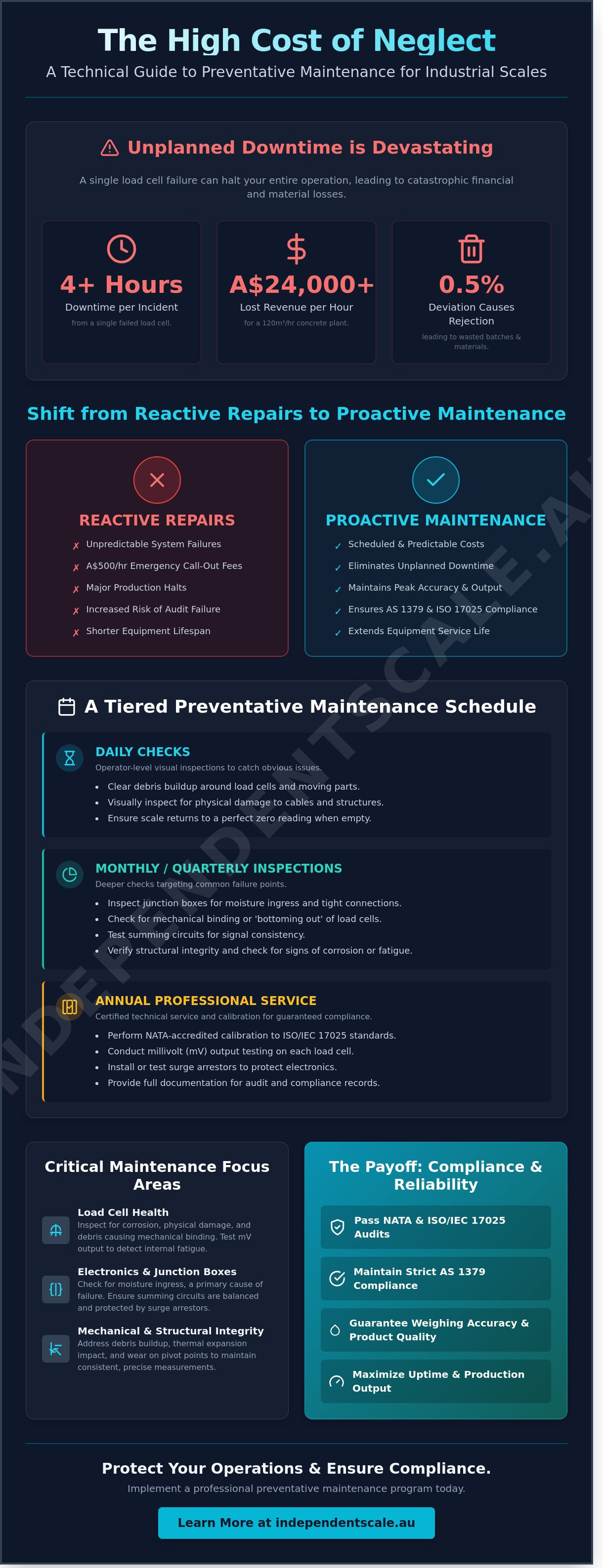
Downtime in a high-output concrete plant is measured in thousands of dollars per hour. If a plant producing 120 cubic metres per hour goes offline due to a scale fault, the loss in gross revenue exceeds A$24,000 per hour based on average market rates. Beyond lost time, erratic readings cause significant material waste. An over-reading scale might lead to "lean" mixes that fail strength tests, while under-reading wastes expensive cement powder. It's a risk that most Tier 1 contractors cannot afford to take.
The ROI of preventative maintenance for scales is realised by converting unpredictable A$500 per hour emergency 24/7 call-out fees into manageable, scheduled operational expenses.
Compliance Standards: AS 1379 and ISO 17025
Adherence to AS 1379 is a legal and contractual requirement for concrete production in Australia. This standard dictates the frequency and accuracy of plant calibrations to ensure structural integrity across the construction sector. NATA accreditation to ISO/IEC 17025 provides the technical validation required for these records to hold up under scrutiny during a government or private audit.
Documentation plays a critical role in passing third-party quality audits. A comprehensive PM program provides a paper trail of:
- Consistent weighing scale calibration records.
- Verification of gravimetric method accuracy.
- Evidence of technical competence and equipment reliability.
- Compliance with National Measurement Institute (NMI) standards for trade-use scales.
Without this documentation, a facility risks losing its certification and its ability to supply major infrastructure projects. Maintaining these records is as vital as the physical maintenance of the hardware itself.
Technical Components: Maintenance of Load Cells and Electronics
Load cells and electronic components form the critical core of any industrial weighing system. Neglecting these parts leads to measurement drift, non-linearity, and eventual system failure. Effective preventative maintenance for scales requires a systematic approach to inspecting these high-precision components to ensure they operate within specified tolerances.
Load Cell Health and Inspection
Visual inspections must identify corrosion or physical damage immediately. Mechanical binding occurs when debris, rust, or ice build-up restricts the load cell movement, causing significant weighing errors. Technicians must check for 'bottoming out' where the gap between the load cell and the mounting hardware is compromised. For detailed technical specifications on tolerances and device requirements, the NIST Handbook 44 serves as the primary industry reference for weighing device performance.
Testing the millivolt (mV) output ensures each cell in a multi-cell system remains balanced and consistent. A deviation of more than 0.2 mV from the manufacturer's zero-balance specification often indicates internal strain gauge fatigue or moisture ingress. Routine checks prevent the 15% drop in accuracy often seen in unmaintained outdoor scales. For more technical data, refer to our Guide to Industrial Load Cells to understand how these sensors behave under industrial stress.
Junction Boxes and Surge Protection
Summing circuits and junction boxes are highly vulnerable to moisture and dust ingress. In regional Australian environments, humidity and rapid temperature shifts cause condensation inside enclosures, leading to signal "ghosting" or erratic readings. Technicians must clean terminals and reseal boxes with high-quality gaskets or desiccant packs during every preventative maintenance for scales service interval.
Protecting electronics from electrical events is mandatory for maintaining site uptime. Australian regional sites frequently experience lightning strikes that can vaporise sensitive circuitry in milliseconds. Installing surge arrestors provides a sacrificial path for high-voltage transients, effectively shielding the main indicator. This protection is a cost-effective alternative to replacing an entire electronics suite after a storm.
Regularly verify the integrity of conditioners and transmitters within the control cabinet. Ensure all cable shielding is grounded at one end only to prevent ground loops. RFI (Radio Frequency Interference) from nearby heavy machinery or handheld radios causes signal fluctuations if cable shielding is compromised or frayed. Maintaining these components ensures your system remains compliant with standards like AS 1379. If you suspect your electronics are failing, book a professional weighing scale calibration to verify your system's accuracy and compliance.
Environmental and Mechanical Factors Affecting Accuracy
Environmental conditions often dictate the reliability of industrial weighing systems. Thermal expansion and contraction pose a constant challenge for large scale structures. A temperature shift of 10 degrees Celsius can cause steel components to expand enough to bind against safety stays or pits, leading to significant weighing errors. Preventative maintenance for scales must include a thorough inspection of these clearances to ensure the structure remains free to move.
Structural grounding is another technical priority. Without robust electrical grounding, static interference builds up within the system. This static disrupts the millivolt signals sent from load cells to indicators, causing the display to drift or lock up. Ensuring that all components are correctly bonded to a common earth point eliminates this interference and protects sensitive electronics from surge damage during electrical storms.
Debris Management and Cleaning Protocols
Material accumulation is a primary cause of mechanical binding in heavy industry. Debris buildup around tank and silo weighing assemblies creates a physical bridge that bypasses the load cells. This results in the scale under-reporting the actual weight.
Cleaning protocols should prioritise dry methods, such as industrial vacuums or brushes. High-pressure hosing is frequently detrimental to the system. Even when equipment is rated for moisture, high-pressure water can force its way past seals and into junction boxes or load cell internals. This leads to internal corrosion and premature failure. Maintenance teams should verify that all free-floating components have at least 15mm of clearance from surrounding structures to prevent material bridging.
Vibration and Structural Integrity
Mechanical noise from adjacent machinery often causes fluctuating weight displays. In 22% of industrial sites, vibration from nearby conveyors or crushers introduces enough signal noise to make accurate batching impossible. Identifying these sources is a critical step in preventative maintenance for scales.
Technicians must verify the stability of industrial weighing scales by checking that foundations are level and non-deflecting. This structural integrity is a requirement under OIML R 76-1, which governs the technical standards for weighing instruments. Key inspection points include:
- Checking mounting bolts for correct torque settings to prevent shifting.
- Inspecting shackle pins for grooves or flat spots that indicate uneven wear.
- Verifying that load cell mounts are plumb and square to the load.
- Ensuring anti-vibration pads are intact and haven't perished due to oil or chemical exposure.
Developing a Maintenance Schedule: Daily to Annual Tasks
Reliability in industrial weighing is achieved through a tiered maintenance strategy. You can't rely solely on annual visits to maintain accuracy under heavy use. A structured schedule ensures that minor issues, such as debris build-up or cable wear, are identified before they cause catastrophic failure. Effective preventative maintenance for scales requires clear delegation between on-site operators and NATA-accredited technicians.
- Daily: Operator-led verification and cleaning.
- Weekly: Supervisor inspections of mechanical integrity.
- Quarterly: Technical audits of electrical components and summing circuits.
- Annual: Full system recalibration and compliance certification.
Integrating these tasks into your digital management systems ensures accountability. Digital logs provide an audit trail that's critical for ISO/IEC 17025 compliance and internal quality control. When maintenance data is centralised, you can track performance trends and predict load cell failure before it occurs. Independent Scale Service has observed that plants using digital tracking reduce their unplanned downtime by up to 40% compared to those using paper logs.
The Daily and Weekly Checklist
Site personnel must be trained to conduct basic daily checks effectively. This starts with a zero-point verification. If the scale doesn't return to zero after a load is removed, it indicates mechanical binding or electronic drift. Operators should perform a simple weight test using a known mass to confirm immediate repeatability. Visual inspections are equally vital. Clearing visible debris from under the scale or around load points is a priority; even a small stone can cause significant weighing errors in a 100-tonne silo. Ensure cables and connectors show no signs of moisture ingress or physical damage from site machinery.
Professional Quarterly and Annual Inspections
While daily checks catch surface issues, professional audits involve in-depth electrical testing of the entire weighing string. ISS technicians measure the millivolt output of each load cell to identify internal fatigue that isn't visible to the naked eye. For industrial facilities, concrete batching plant calibration and repair is a mandatory requirement to meet AS 1379 standards. These inspections include full system diagnostics and indicator and display programming to ensure the software parameters match the physical hardware output.
Expert technicians use NATA-certified test masses to perform eccentricity tests and linearity checks. This level of precision is necessary for high-volume operations where a 1% error margin leads to significant material loss over a single shift. Don't wait for a breakdown to call for service. Establish a proactive preventative maintenance for scales schedule today. Book a professional calibration audit to ensure your equipment remains compliant and accurate.
Closing the Loop: Maintenance vs. NATA Calibration
Preventative maintenance for scales is not a substitute for NATA calibration. These two processes serve distinct but complementary functions within an industrial environment. Maintenance focuses on the physical health and mechanical integrity of the equipment. It involves deep cleaning, lubrication, and checking for structural wear. Calibration is the formal process of verifying that the scale's output matches a traceable standard. One ensures the machine works; the other ensures the numbers are legal and accurate.
You can't achieve a successful NATA accreditation test on a scale that's physically compromised. If debris or corrosion restricts the movement of the weighing platform, the calibration results will be inconsistent. Performing PM before the technician arrives ensures the scale is in peak condition to pass. Combining these services into a single visit is a strategic move. It reduces site disruption by up to 40% compared to scheduling separate visits, ensuring your equipment is both operational and compliant in a single window of downtime.
When Maintenance Uncovers a Fault
During a routine inspection, technicians often identify components nearing the end of their service life. The decision to repair or replace a load cell depends on its stability and age. If a cell shows significant zero drift or fails a bridge resistance test, replacement is the only way to maintain AS 1379 compliance. You must remember that calibration services are mandatory after any major component change. Replacing a load cell or a junction box alters the signal path, which immediately voids any existing NATA certificate.
- Component Integrity: We assess whether a repair provides a long-term solution or if replacement is more cost-effective for your specific duty cycle.
- Chain of Custody: Every adjustment or part replacement is documented. This creates a clear audit trail for quality assurance managers and external auditors.
- Compliance Security: Immediate recalibration after a repair ensures your business stays within the legal tolerances required for trade and safety.
Partnering with Independent Scale Service
Independent Scale Service brings over 30 years of technical experience to every site visit. We currently service 98% of concrete plants across Sydney, providing a level of industry-specific knowledge that general contractors can't match. Our team understands that equipment failure doesn't follow a 9-to-5 schedule. We provide a 24/7 emergency response for critical industrial failures to ensure your production lines stay active. Our expertise extends beyond standard scales into specialised areas like force gauge calibration and high-capacity hopper systems.
Our NATA accreditation to ISO/IEC 17025 is the highest level of technical recognition available. It protects your business by ensuring that all measurements are traceable to national standards. When we perform preventative maintenance for scales, we aren't just cleaning equipment. We're applying a methodical, technical approach to protect your accuracy and your bottom line. Trusting a NATA-accredited partner means your compliance is never in doubt.
Optimise Your Operational Accuracy and Compliance
Implementing a rigorous schedule for preventative maintenance for scales ensures your facility avoids costly downtime and maintains precision in harsh Australian environments. Protecting sensitive load cells from moisture and ensuring summing circuits remain debris-free are critical steps for any industrial site. While daily checks identify immediate mechanical issues, they don't replace the technical oversight required for long-term reliability. Compliance with AS 1379 is non-negotiable for concrete production; aligning your maintenance with NATA-accredited standards ensures every measurement stands up to audit.
Independent Scale Service brings over 30 years of technical expertise to your site. We're NATA Accredited to ISO/IEC 17025 and provide AS 1379 compliant services to ensure your equipment meets strict regulatory demands. If a critical failure occurs, our 24/7 emergency breakdown support is available to restore your operations immediately. Don't wait for a mechanical failure to disrupt your production schedule. Maintain your competitive edge with a system that's built to last.
Book a professional preventative maintenance audit for your site
Frequently Asked Questions
How often should industrial scales undergo preventative maintenance?
Industrial scales should undergo preventative maintenance at least every 6 months to ensure accuracy and operational compliance. High-volume facilities, such as concrete batching plants or waste transfer stations, often require quarterly inspections to mitigate heavy wear. For businesses operating under AS 1379 standards, the schedule is strictly defined by production volume. Regular servicing prevents the 15% increase in component failure rates typically seen in neglected equipment.
Can we perform our own scale maintenance or do we need a professional?
You can perform basic housekeeping like debris removal, but technical preventative maintenance for scales requires a NATA-accredited professional. Expert technicians possess the certified test weights and diagnostic tools needed to identify internal faults accurately. Attempting DIY repairs on complex summing circuits or load cell mounts often voids warranties. Professional intervention ensures your equipment meets ISO/IEC 17025 standards and remains legally compliant for trade use.
What is the difference between scale calibration and maintenance?
Scale calibration is the specific process of comparing a scale's output against a known standard to verify accuracy. Preventative maintenance involves physical tasks like lubricating pivots, checking surge arrestors, and inspecting structural integrity. While calibration identifies if a scale is out of tolerance, maintenance addresses the mechanical issues causing that drift. Both are essential components of a comprehensive reliability program for heavy industrial weighing systems.
What are the first signs that a load cell is beginning to fail?
The first signs of load cell failure include weight readings that drift when a static load is applied and an inability to return to zero. You might also notice non-repeatability, where the scale provides different results for the same weight. Physical indicators include cracked cable jacketing or corrosion on the cell body. These symptoms often precede a total system shutdown, which can cost facilities upwards of A$2,000 per hour in lost productivity.
How does AS 1379 affect the maintenance schedule of a concrete plant?
AS 1379 dictates that concrete batching plants must calibrate and maintain their weighing systems every 3 or 6 months, depending on production output. This Australian Standard ensures that chemical admixtures and aggregates are measured within strict tolerance limits. Failure to adhere to these intervals results in non-compliant concrete, leading to structural risks and potential project rejections. ISS services 98% of concrete plants in Sydney, ensuring they meet these rigorous regulatory requirements.
Does preventative maintenance help extend the life of my weighing equipment?
Preventative maintenance can extend the operational life of industrial scales by 5 to 10 years. By identifying moisture ingress or cable fatigue early, technicians prevent catastrophic failures that require full system replacements. Routine checks on surge arrestors protect expensive digital indicators from electrical spikes. This proactive approach ensures your capital investment remains functional and accurate well beyond the standard manufacturer warranty period.
What environmental factors cause the most damage to industrial scales?
Moisture and extreme temperature fluctuations cause 70% of premature scale failures in Australian industrial environments. High humidity leads to corrosion in junction boxes, while rapid heat changes affect the metal's expansion in load cells. Dust accumulation in pits can also create mechanical binding, which produces inaccurate readings. Protecting equipment from these elements through proper sealing and drainage is a core focus during every ISS service visit.
Is it necessary to maintain digital indicators as well as the load cells?
Maintaining digital indicators is just as critical as servicing load cells. These units house the sensitive electronics that process weight data and manage communication protocols. Technicians inspect internal batteries, tighten terminal connections, and update firmware to ensure seamless operation. Neglecting the indicator can lead to "ghosting" errors or display failures, even if the physical load cells are functioning perfectly.
