


Optimising Weighing Workflow in Warehouse Operations: A Technical Guide
Warehouse efficiency is fundamentally a hardware precision problem rather than a software limitation. While digital management systems are vital, they're only as reliable as the physical data they ingest. If your facility is plagued by shipping chargebacks and data discrepancies, the issue likely stems from how you're optimising weighing workflow in warehouse environments. Inconsistent measurements between physical stock and your WMS create immediate logistics bottlenecks that stall throughput and erode profit margins.
You're likely aware that even a minor margin of error in weight readings can lead to significant financial penalties and audit failures. We understand the pressure to maintain high-speed operations without sacrificing the NATA-certified accuracy required for regulatory compliance. This technical guide explains how to eliminate these bottlenecks by strategically integrating high-precision weighing hardware into your existing processes. We'll examine the deployment of ruggedised load cells and industrial scales to reduce manual handling time and ensure every shipment meets Australian standards. By focusing on hardware integration, you can achieve a seamless flow that keeps your operations compliant and your data accurate.
Key Takeaways
- Learn how strategic placement of measurement points reduces transit times and eliminates costly shipping surcharges caused by inaccurate data.
- Identify the specific industrial weighing hardware required for your facility, including the selection of ruggedised load cells for high-traffic floors.
- Understand the technical requirements for optimising weighing workflow in warehouse operations by integrating physical measurement points with digital WMS data.
- Establish a robust compliance framework through NATA-accredited calibration to meet ISO/IEC 17025 and 'Trade Approved' standards.
- Discover how professional hardware supply and on-site technical support solve critical logistics bottlenecks across major Australian industrial hubs.
The Role of Weighing in Modern Warehouse Efficiency
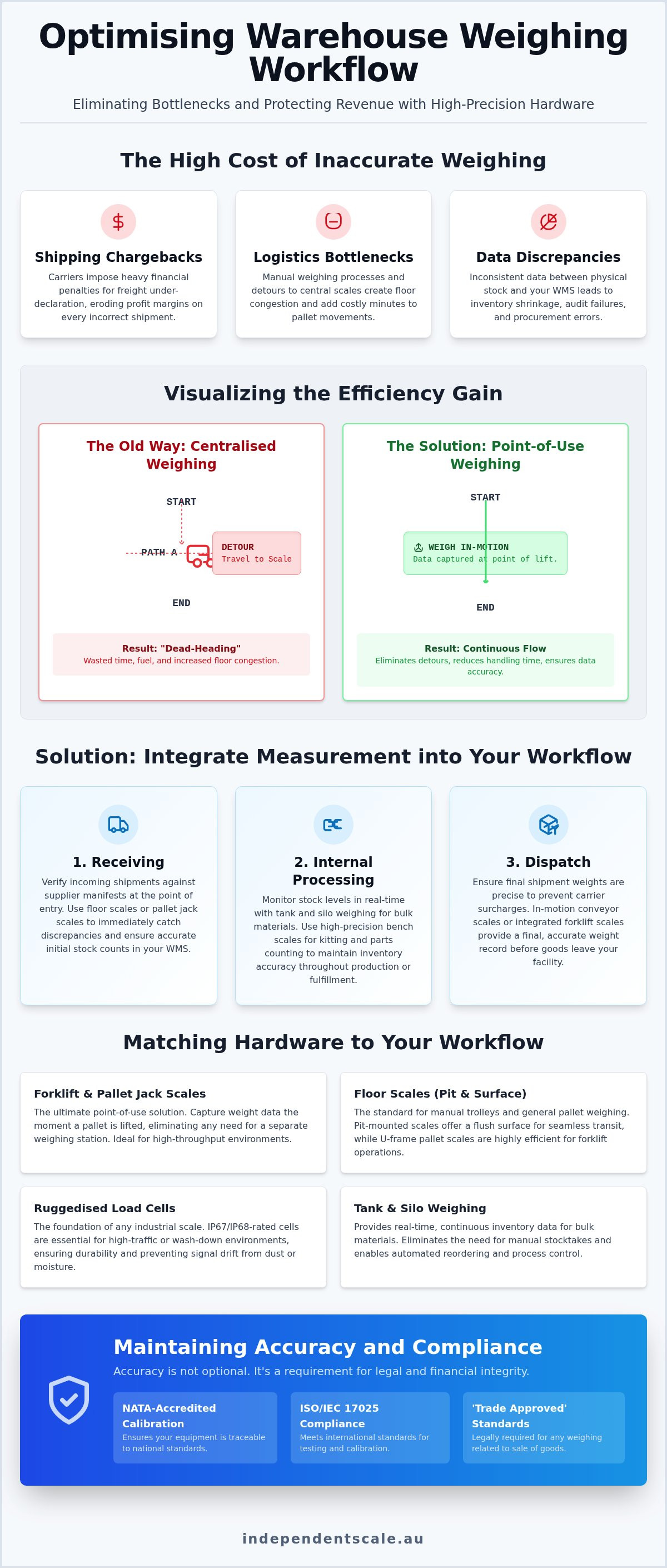
Efficiency in a high-throughput warehouse isn't just a digital challenge; it's a physical one. Optimising weighing workflow in warehouse operations requires the strategic placement of measurement hardware to reduce transit times and ensure data integrity. When weighing is treated as an afterthought, it becomes a literal roadblock. True optimisation means integrating weight capture into the natural movement of goods, rather than forcing stock to deviate from its path for measurement.
Inaccurate data, often called 'dirty data', carries a high price in industrial logistics. If your outbound weights are incorrect, you face immediate shipping surcharges from carriers who use automated dimensioning systems to verify freight. Internally, inconsistent data between physical stock and your WMS leads to inventory shrinkage and procurement errors. To maintain a lean operation, you must establish precise measurement points across three primary weighing zones: Receiving, Internal Processing, and Dispatch.
Modern facilities are increasingly moving away from static station weighing toward 'in-motion' solutions. While static scales are necessary for high-precision kitting, in-motion systems allow for data capture as items move along conveyors or are lifted by forklifts. This transition is essential for facilities handling high volumes where every second of dwell time impacts the bottom line.
Eliminating the Weighing Bottleneck
Manual weighing is a common friction point in many Australian warehouses. The most significant efficiency drain is 'dead-heading', where forklift operators must travel to a central floor scale, wait for a reading, and then return to their original path. This redundant movement wastes fuel, increases floor congestion, and adds minutes to every pallet movement. Point-of-use weighing solves this by bringing the scale to the stock. By utilising forklift scales or pallet jack scales, you capture weight data at the moment of lift, allowing for a continuous flow of goods without the need for dedicated weighing detours.
Data Accuracy and Revenue Protection
Precision measurement is your primary defence against freight under-declaration and the resulting financial penalties. Carriers are increasingly sophisticated in their auditing; they won't hesitate to apply back-charges if your declared weights don't match their bridge readings. High-quality industrial weighing scales are necessary for verifying bulk inventory and ensuring outbound accuracy. In Australian logistics, costs are calculated based on the greater of volumetric weight or actual weight, so having precise physical data is the only way to effectively control shipping expenditure. When you're optimising weighing workflow in warehouse environments, you're not just moving things faster; you're protecting your revenue through technical precision.
Hardware Selection: Matching Equipment to Workflow
Hardware selection is the decisive factor in optimising weighing workflow in warehouse environments. Even the most advanced WMS cannot compensate for physical sensors that are unfit for the operational environment. Selecting the wrong weighing interface creates friction, leading to operator workarounds and data inaccuracies. To build a resilient system, you must match hardware capabilities to the specific movement patterns of your goods, whether they are palletised, bulk, or moving on automated lines.
High-traffic warehouse floors demand ruggedised load cells designed to withstand constant impact and heavy machinery movement. In environments prone to dust or requiring wash-down procedures, IP-rated housing is mandatory. An IP67 or IP68 rating ensures that moisture and fine particles don't penetrate the sensor housing, which would otherwise cause signal drift or total hardware failure. For facilities managing bulk materials, tank and silo weighing assemblies allow for real-time inventory tracking without the need for manual stocktakes.
Pallet Scales vs. Floor Scales
Low-profile floor scales are the standard for facilities using manual trolleys or pallet jacks. While surface-mounted versions are common, they require ramps that can become trip hazards or forklift obstacles. Pit-mounted floor scales provide a flush surface for seamless transit but require more intensive installation. In contrast, U-frame pallet scales are highly efficient for forklift operations. Their open-frame design allows a forklift to place a pallet directly onto the weighing beams without ramps, significantly reducing cycle times. This level of precision is vital for digital-first suppliers like Liken who manage large volumes of agricultural supplements and rely on accurate dispatch data. For high-traffic areas, regular NATA-accredited calibration is essential to ensure that the constant vibration and impact of heavy loads haven't compromised the sensor's accuracy.
You don't always need to replace existing structures to achieve precision. Retrofitting existing hoppers, conveyors, or packing benches with high-quality load cells is a cost-effective method for optimising weighing workflow in warehouse settings. When selecting these components, you must determine the required accuracy class. C3 class load cells are sufficient for most industrial applications; however, C6 class sensors provide higher resolution for applications requiring extreme precision or trade-approved status. For overhead weighing and lifting, special purpose and shackle pins integrate measurement directly into the rigging, allowing for safe and accurate data capture during movement. Review our industrial weighing range to identify the correct hardware specifications for your specific facility layout.
Integration & Automation: Load Cells and WMS
Digital transformation in the warehouse is ineffective if it relies on manual data entry. Optimising weighing workflow in warehouse operations requires a robust bridge between physical load cells and your Warehouse Management System (WMS). The primary interface for this data is the indicator and display, which converts raw sensor signals into human-readable data and, more importantly, digital packets for network transmission. Without this seamless link, the precision of your hardware is lost in the friction of manual logging.
Transmitting this data accurately over long distances in an industrial setting requires specialised conditioners and transmitters. These components convert low-voltage analog signals from load cells into stable 4-20mA or digital outputs that a PLC or WMS can interpret. By automating this signal path, you eliminate the possibility of human transcription errors, which are a primary cause of inventory discrepancies. Wireless weighing systems further enhance safety by removing the need for physical cabling across high-traffic areas, effectively reducing trip hazards and simplifying facility reconfigurations.
From Analog Signal to Digital Insight
Signal conditioners play a critical role in noisy industrial environments where electromagnetic interference from motors and heavy machinery can degrade raw data. When integrating these systems, you must select the appropriate connectivity protocol. While RS232 remains a standard for local printer connections, Ethernet and Wi-Fi are preferred for facility-wide WMS integration. Ensuring compatibility between legacy weighing hardware and modern digital modules is essential for a unified data environment. This technical alignment allows for real-time stock visibility and immediate response to weight-based triggers in the supply chain, ensuring that optimising weighing workflow in warehouse settings remains a data-driven process.
Automating the Shipping Label Process
Integrating industrial scales directly with carrier software allows for instantaneous shipping label generation. When a pallet is weighed, the data is pushed directly to the dispatch module, reducing manual intervention to under 5 seconds per unit. To maintain the reliability of these integrated systems, you must use high-quality junction boxes and surge arrestors. These components protect sensitive electronics from power spikes and environmental damage, ensuring consistent uptime. By automating the data logging process, you secure your revenue through accurate freight declarations while protecting your investment in high-precision hardware. For those seeking to upgrade their dispatch stations with professional-grade printing hardware, visit OptiMediaLabs Canada for high-performance color label printers and finishing equipment.
Precision hardware and digital integration are only effective if the underlying measurements are accurate. In the context of optimising weighing workflow in warehouse operations, accuracy isn't a one-time setup but a continuous requirement. Australian law mandates that any scale used for commercial transactions must be 'Trade Approved', necessitating regular calibration services to maintain legal compliance. Failure to adhere to these standards exposes your business to regulatory penalties and potential litigation from customers or carriers over weight discrepancies.
Environmental factors in Australian warehouses, such as extreme temperature fluctuations and constant floor vibration from heavy machinery, cause unavoidable load cell drift. This drift is a gradual shift in the sensor's output that leads to measurement errors over time. While a standard check verifies that a scale is roughly accurate, only a NATA-accredited calibration provides the technical assurance and legal documentation required for high-stakes industrial audits.
To ensure a smooth service visit, follow this 5-step process for on-site calibration preparation:
- Clear Access: Ensure a 2-metre radius around the scale is free of stock and equipment.
- Surface Cleaning: Remove debris or build-up from under the scale platform or around load cell mounts.
- Power Stability: Verify that the indicator has a stable power source and has been switched on for at least 30 minutes to reach operating temperature.
- Documentation: Have previous calibration certificates and the asset register ready for the technician.
- Operational Downtime: Schedule the calibration during low-traffic periods to prevent workflow disruptions while the unit is out of service.
NATA Accreditation and ISO/IEC 17025
NATA accreditation is the definitive benchmark for technical competence in the Australian weighing industry. Using a non-accredited provider for your compliance audits introduces significant risk; their reports may not be recognised by regulatory bodies or during legal disputes. ISO/IEC 17025 is the international standard that specifies the general requirements for the competence, impartiality, and consistent operation of laboratories, ensuring that your calibration data is globally defensible. For guaranteed compliance, book a NATA-accredited weighing scale calibration today.
Developing a Calibration Schedule
The frequency of your calibration schedule should be dictated by usage volume and the harshness of the warehouse environment. High-throughput facilities weighing hundreds of pallets daily require more frequent professional intervention than low-volume kitting stations. We recommend a dual-layer approach: daily 'bump tests' performed by operators using a known test weight, supplemented by annual or bi-annual professional calibration. Maintaining a digital asset register for all weighing equipment is essential for tracking these intervals and ensuring no device falls out of compliance, which is a critical component of optimising weighing workflow in warehouse management.
Optimising Workflows with Independent Scale Service
Achieving a high-performance logistics environment requires more than a software-first approach. It demands the strategic deployment of NATA-calibrated hardware that integrates seamlessly with your physical movements. Independent Scale Service provides the technical expertise required for optimising weighing workflow in warehouse operations by combining high-precision hardware supply with rigorous calibration standards. We ensure your facility meets AS 1379 requirements and remains compliant with national trade regulations. Our approach focuses on the physical point of data capture, ensuring that every pallet, hopper, and conveyor provides accurate, defensible data to your management systems.
Expert Load Cell Supply and Repair
Maintaining a seamless workflow requires immediate access to replacement parts and expert repair capabilities. We maintain an extensive inventory of industrial load cells and indicators specifically selected for their durability in high-traffic environments. Equipment failure isn't just a technical issue; it's an operational crisis that leads to immediate logistics bottlenecks. Our technicians provide rapid fault diagnosis and on-site repair services to minimise client downtime and restore throughput. We also develop custom solutions for unique warehouse configurations where standard off-the-shelf hardware may not meet the specific spatial or capacity requirements of your packing line.
The Independent Scale Advantage
Our company has spent decades serving the Australian industrial sector, building a reputation for reliability and technical competence. The core differentiator for our clients is our NATA accreditation to ISO/IEC 17025. This accreditation serves as a constant stamp of authority, ensuring that our calibration services meet the highest international standards. We support national operations with on-site services across Sydney, Melbourne, and regional hubs, providing a unified compliance framework for businesses with multiple facilities. Our service range is comprehensive, encompassing everything from hopper calibration and silo maintenance to the precision tuning of complex batching systems.
Securing your revenue against shipping discrepancies and ensuring your operations survive rigorous audits requires a methodical approach to hardware maintenance. We provide the quantifiable proof points and technical documentation necessary to satisfy both regulatory bodies and corporate stakeholders. By focusing on hardware precision, you eliminate the "dirty data" that causes inventory shrinkage and freight surcharges. Optimise your warehouse weighing workflow today with Independent Scale Service by contacting our team for a technical consultation or a comprehensive on-site audit of your existing weighing infrastructure.
Securing Operational Precision and Compliance
Achieving sustained efficiency requires a methodical approach to both hardware selection and signal integration. By prioritising NATA-accredited calibration and ruggedised load cell technology, you eliminate the recurring logistics bottlenecks that lead to shipping surcharges and inventory discrepancies. Optimising weighing workflow in warehouse environments is fundamentally about ensuring the technical integrity of every data point within your WMS. This precision protects your revenue and ensures your facility remains compliant with Australian trade regulations.
Independent Scale Service provides the authoritative expertise needed to maintain AS 1379 compliance across Sydney, Melbourne, and regional Australia. Our technicians focus on delivering reliability and technical competence, ensuring your equipment meets the rigorous standards of ISO/IEC 17025. Don't let inaccurate measurements erode your profit margins or compromise your regulatory standing during a high-stakes audit. We're committed to minimising your downtime through responsive, expert service. Request a NATA-Accredited Calibration Quote to secure your facility's accuracy and throughput today. We look forward to supporting your industrial weighing requirements.
Frequently Asked Questions
How often should warehouse scales be calibrated for NATA compliance?
Frequency depends on usage volume and environmental factors, but annual NATA-accredited calibration is the industry standard for maintaining compliance. High-traffic facilities weighing hundreds of loads daily may require quarterly checks to combat sensor drift. In Australia, maintaining a schedule ensures you meet ISO/IEC 17025 requirements. This structured approach is a core part of optimising weighing workflow in warehouse operations, as it prevents the accumulation of measurement errors that lead to shipping surcharges.
What is the difference between a floor scale and a pallet scale for warehouse use?
Floor scales are large platforms installed flush with the ground or accessed via ramps, suitable for various load types. Pallet scales, specifically U-frame models, are designed for direct forklift access without the need for ramps. Using U-frame scales increases efficiency by allowing operators to drop and lift pallets in one motion. Choosing the correct hardware is essential for optimising weighing workflow in warehouse settings where floor space and transit speed are primary operational constraints.
Can I integrate my existing weighing scales into a new WMS?
Existing scales can be integrated into a new WMS by using modern indicators and digital transmitters. These components convert the analog signal from your load cells into a digital format compatible with your software via Ethernet, Wi-Fi, or RS232. This bridge allows for automated data logging and real-time inventory updates. Professional technical support is recommended to ensure your legacy hardware communicates effectively with new PLC or cloud-based management modules.
What are the common causes of load cell failure in a warehouse environment?
Physical impact from forklifts and moisture ingress are the most frequent causes of load cell failure. While ruggedised cells are durable, constant vibration and accidental overloading beyond the rated capacity can cause permanent deformation of the internal strain gauge. Electrical surges and lightning strikes also pose risks to integrated electronics. Using high-quality junction boxes and surge arrestors provides a necessary layer of protection for your measurement hardware in harsh industrial environments.
Do I need NATA-accredited calibration if I am not selling by weight?
NATA-accredited calibration is necessary even if you aren't selling by weight, as it provides a defensible audit trail for safety and quality standards. Compliance with ISO/IEC 17025 demonstrates technical competence and ensures that your internal inventory data is accurate. Without this accreditation, your measurements lack the formal verification required for high-stakes industrial audits. It also guarantees that your safety margins for lifting and storage remain within legal and engineering specifications.
How do I choose the right load cell capacity for my conveyor system?
Choosing the right capacity involves calculating the total dead load of the conveyor structure plus the maximum possible live load of the material. You should include a safety factor of at least 25% to 50% to account for dynamic forces and potential overloading. Selecting a capacity that is too high reduces resolution, while one that is too low leads to sensor damage. Consult with a technical expert to match the accuracy class to your throughput requirements.
What is the benefit of wireless weighing indicators in a logistics hub?
Wireless indicators significantly improve safety in a logistics hub by eliminating cables that create trip hazards for staff and forklifts. They offer greater flexibility for facility reconfigurations, as measurement points aren't tethered to fixed data ports. This technology allows operators to view weight data on mobile displays or remote terminals, improving visibility during the loading process. Reducing physical infrastructure also lowers maintenance costs associated with cable wear and accidental damage in high-traffic zones.
How does AS 1379 compliance affect weighing equipment in industrial plants?
AS 1379 specifies the requirements for the specification, production, and delivery of concrete, which directly impacts weighing accuracy in batching plants. Compliance requires that all scales and dispensers are calibrated to strict tolerances by a NATA-accredited provider. This ensures that every batch meets the engineered strength and durability standards required for Australian construction. Regular professional calibration is mandatory to maintain this certification and avoid the significant costs associated with non-compliant structural materials.
