


NATA Calibration Services: The Definitive Guide for Australian Industry
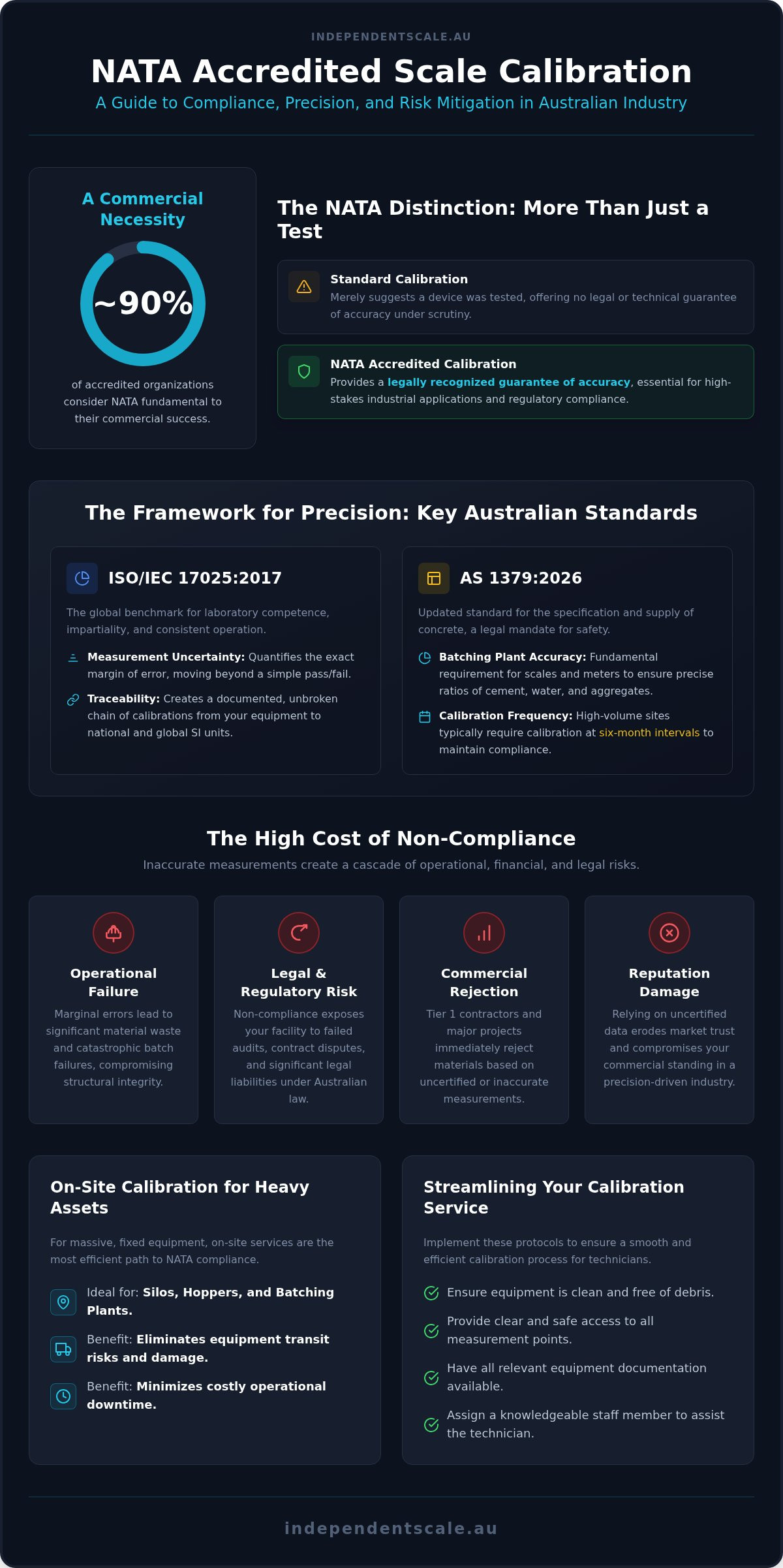
Nearly 90% of accredited organizations in Australia consider NATA accreditation fundamental to their ongoing commercial success. For industrial operations requiring NATA accredited scale calibration Sydney, this certification represents the thin line between operational excellence and costly regulatory failure. You recognize that even a marginal error in measurement leads to significant material waste and the immediate risk of audit non-compliance. Inaccurate data doesn't just disrupt your workflow; it compromises your legal and commercial standing in a competitive market where precision is the primary currency.
This definitive guide explains how NATA accredited calibration ensures your weighing equipment meets the rigorous demands of ISO/IEC 17025:2017 and the newly updated AS 1379:2026 standards. We'll detail the technical necessity of certified accuracy for load cells and batching plants while providing a clear roadmap for achieving total compliance without excessive downtime. You'll discover how to secure your measurement infrastructure against the risks of inaccuracy and legal exposure, ensuring your facility remains productive and fully protected under Australian law.
Key Takeaways
- Verify compliance requirements for ISO/IEC 17025:2017 and the newly published AS 1379:2026 to ensure total regulatory alignment for your facility.
- Secure your commercial and legal interests by utilizing NATA accredited scale calibration Sydney for all critical industrial weighing equipment and measurement systems.
- Evaluate the efficiency of on-site calibration services for massive assets such as silos, hoppers, and batching plants to eliminate transit risks and minimize downtime.
- Reduce operational disruption by implementing specific equipment preparation protocols that streamline the calibration process for field technicians.
- Leverage specialized expertise in load cell repair and supply to maintain the long term integrity of your measurement infrastructure beyond standard calibration cycles.
What are NATA Calibration Services and Why are They Critical?
The National Association of Testing Authorities (NATA) is the sole body in Australia responsible for the accreditation of laboratories and inspection bodies. While many service providers offer generic calibration, only those with NATA accreditation have undergone rigorous, independent assessments to prove their technical competence. For businesses requiring NATA accredited scale calibration Sydney, this distinction is vital. A standard calibration report merely suggests a device was tested. A NATA-endorsed report provides a legally recognized guarantee of accuracy that is essential for high-stakes industrial applications. It's the only way to ensure your data holds up under intense regulatory scrutiny.
Traceability and the ISO/IEC 17025 Framework
NATA accreditation is governed by the ISO/IEC 17025:2017 standard, which sets the global benchmark for laboratory operation. This framework ensures that every measurement is technically valid and impartial. A critical element of this process is the calculation of measurement uncertainty. Rather than providing a simple pass or fail, NATA-endorsed reports quantify the exact margin of error at specific test points. This level of detail is crucial for maintaining the hierarchy of measurement standards from global SI units down to your specific factory floor. In the context of Australian metrology, traceability is the property of a measurement result whereby the result can be related to a reference through a documented unbroken chain of calibrations, each contributing to the measurement uncertainty.
The Cost of Non-Compliance in Heavy Industry
Meeting Australian Standards: AS 1379 and Beyond
Compliance with Australian Standards isn't optional for heavy industry; it's a legal mandate that ensures safety and structural integrity. The Commonwealth government recognition of NATA as the sole national accreditation body establishes the legal weight of a NATA-endorsed certificate. For projects across New South Wales, obtaining NATA accredited scale calibration Sydney is the primary method for demonstrating adherence to rigorous national frameworks. This is especially critical for the concrete industry, where the recent publication of AS 1379:2026 on May 22, 2026, has introduced updated requirements for the specification and supply of concrete.
Calibration for Concrete Batching Plants
Under AS 1379:2026, the accuracy of scales and liquid meters in a batching plant is a fundamental requirement for structural safety. The chemical properties of concrete depend entirely on the precise volumetric and gravimetric ratio of cement, water, and aggregates. Any deviation in these measurements can lead to batch rejection or, worse, long-term structural failure. High-volume production sites typically require calibration at six-month intervals to maintain compliance and avoid costly operational delays. Professional concrete batching plant calibration ensures your facility meets these stringent criteria consistently. Using NATA accredited scale calibration Sydney providers guarantees that your batching results are traceable to national standards, providing a robust defense during technical audits. You can find more details on these protocols in our Calibration Services: The Authoritative Guide.
Force Gauge and Load Cell Compliance
Accuracy in construction extends beyond simple weighing into the technical domain of force metrology. Testing machines used for tension and compression must adhere to AS 2193 to ensure they provide valid data for safety-critical components. This necessitates specialized calibration for force gauges and high-capacity load cells used in tension testing. When these components are integrated into lifting systems or structural monitoring rigs, traceable calibration acts as a primary defense against liability. If you're currently operating without a NATA-endorsed certificate for your force equipment, your data may be inadmissible in a contract dispute. We suggest reviewing your current load cell calibration status to ensure your safety margins are technically verified and legally sound.
On-Site vs. Lab Calibration: Choosing the Right Approach
New South Wales currently houses 41% of all NATA-accredited facilities in Australia, reflecting the high demand for specialized technical services in the region. When scheduling NATA accredited scale calibration Sydney, the primary decision is whether to perform testing in a controlled laboratory or at your operational site. This choice is dictated by the physical scale of your equipment and the specific precision requirements of your industry. While laboratories offer the most stable environments, the logistical reality of heavy industry often makes on-site service the only viable path for maintaining continuous production.
The On-Site Calibration Process
For massive infrastructure such as hoppers and silos, transporting equipment to a lab is physically impossible. On-site calibration solves this by bringing certified reference masses and master load cells directly to your facility. This approach is the most effective way to minimize downtime for plants in Sydney and Melbourne, as it eliminates the need for equipment removal and transit. Field technicians perform in-situ testing to ensure that the entire weighing system, including the mounting assembly and digital integration, functions correctly under real-world conditions.
Technical competence in the field requires strict management of environmental factors that are absent in a lab setting. Our technicians specifically account for:
- Wind loading effects on tall outdoor structures.
- Ground or structural vibrations from nearby heavy machinery.
- Temperature-induced drift in sensitive electronic components.
Accounting for these variables ensures that your field results maintain the technical integrity required for compliance, as detailed in our Industrial Weighing Scale: The Complete Guide.
When to Opt for Laboratory Calibration
Laboratory calibration remains the gold standard for portable instruments that require the lowest possible measurement uncertainty. Precision indicators and displays and high-accuracy force metrology tools are best serviced in a climate-controlled facility. The National Association of Testing Authorities (NATA) enforces strict laboratory standards for temperature and humidity, which are essential for calibrating instruments to the highest levels of accuracy. While this method involves shipping logistics and temporary equipment absence, it's necessary for master instruments used to verify other site equipment. For most heavy industrial applications, however, NATA accredited scale calibration Sydney performed on-site provides the necessary balance of certified accuracy and operational efficiency.
How to Prepare for a NATA Calibration Service
Preparation is the most effective way to minimize the time a technician spends on your site. When you organize your facility before the service begins, you significantly reduce the billable hours required and prevent unnecessary production delays. For industrial facilities requiring NATA accredited scale calibration Sydney, a methodical approach to site readiness ensures the testing process remains efficient and technically sound. A technician's primary role is to verify accuracy, not to perform basic housekeeping or mechanical repairs that should have been addressed during routine maintenance.
Safety and access are paramount. Technicians require clear, unobstructed paths to all weighing points and sufficient space to deploy reference masses. If your equipment is integrated into a larger automated system, ensure that your maintenance team is available to isolate the specific units for testing. This prevents accidental material discharge and ensures the technician can work safely within your operational environment. Gathering previous calibration reports and maintenance logs beforehand also allows the specialist to identify long term drift patterns or recurring mechanical issues.
Step-by-Step Pre-Calibration Checklist
Follow these specific steps to ensure your equipment is ready for a NATA-endorsed inspection:
- 1. Mechanical Inspection: Check for physical damage, excessive wear, or binding in the mounting hardware. Address these issues before the calibration date to avoid a failed result.
- 2. Environmental Cleaning: Clear all debris, buildup, or spilled material from around tank and silo weighing assemblies. Foreign material can create "shunts" that cause significant weighing errors.
- 3. Power and Signal Verification: Confirm that all indicators and transmitters are powered on and functioning. Electronic components should be warmed up for at least 30 minutes prior to testing.
- 4. Strategic Scheduling: Plan your NATA accredited scale calibration Sydney during low-production windows to minimize the impact on your supply chain.
Understanding Your NATA Calibration Report
Once the service is complete, you'll receive a NATA-endorsed report. This document is a critical piece of evidence for ISO audits and regulatory inspections. You must specifically review the 'As Found' data, which shows the equipment's accuracy before any adjustments. This data is vital for assessing the validity of previous production batches. The 'As Left' data confirms the final accuracy of the machine after our technician has performed necessary spans and linearizations. Every report includes a statement of measurement uncertainty, which quantifies the technical confidence in the results. Proper filing of these reports is a mandatory requirement for maintaining your compliance status under Australian law. To ensure your equipment remains within these strict tolerances, book your next calibration service with our technical team today.
Independent Scale Service: Your Partner in NATA Compliance
Independent Scale Service is the technical authority for heavy industrial weighing across Australia. We provide more than just a certificate; we offer a partnership built on technical competence and regulatory assurance. As a primary provider for NATA accredited scale calibration Sydney, we understand that our clients operate in high-pressure environments where equipment failure is not an option. Our service coverage extends across Sydney, Melbourne, and regional industrial hubs, ensuring that Tier 1 contractors and infrastructure projects have access to certified metrology expertise whenever and wherever it is required.
Our capabilities go beyond standard testing protocols. We specialize in both NATA calibration and professional load cell repair, allowing us to diagnose and resolve mechanical or electronic faults during the service cycle. This integrated approach prevents the need for multiple service visits and secondary call-out fees. For logistics and transport sectors, our deep understanding of weighbridge systems ensures that large-scale measurement assets remain compliant with national trade and safety regulations. We don't just identify inaccuracies; we provide the technical solutions to correct them.
Expertise in Concrete and Construction Metrology
Our role as an industry partner includes the supply and installation of high-quality hardware designed for harsh environments. We stock and install special purpose pins and accessories that are engineered for durability in silo and hopper applications. If your system exhibits intermittent errors or signal drift, our diagnostic services for faulty load cells and indicators provide the data necessary for informed repair or replacement decisions. We ensure that every component of your weighing infrastructure, from the physical mounting to the digital output, meets the highest standards of precision. To secure your facility's compliance, Contact Independent Scale Service for NATA Accredited Calibration and professional technical support.
Secure Your Industrial Compliance and Precision
Maintaining the technical integrity of your weighing equipment is a continuous operational requirement. Accuracy is non-negotiable. Implementing a regular schedule for NATA accredited scale calibration Sydney provides the necessary legal protection and commercial assurance required for Tier 1 infrastructure and mining projects. By aligning your facility with ISO/IEC 17025:2017 and the updated AS 1379:2026 standards, you eliminate the risks of audit failure and significant material waste. Reliable data is the only foundation for sustainable industrial growth.
Independent Scale Service is a dedicated partner for heavy industry. We offer specialist expertise in load cell repair and on-site calibration for massive assets like silos and concrete batching plants. We serve Sydney, Melbourne, and regional Australia with a focus on technical proficiency and the urgent minimization of client downtime. Our NATA accredited technicians ensure your measurement data remains traceable, accurate, and legally sound under all operational conditions. We look forward to helping you maintain the highest standards of accuracy in your facility.
Book Your NATA Accredited Calibration Service Today
Frequently Asked Questions
What is the difference between NATA calibration and standard calibration?
NATA calibration is performed by a laboratory accredited to ISO/IEC 17025, providing a guaranteed level of technical competence and traceability. Standard calibration is often a simple comparison against a reference without the same level of independent audit or legal standing. For NATA accredited scale calibration Sydney, the endorsement on the report signifies that the results are internationally recognized and legally robust, making it the only choice for high-stakes industrial compliance.
How often does industrial weighing equipment need NATA calibration?
The frequency depends on your specific industry standard and usage intensity. For concrete production, AS 1379:2026 typically requires calibration every six months to maintain structural integrity standards. Other industrial applications may follow a 12-month cycle. Factors such as environmental conditions, mechanical wear, and the criticality of the measurement should dictate your specific interval. Regular testing ensures that measurement drift is identified before it impacts production quality or compliance status.
Can NATA calibration be performed on-site at a concrete batching plant?
Yes, on-site calibration is the standard procedure for massive infrastructure like batching plants, silos, and hoppers. Technicians bring certified reference masses and master load cells to your facility to perform testing in the actual operational environment. This approach is essential for identifying errors caused by structural binding or vibration that wouldn't be visible in a laboratory setting. It also minimizes downtime by eliminating the need for equipment removal and transit.
What happens if my equipment fails a NATA calibration test?
If a device fails, it must be adjusted or repaired until it meets the required accuracy specifications. Our technicians perform 'As Found' testing to document the initial error, followed by 'As Left' testing after the necessary span adjustments or linearizations are complete. If mechanical failure prevents successful calibration, we provide diagnostic services and load cell repair to restore the system to a compliant state before issuing the final endorsed report.
Is NATA calibration mandatory for AS 1379 compliance?
AS 1379:2026 mandates that weighing and measuring equipment must be calibrated by an authority acceptable to the purchaser or regulatory body. In the Australian industrial landscape, NATA accreditation to ISO/IEC 17025 is the recognized benchmark for this requirement. Utilizing NATA accredited scale calibration Sydney ensures that your concrete batching data is technically valid and legally defensible during audits by Tier 1 contractors or government agencies. It provides the necessary verification for structural safety.
How long does a typical NATA calibration service take for a silo?
A standard silo calibration generally takes between two to four hours per unit, depending on site access and the complexity of the weighing assembly. This timeframe includes the setup of reference equipment, multiple test cycles to check linearity and repeatability, and the documentation of results. Providing clear access and ensuring the silo is empty before the technician arrives will streamline the process and reduce the total time spent on-site, allowing you to resume operations quickly.
Do I need to calibrate my load cells if they are brand new?
Yes, new load cells require calibration once they are installed in their final mounting assembly. While a manufacturer provides a factory certificate, this doesn't account for the mechanical influences of your specific silo, hopper, or platform. In-situ calibration verifies that the entire system, including the mounting hardware and digital indicators, provides accurate results. This initial calibration establishes the baseline for all future compliance and maintenance tracking, ensuring your system starts with certified accuracy.
What information is included in a NATA-endorsed calibration report?
A NATA-endorsed report includes the unique accreditation number of the laboratory and a detailed statement of measurement uncertainty. It lists 'As Found' and 'As Left' data points, the specific standards used for the test, and the environmental conditions during the procedure. The document also contains a formal statement of compliance with relevant standards such as ISO/IEC 17025 or AS 1379, providing the technical evidence required for regulatory inspections and commercial contracts.
