


Mobile Calibration Services Victoria: Industrial Accuracy & Compliance
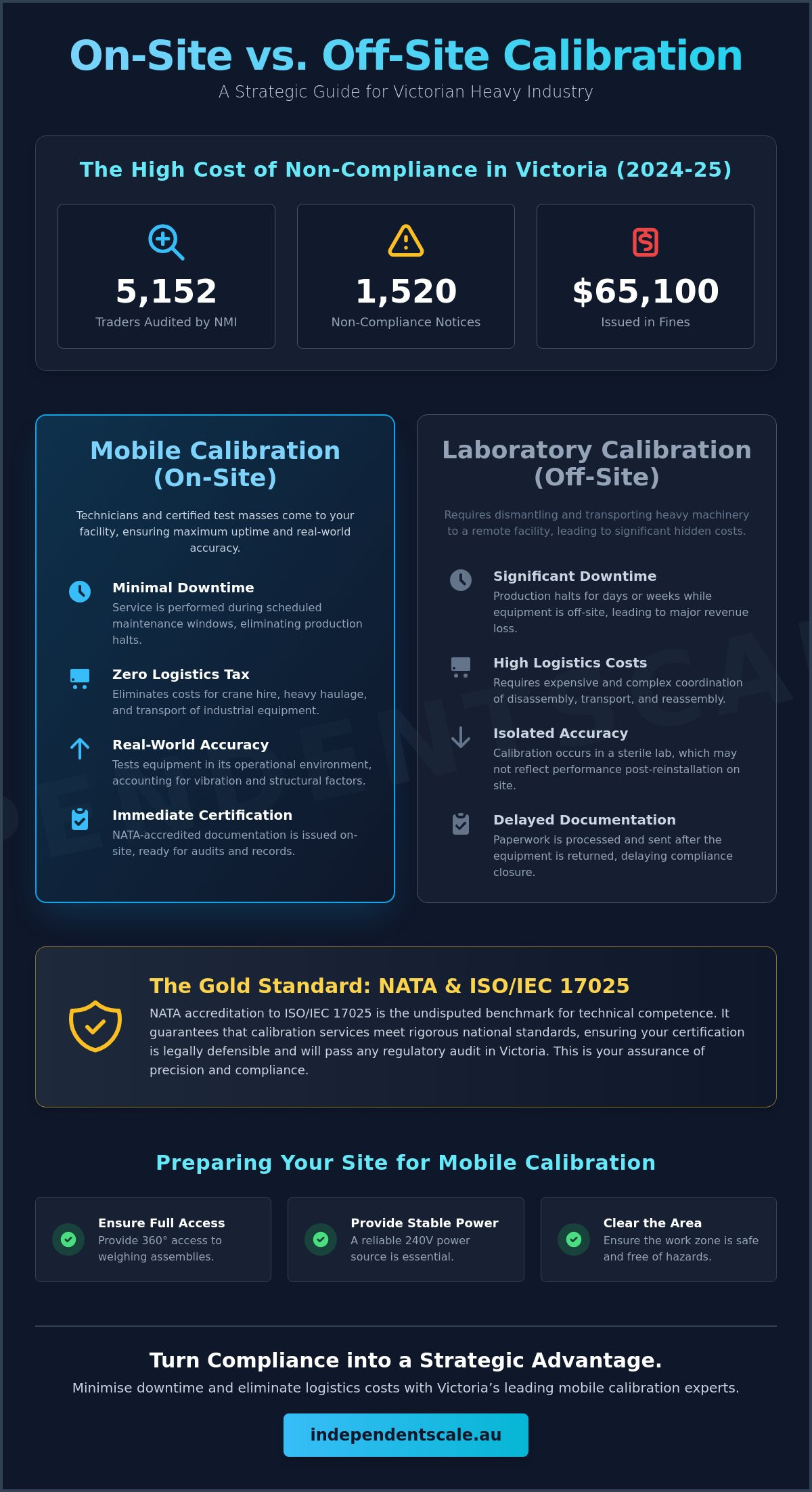
During the 2024-2025 financial year, the National Measurement Institute (NMI) audited 5,152 traders and issued 1,520 non-compliance notices, resulting in $65,100 in fines. These figures highlight a critical reality for Victorian heavy industry: compliance isn't optional, but the downtime usually associated with it should be. You shouldn't have to halt production or pay high logistics costs to transport heavy weighing machinery to a laboratory for testing. By leveraging professional mobile calibration services Victoria, you maintain operational continuity while meeting the strict technical requirements of ISO/IEC 17025:2017.
We understand that accurate load cell performance and NATA-accredited certification are the backbone of your facility's integrity. This article demonstrates how on-site calibration transforms a regulatory burden into a strategic advantage for concrete batching plants, hoppers, and silos. You'll discover the specific methods used to ensure zero-interruption compliance and how NATA-endorsed audits protect your business from the rising tide of regulatory scrutiny. We'll also examine how these services minimize logistical risks while maintaining the high-level accuracy required for industrial weighing systems.
Key Takeaways
- Understand why NATA accreditation to ISO/IEC 17025 is the essential gold standard for passing industrial audits and ensuring technical competence in Victoria.
- Compare the efficiency of on-site testing against traditional laboratory calibration to eliminate the high logistical costs of decoupling heavy tank and hopper assemblies.
- Learn how mobile calibration services Victoria minimize production halts by providing rapid, on-site verification of industrial weighing systems.
- Identify critical site requirements, such as 360-degree equipment access and stable 240V power, needed for a successful and efficient calibration visit.
- Discover the specific compliance protocols required under AS 1379 for Victorian concrete production and how accurate calibration supports these industry standards.
What are Mobile Calibration Services and Why Do They Matter in Victoria?
What are Mobile Calibration Services refers to the on-site testing, adjustment, and verification of weighing equipment using NATA-traceable standards. In the Victorian context, these services are essential for supporting the state’s massive infrastructure projects and manufacturing hubs. Mobile calibration services Victoria provide the technical accuracy required for high-capacity systems without the need to dismantle and transport equipment to a remote laboratory. This methodology ensures that every load cell and indicator is tested under actual operating conditions.
- Elimination of the "logistics tax" associated with transporting heavy hoppers, silos, and batching equipment.
- Verification of weighing systems in their specific environmental context, accounting for vibration and structural deflection.
- Immediate issuance of NATA-accredited documentation for Victorian site audits and compliance records.
- Servicing 98% of concrete plants across major industrial corridors, ensuring regional and metropolitan availability.
Inaccurate weighing leads to more than just bad data; it creates significant safety risks and financial liability. In Victoria’s construction sector, a 2% error in a batching plant's weighing system can compromise the structural integrity of a multi-million dollar project. Mobile calibration mitigates these risks by providing precise, on-site adjustments that keep your facility within legal and technical tolerances.
The Logistics of On-Site Accuracy
Technicians transport certified test masses directly to Melbourne metropolitan areas and regional Victorian sites. This approach ensures that hopper calibration and silo testing are performed while the equipment is fully integrated. Mobile units carry specialized diagnostic tools to maintain environmental controls for sensitive indicators and displays during the testing process. A seasoned technician doesn't just check numbers. They diagnose whether a weighing error stems from a mechanical binding issue in tank and silo weighing assemblies or a technical failure in the summing circuits and surge arrestors. This level of on-site expertise prevents the "logistics tax" of crane hire and heavy haulage transport that laboratory calibration requires.
Economic Impact of Downtime
For a concrete batching plant in Melbourne, halting production for off-site calibration is a significant revenue killer. When equipment is sent to a lab, the combined cost of transport and lost production hours creates a massive financial gap. Mobile calibration services Victoria solve this by performing high-precision work during scheduled maintenance windows. Maintaining AS 1379 compliance ensures every cubic meter of concrete meets the specified mix design, protecting the contractor from costly rework. Mobile calibration is a throughput-preservation strategy that aligns technical compliance with industrial productivity.
Technical Standards: NATA, ISO 17025, and AS 1379 in Victoria
Adherence to rigorous technical standards is the only way to ensure industrial weighing data stands up to legal and commercial scrutiny. For Victorian operators, mobile calibration services Victoria must provide a clear chain of traceability back to national primary standards. Without this link, a calibration certificate is merely a piece of paper with no standing in a court of law or a NATA audit. Technical competence is verified through NATA accreditation, which confirms that a facility or mobile lab meets the requirements of ISO/IEC 17025:2017.
Traceability ensures every gram measured on your site is accounted for. This is achieved by using certified test masses that have been compared against higher-level standards. When a Victorian compliance officer inspects your facility, they look for specific markers in your documentation:
- The NATA endorsement logo and accreditation number.
- The specific uncertainty of measurement for each test point.
- Evidence of environmental monitoring during the calibration process.
- A clear statement of compliance with relevant Australian Standards.
Understanding ISO/IEC 17025
ISO/IEC 17025 is the international standard for testing and calibration laboratories. It's more than a quality management system; it's a guarantee of technical proficiency. Victorian government contracts and major infrastructure projects, such as the North East Link, strictly require NATA-accredited weighing data to ensure material quality. Independent Scale Service maintains this accreditation to provide expert load cell calibration that meets these high-stakes requirements. A standard calibration might check if a scale is "close enough," but an ISO 17025 service quantifies the exact performance and reliability of the instrument.
AS 1379 and the Victorian Concrete Industry
AS 1379, the standard for the specification and supply of concrete, mandates strict accuracy for all batching components. This includes not just the aggregate and cement, but also chemical admixtures and water. In the Victorian concrete industry, the accuracy of these measurements is vital for mix consistency and structural performance. Plants must adhere to specific calibration intervals, often every 6 months, to remain compliant. Utilizing specialized concrete batching plant calibration services ensures that your weighing systems meet these exact tolerances. Accurate admixture weighing is particularly critical, as even a 1% deviation can significantly alter the set time or strength of a concrete batch. If your plant is nearing its next audit window, you can book a compliance check to verify your system's performance against current Australian Standards.
Mobile vs. Laboratory Calibration: Which is Best for Your Site?
Choosing between mobile and laboratory calibration is a decision that directly impacts your facility's operational uptime and bottom line. Laboratory calibration often requires a lead time of 7 to 14 days, including transit. In contrast, mobile calibration services Victoria deliver results in minutes or hours. For heavy industrial equipment, the time lost during shipping is rarely justifiable. On-site technicians perform the work while your systems remain in place, allowing for immediate re-integration into your production workflow.
The logistical complexity of laboratory testing is a significant hidden cost. Decoupling massive tank assemblies or removing load cells from a silo involves specialized labor and often requires crane hire. On-site testing eliminates these expenses entirely. Technicians also account for environmental factors specific to regional Victoria, such as wind loads and structural vibrations. These variables are impossible to replicate in a sterile laboratory environment, meaning on-site results often provide a more accurate representation of how your equipment performs under real-world stress.
- Turnaround: On-site takes hours; Lab takes weeks.
- Logistics: Mobile eliminates the need for decoupling and heavy haulage.
- Accuracy: On-site accounts for local vibration and environmental interference.
- Cost: A call-out fee is typically a fraction of the revenue lost during a week of downtime.
When On-Site is Essential
High-capacity systems like hoppers, silos, and weighbridges are practically impossible to move without significant structural intervention. On-site service is the only viable path for these assets. This is especially true for integrated systems where indicators and displays are hardwired into complex plant PLC networks. Disconnecting these components risks electrical faults or software communication errors upon reassembly. Emergency 24/7 responsiveness further underscores the value of mobile units; when a batching plant fails at 2:00 AM, waiting for a lab is not an option.
The Limitations of Laboratory Calibration
A major risk of laboratory calibration is "re-installation drift." Even if a load cell is perfectly calibrated in a lab, the vibration and physical shocks experienced during transit back to your site can alter its sensitivity. Furthermore, lab technicians cannot perform situational testing. They don't see how your specific tank/silo weighing assemblies react when the vessel is at 90% capacity or how thermal expansion affects the mounting hardware. Shipping heavy industrial components also introduces a logistical nightmare of insurance and potential damage. Mobile calibration services Victoria bypass these risks by verifying the entire weighing string, from the physical load point to the final digital readout, in its permanent location.
Preparing Your Victorian Site for Mobile Calibration: A 5-Step Checklist
The efficiency of mobile calibration services Victoria relies heavily on site readiness. While mobile labs bring the necessary technical expertise to your doorstep, lack of preparation can lead to unnecessary diagnostic delays and increased downtime. A methodical approach to site preparation ensures that NATA-accredited technicians can execute gravimetric testing without technical obstructions. Every minute spent preparing the site translates to a minute saved during the actual calibration process.
- Clear the area: Technicians require 360-degree access to all scales, hoppers, and silos. Obstructions like parked machinery or stored materials must be moved at least 24 hours before the scheduled visit.
- Power and connectivity: Provide stable 240V power to the calibration area. This is essential for powering sensitive test indicators, laptops for data logging, and specialized diagnostic equipment.
- Equipment cleaning: Remove all concrete buildup, dust, and debris from load cells and mounting hardware. Clean mechanical components move freely, ensuring the technician captures the true performance of the weighing string.
- Personnel availability: Ensure a site operator or plant electrician is present. They must provide access to plant software and PLC systems to facilitate zero-point adjustments and span calibrations.
- Documentation ready: Have all previous calibration certificates and the current asset register on hand. This allows the technician to verify serial numbers and historical drift patterns immediately.
Safety and Access Requirements
Safety is a non-negotiable component of industrial calibration. Ensure that the technician has completed all necessary Victorian site inductions and has access to required PPE before arrival. If high-capacity testing is scheduled, verify forklift availability for moving heavy test masses. You must also provide a level, stable surface for the mobile laboratory setup to ensure the accuracy of gravimetric measurements. Failure to provide safe access can result in the postponement of the service, affecting your mobile calibration services Victoria compliance schedule.
Technical Pre-Checks
Performing basic technical checks can prevent a "failed" calibration result. Inspect your junction boxes and surge arrestors for visible moisture ingress or cable damage. Ensure the plant is scheduled to be offline for the entire duration of the testing window to prevent production interference. It's also vital to check for mechanical binding, such as debris caught in stay rods or bumpers, before the technician arrives to avoid diagnostic delays. If you're unsure about your site's readiness, you can consult with a technical expert to review your preparation steps.
Independent Scale Service: Victoria’s Industrial Calibration Experts
Independent Scale Service brings over 30 years of specialized experience to the Victorian industrial landscape. We focus on sectors where accuracy isn't just a preference but a regulatory necessity, including concrete, mining, and bulk manufacturing. Our mobile calibration services Victoria are underpinned by NATA accreditation to ISO/IEC 17025, providing the ultimate proof of technical integrity for your next audit. Unlike providers who only identify errors, our technicians possess the diagnostic expertise to perform immediate on-site repairs, ensuring your weighing systems return to service without delay.
Emergency 24x7 responsiveness is a core component of our service model. We recognize that weighing failures don't adhere to business hours. When a critical load cell or indicator fails in the middle of a high-volume production run, our team is available to minimize downtime and prevent catastrophic throughput loss. This commitment to reliability is why we are the preferred partner for Tier 1 industrial operators who cannot afford extended outages. We maintain a methodical approach to every call, ensuring that urgent repairs still meet the highest technical standards.
Our Victorian Service Reach
We provide comprehensive coverage across the state, from the high-density industrial zones of the Melbourne CBD to remote regional hubs. Our track record includes long-standing relationships with industry leaders like Holcim, Boral, and Hanson. These Tier 1 clients rely on our methodical approach to maintain compliance and operational efficiency across their entire network of plants. For a deeper look at equipment selection and maintenance, see our industrial weighing scale guide. Our mobile calibration services Victoria ensure that no matter where your site is located, you have access to NATA-traceable accuracy.
The ISS Difference: Beyond Calibration
The ISS difference lies in our full diagnostic and repair capabilities. We don't just find a deviation; we fix it. Our mobile units carry a comprehensive inventory of premium components, including conditioners and transmitters, to resolve issues during the initial visit. This "find and fix" philosophy eliminates the need for follow-up appointments and secondary call-out fees. For more information on our methodology and why NATA accreditation matters, visit our calibration services pillar. We are committed to solving critical business problems for our clients with precision and technical competence.
Secure Your Operational Compliance and Accuracy
Maintaining industrial weighing systems requires a commitment to technical rigor and operational efficiency. By prioritizing on-site verification, Victorian facilities eliminate the logistical risks and extended downtime associated with laboratory transport. You've seen how NATA accreditation to ISO/IEC 17025 serves as the non-negotiable benchmark for technical competence and how proper site preparation ensures a seamless audit process. Utilizing mobile calibration services Victoria allows your facility to remain AS 1379 compliant while protecting your throughput against unforeseen equipment drift. Every measurement matters for your bottom line and structural safety.
Independent Scale Service provides the authoritative expertise needed to navigate complex regulatory requirements without disrupting your workflow. Our 24/7 emergency industrial support ensures that your production lines don't stay offline when critical load cell or indicator failures occur. Whether you're managing high-capacity silos or batching plants, our methodical approach guarantees precision. Don't let compliance become a bottleneck for your Victorian operations or risk the fines associated with non-compliant measuring instruments.
Book Your NATA-Accredited Mobile Calibration Today to verify your systems. We look forward to helping you maintain a precise and compliant facility.
Frequently Asked Questions
How often should my industrial scales be calibrated in Victoria?
Calibration frequency is determined by your quality management system and specific industry standards. For concrete production, AS 1379 mandates a maximum 6-month interval for weighing systems. High-volume facilities often opt for quarterly verification to mitigate the risk of cumulative drift. Regular intervals ensure your mobile calibration services Victoria schedule aligns with NATA audit requirements and maintains consistent batch accuracy.
Can you calibrate high-capacity silos and hoppers on-site?
We calibrate high-capacity silos and hoppers on-site using the gravimetric method. This process involves applying certified test masses directly to the vessel or using hydraulic force-transfer systems. Performing this work on-site accounts for structural deflections and environmental variables that a laboratory environment cannot replicate. This method is essential for verifying the performance of tank and silo weighing assemblies in their operational state.
What is the difference between a NATA calibration and a standard service?
A NATA-endorsed calibration provides a formal report detailing the uncertainty of measurement and a guaranteed chain of traceability to national standards. Standard services often lack the rigorous technical assessment required by ISO/IEC 17025:2017. While a standard check confirms a scale is functional, only a NATA-accredited service provides the legal and technical assurance necessary for high-stakes industrial audits and government contracts.
Do you provide 24/7 emergency repair if my weighing system fails?
Yes, we provide 24/7 emergency support for critical weighing system failures across Victoria. Rapid response is vital because a single failed load cell can halt an entire production line, leading to significant revenue loss. Our technicians arrive with diagnostic tools and replacement components to perform immediate on-site repairs. This service is designed to restore operational throughput as quickly as possible, regardless of the hour or location.
What Victorian regions do your mobile calibration services cover?
Our service reach includes the Melbourne metropolitan area and all regional Victorian industrial hubs. We provide mobile calibration services Victoria to sites in Geelong, Ballarat, Bendigo, and the Latrobe Valley. Whether your facility is a central manufacturing plant or a remote quarry, our mobile labs are equipped to provide NATA-accredited support. We maintain a consistent service standard across all locations to ensure state-wide compliance.
Is AS 1379 compliance mandatory for my concrete batching plant?
Compliance with AS 1379 is mandatory for any facility supplying concrete to Australian construction projects. This standard specifies the accuracy tolerances for cement, aggregates, water, and admixtures. Failure to meet these requirements can lead to structural rejection and legal liability. Regular calibration of your batching plant’s weighing systems is the primary method for demonstrating adherence to this essential industry code.
How long does a typical on-site calibration take?
A typical on-site calibration for a single hopper or scale takes between 2 and 4 hours. This timeframe includes the initial zero-point check, full-span testing with certified masses, and the final adjustment of indicators. Complex systems with multiple load cells or integrated PLCs may require additional time for diagnostic verification. We coordinate with site managers to perform these tasks during scheduled maintenance windows to avoid production interference.
Do I need to provide test weights for the technician?
You don't need to provide test weights, as our mobile units carry a full suite of certified masses. However, for high-capacity systems requiring several tonnes of weight, we may require a forklift and operator to assist with the placement of large mass blocks. This collaboration ensures the technician can safely and efficiently apply the necessary loads to your silos or weighbridges. Clear access for the mobile lab is also required.
