


Load Cell Suppliers Melbourne: A 2026 Guide to Industrial Supply & NATA Calibration
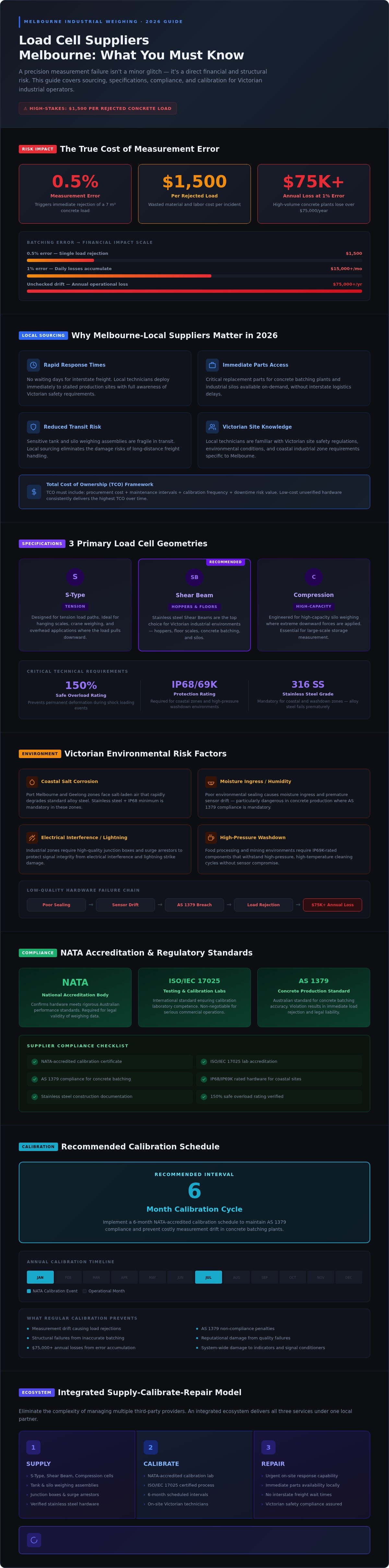
A single 0.5% measurement error can lead to the immediate rejection of a 7-cubic-meter concrete load, resulting in $1,500 of wasted material and labor. For Victorian industrial operators, these inaccuracies aren't just minor technical glitches; they represent significant financial risks and potential structural failures. Identifying the most proficient load cell suppliers Melbourne provides is the only way to ensure your hardware maintains the precision required for high-volume output. You need a partner who understands that waiting for interstate technicians isn't an option when production is stalled.
It's clear that maintaining compliance with AS 1379 and ISO/IEC 17025 is a non-negotiable requirement for serious commercial operations. This 2026 guide will show you how to secure a reliable local supply chain and implement a NATA-accredited calibration schedule that eliminates measurement drift. We'll break down the latest regulatory requirements, the costs of non-compliance, and the technical benchmarks you must meet to minimize operational downtime and protect your reputation for quality.
Key Takeaways
- Understand why sourcing from local load cell suppliers Melbourne ensures rapid response times and minimizes expensive industrial downtime.
- Identify the specific load cell geometries and materials, such as stainless steel Shear Beams, required for durability in Victorian industrial environments.
- Learn the critical role of NATA accreditation and ISO/IEC 17025 in maintaining the legal and technical validity of your weighing data.
- Implement a 6-month calibration schedule to maintain AS 1379 compliance and prevent costly material waste in concrete batching plants.
- Streamline operations by utilizing an integrated 'Supply-Calibrate-Repair' ecosystem that eliminates the need for multiple third-party service providers.
Navigating Load Cell Sourcing in Melbourne’s Industrial Sector
In Melbourne’s industrial sector, a load cell supplier must function as a technical partner rather than a simple hardware vendor. Precision measurement is the backbone of operational efficiency in sectors like Victorian construction, mining, and waste management. When these systems fail, the financial impact extends far beyond the cost of a replacement part. To understand the underlying technology, one might ask, What is a Load Cell? Essentially, it's a transducer that converts force into a measurable electrical signal. For local operators, the primary challenge lies in balancing initial procurement costs with the Total Cost of Ownership (TCO). This calculation must include maintenance, frequent calibration, and the extreme price of potential downtime. Choosing the right load cell suppliers Melbourne has to offer ensures that your weighing infrastructure is built for longevity and strict regulatory compliance.
Why Local Melbourne Supply Matters in 2026
Proximity is a critical factor for minimizing downtime in 2026. Sourcing load cells from a local Melbourne partner means you aren't waiting days for interstate shipping on heavy-duty assemblies. Local suppliers provide immediate access to critical replacement parts for concrete batching plants and industrial silos. This proximity also allows for the rapid deployment of on-site technicians who are already familiar with Victorian site safety requirements and environmental conditions. By eliminating the logistics of interstate freight, you reduce the transit risks associated with sensitive tank and silo weighing assemblies. A local presence translates directly into urgent response times that interstate vendors simply cannot match.
The Risks of Low-Quality Load Cell Sourcing
Opting for low-cost, unverified hardware often leads to catastrophic system failures. In Victoria’s variable climate, poor environmental sealing results in moisture ingress and premature sensor drift. This is particularly dangerous in concrete production, where even a minor measurement error leads to non-compliance with AS 1379 standards. Beyond simple inaccuracies, low-quality electronics can cause system-wide damage to your integrated indicators and signal conditioners. Relying on unvetted components increases your operational risk and guarantees higher long-term costs through frequent repairs and rejected product loads. High-volume Australian concrete plants can lose over $75,000 annually due to a mere 1% margin of error in batching accuracy. Investing in verified, high-quality hardware is the only way to protect your bottom line from these avoidable losses.
Critical Specifications for Victorian Industrial Environments
Industrial weighing hardware must withstand specific mechanical and environmental stresses found in Victorian facilities. Professional load cell suppliers Melbourne provide three primary geometries designed for different load paths: S-type for tension applications, Shear Beam for hoppers and floor scales, and Compression for high-capacity silos. Stainless steel construction is mandatory for longevity, particularly in coastal or washdown zones. Beyond material choice, correct safety margins are a technical necessity. A standard 150% safe overload rating prevents permanent deformation during shock loading, which is critical for maintaining long-term accuracy and operator safety on-site. Similar precision is required in the agricultural sector; you can learn more about livestock handling equipment that integrates these robust weighing solutions for farm management.
Environmental Protection and IP Ratings
Melbourne’s coastal industrial zones, such as Port Melbourne and Geelong, present high corrosion risks due to salt-laden air. For these environments, IP68 or IP69K ratings are essential to prevent moisture ingress during high-pressure washdowns or exposure to high humidity. Standard alloy steel components often fail prematurely in these aggressive conditions. To protect the integrity of the signal, using high-quality junction boxes and surge arrestors is vital in areas prone to electrical interference or lightning strikes. Ensuring your equipment carries verified NATA accreditation markers provides assurance that the hardware meets rigorous Australian performance standards under these environmental pressures.
Specialized Weighing Assemblies
Heavy-duty storage requires robust tank and silo weighing assemblies that incorporate lift-off protection and stay rods. These mechanical features ensure the vessel remains stable under wind loads or seismic activity, which is a requirement for large-scale Victorian infrastructure. In lifting and rigging sectors, special purpose and shackle pins replace standard clevis pins to provide real-time load monitoring without compromising structural integrity. These components are essential for safety-critical applications where knowing the exact force is a regulatory mandate.
Data visibility is the final component of a precise system. Integrating advanced indicators and displays allows operators to monitor batch weights with high resolution in real-time. These units often feature signal conditioners that filter out mechanical vibration, ensuring only the true weight is recorded despite industrial noise. If you're looking to optimize your current system, you can browse our full range of industrial load cells to find the exact specification required for your Victorian facility.
NATA Accreditation: The Standard for Melbourne Suppliers
In the Australian National Measurement System, NATA accreditation serves as the formal recognition of a laboratory's technical competence. It's the definitive benchmark for industrial weighing. While many load cell suppliers Melbourne provides might offer "traceable" calibration, this isn't equivalent to a NATA-endorsed report. NATA accreditation involves rigorous peer reviews of staff qualifications, equipment maintenance, and testing methodologies. This process is overseen by the National Measurement Institute, ensuring that all measurements are linked back to national standards. For Victorian infrastructure projects, gravimetric calibration is often a mandatory requirement to satisfy legal audits and safety standards. Precision requires proof.
Understanding ISO/IEC 17025 Compliance
ISO/IEC 17025:2017 is the global benchmark for testing and calibration laboratories. Compliance with this standard requires a laboratory to maintain detailed uncertainty budgets. These budgets quantify the potential for measurement error. Without them, industrial measurements lack the precision needed for high-stakes applications. NATA-certified calibration costs more than standard checks, typically between $45 and $155 extra, but this investment protects Melbourne businesses from litigation and rejected materials. It provides a level of legal validity that standard traceable checks can't offer. If a batching error leads to structural failure, a NATA-endorsed certificate is your primary defense in a technical audit.
The ISS Calibration Advantage
Independent Scale Service (ISS) integrates technical supply with an accredited service model. Our load cell calibration process is designed to meet the strictest Australian industrial requirements. We prioritize on-site service. It eliminates the risks associated with transporting sensitive equipment and minimizes operational downtime. By performing calibrations in the actual operating environment, we account for local factors like vibration and temperature fluctuations. Data integrity is paramount. For a deeper understanding of how these standards apply to your facility, consult our authoritative guide on calibration services. This comprehensive approach ensures your hardware isn't just functional, but remains compliant with the evolving demands of the 2026 industrial landscape.
Optimising Batching Plant Performance with Local Calibration
Maintaining AS 1379 compliance is the primary operational challenge for concrete producers in Victoria. This standard mandates strict accuracy tolerances for every weighing system within a batching plant to ensure the structural integrity of the finished product. A single 0.5% measurement error leads to the immediate rejection of a standard 7-cubic-meter load, costing approximately $1,500 in wasted material and labor. For high-volume facilities, a 1% margin of error can result in over $75,000 of annual product giveaway. In extreme cases, batching inaccuracies have led to structural failures in residential slabs, requiring over $85,000 in remediation. To mitigate these risks, Victorian batching plants must calibrate their systems at least every 6 months. Partnering with the expert load cell suppliers Melbourne provides ensures these technical benchmarks are met without interrupting production. Precision also extends to chemical additives, necessitating liquid flowmeter calibration to ensure exact dosing ratios.
AS 1379 Compliance Checklist for Melbourne Operators
Adhering to a structured compliance schedule is the only way to avoid heavy fines under the National Measurement Act 1960, which can exceed $220,000. Operators should use the following steps to maintain system accuracy:
- Verification of Certificates: Confirm that NATA calibration certificates for all active load cells are current and within the mandatory 6-month window.
- Mechanical Inspection: Conduct routine checks of mechanical mountings and cable integrity. Worn cables or loose mounts introduce significant signal noise and measurement drift.
- Indicator Alignment: Program digital indicators to match updated calibration data points. Misalignment at this stage renders high-quality hardware ineffective.
- System Calibration: Schedule professional concrete batching plant calibration to verify the entire weighing chain from sensor to display.
Minimising Downtime During Calibration
Operational continuity is non-negotiable for busy Victorian sites. Independent Scale Service coordinates on-site visits during your plant’s scheduled maintenance windows to ensure no production time is lost. This comprehensive service includes hopper calibration to guarantee that aggregate ratios remain within specified tolerances. By choosing the most responsive load cell suppliers Melbourne has available, you secure a partner capable of providing both high-quality hardware and emergency site support. If a load cell fails during an active pour, our Melbourne-based team provides emergency repair protocols to minimize the duration of the stoppage. We've designed our service model to solve critical problems quickly. Ensure your facility remains compliant and efficient by booking your next AS 1379 batching plant calibration with our technical team today.
Independent Scale Service: Comprehensive Load Cell Solutions in Melbourne
Independent Scale Service represents the definitive technical partner for Victorian industry. As one of the most established load cell suppliers Melbourne provides, we deliver a unified ecosystem that covers supply, NATA-accredited calibration, and professional repair. This integrated model eliminates the logistical friction often caused by third-party intermediaries who lack local technical depth. By maintaining an extensive load cell collection in our Melbourne facility, we ensure that critical components are available for immediate dispatch. This capability bypasses the significant lead times associated with interstate or international shipping, which is vital for maintaining production schedules in 2026.
The ISS Advantage: Expertise and Compliance
Our approach is built on decades of technical proficiency and a deep understanding of Australian standards. We don't just sell components; we provide engineered solutions. This expertise is documented in our Essential Guide to Industrial Load Cells, which details the complexities of precision measurement in local environments. Our NATA-accredited technicians specialize in heavy industrial environments, ensuring your systems remain compliant with ISO/IEC 17025 and AS 1379. We provide comprehensive support across the entire signal chain, from high-precision conditioners and transmitters to full system overhauls. This specialized focus ensures that every installation is optimized for accuracy and long-term durability despite harsh site conditions.
Get a Quote for Load Cell Supply and Calibration
Reliability in industrial weighing is achieved through methodical maintenance and high-quality hardware sourcing. If your facility is approaching its 6-month calibration window or requires a hardware upgrade to meet 2026 standards, our technical team is ready to assist. We prioritize responsiveness to keep your operations running at peak efficiency. Contact Independent Scale Service today to schedule a comprehensive site audit or to request a technical consultation for your next weighing project.
Securing Precision for Your Victorian Infrastructure Projects
Maintaining industrial accuracy in 2026 requires a proactive approach to hardware procurement and regulatory compliance. Local sourcing eliminates interstate delays while NATA accreditation to ISO/IEC 17025 safeguards your facility against measurement errors and legal audits. For batching plants, it's essential to adhere to the 6-month calibration cycle mandated by AS 1379 to prevent material waste and structural failures.
Independent Scale Service is the primary technical partner among load cell suppliers Melbourne provides. We combine heavy-duty hardware supply with specialized field expertise. Our team is NATA accredited to ISO/IEC 17025 and acts as AS 1379 compliance specialists for the Victorian construction sector. We provide 24/7 emergency support for Melbourne industrial sites to keep your production moving without interruption.
Take the next step in optimizing your weighing systems and protecting your bottom line. Request a Quote for Load Cell Supply or NATA Calibration today to ensure your equipment meets the highest Australian standards. We look forward to supporting your operational goals with precision and reliability.
Frequently Asked Questions
How do I choose the right load cell supplier in Melbourne for AS 1379 compliance?
Select a provider that holds current NATA accreditation to ISO/IEC 17025 and possesses specific experience in the concrete production sector. AS 1379 compliance requires strict adherence to accuracy tolerances that only an accredited laboratory can legally verify. The most reliable load cell suppliers Melbourne has available will offer an integrated model that combines high-quality hardware supply with ongoing NATA-endorsed calibration services.
What is the difference between NATA-accredited calibration and standard calibration?
NATA-accredited calibration provides a superior level of legal and technical validity by confirming traceability to national standards through a peer-reviewed laboratory. While standard calibration checks for functional accuracy, only NATA-endorsed reports satisfy the requirements for legal audits and safety-critical Victorian infrastructure projects. This accreditation acts as a formal recognition of the laboratory's technical competence under the ISO/IEC 17025 benchmark.
How often should industrial load cells in Melbourne be calibrated?
Industrial load cells used in concrete batching plants must undergo calibration at least every 6 months to maintain AS 1379 compliance. For other heavy-duty weighing systems, annual calibration is typically the minimum requirement. High-volume Victorian facilities or those operating in extreme environmental conditions often require more frequent testing to prevent measurement drift that leads to material waste and structural failures.
Can Independent Scale Service provide on-site load cell repair in Melbourne?
Yes, we provide comprehensive on-site load cell repair and calibration across the Melbourne metropolitan area and regional Victoria. Our technicians arrive with the specialized equipment necessary to diagnose signal interference and replace faulty sensors without removing the entire assembly from your site. This on-site service model is essential for minimizing downtime in large-scale silo and hopper installations.
What are the most common causes of load cell failure in Victorian industrial zones?
Moisture ingress and salt-air corrosion are the leading causes of load cell failure in coastal Victorian zones like Port Melbourne and Geelong. These conditions often compromise environmental seals, leading to internal short circuits and signal drift. Other frequent causes include mechanical shock loading that exceeds safe margins and electrical surges in outdoor installations that lack proper surge protection or grounding.
Do you supply NATA-certified load cells for new batching plant installations?
We supply a wide range of industrial load cells that can be provided with NATA-endorsed calibration certificates upon installation for new batching plants. Integrating accredited hardware from the start ensures your facility meets Australian standards immediately upon commissioning. As established load cell suppliers Melbourne businesses trust, we manage the technical alignment between your new sensors and digital indicators to guarantee precision.
What IP rating do I need for load cells in Melbourne washdown environments?
You should specify hardware with a minimum rating of IP68 or IP69K for any industrial washdown environment. These ratings indicate the sensor is hermetically sealed against high-pressure water jets and potential submersion. Using lower-rated components in these areas leads to premature failure as moisture contaminates the internal strain gauges, resulting in inconsistent data and expensive replacement costs.
How quickly can a Melbourne technician respond to a weighing system breakdown?
Our Melbourne-based technical team prioritizes emergency breakdowns to restore your production capacity as quickly as possible. We maintain a local presence to ensure rapid response times across the metro area, often reaching critical sites within the same business day. Our primary objective is to minimize your operational downtime by providing immediate technical support and access to our local inventory of replacement parts.
