


Load Cell Signal Conditioner Australia: The Industrial Integration Guide
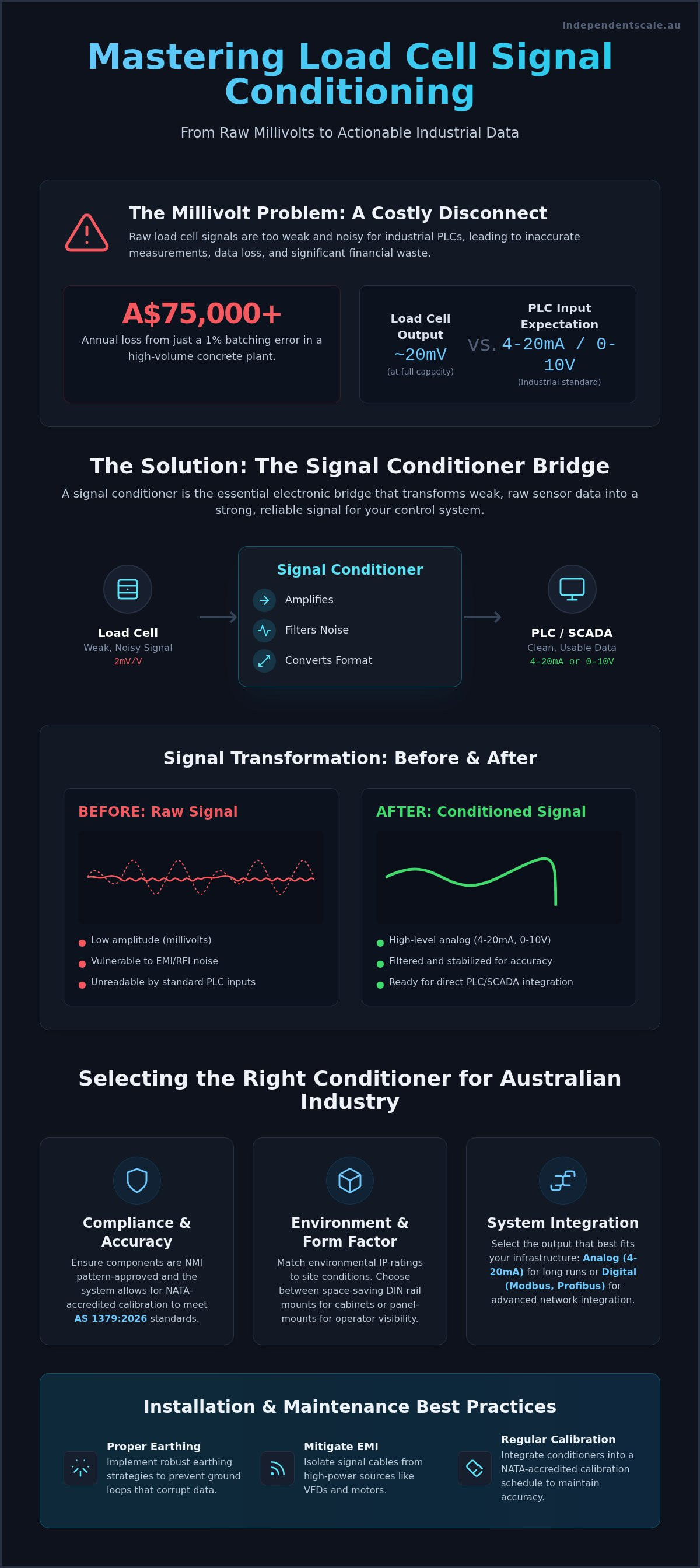
For a high-volume Australian concrete plant, a mere 1% margin of error in batching accuracy can lead to over A$75,000 in annual product giveaway. This financial drain often stems from poor signal processing between the scale and the control system. Selecting the right load cell signal conditioner Australia professionals trust is about more than just connectivity; it's about protecting your bottom line through precision. You likely understand the frustration of dealing with erratic weight readings caused by industrial signal noise or the headache of ensuring your hardware actually talks to your PLC without data loss.
It's a common challenge to maintain stable, high-resolution data while meeting strict regulatory audits. This guide will help you master the technical requirements for converting raw millivolt signals into actionable industrial data while maintaining NATA-traceable accuracy across your site. We'll examine how to achieve seamless integration with SCADA and PLC systems, ensuring your facility remains compliant with the updated AS 1379:2026 and ISO 17025 standards. From mitigating harsh environmental interference to selecting NMI pattern-approved components, you'll gain the expertise needed for a reliable, high-performance weighing installation.
Key Takeaways
- Identify why raw millivolt signals require precision amplification and conversion before they can be successfully processed by industrial PLC or SCADA systems.
- Select the appropriate load cell signal conditioner Australia specialists recommend by matching environmental IP ratings and accuracy classes to your specific site conditions.
- Ensure legal and operational compliance by integrating signal conditioners into a NATA-accredited calibration schedule as mandated by the updated AS 1379:2026 standard.
- Implement advanced wiring and earthing strategies to eliminate signal noise and maintain data integrity across extensive industrial cable runs.
- Differentiate between analog amplifiers and digital weight transmitters to choose the most efficient interface for your high-resolution weighing requirements.
What is a Load Cell Signal Conditioner?
A load cell signal conditioner Australia is the essential technical bridge between a physical weight sensor and your control logic. It's an electronic device designed to amplify, filter, and convert raw data from a transducer into a format your PLC or SCADA system can interpret. Without this component, the tiny electrical changes produced by a sensor are essentially invisible to industrial hardware. It ensures that the mechanical force applied to a scale becomes a reliable digital or analog value.
The core challenge is known as the "Millivolt Problem." Most industrial sensors rely on strain gauge technology. To understand the underlying physics, you should first ask: What is a load cell? These sensors typically output a signal measured in millivolts per volt (mV/V). For instance, a 2mV/V load cell powered by 10V will only output 20mV at full capacity. This signal is too weak for a standard PLC analog input card, which usually expects a 0-10V or 4-20mA signal. A dedicated load cell signal conditioner amplifies this minute voltage by a factor of hundreds to ensure the data is usable.
Modern conditioners provide several standard output formats to suit different infrastructure needs:
- 4-20mA Current Loop: The industry standard for long cable runs, as it's highly resistant to voltage drops and electrical noise.
- 0-10V or 0-5V DC: Common for short distances and simple control panels where high-impedance inputs are available.
- Digital Protocols: Communication via Modbus RTU, Profibus, or Ethernet/IP for direct integration into digital automation networks.
Bridge Excitation and Signal Amplification
For a load cell to function, it requires a highly stable excitation voltage. Even minor fluctuations in the input power will cause the output signal to drift, leading to immediate weighing errors. A professional conditioner provides a regulated DC excitation source, typically 5V or 10V, to the Wheatstone bridge. The device then scales the resulting 2mV/V or 3mV/V signal to the full industrial range. High-resolution amplification is critical here; poor quality components will introduce "stepping" in the data, making it impossible to achieve the precision required for NATA-accredited systems.
Signal Filtering and Noise Suppression
Australian industrial sites are often electrically noisy environments. Variable Frequency Drives (VFDs), heavy motors, and high-voltage cabling generate significant Electromagnetic Interference (EMI). Selecting a robust load cell signal conditioner Australia ensures that active analog or digital filters strip away this high-frequency noise. In high-vibration applications, such as concrete batching or silo weighing, digital filters stabilize the weight reading by averaging out physical oscillations. Proper galvanic isolation within the conditioner is also necessary to prevent ground loops, which can destroy sensitive electronic components and corrupt data.
Types of Load Cell Amplifiers and Transmitters
Industrial weighing systems require specific hardware configurations based on the control architecture and the environmental demands of the site. Choosing a load cell signal conditioner Australia sites can rely on involves deciding between basic analog amplifiers and sophisticated digital transmitters. Analog conditioners provide a direct, cost-effective method for converting millivolt signals into standard 4-20mA or 0-10V outputs. These units are ideal for simple, localized monitoring where advanced data processing isn't required and the primary goal is signal transmission over moderate distances.
In contrast, digital weight transmitters offer high-resolution displays, internal calibration menus, and advanced bus communication. These devices allow for more complex integration with modern SCADA systems and provide diagnostic tools that analog units lack. Form factor also plays a role in system design. DIN rail units are the standard for internal cabinet mounting, while panel-mount versions allow operators to view weight data directly on the enclosure door. For applications involving multiple sensors, such as silo or hopper weighing, multi-channel conditioners are necessary. These units aggregate signals from several load cells into a single, unified output for the PLC, ensuring the total weight is accurately represented.
DIN Rail Weight Transmitters
Space-saving DIN rail designs are the preferred choice for modern conditioners and transmitters installations. These units optimize cabinet real estate while providing essential features like front-panel LED displays and tactile buttons for local zeroing or span adjustment. In Australian automation, compatibility with high-speed protocols is mandatory. You should prioritize transmitters that support EtherNet/IP, Modbus TCP, or Profinet to ensure low-latency data transfer between the scale and the central processor. This connectivity is vital for real-time batching control where every millisecond affects the final product accuracy.
Junction Boxes with Integrated Conditioning
Standard junction boxes typically serve as passive termination points for load cell cables. However, smart summing units incorporate integrated conditioning to digitize or amplify the signal at the scale assembly itself. This approach significantly minimizes the risk of signal degradation or interference over long cable runs. For regional Australian locations prone to lightning strikes or power surges, selecting units equipped with heavy-duty surge arrestors is a non-negotiable requirement. This protection prevents costly downtime by shielding sensitive conditioning electronics from atmospheric disturbances. If you're upgrading an existing batching system or designing a new facility, you can view our full range of industrial weighing components to ensure your hardware meets local compliance standards.
Selecting the Right Conditioner for Australian Industry
Selecting a load cell signal conditioner Australia professionals can rely on requires a rigorous criteria-based framework. While basic specifications are important, the unique environmental challenges of Australian worksites demand higher standards for hardware resilience. Environmental protection is the first non-negotiable factor. In dust-heavy environments like concrete batching plants or regional grain silos, IP67 or IP68 ratings are mandatory. These ratings ensure the internal electronics remain sealed against fine particulates and moisture, preventing the premature component failure common in less robust hardware.
Accuracy must be synchronized across the entire measurement string. It's a technical error to pair high-precision load cells with a low-resolution conditioner. The signal conditioner's internal analog-to-digital converter (ADC) must provide enough counts to resolve the smallest weight increment required by your process. Additionally, consider your power infrastructure. While 24VDC is the standard for modern PLC cabinets, 240VAC versions are often necessary for standalone retrofits or remote installations where a dedicated DC supply isn't available. For sites where physical test weights are difficult to maneuver, prioritize units with digital "theoretical" calibration. This feature allows technicians to input the mV/V sensitivity of the sensors directly, facilitating a rapid initial setup.
Input and Output Compatibility
Your transmitter must have the capacity to handle the total current draw of the load cell network. When summing four or more sensors, ensure the conditioner's excitation supply doesn't sag under the load. The output signal must also align perfectly with your control hardware, whether that involves standard 4-20mA loops for indicators and displays or digital fieldbus protocols. Many Australian facilities are now transitioning to digital communication to take advantage of remote diagnostics, which allow engineers to monitor signal health from a central control room without entering the field.
Temperature Stability and Drift
Extreme Australian temperatures can cause significant signal drift in outdoor applications. In regional areas where ambient temperatures frequently exceed 40°C, the internal components of a conditioner can expand or change resistance, leading to "creeping" weight readings on silos and hoppers. To combat this, you must select low-drift components that feature active temperature compensation. This technology ensures the weight data remains stable from the cool of the morning to the peak heat of the afternoon, maintaining the integrity of your inventory data and batching accuracy throughout the production cycle.
Compliance: NATA Calibration and AS 1379 Standards
In the Australian industrial sector, a measurement is only as reliable as its last certified calibration. When you install a load cell signal conditioner Australia regulations require that the entire weighing string be verified as a single, cohesive system. It's a common technical oversight to calibrate a load cell in isolation while ignoring the signal conditioner. However, since the conditioner performs the critical task of scaling and filtering the raw data, any drift in the electronics directly compromises the accuracy of the final weight reading. This makes professional calibration services an operational necessity rather than an optional safeguard.
Maintaining NATA accreditation to ISO/IEC 17025 is the mandatory benchmark for technical competence in Australian calibration. This accreditation ensures that your audit trail is legally defensible and meets the rigorous requirements of quality management systems. For facilities operating in the construction and infrastructure sectors, compliance with AS 1379:2026 is the primary driver for equipment maintenance. This standard dictates strict accuracy tolerances that cannot be met if your signal conditioning hardware is out of sync with your physical sensors.
NATA Traceable Calibration
Independent Scale Service provides comprehensive load cell calibration that includes a full assessment of the conditioning electronics. Our technicians use NATA-traceable test weights and precision signal simulators to verify that the millivolt output from the sensor is correctly translated into the desired industrial signal. In high-use environments, such as 24-hour processing plants, we recommend a calibration frequency of six to twelve months to account for electronic component aging and environmental wear. This systematic approach eliminates the risk of "silent" errors where the display appears stable but the underlying data has drifted beyond acceptable limits.
AS 1379 Compliance for Concrete Plants
The updated AS 1379:2026 standard mandates that weighing systems in concrete batching plants undergo verification at least every six months. The signal conditioner plays a pivotal role here; it must maintain batch consistency by providing rapid, high-resolution data to the batching computer. Even a minor calibration error can lead to significant material waste or, worse, structural compromises in the delivered concrete. We specialize in concrete batching plant calibration across Sydney, Melbourne, and regional Australia, ensuring your facility is prepared for any compliance inspection. If your current batching accuracy is in question, you can book a NATA-accredited calibration to restore your plant to full specification.
Installation and Maintenance of Conditioning Hardware
The physical installation of a load cell signal conditioner Australia is as critical as the hardware selection itself. Improper wiring is the primary cause of signal degradation, especially over long cable runs exceeding 20 metres. To maintain millivolt integrity, technicians must use high-quality shielded cables. The shield should be earthed at a single point, typically at the conditioner end, to prevent ground loops that introduce noise into the weighing string. This practice ensures that the low-level signal remains protected from the high-frequency interference common in industrial switchrooms.
Correct earthing practices are non-negotiable. In many Australian industrial sites, high-power machinery creates significant electromagnetic interference. Without proper isolation and earthing, the signal conditioner will struggle to provide a stable output, leading to erratic batching results. Routine diagnostic checks should include inspecting terminal connections for corrosion and ensuring that cable glands remain tight to prevent moisture ingress. For complex systems, partnering with a licensed provider for a hopper calibration service ensures that the physical installation and the electronic conditioning are harmonised for maximum accuracy. This synergy is vital for maintaining the structural and operational integrity of your weighing vessels.
Common Fault Diagnosis
Identifying the root cause of an unstable weight reading requires a methodical approach. First, verify the excitation voltage using a calibrated multimeter; it should match the conditioner's specification within a tight tolerance, usually +/- 0.1V. If the excitation is stable but the signal return is fluctuating, inspect the load cell bridge for moisture or physical damage. If the return signal is steady at the junction box but erratic at the PLC, the fault likely lies within the transmitter itself or the interconnecting cable. While some analog drift can be corrected through span adjustment, a weight transmitter that fails to maintain a stable zero should be replaced rather than repaired to ensure long-term reliability.
Professional Support in Australia
Local technical expertise is indispensable for maintaining a high-performance industrial scale network. Independent Scale Service manages the entire lifecycle of your weighing infrastructure, from the initial supply of NMI pattern-approved components to the final NATA-accredited calibration. Our team provides on-site technician support across Sydney, Melbourne, and regional Australia, ensuring that your conditioning hardware is installed according to both manufacturer specifications and Australian regulatory standards. This comprehensive service model minimizes downtime and guarantees that your data remains actionable and compliant with the latest industry benchmarks.
Securing Your Industrial Measurement Integrity
Achieving precision in industrial weighing requires more than just high-quality sensors. It demands a robust signal processing strategy that accounts for electrical noise, environmental heat, and strict regulatory standards. By selecting a high-resolution load cell signal conditioner Australia sites can trust, you ensure that raw millivolt data translates into actionable, high-stability information for your control systems. Remember that hardware selection is only half the battle; proper installation and shielded wiring are essential to prevent data corruption over long distances.
Operational success also depends on rigorous adherence to NATA standards. Calibrating your conditioning electronics alongside your physical load cells is the only way to guarantee a legally defensible audit trail and remain compliant with the updated AS 1379:2026 standard. Independent Scale Service is NATA accredited to ISO/IEC 17025, providing the technical expertise required for complex batching and silo systems across Sydney, Melbourne, and regional areas. You can contact Independent Scale Service for NATA-accredited signal conditioner supply and calibration to eliminate measurement drift and protect your facility from costly product giveaway. It's time to secure your plant's accuracy with a reliable, professionally maintained weighing network.
Frequently Asked Questions
What is the difference between a load cell amplifier and a signal conditioner?
Amplifiers strictly increase the strength of a millivolt signal, while conditioners perform additional functions like filtering, scaling, and conversion. A load cell signal conditioner Australia professionals use typically provides regulated bridge excitation and galvanic isolation. It translates the raw mV/V signal into a standardized industrial format. While the terms are often used interchangeably, conditioners offer a more comprehensive suite of signal processing features to ensure data integrity in noisy environments.
Do I need a signal conditioner if my PLC has a strain gauge input module?
You don't usually need an external conditioner if your PLC has a dedicated strain gauge input module. These cards handle bridge excitation and mV amplification internally. However, you might still opt for an external unit if you require a local weight display, faster signal processing, or galvanic isolation to protect the PLC rack from field-side surges. External conditioners also simplify maintenance by allowing technicians to perform standalone calibration without stopping the PLC logic.
Can a signal conditioner improve the accuracy of my old load cells?
A signal conditioner cannot improve the base mechanical accuracy or linearity of an aging load cell. If the sensor has internal strain gauge damage or moisture ingress, the conditioner will simply amplify the corrupted data. However, a modern conditioner with advanced digital filtering can stabilize erratic readings caused by external electrical noise or mechanical vibration. This makes the existing data more usable even if the sensor's physical performance remains unchanged.
How far can I run a load cell cable before I need a signal conditioner?
You should ideally place a signal conditioner within 10 to 20 metres of the load cell sensors. Millivolt signals are highly susceptible to voltage drops and electromagnetic interference over long distances. If your control cabinet is 50 metres away, installing a conditioner near the scale to convert the signal to a 4-20mA current loop or digital protocol is necessary. This ensures the data reaches the PLC without significant degradation or interference.
What output signal is best for a modern Australian industrial PLC?
EtherNet/IP and Modbus TCP are the preferred digital protocols for modern Australian industrial PLCs. These digital outputs provide high-resolution data and remote diagnostic capabilities that analog signals lack. If your architecture is older, a 4-20mA current loop remains the most reliable analog choice due to its high noise immunity. You should avoid 0-10V signals for long industrial runs because they are prone to voltage drops and electromagnetic interference.
Is NATA calibration required for every signal conditioner in a plant?
NATA calibration is mandatory for systems used in legal trade measurement or those governed by standards like AS 1379:2026. While a non-critical level sensor might not require a NATA-traceable certificate, any system impacting product quality or safety should be calibrated to ISO/IEC 17025 standards. This ensures your site maintains a legally defensible audit trail. Regular verification also prevents the electronic drift that leads to inventory discrepancies and batching errors across your facility.
What are the signs that my signal conditioner is failing?
Unstable weight readings, sudden zero shifts, and failure to respond to known loads are primary indicators of hardware failure. You might also notice the output signal locking at a specific value, such as 4mA or 20mA, regardless of the physical weight applied. If the excitation voltage measured at the load cell terminals fluctuates or drops below specification, the conditioner's internal power supply is likely compromised and requires immediate professional assessment or replacement.
How does a weight transmitter differ from a standard signal conditioner?
A weight transmitter is a specialized type of signal conditioner that includes a digital display and local calibration interface. While a basic conditioner might only provide a blind analog output, a transmitter allows technicians to perform zero and span adjustments directly at the device. Transmitters also typically feature advanced communication ports for fieldbus integration, making them the superior choice for complex automation environments where local monitoring and rapid diagnostic access are required.
