


Load Cell Maintenance: Guide to Sustained Accuracy
Most industrial operators mistakenly treat weighing accuracy as a software calibration issue, but sustained precision is actually won or lost in the mechanical environment of the mounting assembly. You know that a single rejected batch or a failed silo sensor can halt production for hours, resulting in significant revenue loss and the high-stakes pressure of a NATA audit. Unplanned downtime isn't just an inconvenience; it's a direct threat to your operational margins and regulatory standing.
This guide provides the rigorous technical protocols for preventative maintenance for load cells required to eliminate signal drift and ensure your site remains fully compliant with AS 1379 standards. By shifting from reactive repairs to a disciplined maintenance schedule, you can secure zero unplanned downtime and documented audit readiness. We'll outline the specific mechanical checks, moisture ingress prevention, and scheduled calibration cycles necessary to maintain peak performance in harsh Sydney and Melbourne industrial environments. This transition ensures your equipment delivers consistent accuracy while significantly extending its operational lifecycle.
Key Takeaways
- Learn how proactive maintenance mitigates "Zero Drift" and prevents the significant financial losses associated with measurement errors in high-volume industrial sectors.
- Understand the three technical pillars-mechanical, electrical, and environmental-necessary to protect signal integrity and eliminate parasitic loads from your weighing systems.
- Discover the specific protocols for preventative maintenance for load cells required to maintain AS 1379 compliance and meet NATA ISO/IEC 17025 accreditation benchmarks.
- Implement a structured maintenance hierarchy, ranging from daily debris inspections to monthly mechanical assessments of critical hardware like stay rods and bumpers.
- Identify the technical diagnostic markers, such as bridge resistance shifts and insulation failure, that signal the immediate need for professional NATA-accredited calibration or repair.
Why Preventative Maintenance for Load Cells is a Business Imperative
Preventative maintenance is not an optional overhead; it's a technical necessity for maintaining the structural and electrical integrity of industrial weighing systems. In high-volume sectors like mining and concrete production, a proactive approach to preventative maintenance for load cells ensures that signal degradation is identified and rectified before it manifests as critical system failure. This methodology shifts the operational focus from reactive crisis management to sustained precision.
Measurement errors lead to compounding financial losses. For example, a 1% error in a concrete batching plant processing 500 cubic metres daily results in significant material waste and potential structural liability. Regular technical care directly extends the operational lifecycle of tank and silo weighing assemblies by preventing corrosion, mechanical binding, and mounting hardware fatigue. This discipline ensures that your data remains accurate for internal quality control and external industrial audits.
The Phenomenon of Load Cell Drift
Load cell sensors are precision instruments subjected to constant environmental and mechanical stress. These factors cause gradual calibration loss over time. Early warning signs include inconsistent readings during tare operations or signal fluctuations that don't correlate with physical load changes. Identifying these shifts early prevents them from triggering system alarms or causing expensive batch rejections. Zero Drift is the change in output signal when no load is applied.
Avoiding Unplanned Downtime in Australia
The Australian climate presents unique challenges for precision measurement equipment. Extreme heat or high humidity in coastal regions like Sydney and Melbourne can accelerate insulation breakdown and moisture ingress in load cell cables. Relying on reactive repairs is a high-risk strategy. A scheduled calibration service is consistently more cost-effective than emergency call-outs.
Consider the implications of a 24-hour shutdown at a major concrete batching plant. Beyond the immediate loss of revenue, which can exceed A$20,000 in a single shift for large facilities, delivery delays damage client relationships and project timelines. Industrial audits, specifically those required for AS 1379 compliance, demand rigorous data integrity. Without a documented history of preventative maintenance for load cells, your facility risks failing NATA assessments. This can lead to a mandatory cessation of operations until you prove compliance.
The 3 Pillars of Load Cell Integrity: Mechanical, Electrical, and Environmental
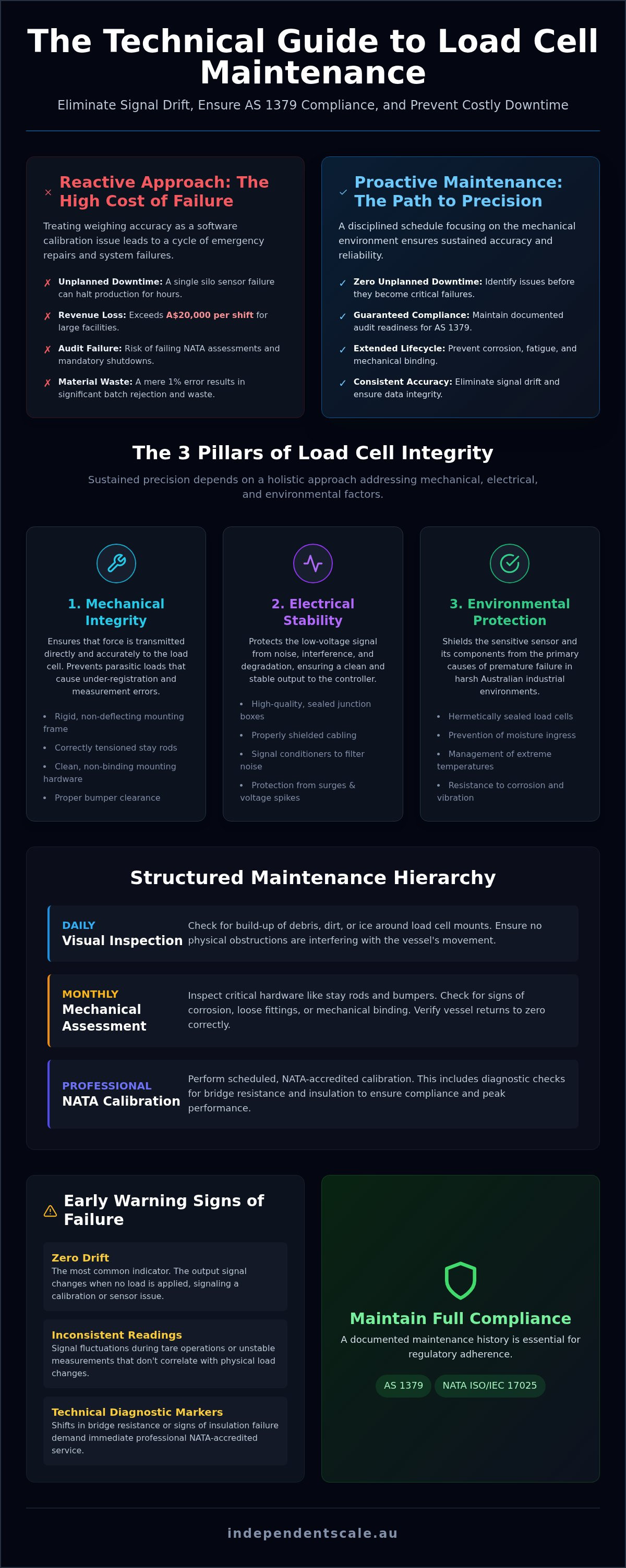
Sustained precision in industrial weighing depends on three foundational pillars: mechanical alignment, electrical integrity, and environmental protection. Neglecting any single pillar compromises the entire system's reliability. Effective preventative maintenance for load cells addresses these factors simultaneously to prevent measurement drift and structural failure. It's a technical discipline that ensures the sensor only measures the intended force without interference from external variables.
Mechanical integrity involves more than just the load cell itself. It requires a mounting frame that remains rigid under full capacity. If the frame deflects, it introduces parasitic loads that bypass the sensor, leading to under-registration. Similarly, electrical stability relies on high-quality junction boxes to sum signals without introducing resistance errors. Integrating precision conditioners and transmitters further stabilizes measurement data by filtering out high-frequency noise before the signal reaches the controller.
Environmental factors are the primary cause of premature sensor failure in Australia. Moisture ingress into a non-hermetically sealed cell leads to internal corrosion of the bridge circuit. Temperature fluctuations also cause material expansion and contraction. While modern load cells are temperature-compensated, extreme shifts can still cause zero-shift if the mounting hardware isn't properly aligned to accommodate thermal movement.
Mechanical Alignment and Mounting Frame Rigidity
A non-deflecting frame is critical for accurate strain gauge performance. When a support structure bows or twists, the load path is no longer vertical, which causes significant weighing errors. Technicians must check for "binding" in tank mounts where debris, ice, or paint buildup prevents the assembly from moving freely. We verify the torque on all mounting hardware during every service. Shifting bolts lead to misalignment that is often invisible to the naked eye but obvious in the calibration data.
Electrical Signal Protection and Cable Integrity
Industrial cables often face harsh conditions. We inspect cables for abrasions, chemical damage, or moisture wicking, which can pull water directly into the internal circuitry. Surge arrestors are essential in Australian environments prone to lightning or power fluctuations. They protect sensitive weighing electronics from catastrophic failure. Testing insulation resistance is a standard diagnostic step; it identifies internal leakage that causes erratic signal behaviour before the load cell fails completely. If you suspect signal noise is affecting your batch quality, a professional diagnostic assessment can pinpoint the source of the interference.
Australian Standards and Regulatory Compliance (AS 1379)
AS 1379 dictates the technical requirements for the specification and manufacture of concrete in Australia. For batching plant operators, compliance isn't a suggestion; it's a prerequisite for supplying government and major infrastructure projects. These contracts demand absolute traceability and verified accuracy. A rigorous program of preventative maintenance for load cells provides the empirical evidence required to satisfy these high-stakes regulatory environments. Independent Scale Service specializes in AS 1379 compliance for batching plants, ensuring every sensor in the assembly meets the stringent tolerances defined by Australian law.
NATA accreditation to ISO/IEC 17025 represents the international gold standard for laboratory and calibration competence. In the Australian weighing industry, this accreditation serves as the primary differentiator between a basic equipment check and a legally defensible calibration. While an internal check might confirm a system is close enough for daily operations, only a NATA-certified technician can issue the documentation required for regulatory audits. This level of certification is essential for maintaining the data integrity that auditors demand during site inspections.
The Role of NATA in Australian Weighing
NATA accreditation ensures that the equipment and methods used during a service are traceable to national standards. It's the difference between a subjective observation and a verified measurement. A check is a routine verification performed by site staff to monitor for obvious errors. In contrast, a NATA-certified calibration involves a comprehensive assessment of the weighing system's linearity, repeatability, and hysteresis using certified test masses. For a deeper technical breakdown of these requirements, refer to our Guide to Calibration Services.
Documentation and Audit Readiness
A compliant maintenance program is only as strong as its documentation. Industrial auditors expect to see a clear, chronological history of all service activities. Your maintenance log must include specific fields: dates of service, identified faults, corrective actions taken, and the serial numbers of the test weights used. This record-keeping is particularly vital for the annual inspection of your hopper and silo systems. Maintaining a structured log demonstrates a commitment to quality and significantly reduces the risk of non-compliance findings during a NATA or AS 1379 audit. It's the primary tool for proving that your facility operates within the required accuracy thresholds.
The Load Cell Maintenance Schedule: Daily, Monthly, and Annual Tasks
Reliable weighing performance is the result of a tiered maintenance hierarchy. A structured approach to preventative maintenance for load cells ensures that minor mechanical issues are corrected before they escalate into systemic failures. By categorising tasks into daily, monthly, and annual intervals, site managers can maintain AS 1379 compliance without disrupting production cycles. This methodical discipline is the only way to guarantee the long-term accuracy of high-capacity industrial systems.
- Daily: Visual inspections for debris buildup and zero-balance checks.
- Monthly: Mechanical check of stay rods, bumpers, and cable connections.
- Quarterly: Signal output verification using a digital multimeter or indicator.
- Annual: Full NATA-accredited calibration and system recertification.
Daily and Weekly Housekeeping
Industrial environments are inherently hostile to precision sensors. Daily inspections must focus on removing material buildup, such as sand, cement, or dust, from around the load cell base. This debris can harden and create a "load shunt," where a portion of the weight bypasses the sensor entirely. Operators should perform a zero-balance check at the start of every shift. If the weight display fails to return to zero after the hopper is emptied, it's an immediate red flag for mechanical binding or electrical signal leakage.
Weekly checks should include a visual assessment of load pins and shackles. Technicians need to look for signs of corrosion, hairline fractures, or physical impact damage. In coastal areas like Sydney, pitting corrosion on stainless steel components can compromise structural integrity long before a total failure occurs. Promptly identifying these surface issues prevents catastrophic assembly collapse and unplanned downtime.
Monthly Technical Verifications
Monthly protocols involve a more detailed analysis of the weighing assembly's physical state. Consistent preventative maintenance for load cells during these intervals involves inspecting all junction boxes for evidence of moisture ingress or loose terminal connections caused by vibration. A single loose wire can introduce significant signal noise. We also recommend verifying that all assemblies remain "level" and "plumb." Even a slight tilt in a silo mount introduces side-loading forces that skew measurement data and accelerate sensor wear.
Testing for repeatability using a known test weight confirms the system's consistency across multiple weighments. Finally, an annual NATA-accredited calibration is mandatory for recertification and legal compliance. This comprehensive service involves testing the system to its full capacity using certified test masses. For site-specific advice or to schedule your next compliance check, contact our team for professional load cell calibration and repair.
Professional Load Cell Calibration and Repair Services
While site-level housekeeping manages debris and visual alignment, technical faults require NATA-accredited intervention to restore system integrity. Professional diagnostic services identify the root causes of signal instability that routine checks cannot resolve. Integrating a structured service agreement for your industrial weighing scales ensures that preventative maintenance for load cells is performed by technicians with the specialized instrumentation required for ISO/IEC 17025 compliance. This professional oversight is the final safeguard against the compounding costs of measurement drift.
Independent Scale Service operates as the authoritative partner for industrial clients in Sydney and Melbourne. We provide a comprehensive diagnostic suite that includes bridge resistance checks and insulation testing to detect internal moisture or circuit breakdown. Our technicians don't just identify that a system is "out"; they pinpoint whether the failure is electrical, mechanical, or a result of environmental ingress. This level of technical precision is essential for maintaining the operational uptime of high-capacity assets.
Expert Fault Diagnosis
Erratic readings, often referred to as "ghosting," are frequently caused by electrical interference or compromised cable shielding. We resolve these issues through systematic signal testing, measuring the load cell’s millivolt (mV) output under incremental loads to verify linearity. If the bridge resistance deviates from the manufacturer's specification, it typically indicates a permanent deformation of the strain gauge. In these instances, we provide a technical "repair vs. replacement" analysis. While some mounting hardware can be refurbished, a compromised sensor usually requires replacement to maintain the site's NATA certification and AS 1379 standing.
On-Site Service Capabilities
Minimizing downtime requires immediate, on-site responsiveness. Our mobile calibration units are equipped to service concrete batching plants, silos, and hoppers directly at your facility. This eliminates the logistical burden of transporting heavy equipment and ensures that preventative maintenance for load cells is conducted under actual operating conditions. We also provide specialized force gauge calibration for laboratory and quality control environments, ensuring every measurement tool on your site is traceable to national standards.
A proactive service agreement provides documented audit readiness and priority scheduling for critical repairs. This prevents the high costs associated with emergency call-outs and production stoppages. To secure your site's accuracy and compliance, Contact Independent Scale Service for a professional preventative maintenance quote today.
Securing Long-Term Measurement Precision and Compliance
Maintaining industrial weighing accuracy requires a disciplined approach to the mechanical, electrical, and environmental variables that influence sensor performance. By implementing a tiered schedule that includes daily housekeeping and monthly technical verifications, you mitigate the risk of zero drift and signal degradation. This commitment to preventative maintenance for load cells is the primary method for ensuring your facility remains audit-ready and operationally efficient. It transforms your maintenance strategy from a reactive cost center into a proactive safeguard for production quality.
Accuracy is a technical mandate, not a variable. Independent Scale Service provides the authoritative expertise required to meet NATA ISO/IEC 17025 benchmarks and AS 1379 compliance standards across Sydney and Melbourne. Our expert technicians deliver the precise diagnostic and calibration services necessary to eliminate unplanned downtime and protect your batching integrity. Professional oversight ensures your assets perform to their original specifications throughout their entire lifecycle. We're committed to providing the reliability your industrial operations demand.
Book a NATA-Accredited Load Cell Calibration Service to secure your facility's accuracy today.
Frequently Asked Questions
How often should load cells be calibrated in an industrial environment?
Load cells in standard industrial settings typically require annual calibration; however, high-volume facilities like concrete plants often require six-monthly intervals to maintain accuracy. Sites operating under strict quality management systems or AS 1379 protocols must adhere to the specific frequency defined in their compliance documentation. Regular preventative maintenance for load cells between these formal calibrations helps identify early signs of drift before they impact production quality.
Can a damaged load cell cable be repaired, or must the whole unit be replaced?
While minor abrasions to the outer sheath can sometimes be sealed, internal core damage or moisture wicking typically necessitates replacing the entire unit. Signal integrity is compromised once moisture enters the cable, leading to erratic readings that are impossible to calibrate out. In NATA-accredited environments, attempting to splice a load cell cable is generally discouraged as it introduces resistance changes that invalidate the sensor's original factory specifications.
What is the most common cause of load cell failure in concrete plants?
Moisture ingress and mechanical "load shunting" caused by material buildup are the most frequent causes of failure in concrete batching plants. Cement dust and sand accumulate around the mounting assembly, eventually hardening and creating a physical bridge that bypasses the sensor. This results in significant under-registration. Additionally, non-hermetically sealed cells are vulnerable to high-pressure washdowns, which force water into the internal bridge circuit and cause catastrophic electrical failure.
How do environmental factors like temperature affect load cell accuracy?
Temperature fluctuations cause thermal expansion and contraction in the mounting hardware and the load cell's spring element. Modern industrial sensors include temperature compensation circuits, but extreme Australian heat can still lead to Zero Drift if the shifts exceed the compensated range. These environmental factors emphasize the need for robust preventative maintenance for load cells to ensure that mounting assemblies remain plumb and free to move as they expand.
What is the difference between a load cell check and a NATA calibration?
A load cell check is an informal verification performed by site staff to confirm the system is roughly accurate. A NATA calibration is a formal, technical process conducted by an accredited laboratory under ISO/IEC 17025 standards. NATA-certified calibrations provide full traceability to national measurement standards, which is a legal requirement for trade-certified weighing and compliance with major infrastructure project contracts in Australia.
Is AS 1379 compliance mandatory for all concrete batching plants in Australia?
Compliance with AS 1379 is mandatory for all Australian plants manufacturing concrete for commercial supply or structural engineering applications. This standard specifies the tolerances for weighing and batching equipment to ensure the structural integrity of the final product. Failure to maintain compliant, calibrated weighing systems can result in the rejection of concrete batches and the loss of accreditation required to supply government-funded infrastructure projects.
How can I tell if my load cell has suffered from mechanical overload?
Mechanical overload is typically identified by a significant, permanent shift in the system's zero-balance reading. If the zero output has shifted by more than 10% of the load cell's rated capacity, the internal spring element has likely suffered permanent deformation. Technicians also look for physical signs such as cracked paint on the sensor body or distorted mounting plates, which indicate the system has been subjected to forces exceeding its safe limit.
Do I need to recalibrate after replacing a junction box?
Yes, you must perform a full system recalibration after replacing a junction box. The junction box is a critical component of the electrical summing circuit; even minor differences in terminal resistance or board components can alter the combined signal sent to the indicator. Recalibration ensures that the relationship between the physical load and the summed electrical output remains linear and accurate across the entire weighing range.
