


Legal for Trade Weighbridge Certification: The Complete 2026 Guide
A single measurement error can cost your company up to $170,000 per offense under the National Measurement Act 1960. For industrial operators, achieving legal for trade weighbridge certification isn't just a regulatory chore; it's a strategic business shield that protects your revenue and reputation. You likely understand the pressure of maintaining precision while facing the threat of heavy fines and operational downtime. The confusion between NATA accreditation and NMI verification often complicates this process, leading to unnecessary delays and compliance gaps.
This guide clarifies the 2026 regulatory landscape to provide a direct, step-by-step path for securing your certification. You'll master the complexities of NMI pattern approval and on-site verification to ensure your equipment performs reliably under demanding industrial conditions. We'll detail the current $785 government application fees, the shift toward mobile weighbridge technology, and the precise technical standards required to maintain NMI compliance. From load cell performance to final verification, this expert-led guide ensures your business remains protected and operational.
Key Takeaways
- Identify the mandatory NMI standards required for commercial transactions to mitigate the risk of significant non-compliance fines.
- Execute a structured 5-step verification sequence that includes comprehensive audits of load cells and system structural integrity.
- Navigate technical tolerance limits by understanding the specific Maximum Permissible Error (MPE) for both initial and in-service inspections.
- Implement proactive maintenance protocols to secure your legal for trade weighbridge certification and prevent common causes of verification failure.
- Leverage NATA-accredited calibration to ISO/IEC 17025 standards to ensure long-term equipment precision and regulatory reliability.
What is Legal for Trade Weighbridge Certification?
Legal for trade weighbridge certification is the formal verification process that ensures a weighing system complies with the strict accuracy and performance standards set by the National Measurement Institute (NMI). In Australia, this requirement is governed by the National Measurement Act 1960 and the National Trade Measurement Regulations 2009. These laws mandate that any weighing instrument used to determine the price of a commodity or a service must be "trade approved" and verified by a licensed professional. Understanding What is a Legal for Trade Weighbridge? is the first step toward ensuring your industrial operations remain compliant and legally defensible.
The NMI serves as the federal regulator responsible for maintaining Australia's measurement system. Their role is to ensure that measurements are consistent, accurate, and internationally recognized. For industrial clients, this means that every legal for trade weighbridge certification must involve equipment that has received NMI pattern approval. Without this certification, any transaction based on weight readings is legally invalid. This exposes your business to significant financial risk and potential litigation from customers or regulatory bodies.
Trade vs. Non-Trade Weighing Applications
Identifying whether your application requires a trade-approved system is a critical business decision. If you use a weighbridge for internal inventory checks or process monitoring where no financial transaction occurs, it's considered a non-trade application. However, as soon as a weight reading is used to generate an invoice, calculate a tax, or determine a fee, trade certification becomes a legal necessity. This applies to various sectors including waste management, bulk material sales, and logistics invoicing. Using non-certified equipment for these commercial transactions can result in fines of up to $170,000 per offense for companies.
Key Regulatory Bodies: NMI and NATA
A common point of confusion for industrial operators is the distinction between the NMI and NATA. The NMI is the government body that sets the legal standards and issues pattern approvals for weighing equipment. NATA (National Association of Testing Authorities) is an accreditation body that assesses the technical competence of laboratories and calibration providers. While NMI provides the legal framework, NATA ensures that the technicians performing the work have the proficiency and equipment to do so accurately.
Professional calibration services bridge the gap between these two entities. By utilizing NATA-accredited procedures, service providers ensure that weighing scale calibration meets the rigorous requirements for NMI verification. This dual layer of oversight is essential for maintaining high-capacity systems. It ensures that components like load cells and digital indicators perform within the legal tolerance limits required for legal for trade weighbridge certification. Relying on accredited expertise is the only way to minimize measurement uncertainty and secure your operational integrity.
The 5-Step Process to Securing Your Certification
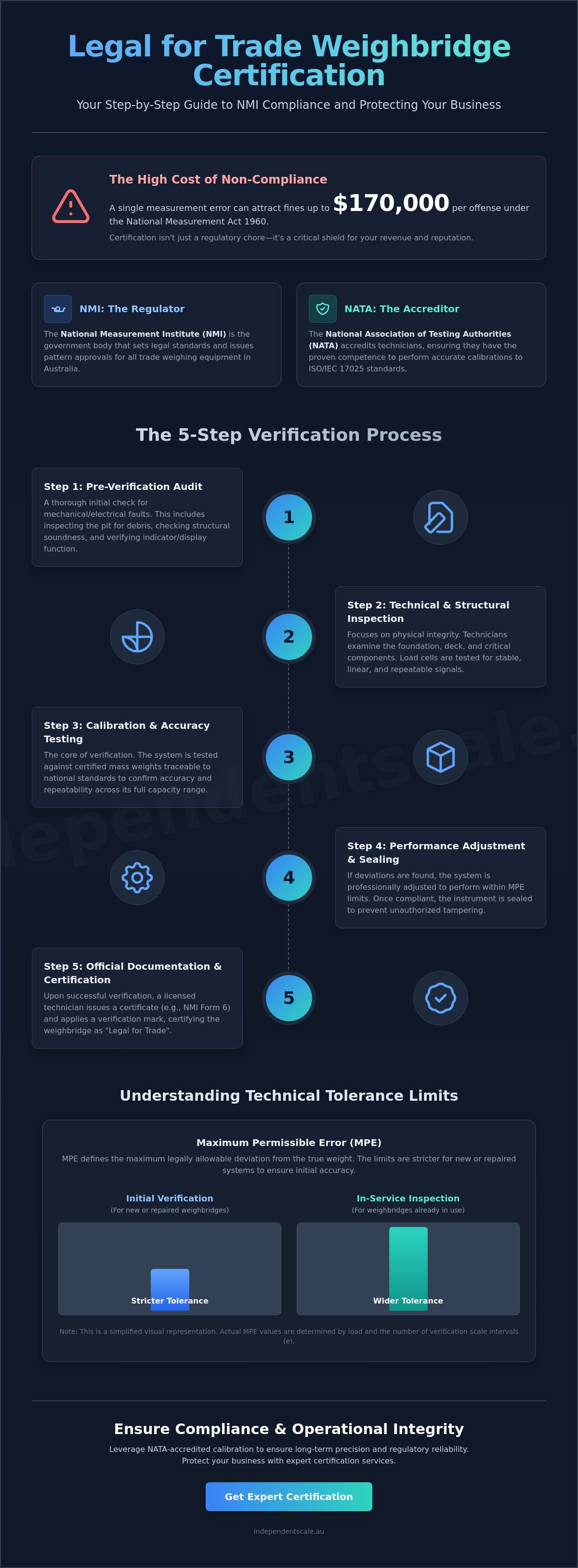
Securing legal for trade weighbridge certification requires a methodical technical approach to meet the National Measurement Institute (NMI) requirements. This is not a simple routine check; it's a rigorous validation of a system's accuracy and structural integrity. Following a structured sequence ensures that industrial weighing equipment operates within the legal limits of reliability while minimizing the risk of expensive re-testing fees.
- Step 1: Pre-Verification Audit. Technicians identify mechanical or electrical faults that could lead to a failed verification. This includes checking for debris in the weighbridge pit and ensuring that indicators and displays are functioning correctly.
- Step 2: Technical Inspection. This phase focuses on the structural integrity of the weighbridge. Technicians examine the foundation, the deck, and the performance of the load cells to ensure they provide stable, linear signals.
- Step 3: Calibration and Testing. Accuracy is verified using certified mass weights traceable to national standards. This step confirms the system's ability to repeat measurements consistently across different load points.
- Step 4: NMI Verification. An official test is conducted by a Servicing Licensed technician. They use NMI-approved procedures to confirm the instrument meets all trade measurement requirements.
- Step 5: Documentation. Upon success, the technician issues a Regulation 13 certificate. The instrument is then sealed with a physical lead or wire seal to prevent any unauthorized adjustments to the calibration settings.
For businesses requiring technical support during this process, professional load cell calibration services provide the precision needed to pass NMI inspections on the first attempt.
Pre-Verification Audit Requirements
A successful legal for trade weighbridge certification starts with a clean and stable structure. Technicians must inspect the weighbridge pit for any binding or build-up of material that could affect weight transfer. It's essential to verify that all load cells are balanced and providing consistent signals across the entire platform. If you suspect an issue with your sensors, sourcing a high-quality load cell supply before the official audit can prevent costly operational downtime. Any electrical interference or grounding issues must be resolved at this stage to ensure signal stability during testing.
The Role of Certified Mass Weights
Verification is only valid if conducted with traceable, certified weights. These weights must adhere to specific Technical Standards and Tolerance Limits to ensure the measurement is legally defensible. For high-capacity weighbridges, technicians often use substitution testing. This involves using a combination of known weights and a stable load, such as a test truck, to verify the scale at its maximum capacity. The test truck and weights must meet NMI pattern approval requirements. This process ensures the entire system handles heavy loads without structural deflection that could cause measurement errors in commercial transactions.
NMI Technical Standards and Tolerance Limits
The technical foundation of legal for trade weighbridge certification is the Maximum Permissible Error (MPE). These limits define the maximum allowable deviation between the weight indicated by the scale and the actual known mass. In Australia, the National Measurement Institute (NMI) categorizes these tolerances based on verification scale intervals, denoted as "e". While general industrial weighing might tolerate broader fluctuations, trade-certified systems must operate within strict bands to ensure commercial equity. Failure to meet these limits during an inspection results in immediate decertification and potential fines.
Accuracy requirements differ depending on whether the instrument is undergoing an initial verification or an in-service inspection. Initial verification applies to new installations or systems that have undergone significant structural repairs. For these, the MPE is typically half of the tolerance allowed during subsequent in-service inspections. This higher standard for new equipment ensures that the system has sufficient "accuracy headroom" to account for natural wear and environmental degradation over time.
Environmental factors significantly impact compliance with these technical standards. High winds can exert vertical force on a large weighbridge deck, creating "ghost" weight readings that exceed allowable tolerances. Similarly, extreme temperature fluctuations can cause thermal expansion in the steel structure or drift in load cell signals. Technicians must account for these variables by ensuring the weighbridge is installed with adequate drainage, clearance, and shielding to maintain stability during the certification process.
Maximum Permissible Error (MPE) Breakdown
The NMI utilizes three primary tolerance bands based on the number of scale intervals (e) being tested. For a typical Class III heavy-capacity weighbridge, the in-service MPE limits are structured as follows:
- 0 to 500e: The allowable error is ±1.0e. For a weighbridge with a 20kg interval, this equates to ±20kg.
- 501 to 2,000e: The allowable error increases to ±2.0e (±40kg for a 20kg interval).
- 2,001 to 10,000e: The allowable error is ±3.0e (±60kg for a 20kg interval).
These bands ensure that the percentage of allowable error remains consistent across the entire capacity of the scale. Precision is non-negotiable; if a system exceeds these limits at any test point, it cannot receive legal for trade weighbridge certification until recalibrated.
Pattern Approval and NMI Certificates
A weighbridge cannot be certified for trade unless every component in the measurement chain has NMI Pattern Approval. This means the design of the load cells, the digital indicator, and the signal processing hardware must be evaluated and approved by the NMI. When upgrading or repairing a system, it's vital to check that all conditioners and transmitters carry valid NMI compliance markers or "S-certificates."
If you use a component that isn't pattern-approved, the entire system is disqualified from trade use, regardless of how accurate its readings appear. You can verify your weighbridge design by cross-referencing the manufacturer's NMI certificate number against the NMI's public database. Ensuring your hardware meets these specifications before a technician arrives is the most effective way to prevent certification failure and minimize operational downtime.
Maintaining Compliance: Avoiding Certification Failure
Failing a legal for trade weighbridge certification often results from preventable mechanical issues rather than internal electronic failure. Build-up of mud, stones, or industrial waste in the gaps between the weighbridge deck and the pit wall is a primary cause of measurement "binding." This physical restriction prevents the full load from reaching the load cells. It leads to inaccurate readings that exceed the MPE limits discussed in the previous section. Failing a certification is expensive. It stops your billing. It invites regulatory scrutiny. Proactive management is the only way to ensure a first-time pass.
Environmental hazards pose a constant threat to system accuracy. Moisture ingress in junction boxes or damage from lightning strikes can cause signal instability. Implementing robust surge arrestors is a critical preventative measure for outdoor installations. Regular maintenance schedules must include visual inspections of the structural foundation and cable integrity. This ensures the system remains compliant between formal NMI inspections. Staff training is equally vital. Operators must understand how to correctly zero the scale and identify error codes that could signal a loss of calibration.
If you require immediate technical support to rectify a failed system, our technicians provide expert load cell calibration and repair to restore your legal compliance.
Site Preparation Checklist for Site Managers
A successful inspection requires more than just a functional scale. Site managers must ensure the environment is ready for the technical team. Use this checklist to prevent delays:
- Sanitation: Pressure wash the weighbridge and clear all debris from under the deck and around the load cell mounts.
- Access: Clear a path for the heavy test unit. The inspector's truck and certified weights require significant maneuvering space.
- Records: Have all historical calibration records and NMI pattern approval documents ready for review.
- Power: Ensure the digital indicator has been powered on for at least 30 minutes to reach thermal stability before testing begins.
Dealing with Repairs and Re-Certification
Component failure is inevitable in harsh industrial environments. If a load cell fails, the load cell repair process must be followed by a formal re-verification. Replacing a critical component like a load cell or an indicator breaks the original NMI seal. Under the National Measurement Act, the instrument is technically "unverified" once the seal is broken. You must place an "Out of Order" tag on the system and refrain from trade use until a licensed technician performs a re-verification. This process confirms that the repair hasn't introduced non-linearity or hysteresis into the weighing results. Promptly scheduling a re-test is the only way to minimize operational downtime and avoid the legal risks of using an unsealed instrument.
Expert Certification Services with Independent Scale Service
Independent Scale Service provides comprehensive management of the legal for trade weighbridge certification process for industrial clients throughout Australia. We operate with a focus on technical precision and regulatory compliance to ensure your weighing infrastructure meets National Measurement Institute (NMI) standards. Our service model is designed to eliminate the administrative and technical complexities associated with the National Measurement Act. We manage the entire verification sequence, from pre-audit inspections to the final issuance of Regulation 13 certificates. This end-to-end approach allows your facility to maintain operational continuity while securing a legally defensible measurement system.
Our technical reach extends across Sydney, Melbourne, and regional Australia. We specialize in high-capacity systems and complex industrial environments that require more than a basic accuracy check. This includes specialized concrete batching plant calibration and repair services that comply with AS 1379 requirements. By integrating NMI verification with our broader maintenance capabilities, Independent Scale Service provides a single point of accountability for your weighing accuracy. We understand the urgency of industrial timelines and prioritize responsive service to minimize the risk of equipment downtime during the certification window.
NATA Accredited Precision
A critical differentiator in our service is our NATA accreditation to ISO/IEC 17025. While NMI verification is the legal minimum for trade, NATA accreditation represents the global gold standard for technical competence in calibration. This accreditation confirms that our equipment, procedures, and technicians have been rigorously audited for measurement proficiency. For your quality management system, Independent Scale Service provides a level of assurance that standard verification cannot match. Our technical reports include detailed uncertainty data and linearity analysis, offering a deeper insight into your instrument's performance than a simple "pass or fail" trade stamp. This data-driven approach is essential for high-stakes industrial applications where even minor deviations impact the bottom line.
Total Weighing Solutions
Our expertise goes beyond the initial legal for trade weighbridge certification. We provide a full lifecycle of support for industrial weighing infrastructure. This includes the professional load cell supply and installation of NMI pattern-approved components. We also offer specialized solutions for non-standard weighing systems, such as tank and silo weighing assemblies and hopper calibration service. If your facility is preparing for an upcoming inspection or upgrading its current hardware, contact Independent Scale Service for a tailored compliance audit. We'll identify potential failure points before they lead to decertification, ensuring your equipment remains a reliable asset for your commercial operations.
Secure Your Operational Integrity
Achieving legal for trade weighbridge certification is a technical necessity that safeguards your industrial operations against substantial legal and financial risks. By mastering NMI pattern approvals and adhering to strict MPE tolerance bands, you ensure every commercial transaction remains accurate and defensible. Maintaining a clean weighbridge deck and scheduling regular audits are the most effective ways to prevent certification failure and the resulting operational downtime. These proactive measures protect your revenue and reinforce your reputation for precision in a competitive market.
Independent Scale Service provides the specialized expertise required to navigate these regulatory complexities with methodical precision. As NATA accredited specialists to ISO/IEC 17025 and AS 1379 compliant experts, we deliver authoritative calibration and verification services across Sydney, Melbourne, and regional Australia. Our technicians focus on technical proficiency and responsiveness to ensure your equipment meets every national standard. We manage the technical burden of NMI compliance so your facility can maintain a high standard of measurement integrity and commercial transparency.
Secure Your NMI Compliance with Independent Scale Service Today
Reliable measurement is the foundation of your industrial success.
Frequently Asked Questions
How often does a weighbridge need to be certified for trade in Australia?
Weighbridges used for trade don't have a fixed expiration date under the National Measurement Act, but they must remain accurate within MPE limits at all times. Public weighbridges require a license that is renewed through an annual fee. We recommend an annual inspection cycle for all trade systems to account for structural wear and environmental changes. This frequency ensures you avoid the heavy penalties associated with using an inaccurate instrument.
What is the difference between calibration and NMI verification?
Calibration is the technical process of comparing a scale's output against a known mass and adjusting it to minimize error. Verification is the legal act of confirming that the instrument complies with NMI pattern approval and technical standards. While calibration ensures accuracy, only verification allows you to legally use the scale for trade. A Regulation 13 certificate is only issued following a successful verification.
Can any technician perform a legal for trade verification?
No, general electricians or unlicensed technicians aren't authorized to perform legal for trade weighbridge certification. Only an NMI-accredited Servicing Licensee has the legal authority to verify and seal a weighing instrument for commercial use. These professionals use certified test masses that are traceable to national standards. Using an unlicensed individual for verification invalidates the legal status of your weighing data.
What documents do I need to provide for a public weighbridge license?
You must provide a formal application to the NMI along with a valid verification certificate, known as a Regulation 13, from a licensed technician. The application process also requires proof of operator competence and the payment of government fees. For the 2025-2026 period, the NMI has set the new application fee at $785.00. Licenses are typically issued for up to three years with an annual fee of $550.00.
What happens if my weighbridge fails its NMI verification test?
If an instrument fails verification, it must be removed from trade service immediately and marked with an "Out of Order" tag. You're legally prohibited from using the scale for commercial transactions until the fault is repaired. After repairs are completed, a licensed technician must perform a full re-verification and apply a new seal. This ensures the system is restored to the required NMI accuracy standards.
Is NATA accreditation required for legal for trade weighbridge certification?
NATA accreditation isn't legally mandatory for trade verification, but it's the industry benchmark for technical proficiency. While NMI verification confirms your scale meets the minimum legal standards, NATA accreditation to ISO/IEC 17025 provides a more detailed analysis of measurement uncertainty. Many industrial clients prefer NATA-standard reports to satisfy their internal quality management systems and high-profile corporate contract requirements.
Do I need to re-verify my weighbridge if I replace a load cell?
Yes, replacing a load cell requires the weighbridge to undergo a full re-verification. Replacing a major component like a load cell or digital indicator involves breaking the original NMI seal, which renders the current certification void. A licensed technician must test the system across its full range to ensure the new component performs correctly. They'll then apply a new seal and issue a fresh Regulation 13 certificate.
How much does legal for trade weighbridge certification typically cost?
The total cost for legal for trade weighbridge certification depends on several factors, including the capacity of the scale and the travel distance for the test unit. While the government application fee is fixed at $785.00 for new licenses, the service fee for the technical verification is separate and based on the provider's scope. You should request a tailored quote that includes the provision of certified test weights and the technician's expertise.
