


Industrial Weighing Equipment: The 2026 Guide to Accuracy and Compliance
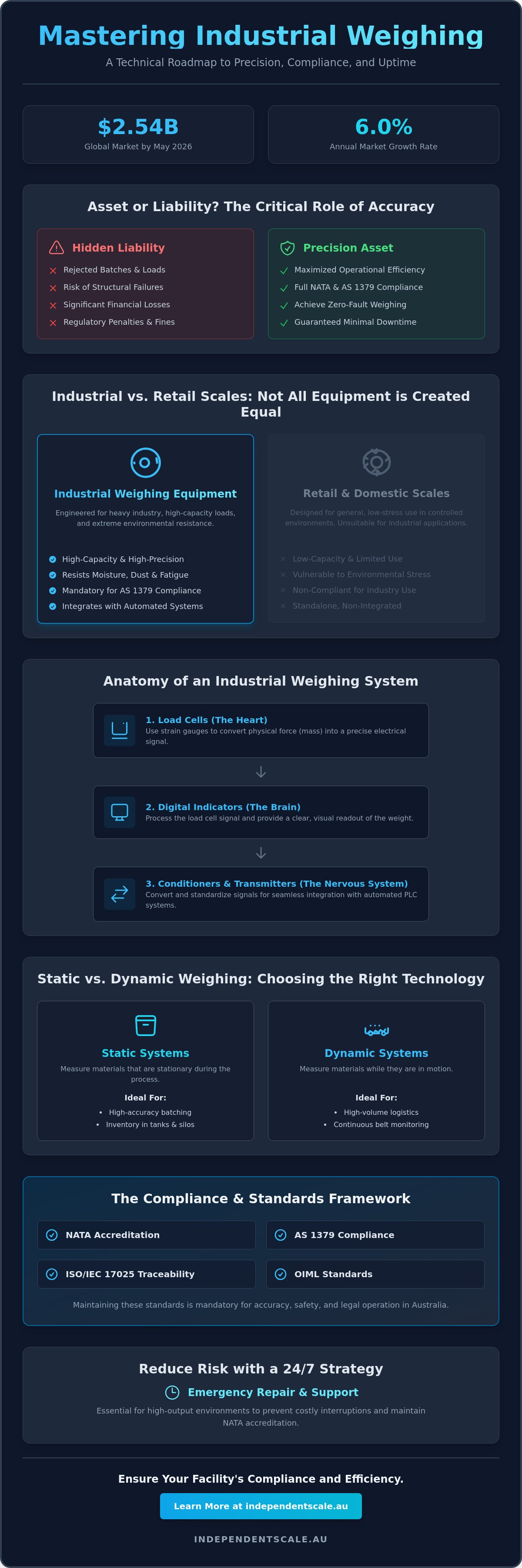
Is your weighing equipment a precision asset or a hidden liability costing your facility thousands in batching errors? By May 2026, the global industrial weighing market has expanded to $2.54 billion, reflecting a 6.0% growth rate as facilities move toward automated, smart systems. You likely understand that maintaining accuracy isn't just about operational efficiency. It's a mandatory requirement for staying compliant with Australian Standards like AS 1379. When a single inaccurate measurement leads to rejected loads or structural failure, there's no room for technical ambiguity or unexpected hardware failure.
You've likely felt the pressure of maintaining NATA accreditation while trying to minimize downtime. This guide provides the technical roadmap to master calibration standards and selection criteria for your specific industrial needs. We'll examine the 2026 updates to international standards like ISO/IEC 17025 and provide a breakdown of the hardware configurations required for long-term durability in harsh environments. You'll gain the expertise needed to achieve zero-fault weighing operations and ensure your facility remains fully compliant with all current Australian regulatory frameworks.
Key Takeaways
- Differentiate between retail scales and high-precision industrial weighing equipment to ensure your assemblies meet the rigorous demands of heavy industry.
- Learn to specify load cells based on capacity and environmental stressors to prevent failure from moisture, lightning, and mechanical fatigue.
- Maintain full NATA accreditation and AS 1379 compliance through structured calibration schedules traceable to ISO/IEC 17025 standards.
- Reduce operational risks by implementing a 24/7 emergency repair strategy designed to minimise downtime in high-output production environments.
What is Industrial Weighing Equipment? Scope and Definitions
Industrial weighing equipment refers to high-precision measurement assemblies engineered to determine the mass of materials within heavy industrial environments. Unlike a standard weighing scale used in retail or domestic settings, industrial-grade systems are designed for high-capacity loads and extreme environmental resistance. In sectors like concrete production and mining, precision is the difference between a compliant batch and a structural failure. For instance, in Sydney's concrete industry, where ISS services 98% of plants, adherence to AS 1379 requires equipment to maintain strict accuracy tolerances under continuous operation.
This equipment is the foundation of batching, logistics, and quality control. Inaccurate measurements don't just affect product quality; they lead to significant financial losses and regulatory penalties. As of May 2, 2026, the global market for these systems has reached $2.54 billion, driven by a 6.0% growth rate as facilities integrate weighing data directly into ERP and warehouse management systems. Precision isn't optional for serious industrial clients; it's a technical requirement for survival.
The Core Components of a Weighing System
A functional weighing assembly relies on three primary elements to convert physical force into actionable data. The load cells act as the system's heart, using strain gauges to detect mechanical stress. This signal is processed by digital indicators and displays, which provide the operator with a visual readout of the mass. For complex automation, conditioners and transmitters are essential. These components convert low-level signals into standardized outputs for PLC systems. This ensures that data flows seamlessly into automated production lines, reducing the risk of manual entry errors and improving overall facility efficiency.
Static vs. Dynamic Weighing Equipment
Choosing the right technology depends on the material flow within your facility. Static weighing equipment, such as platform scales or tank and silo assemblies, measures a fixed load that remains stationary during the process. This is the standard for batching plants where specific weights must be verified before mixing to meet AS 1379 standards.
- Static Systems: Ideal for high-accuracy batching and inventory verification of stationary tanks.
- Dynamic Systems: Critical for high-volume logistics, measuring materials on moving conveyor belts or through liquid flowmeters.
Dynamic weighing involves measuring materials while they're in motion. Belt scales and liquid flowmeters allow for continuous monitoring of bulk materials or fluids without stopping the production line. While static systems offer higher absolute precision for batching, dynamic systems are essential for high-volume logistics and inventory management. Selecting the incorrect type leads to measurement errors that compromise both product quality and regulatory compliance.
Essential Hardware: Load Cells and Indicators
Hardware selection determines the ultimate precision and lifespan of your weighing system. In industrial environments, the choice of load cell supply depends strictly on the force application. Compression load cells are standard for truck scales and large silos. Tension cells are utilized for suspended hoppers. Beam cells, including single-point and shear beam variants, are common in platform scales. These components must adhere to standards set by the International Organization of Legal Metrology (OIML) to ensure global measurement consistency. Capacity selection must account for both the live load and the dead load of the structure. A common industry standard is to select cells where the total capacity is 20% to 50% higher than the maximum anticipated gross weight to prevent structural overload.
Beyond the cells, system integrity relies on junction boxes and surge arrestors. These components protect sensitive electronics from lightning strikes and electrical noise. Summing circuits in junction boxes ensure multiple load cells provide a single, accurate output. Without these protective measures, your weighing equipment is vulnerable to catastrophic failure during electrical storms or power surges. Lightning protection is non-negotiable for outdoor weighbridges. Surge arrestors divert high-voltage transients to the ground, preventing the destruction of the summing board and the indicator's internal circuitry.
Selecting the Right Load Cell for Your Environment
Environmental factors dictate material choice. Alloy steel is cost-effective for dry, controlled environments. Stainless steel is mandatory for corrosive or washdown areas. IP ratings are the primary metric for ingress protection. IP67-rated cells withstand temporary immersion, while IP68 cells are required for continuous submersion or high-pressure cleaning. For heavy-duty storage, specialized tank and silo weighing assemblies incorporate mounting kits that handle thermal expansion and side-loading forces. These assemblies ensure that the load is applied vertically to the cell, maintaining accuracy even as the tank expands or contracts with temperature changes.
Digital Indicators and Signal Conditioners
The indicator translates raw millivolt signals into readable data. High-resolution indicators and displays are vital for precision batching where small deviations compromise the final product. In modern facilities, conditioners and transmitters bridge the gap between the scale and the control room. They minimize signal interference over long cable runs, ensuring the PLC receives a clean signal. This is critical in plants with high electromagnetic interference from large motors or high-voltage lines. If you're upgrading an aging plant, you can browse our full technical range to find compatible components for your existing infrastructure.
Industry-Specific Equipment: From Concrete to Silos
Industrial weighing equipment is never a universal solution; it must be engineered for the specific material and environment it serves. In Australia, the concrete production sector represents one of the most demanding applications for this technology. Accuracy isn't merely a preference; it's a legal requirement under AS 1379. This standard dictates the allowable deviations for every component of a concrete mix, from cementitious materials to chemical admixtures. When equipment fails to meet these tolerances, the consequences include rejected batches, structural integrity risks, and costly project delays on major infrastructure sites.
The operational environment in mining and heavy manufacturing further complicates hardware selection. Dust, vibration, and mechanical shock can all degrade the accuracy of a system over time. To maintain zero-fault operations, facilities must match their hardware to the specific physical demands of their material flow. Whether you're managing bulk solids in a silo or volatile liquids in a tank, the weighing assembly must be robust enough to provide repeatable data under continuous load.
Concrete Batching Plant Equipment Requirements
A typical concrete plant utilizes a complex network of weighing systems for cement, water, and aggregate hoppers. Each requires a specific hardware configuration to handle the vibration and dust inherent in the batching process. Cement hoppers typically utilize three-point compression mountings to ensure stability and precise measurement. Ensuring these systems remain accurate requires AS 1379 compliant calibration and repair. While local standards are paramount, the technical specifications often mirror the rigorous tolerances found in the NIST Handbook 44, which serves as a global benchmark for weighing device specifications. If your equipment drifts outside these limits, you're not just losing material; you're risking your NATA accreditation.
Hopper and Tank Weighing Assemblies
Bulk material management in silos and tanks requires specialized tension or compression assemblies. For suspended systems, special purpose and shackle pins provide a robust solution for overhead weighing. These pins replace standard load pins in cranes or hoists, turning a lifting component into a precision measurement tool. For liquid storage tanks, the gravimetric method is employed during hopper calibration services. This method is the most accurate way to verify scale performance, as it relies on the physical weight of a known mass rather than inferred volume. Regular service intervals are essential to prevent mechanical fatigue in the mountings and ensure that moisture ingress hasn't compromised the summing circuits in your junction boxes.
The Critical Role of Calibration and Compliance
Precision hardware is a depreciating asset without a rigorous calibration schedule. Your weighing equipment is only as accurate as its most recent NATA-accredited verification. In the Australian regulatory landscape, specifically for concrete production under AS 1379, calibration isn't a suggestion; it's a mandatory operational requirement. A high-resolution indicator paired with a premium load cell will still produce erroneous data if mechanical fatigue or environmental drift remains uncorrected. Inaccurate measurements lead to rejected loads, which directly impacts your bottom line and project timelines.
Effective compliance requires adherence to ISO/IEC 17025. This international standard distinguishes a professional calibration from a basic commercial test. While a standard test might verify that a scale functions, an ISO/IEC 17025 calibration ensures that every measurement is traceable to national standards. ISS leverages over 30 years of experience to deliver these technical services across Sydney and beyond. For high-use industrial facilities, the frequency of these services is determined by throughput and risk. Most concrete batching plants require quarterly or bi-annual inspections to maintain zero-fault operations and avoid the commercial disputes that arise from inaccurate load-out data.
NATA Accredited Calibration vs. Standard Testing
NATA-accredited load cell calibration involves testing the full range of the sensor's capacity using certified test masses. This process confirms linearity, hysteresis, and repeatability under real-world conditions. In Australia, traceability is the backbone of legal metrology. If your data isn't traceable, it's legally indefensible in a contract dispute. For a comprehensive breakdown of the requirements for weighing equipment in Australia, consult our authoritative guide to calibration services.
Force Gauge and Specialized Calibration
Specialized applications require specific metrological approaches. Force gauge calibration is essential for tension testing, safety equipment verification, and material strength analysis. For liquid handling, liquid flowmeter calibration using gravimetric methods provides the highest level of accuracy by comparing flow volume to physical mass. This method is the industry gold standard, as it eliminates variables like temperature and aeration that often compromise volumetric meters. Regular weighing scale calibration protects your margins by ensuring you never over-deliver product or under-bill clients. If your facility is due for an audit, book a NATA-accredited technician today to secure your compliance status.
Maintenance and Repair: Minimising Industrial Downtime
Unscheduled downtime in a 24-hour production facility is a primary driver of revenue loss. While high-quality weighing equipment is engineered for longevity, the harsh conditions of industrial sites eventually induce mechanical and electrical stress. Moisture ingress, lightning strikes, and mechanical fatigue are the three most common causes of system failure. In a concrete batching environment, a single failed load cell can halt production entirely, leading to thousands of dollars in lost throughput and wasted material. Effective maintenance is not merely about fixing broken parts; it is about predictive intervention to ensure continuous operation. As of May 2026, the adoption of smart weighing systems with automatic malfunction detection has increased, yet physical inspections remain the only way to verify structural integrity.
Preventative maintenance extends the lifecycle of your assets by identifying minor issues before they escalate into catastrophic failures. For instance, regular checks of cable shielding and mounting hardware prevent signal drift and mechanical binding. In plants where operations never stop, access to 24/7 emergency repair services is essential. A delay of even a few hours can disrupt entire supply chains for Tier 1 contractors like Boral or Holcim. Independent Scale Service provides the technical responsiveness required to keep these critical systems online, ensuring that your facility maintains its NATA-accredited status and AS 1379 compliance without interruption.
Load Cell Testing and Fault Diagnosis
Identifying a drifting load cell requires specialized diagnostic tools and technical expertise. Technicians look for inconsistencies in millivolt output and insulation resistance to pinpoint failing components. Many electrical failures are preventable through the correct installation of junction boxes and surge arrestors. These components act as the first line of defence against the high-voltage transients caused by lightning or industrial power surges. For a deeper technical analysis of troubleshooting procedures, refer to our essential guide to industrial load cells. Early diagnosis prevents the total loss of the summing board and protects the digital indicator from back-fed electrical noise.
Why Choose Independent Scale Service?
Independent Scale Service (ISS) is the trusted authority for industrial weighing in Australia. With over 30 years of experience, we provide a level of technical competence that general contractors cannot match. We currently service 98% of concrete plants across Sydney, providing the precision required to meet rigorous Australian Standards. Our technicians are experts in gravimetric calibration and NATA-accredited testing, ensuring your facility remains compliant and productive. Whether you require a routine audit or an emergency intervention, our team is equipped to handle the most complex industrial challenges. Contact our expert team for 24/7 emergency support to secure your weighing operations today.
Securing Operational Accuracy for 2026 and Beyond
Maintaining precise weighing equipment is a technical necessity for any high-output industrial facility. This guide has detailed how selecting hardware based on IP ratings and environmental stressors prevents premature failure. You now understand that accuracy is not a static achievement; it requires constant verification against standards like AS 1379 to ensure structural and commercial integrity. Adhering to quarterly or bi-annual calibration schedules is the only way to safeguard your facility against the financial fallout of rejected material batches and regulatory non-compliance.
Independent Scale Service provides the specialized expertise needed to maintain these rigorous standards. As AS 1379 compliance experts, we ensure your systems remain NATA Accredited to ISO/IEC 17025. Our team offers emergency 24/7 support across Australia to minimize downtime by addressing mechanical and electrical failures immediately. Whether you're managing concrete production or bulk mining logistics, we deliver the precision your operations demand. Secure your facility's long-term durability and regulatory standing by partnering with a trusted authority. Get a Professional Quote for Industrial Equipment or Calibration today.
Frequently Asked Questions
What is the difference between NATA-accredited and standard calibration?
NATA-accredited calibration is performed under the ISO/IEC 17025 standard, ensuring that all measurements are traceable to national standards. A standard calibration is a basic verification that lacks the documented traceability and technical rigour required for legal metrology. NATA certificates provide the technical evidence necessary for audits and legal defensibility in heavy industry.
How often should industrial weighing equipment be calibrated?
Calibration frequency depends on equipment usage and the risk associated with measurement errors. High-output facilities, such as concrete batching plants, typically require quarterly inspections to maintain AS 1379 compliance. Lower-volume operations may only require annual servicing, provided the hardware remains protected from environmental stressors and mechanical shock.
What are the main causes of load cell failure in concrete plants?
Moisture ingress and lightning strikes account for approximately 75% of load cell failures in outdoor industrial environments. Mechanical fatigue from continuous vibration and overloading also degrades the strain gauge's ability to return to zero. Utilizing stainless steel cells with IP68 ratings and surge protection significantly reduces these failure rates in harsh Sydney plant conditions.
Does my equipment need to comply with AS 1379?
Yes, any facility producing concrete for structural applications in Australia must adhere to the tolerances defined in AS 1379. This standard mandates specific accuracy requirements for cement, water, and aggregate weighing systems. Non-compliance results in rejected batches and the potential loss of NATA accreditation for the facility.
Can load cells be repaired or do they always need replacement?
Load cells are precision-sealed instruments and generally require replacement rather than repair once the internal strain gauge or hermetic seal is compromised. While external cables and connectors can be serviced, the internal circuitry is fixed in resin to prevent moisture ingress. Replacing a faulty cell is the only way to guarantee the return of the weighing equipment to its original factory specifications.
What is the gravimetric method for flowmeter calibration?
The gravimetric method calibrates liquid flowmeters by comparing the meter's reading against the actual physical mass of the liquid as measured on a NATA-certified scale. This is the most accurate calibration technique because mass is a constant value unaffected by temperature or aeration. It eliminates the 2% to 5% error margins often found in volumetric calibration methods.
How do surge arrestors protect my weighing equipment?
Surge arrestors protect sensitive electronics by diverting high-voltage transients, such as those from lightning or industrial power spikes, directly to the ground. They are installed between the load cells and the digital indicator to prevent the destruction of the summing circuit. This protection is essential for outdoor weighbridges where electrical storms can cause catastrophic hardware failure.
What information is included in a NATA calibration certificate?
A NATA calibration certificate includes the measurement results, the calculated uncertainty of measurement, and evidence of traceability to national standards. It also lists the specific test masses used, the environmental conditions during testing, and the unique accreditation number of the laboratory. This document serves as the primary proof of compliance during ISO/IEC 17025 audits.
