


Industrial Scales for Sale in Sydney: The 2026 Compliance & Selection Guide
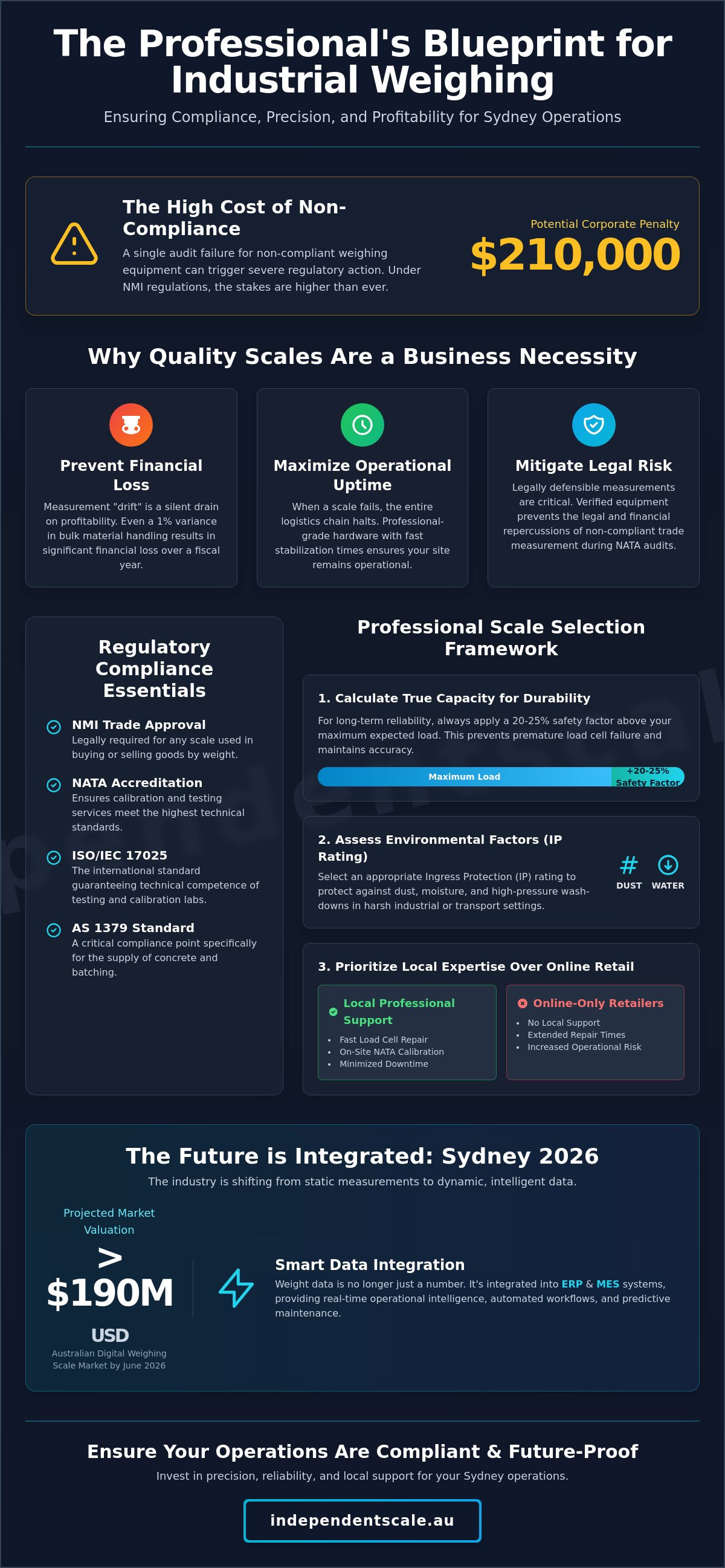
In 2026, a single audit failure for non-compliant weighing equipment can result in corporate penalties of up to $210,000 under National Measurement Institute (NMI) regulations. When sourcing industrial scales for sale Sydney operators often prioritize initial purchase price, yet the true value of an instrument is measured by its sustained precision and legal adherence. For serious industrial clients, a scale isn't just hardware; it's a critical component of regulatory risk management.
You're likely aware that equipment downtime and inaccurate measurements do more than just disrupt your workflow. They cause material waste and site delays that compromise your project timelines and bottom line. This guide provides the technical framework to select rugged weighing solutions that ensure full NATA compliance and long-term accuracy for your Sydney operations. We'll examine the essential criteria for NMI trade approval, the necessity of AS 1379 standards for concrete batching, and how local calibration support minimizes your operational risk. From load cell supply to hopper and silo calibration, ensuring your equipment meets ISO/IEC 17025 standards is the only way to guarantee technical competence.
Key Takeaways
- Understand the legal necessity of NATA accreditation and AS 1379 compliance to avoid significant regulatory penalties and ensure trade-approved accuracy.
- Learn how to select industrial scales for sale Sydney industries rely on by applying a 20-25% safety factor to maximum load capacities for long-term reliability.
- Evaluate environmental factors like IP ratings to ensure weighing equipment durability against dust and water ingress in harsh construction and transport settings.
- Identify why localized load cell repair and professional hopper calibration are superior to online-only retail options for minimizing operational downtime.
- Determine the specific technical requirements for heavy-duty applications ranging from 1t to 100t+ to ensure your load cell supply matches your site's operational demands.
Navigating the Industrial Weighing Landscape in Sydney
For Sydney-based operations, an industrial scale is a precision instrument engineered for high-capacity environments ranging from 1,000kg to 100,000kg and beyond. The current market for industrial scales for sale Sydney offers must address the specific requirements of the construction, civil engineering, and transport sectors. Precision is mandatory. While a standard consumer weighing scale might suffice for light commercial use, it lacks the structural integrity and NMI-approved pattern required for trade verification in heavy industry. Off-the-shelf retail alternatives fail under the stress of high-impact loading and abrasive materials. For professional operators, weighing equipment serves as a compliance safeguard, ensuring every transaction and material batch adheres to strict Australian legal standards.
The Sydney Industrial Market in 2026
The demand for high-capacity systems has surged in Sydney’s western industrial hubs, driven by massive infrastructure projects like the Western Sydney Aerotropolis. By June 2026, the Australian digital weighing scale market has reached a projected valuation of over USD 190 million. This growth is fueled by a shift toward digital integration and real-time data tracking. Modern sites no longer treat weight as a static number. Instead, weight data is integrated into ERP and MES systems to provide operational intelligence. This connectivity allows for predictive maintenance and automated workflow triggers, which are essential for maintaining a competitive edge in high-volume production environments.
Why Quality Scales are a Business Necessity
Measurement "drift" is a silent drain on profitability. In bulk material handling, even a 1% variance in accuracy leads to significant financial loss over a fiscal year. High-quality industrial weighing scales prevent these inaccuracies by utilizing superior load cell technology and robust housing. Robust equipment minimizes site downtime. When a scale fails, the entire logistics chain stops. Investing in professional-grade hardware ensures that your site remains operational and your measurements remain legally defensible during NATA audits. Accuracy isn't just about the display; it's about the reliability of the internal components under constant mechanical stress.
- Load Cell Integrity: High IP ratings protect against Sydney's dust and moisture ingress.
- Operational Efficiency: Fast stabilization times reduce the cycle time for vehicle and hopper weighing.
- Risk Mitigation: Verified equipment prevents the legal and financial repercussions of non-compliant trade measurement.
Essential Types of Industrial Scales for Sydney Operations
Selection of hardware is a technical decision based on material state, capacity requirements, and environmental exposure. When evaluating industrial scales for sale Sydney operators must match the instrument to the specific stressors of their site. A scale used in the salt-laden air of Port Botany requires different protection than a unit situated in the dusty environments of Western Sydney. The heart of every system is the load cell. Choosing the wrong sensor type for your specific application leads to premature failure and measurement drift. Accuracy is maintained through strict calibration protocols overseen by the NATA (National Association of Testing Authorities), ensuring your equipment remains within legal tolerance levels.
Platform and Floor Scales for Logistics
Pallet handling in Sydney warehouses requires low-profile floor scales to facilitate efficient forklift and pallet jack access. For dry, indoor logistics, mild steel platforms provide a cost-effective solution. However, for wash-down areas or chemical storage, 304 or 316-grade stainless steel is mandatory to prevent corrosion. High-visibility digital indicators are essential for safety in high-traffic zones, allowing operators to verify loads quickly without leaving their vehicles. These systems are the workhorses of the logistics sector, providing the first line of defense against overloaded transport vehicles.
Heavy-Duty Crane and Hanging Scales
Sydney’s ports and high-rise construction sites utilize crane scales to monitor suspended loads in real-time. These systems must meet rigorous safety factors to prevent catastrophic failure during lifting operations. It's critical to use certified hardware, such as special purpose and shackle pins, which are engineered for custom lifting and force measurement applications. Safety and precision are non-negotiable in overhead weighing; any deviation can result in site-wide shutdowns or regulatory intervention.
Specialised Tank, Silo, and Hopper Systems
The concrete and chemical sectors are transitioning from volumetric estimation to weight-based measurement for superior accuracy. Utilizing tank and silo weighing assemblies transforms static storage structures into active inventory management tools. This shift ensures that batching plants meet the strict accuracy requirements of AS 1379 while reducing material waste. Weight-based systems eliminate the variables of material density and aeration that often plague volumetric sensors.
If your site requires a specialized configuration, reviewing our comprehensive range of high-performance load cells is the first step toward a compliant and reliable installation.
Compliance Matters: NATA Accreditation and AS 1379 Standards
Procuring industrial scales for sale Sydney businesses require is a decision rooted in risk management rather than mere procurement. In high-stakes sectors like civil engineering and bulk logistics, measurement accuracy is a legal mandate. The international benchmark for this accuracy is ISO/IEC 17025, which governs the technical competence of testing and calibration laboratories. Without adherence to these standards, weight data is legally indefensible. For Sydney operations engaged in government or civil contracts, using non-compliant weighing equipment isn't just a technical oversight; it's a breach of contract that can lead to immediate site shutdowns and significant regulatory fines.
The Role of NATA in Australian Industry
NATA is the national authority for laboratory accreditation in Australia. For a Sydney service provider, NATA accreditation serves as independent verification that their equipment, processes, and staff meet rigorous international standards. There's a fundamental difference between a standard "functional check" and a NATA-certified calibration service. While a functional check confirms the scale is operational, a NATA-certified calibration provides a traceable record of accuracy that is recognized by the National Measurement Institute (NMI). This traceability is essential for any business selling goods by weight, as it ensures the equipment remains "legal-for-trade" under Australian law.
Concrete Batching Compliance (AS 1379)
The concrete industry operates under particularly stringent requirements. AS 1379-2007, which was reconfirmed in 2017, specifies the requirements for the specification and supply of concrete. This standard dictates precise tolerances for the weighing of cement, aggregates, and water. Even minor deviations in these components can compromise the structural integrity of the finished product. To mitigate this risk, Sydney contractors must utilize specialized concrete batching plant calibration services. Regular audits and calibrations protect businesses from structural liability claims and ensure that every batch meets the engineering specifications required for Sydney's infrastructure projects. Reliance on uncertified equipment in this sector is a gamble that professional operators cannot afford to take.
- NATA Accreditation: Ensures technical competence and traceable results under ISO/IEC 17025.
- AS 1379 Compliance: Mandatory for concrete production to ensure structural safety and batch consistency.
- Legal-for-Trade: Required for any industrial scales for sale Sydney firms use to sell goods by weight.
- Risk Mitigation: Prevents fines of up to $210,000 for corporate non-compliance with trade measurement laws.
How to Choose the Right Industrial Scale: A Professional Framework
Selecting the correct hardware from the variety of industrial scales for sale Sydney offers requires a methodical evaluation of five operational variables. Most procurement failures occur because the system capacity matches the maximum load exactly, leaving no margin for error. A professional framework ensures that the chosen instrument survives the mechanical stress of heavy industry while maintaining legal compliance.
- Step 1: Determine Maximum Capacity. Calculate your heaviest anticipated load and apply a safety factor of 20-25%. This buffer accounts for shock loading and off-center placement, which can otherwise deform a sensor.
- Step 2: Assess the Environment. Identify the required Ingress Protection (IP) rating. Sydney’s coastal humidity and western dust hubs demand IP68 or IP69K ratings for load cell assemblies to prevent moisture and particulate failure.
- Step 3: Choose the Interface. Decide between analog and digital load cells. Digital systems offer superior diagnostic capabilities and are less susceptible to signal noise in large-scale factory environments.
- Step 4: Verify Compliance. Confirm if the application requires NMI trade approval for commercial transactions or specific adherence to AS 1379 for concrete production.
- Step 5: Evaluate Total Cost of Ownership. Factor in the frequency of NATA-accredited calibrations and the availability of local repair services to minimize long-term downtime.
Understanding Accuracy vs. Precision
Accuracy refers to how closely the scale's reading matches the true mass of the object. Precision, or repeatability, is the scale's ability to provide the same result over multiple weighments of the identical load. In Sydney’s construction and civil sectors, high precision is often less critical than rugged accuracy. A practical rule of thumb for readability is to select an increment that is at least ten times smaller than your required tolerance. If your tolerance is 1kg, your scale should display in 100g increments to ensure the measurement remains within the acceptable error margin.
Integration with Digital Systems
Modern industrial operations rely on data logging to maintain audit trails. High-performance indicators and displays serve as the primary interface for this data. For automated sites, conditioners and transmitters are required to bridge the communication gap between the weighing hardware and a Programmable Logic Controller (PLC). This integration is the foundation of smart-factory initiatives in Sydney, allowing for wireless data transmission and real-time inventory tracking. Weight data is no longer a static number on a screen; it's a dynamic input for your business management software.
Before finalizing your procurement, review our complete inventory of industrial weighing hardware to ensure every component of your system meets these technical benchmarks.
Industrial Scale Supply, Repair, and Maintenance in Sydney
Procuring industrial scales for sale Sydney operators trust requires more than a simple transaction; it necessitates a long-term service partnership. Online-only retailers lack the technical infrastructure to support high-capacity equipment after installation. If a 50t silo load cell fails, an e-commerce platform cannot provide the on-site diagnostic expertise required to restore operations. Independent Scale Service functions as an authoritative partner for Sydney’s heavy industry, providing the technical competence needed to maintain both hardware and compliance. Our repair process involve rigorous diagnostic testing of digital indicators and load cell bridges to identify fatigue or environmental damage before it leads to a total system failure.
Preventative maintenance is the primary defense against site delays. A structured schedule ensures that weighing equipment remains within NATA and NMI tolerances, preventing the financial losses associated with measurement drift. By identifying worn components early, businesses avoid the high costs of emergency repairs and the legal risks of using non-compliant hardware. Professional maintenance isn't merely a service; it's an essential component of operational risk management.
Local Sydney Support and Rapid Response
We provide comprehensive service coverage across the Sydney metropolitan area and regional NSW, ensuring that critical infrastructure projects remain on schedule. Localized parts availability is a key differentiator for our clients. By maintaining an extensive inventory of load cells and digital indicators within Sydney, we reduce equipment downtime from weeks to hours. Our commitment to minimizing client downtime is supported by our responsiveness to urgent service requests, ensuring your site remains operational under heavy load conditions. Having a local technician who understands the specific environmental stressors of your Sydney site is invaluable for maintaining system uptime.
Beyond the Sale: The Lifecycle of Your Scale
The operational lifecycle of a weighing system extends far beyond the initial installation phase. Regular weighing scale calibration is the most effective method for extending equipment longevity and preventing the gradual onset of measurement drift. As technology advances, many Sydney businesses choose to upgrade legacy analog systems with modern digital load cells. This conversion improves signal integrity and diagnostic capabilities without the capital expense of a full structural replacement. Accuracy is a continuous requirement that demands professional oversight throughout the equipment's life.
- Diagnostic Expertise: Specialized testing of load cell supply and bridge resistance to ensure electrical integrity.
- System Upgrades: Retrofitting legacy hoppers and silos with modern digital transmitters and displays.
- Compliance Continuity: Ensuring every repair is followed by a NATA-accredited verification for legal-for-trade use.
Secure your operational accuracy and maintain regulatory compliance by contacting Independent Scale Service for a professional assessment of your Sydney weighing requirements.
Securing Your Operational Accuracy and Regulatory Compliance
Maintaining measurement integrity in 2026 requires a technical approach to procurement and maintenance. As established, the selection of industrial scales for sale Sydney operators utilize must prioritize NATA accreditation and adherence to ISO/IEC 17025 standards to avoid legal and financial penalties. For the construction and civil sectors, ensuring your equipment meets AS 1379 compliance is the only method to guarantee structural safety and batch consistency. Relying on uncertified hardware or online-only retailers introduces unnecessary risk to your project timelines and audit performance.
Our expert Sydney-based repair and calibration team provides the localized support necessary to minimize site delays and extend the functional life of your weighing systems. By integrating a professional framework that accounts for environmental IP ratings and safety factors, you protect your business from the hidden costs of equipment failure and measurement drift. Precision isn't an optional feature; it's a fundamental requirement for serious industrial operations. Take the next step in securing your facility's technical competence and operational reliability.
View our full range of NATA-compliant industrial scales for sale in Sydney and ensure your site remains fully compliant today.
Frequently Asked Questions
What is the difference between trade-approved and non-trade scales in Sydney?
Trade-approved scales are verified by an NMI-licensed technician for use in commercial transactions where goods are sold by weight. These instruments must meet specific pattern approvals and are legally required under the National Measurement Act. Non-trade scales are intended for internal process monitoring or inventory estimation only. Using a non-trade scale for commercial sales in Sydney can result in significant regulatory penalties and legal liability.
How often should I calibrate my industrial scales to remain compliant?
Industrial scales should typically undergo professional calibration every 6 to 12 months to maintain accuracy and compliance. High-volume sites or facilities adhering to AS 1379 for concrete production often require more frequent intervals, such as quarterly checks. Environmental stressors and heavy mechanical use accelerate measurement drift. Regular NATA-accredited calibration ensures your equipment remains within the strict tolerances required for legal-for-trade operations and internal quality audits.
Can I repair a broken load cell or should I replace the whole scale?
A compromised load cell typically requires replacement rather than repair to ensure the structural and electrical integrity of the weighing system. While digital indicators and junction boxes can often be serviced, a deformed or moisture-damaged load cell bridge cannot be reliably restored to its original precision. We provide professional load cell supply and installation to restore your existing scale to full operational capacity without the cost of a complete structural replacement.
Does Independent Scale Service provide NATA-accredited calibration in Sydney?
Yes, Independent Scale Service provides NATA-accredited calibration to ISO/IEC 17025 standards across the Sydney metropolitan area. This accreditation serves as independent verification of our technical competence and ensures all measurement results are traceable to national standards. Our technicians specialize in the calibration and repair of high-capacity industrial weighing scales, providing the documented proof of accuracy required for government contracts and civil engineering projects.
What weight capacity do I need for a concrete batching plant in NSW?
Capacity requirements vary by plant size, but aggregate hoppers typically require systems ranging from 20,000kg to over 100,000kg. AS 1379 dictates precise tolerances that must be maintained regardless of the total load. We recommend selecting a system capacity that includes a 20-25% safety factor above your maximum batch weight. This buffer protects the load cells from the high-impact forces common during the loading of heavy aggregates and cementitious materials.
What are the benefits of digital load cells over analog systems?
Digital load cells offer superior signal integrity and advanced diagnostic capabilities that are not available in traditional analog systems. They convert the weight signal to a digital format at the sensor, which eliminates the risk of electrical interference over long cable runs. This technology allows for individual sensor monitoring, making it easier to identify a faulty component within a multi-cell platform. Digital systems significantly reduce the time required for setup and calibration.
How do environmental factors in Sydney affect scale accuracy?
Sydney’s coastal humidity and the abrasive dust found in western industrial hubs can lead to corrosion and premature sensor failure. These conditions directly influence the selection of industrial scales for sale Sydney businesses require for outdoor or wash-down environments. Utilizing stainless steel hardware and load cells with IP68 or IP69K ratings is essential to prevent moisture ingress. Without proper protection, environmental factors will cause rapid measurement drift and eventual system breakdown.
Do you provide on-site calibration for large hoppers and silos?
We provide comprehensive on-site calibration and repair services for large hoppers and silos throughout Sydney and regional NSW. Our technicians utilize certified test weights and specialized force measurement equipment to verify accuracy while the structure remains in situ. This on-site approach minimizes operational downtime and ensures that your bulk storage systems meet the strict requirements of AS 1379. Regular hopper and silo calibration is critical for accurate inventory management and batch consistency.
