


Industrial Platform Scales for Sale: The Authoritative Buyer’s Guide for Australian Industry
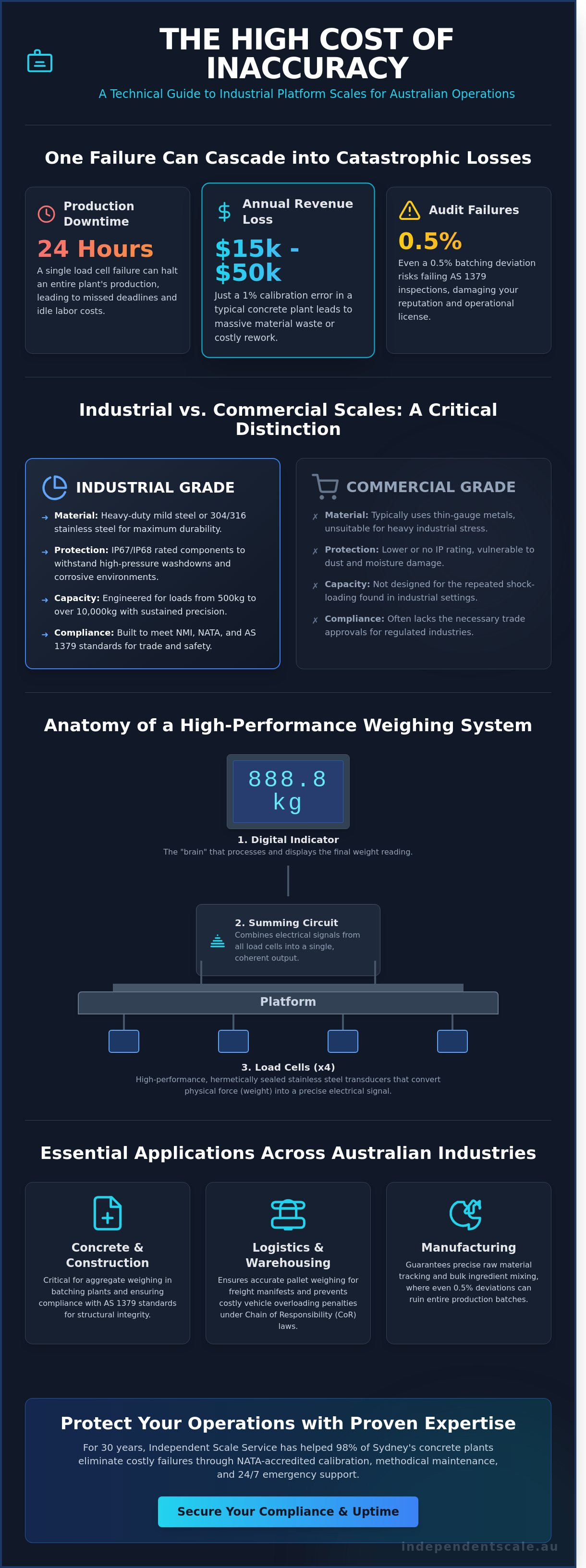
A single load cell failure can halt a concrete plant's production for 24 hours, resulting in thousands of dollars in missed deliveries and wasted material. You're likely aware that even a 0.5% deviation in batching accuracy leads to substantial product waste and failed audits during AS 1379 inspections. When evaluating industrial platform scales for sale, the difference between a reliable asset and a liability often comes down to specific technical engineering and NATA-accredited calibration. Independent Scale Service has spent 30 years ensuring that 98% of concrete plants across Sydney avoid these exact failures through methodical maintenance and precise equipment selection.
This guide provides the expert technical guidance needed to select, calibrate, and maintain high-capacity weighing systems that meet ISO/IEC 17025 standards. We'll show you how to achieve long-term equipment durability and guaranteed accuracy for both trade and safety applications. You'll learn how to secure 24/7 technical support and implement maintenance schedules that effectively eliminate the risk of load cell failure. We'll also examine the critical components of heavy-duty scales, such as summing circuits and surge arrestors, to ensure your Australian operations remain compliant, efficient, and ready for any regulatory audit.
Key Takeaways
- Understand the critical financial impact of measurement inaccuracies and why high-capacity systems require specific components to prevent long-term calibration drift.
- Identify the essential criteria for selecting industrial platform scales for sale, focusing on NMI Trade Approval and the optimal balance between capacity and resolution.
- Master the technical anatomy of weighing infrastructure, including how load cells and summing circuits work together to provide a single, accurate reading.
- Learn how to maintain Australian regulatory compliance by distinguishing between standard factory setups and NATA-accredited ISO/IEC 17025 or AS 1379 calibrations.
- Evaluate the long-term value of expert post-sale support and 24/7 emergency service in minimising downtime for heavy industrial operations.
Beyond the Surface: Why Quality Industrial Platform Scales are Essential for Australian Operations
Industrial platform scales are high-capacity weighing systems engineered to handle loads starting at 500kg and scaling beyond 10,000kg. For Australian operations, identifying the right industrial platform scales for sale involves looking past the initial price tag and evaluating structural endurance. A weighing scale in a heavy industrial setting must maintain precision under extreme mechanical stress. Accuracy isn't a luxury; it's a financial necessity. In a concrete batching plant producing 50,000 cubic meters annually, a mere 1% calibration error leads to significant material wastage or structural non-compliance. This inaccuracy can result in $15,000 to $50,000 in lost revenue or rework expenses each year.
Environmental factors in Australia demand ruggedised equipment. Standard commercial units often fail in high-humidity coastal regions or dust-heavy mining environments. Equipment must also support compliance with Chain of Responsibility (CoR) laws. Under the Heavy Vehicle National Law (HVNL), precise weighing is the primary defense against overloading penalties. Accurate data ensures every pallet, skip, or bulk bag leaving your facility meets legal safety requirements.
Industrial vs. Commercial Scales: Understanding the Difference
Structural integrity defines the industrial category. While commercial scales use thin-gauge metals, industrial versions utilize heavy-duty mild steel or 304/316 stainless steel. Ingress Protection (IP) ratings are critical for longevity. Load cells and indicators should carry IP67 or IP68 ratings to survive high-pressure wash-downs and corrosive environments. For a deeper dive into specifications, see our Industrial Weighing Scale: The Complete Guide for Australian Businesses.
Key Applications in the Australian Market
Weighing requirements vary significantly across sectors. We see three primary areas where high-quality industrial platform scales for sale are vital:
- Concrete and construction: Integration with batching plants for aggregate weighing and ensuring AS 1379 compliance.
- Logistics and warehousing: Pallet weighing for accurate freight manifesting and preventing vehicle overloading.
- Manufacturing: Precise raw material tracking and bulk ingredient mixing where 0.5% deviations ruin entire production batches.
Reliable equipment reduces downtime. When a scale fails in a 24/7 production line, the cost of the hardware is dwarfed by the cost of idle labor. Choosing NATA-accredited weighing solutions ensures your business maintains the standards required for trade-approved operations and rigorous quality audits.
The Anatomy of High-Performance Weighing: Load Cells, Indicators, and Summing Circuits
The load cell is the transducer at the absolute core of every scale. It's responsible for converting physical force into a measurable electrical signal. When you're browsing industrial platform scales for sale, the quality of these cells determines the system's long-term stability and resistance to drift. Cheaper components often suffer from signal degradation where the zero point or span accuracy shifts over time. This is usually caused by temperature fluctuations or material fatigue in the spring element. High-performance scales utilize stainless steel, hermetically sealed cells to prevent moisture ingress and maintain precision in harsh Australian environments. For facilities requiring strict compliance, ensuring your equipment meets the standards of the National Association of Testing Authorities (NATA) is a critical step for operational integrity and audit readiness.
Most industrial platforms utilize a four-cell configuration. A summing circuit, typically housed within a stainless steel junction box, unifies these individual signals into a single, accurate reading. This process is vital for corner loading accuracy. If the summing board is poor quality, the scale will show different weights depending on where the load is placed on the deck. You can learn more about these components in The Essential Guide to Industrial Load Cells.
Load Cell Technologies for Platform Scales
- Shear Beam vs. Compression: Shear beam load cells are the industry standard for industrial platform scales for sale because they handle side loads and vibrations effectively. Compression cells are generally reserved for high-capacity tank or silo weighing.
- Surge Protection: High-performance systems include surge arrestors within the junction box. This protects sensitive electronics from lightning strikes and industrial power spikes, which are common causes of premature component failure.
- Material Choice: Tool steel is acceptable for dry environments, but 17-4 PH stainless steel is required for washdown areas or corrosive chemical processing.
For specific technical data on sensor types, view our Load Cells Collection.
Indicators and Data Transmission
The digital indicator is the interface that converts raw millivolt signals into actionable data. Choosing the right unit depends on your integration requirements. Basic weight displays are sufficient for manual check-weighing, but advanced programmable indicators are necessary for automated batching and PLC integration. These units act as sophisticated transmitters, utilizing protocols such as 4-20mA, 0-10V, Modbus, and Ethernet/IP to communicate directly with your control systems. This connectivity allows for real-time inventory tracking and eliminates manual data entry errors. If your current system lacks these capabilities, you can find compatible upgrades in our range of Indicators and Displays.
Maintaining accuracy across these components requires regular verification. If your facility operates under AS 1379 or ISO/IEC 17025 standards, booking a professional calibration service ensures your hardware remains compliant and your measurements stay precise.
Selecting the Right Platform Scale: Trade Approval, Material, and Capacity Requirements
Selecting industrial platform scales for sale requires a technical evaluation of operational demands and regulatory obligations. Accuracy isn't just a performance metric; it's a legal requirement in many Australian commercial contexts. Choosing the wrong specification can lead to compliance failures or premature equipment breakdown in harsh environments. Operators must prioritize structural integrity alongside metrological precision to ensure long-term ROI.
NMI vs. Non-Trade Scales
When weight determines the price of goods, Australian law mandates an NMI-approved "Legal for Trade" scale. These units feature a specific NMI pattern approval number on their data plate, indicating the design has passed rigorous testing by the National Measurement Institute. Using non-approved scales for commercial transactions violates the National Measurement Act 1960 and carries significant financial penalties. Non-trade scales are suitable for internal process control or check-weighing only. To maintain legal compliance, professional Weighing Scale Calibration Service is required to verify accuracy against NATA-accredited standards. ISS technicians ensure your equipment meets the specific testing protocols demanded by Australian regulators.
Capacity, Resolution, and Material Selection
Balancing capacity and resolution is a critical technical trade-off. A standard 3,000kg platform scale typically offers a 1kg resolution. If your application involves high-value materials requiring 0.1kg precision, a lower capacity or high-resolution load cell configuration is required. Platform dimensions must also match the load footprint. While the 1.2m x 1.2m deck is the standard for Australian pallets, custom oversized platforms are required for machinery or bulk containers. Material choice is equally vital for durability:
- Mild Steel: The industry standard for dry warehouses, shipping docks, and general manufacturing where corrosion is not a primary risk.
- Stainless Steel (304 or 316 Grade): Essential for food-grade environments (HACCP) or corrosive chemical processing where frequent high-pressure wash-downs occur.
- Galvanised Steel: Provides a durable middle-ground option for high-humidity environments that don't require food-safe surfaces.
Mounting and Installation Options
Installation method directly impacts warehouse efficiency and scale longevity. Above-ground industrial platform scales for sale are portable and easier to maintain but require approach ramps for pallet jack access. Pit-mounted scales sit flush with the floor. This saves significant floor space and reduces trip hazards, though it requires specialized drainage and regular pit cleaning to prevent debris buildup. Floor levelness and vibration isolation are paramount; even a slight incline can cause load cell binding and inaccurate readings. For complex industrial setups, ISS utilizes special purpose and shackle pins to ensure structural integrity and weighing precision in non-standard mounts.
Ensuring Long-Term Accuracy: NATA Calibration and AS 1379 Compliance
Purchasing industrial platform scales for sale is only the initial step in establishing a compliant weighing system. Many operators mistakenly believe that a "factory calibrated" status is sufficient for Australian industrial use. It's not. Factory calibration is a basic verification performed in a controlled manufacturing environment. It doesn't account for the mechanical stresses of shipping or the specific environmental conditions of an Australian worksite. For legal and technical compliance, businesses require NATA-accredited ISO/IEC 17025 calibration. This process ensures that measurements are traceable to national standards and provides a calculated uncertainty of measurement, which is essential for quality control. Many operators looking for industrial platform scales for sale overlook the necessity of ongoing NATA support until an audit failure occurs.
Compliance with AS 1379 is a critical requirement for the concrete industry. This standard specifies the accuracy and tolerance levels for batching plants. Even a 1% deviation in aggregate or cement weight can compromise the structural integrity of a concrete mix. Independent Scale Service manages compliance for 98% of Sydney’s concrete plants, including sites operated by Boral and Holcim. Our technicians ensure that every scale meets these rigorous Australian standards to prevent costly batch rejections and safety failures.
The Calibration Process
Accuracy isn't static. The gravimetric method is the only reliable way to calibrate industrial scales. This involves placing physical, NATA-certified test masses onto the scale to verify performance across its entire capacity. It's superior to electronic testing, which merely checks the load cell signal without accounting for mechanical issues like binding or debris buildup. Calibration frequency isn't a "one size fits all" decision. It's a schedule based on usage cycles and environmental stress. A scale used 50 times a day in a dusty quarry needs more frequent attention than one used weekly in a clean warehouse. Review our Concrete Batching Plant Calibration Services for detailed compliance schedules.
NATA Documentation and Audits
A NATA calibration certificate is your primary defense during an audit. It's a comprehensive technical report that proves your equipment is fit for purpose. When reviewing a certificate, look for the NATA endorsement logo and the specific ISO/IEC 17025 accreditation number. Independent Scale Service has over 30 years of experience providing this documentation for Australia’s largest infrastructure projects. We ensure your data is accurate, traceable, and ready for inspection at any time. For more information on maintaining these standards across your facility, see our weighing scale calibration services.
Sourcing and Maintaining Your Industrial Weighing Infrastructure with ISS
Independent Scale Service (ISS) brings over 30 years of heavy industrial experience to the Australian market. When procurement teams search for industrial platform scales for sale, the initial purchase price is often the primary focus. However, the total cost of ownership is determined by the quality of post-sale support and the speed of technical response. A scale that sits idle due to a component failure costs significantly more in lost productivity than any upfront savings. ISS provides a comprehensive infrastructure solution that prioritizes long-term reliability over short-term discounts.
Our commitment to minimizing client downtime is backed by an emergency 24/7 repair service. We understand that industrial operations in Sydney, Melbourne, and regional Australia don't always run on a standard schedule. Our technicians are equipped to handle urgent repairs on-site, ensuring that critical weighing processes resume as quickly as possible. This responsiveness is a core reason why we currently service 98% of concrete plants across Sydney, where equipment reliability is essential for daily operations.
Comprehensive Repair and Maintenance
Maintaining accuracy requires more than simple visual inspections. ISS technicians perform advanced diagnostic testing to identify load cell faults and summing circuit issues before they cause total system failure. Our team handles complex indicator programming and precision flowmeter installation to ensure seamless data integration across your facility. We specialize in heavy-duty installations, including Tank and Silo Weighing Assemblies, where precision is non-negotiable for inventory management and safety. Our maintenance protocols include:
- Verification of summing circuit integrity and surge arrestor functionality.
- NATA-accredited calibration to ISO/IEC 17025 standards.
- Diagnostic testing of load cell output signals to detect moisture ingress or physical fatigue.
- Firmware updates and programming for digital weight indicators.
Getting Started with Your New Weighing System
Success begins with a technical consultation and a detailed site assessment. We don't just ship hardware; we provide a unified supply-install-calibrate partnership. This approach eliminates the compatibility risks associated with using multiple vendors for a single project. Whether you require custom engineering for a complex hopper system or a standard set of industrial platform scales for sale, our process ensures compliance with AS 1379 and relevant trade measurement legislation. We manage the entire lifecycle of your weighing infrastructure, from initial structural design to ongoing gravimetric method calibrations.
Contact Independent Scale Service for a Quote to secure your facility's accuracy and long-term uptime.
Secure Your Operational Accuracy and Compliance
Selecting the right equipment is the first step toward maintaining a reliable industrial facility. Your choice of industrial platform scales for sale must prioritize structural integrity and technical precision to withstand heavy-duty Australian conditions. High-performance components like trade-approved load cells and summing circuits are essential for meeting AS 1379 requirements and ensuring repeatable results. Without rigorous NATA calibration, even the best hardware can't guarantee the long-term accuracy your operations demand.
Independent Scale Service brings over 30 years of technical expertise to your site. We're NATA Accredited to ISO/IEC 17025 and currently manage the weighing infrastructure for 98% of concrete plants across Sydney. Our team understands that equipment failure stops production; that's why we provide 24/7 emergency support for all industrial clients. Whether you're upgrading a single unit or auditing an entire plant, we ensure your systems remain compliant and efficient.
Browse our range of industrial weighing equipment or request a NATA-accredited calibration today.
We look forward to supporting your next project with precision-engineered solutions.
Frequently Asked Questions
What is the difference between NMI-approved and non-trade industrial scales?
NMI-approved scales are mandatory for trade use where price is determined by weight, whereas non-trade scales are for internal process monitoring only. The National Measurement Act 1960 requires any scale used to sell goods by weight to have an NMI pattern approval number. When browsing industrial platform scales for sale, businesses must verify the NMI certification to avoid legal penalties for non-compliant trade.
How often should an industrial platform scale be calibrated in Australia?
Most industrial platform scales require calibration every 6 or 12 months depending on usage intensity and environmental conditions. For concrete production, AS 1379 requires weighing systems to be calibrated at intervals not exceeding 6 months. High-precision industries often adopt a quarterly schedule to maintain ISO/IEC 17025 compliance and ensure total accuracy across all production shifts.
Can I install an industrial platform scale myself?
You shouldn't install an industrial platform scale yourself if you require legal-for-trade certification or precise calibration accuracy. Professional technicians ensure the scale is level, correctly corner-balanced, and calibrated using certified test weights. Incorrect DIY installation often results in ghosting weights or structural damage to load cells during the initial setup process, leading to costly downtime.
What IP rating do I need for a scale in a wet or dusty environment?
You need a minimum of IP67 for dusty environments and IP68 or IP69K for washdown areas where high-pressure water is used. An IP67 rating ensures the scale is dust-tight and protected against temporary immersion. Industrial platform scales for sale often feature stainless steel construction and hermetically sealed load cells to meet these rigorous environmental standards and prevent electronic failure.
What is AS 1379 compliance and why does it matter for concrete plants?
AS 1379 is the Australian Standard for the specification and supply of concrete, mandating strict accuracy limits for batching equipment. It requires scales to be accurate within 0.5% for cement and 2.0% for aggregates. Compliance is critical for concrete plants as it ensures structural integrity and meets the quality standards required by major contractors like Holcim, Boral, and Hanson.
Do you provide on-site repair services for heavy-duty scales in Melbourne?
Yes, ISS provides 24x7 emergency on-site repair services for heavy-duty scales across Melbourne and regional Victoria. Our technicians carry specialized diagnostic tools to identify faults in summing circuits or surge arrestors immediately. This rapid response minimizes downtime for logistics hubs and manufacturing facilities that rely on continuous weighing operations to maintain their supply chain schedules.
What happens if a load cell fails in my platform scale?
If a load cell fails, the scale will display erratic readings, drift, or show an error code indicating an unstable signal. A technician must test the millivolt output of each cell to identify the faulty unit before replacing it. We recommend checking the summing box and cable integrity first, as 70% of reported failures stem from moisture in the junction box rather than the cell itself.
Is NATA accreditation necessary for all industrial weighing equipment?
NATA accreditation to ISO/IEC 17025 is necessary for businesses that must prove technical competence to external auditors or regulatory bodies. While standard calibration is sufficient for basic internal checks, NATA-endorsed reports provide a higher level of legal and technical traceability. It's the gold standard for high-risk industries where weight accuracy is a critical safety or quality control metric.
