


Industrial Batch Weighing Systems: The Authoritative Guide to Precision and Compliance
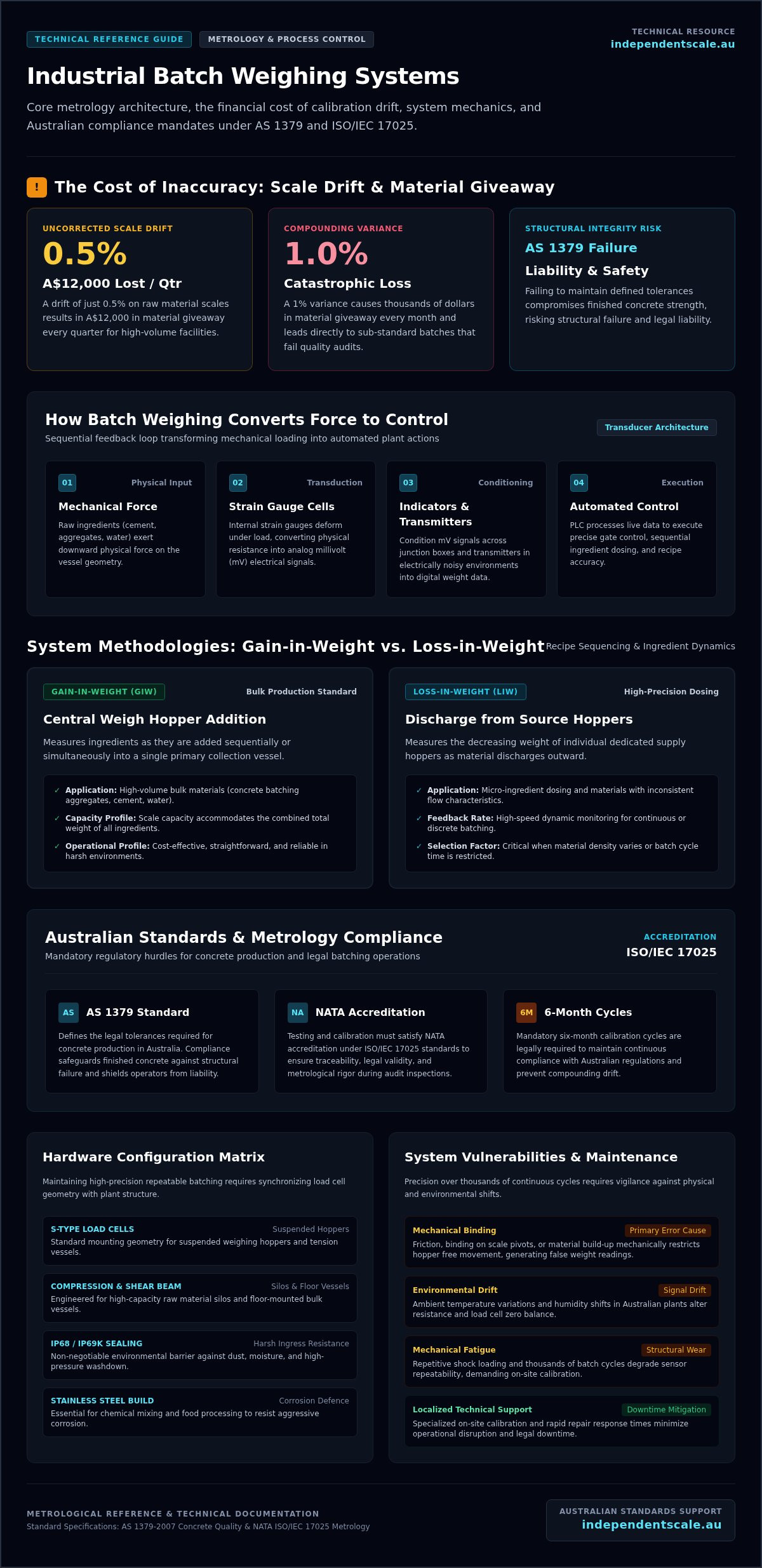
Did you know that an uncorrected scale drift of just 0.5% on your raw material scales can result in a material giveaway of A$12,000 every quarter? For high-volume concrete and bulk solids facilities, these minor inaccuracies quickly compound into significant financial losses and compromised structural integrity. You likely already recognize that managing industrial batch weighing systems requires constant vigilance against mechanical fatigue and environmental shifts. It's a high-stakes environment where even a small error leads to material wastage or the severe risk of non-compliance with AS 1379 standards.
We understand that your priority is maintaining a precise, reliable operation that meets every Australian regulatory hurdle. This authoritative guide will help you master the technical requirements and Australian standards necessary to maintain a high-precision system. You'll gain a clear understanding of NATA accreditation under ISO/IEC 17025 and the mandatory six-month calibration cycles required for legal compliance. We'll also break down the essential hardware components, from digital load cells to advanced batch controllers, that ensure your facility achieves reduced material variance and remains fully operational with localized support.
Key Takeaways
- Define the operational role of industrial batch weighing systems in converting physical force into actionable digital weight data for high-precision process control.
- Establish the necessity of AS 1379 compliance and NATA-accredited calibration for maintaining legal and structural standards in Australian concrete production.
- Identify high-precision components, including load cells and weight indicators, required to maintain system integrity and recipe accuracy.
- Implement maintenance strategies to address mechanical binding and environmental drift, the primary causes of batching errors and material wastage.
- Access localized technical expertise to ensure rapid response times and minimize operational downtime through specialized on-site repair and calibration.
What is an Industrial Batch Weighing System?
Industrial batch weighing systems are specialized metrology assemblies designed to weigh multiple ingredients sequentially or simultaneously based on a pre-defined recipe. These systems don't just facilitate material flow; they provide the critical feedback loop necessary for automated process control. The primary mechanism involves transducers, specifically strain gauge load cells, which convert mechanical force into millivolt signals. These signals are then processed into digital weight data, allowing for precise gate control and material dosing.
Applications for these systems are diverse but share a common requirement for repeatability. In concrete production, they ensure the correct ratio of cement, aggregates, and water to meet engineering specifications. Chemical mixing and food processing facilities rely on them to maintain product consistency and safety. Without robust industrial batch weighing systems, facilities face significant material wastage and the risk of producing sub-standard batches that fail quality audits.
Gain-in-Weight vs. Loss-in-Weight Systems
Loss-in-weight (LIW) systems measure the discharge from individual supply hoppers. This methodology is superior for micro-ingredient dosing or materials with inconsistent flow characteristics. This precision is essential in fields such as equine nutrition, where Healthy Horses Inside Out provides supplements that depend on exact formulation for effectiveness. By monitoring the decreasing weight of the source hopper, the system provides high-speed feedback for continuous or discrete batching. Selecting the right methodology depends on your material density, flow properties, and the required batch cycle time.
The Critical Role of Precision in Batching
In high-volume industrial environments, a variance of just 1% leads to catastrophic financial outcomes. For an average Australian batching plant, uncorrected scale drift results in thousands of dollars in material giveaway every month. Beyond the financial impact, accuracy is a safety requirement. In concrete production, failing to meet the tolerances defined in AS 1379 compromises the structural integrity of the finished product, potentially leading to structural failure and legal liability.
Accuracy isn't optional. Batching accuracy is the ability to repeat measurements within a specified tolerance over thousands of cycles. Achieving this requires high-performance load cells and regular AS 1379 compliant calibration. When your system repeats precisely, you reduce waste, ensure compliance, and protect your bottom line.
Critical Components of a High-Precision Batching System
High-precision industrial batch weighing systems are only as reliable as their weakest component. Maintaining the tight tolerances required by Australian Standard AS 1379 requires a synchronized chain of sensors and signal processors. While the load cell provides the primary measurement, the surrounding infrastructure, including junction boxes, transmitters, and indicators, ensures that data reaches the PLC without degradation or interference.
Industrial Load Cells for Batching
Selecting the correct load cell geometry is the first step in system design. S-type cells are standard for suspended hoppers, while compression and shear beam cells support high-capacity silos and floor-mounted vessels. In Australia's harsh industrial environments, environmental sealing is non-negotiable. Look for IP68 or IP69K ratings to protect against ingress from dust and high-pressure moisture. Stainless steel construction is often a necessity for chemical or food-grade applications to resist corrosion. You can explore our range of industrial load cells to find the exact mounting hardware suited for your specific vessel geometry.
Integration with Indicators and Transmitters
Weight data must be conditioned before it can be used for process control. In electrically noisy environments, conditioners and transmitters play a vital role by amplifying low-voltage signals and filtering out electromagnetic interference. This prevents the "jitter" that often leads to over-batching or premature gate closure. Modern transmitters offer high-speed update rates, often exceeding 800Hz, which is essential for high-velocity material dosing where milliseconds matter.
Real-time monitoring happens through indicators and displays. These units serve as the primary interface for operators, providing visual confirmation of batch progress and system health. For seamless automation, these indicators must support industrial protocols like Modbus, EtherNet/IP, or Profibus to communicate directly with the plant’s control network. This connectivity allows for remote diagnostics and automated data logging, which are critical for compliance audits.
Summing multiple sensor inputs requires high-quality junction boxes. These components ensure that a four-cell hopper system provides a single, accurate weight regardless of material distribution within the vessel. High-precision summing cards allow for individual cell trimming, which compensates for slight variances in load cell output. If you are experiencing signal drift or inconsistent readings, our technicians can assist with professional load cell calibration to restore system precision and ensure your plant remains fully compliant.
Australian Regulatory Compliance: NATA and AS 1379
Operating industrial batch weighing systems in Australia requires more than just mechanical precision; it demands strict adherence to national regulatory frameworks. For concrete production, compliance with AS 1379 isn't optional. This standard dictates the accuracy thresholds and verification frequencies necessary to ensure the structural integrity of every cubic meter of concrete poured. Using non-calibrated or improperly verified equipment in commercial trade exposes your business to severe legal liabilities, potential project rejections, and significant financial penalties.
AS 1379 Calibration Requirements
Under AS 1379 Clause 3.3.2, all weighing equipment must be verified accurate to within ±0.4% or less of the maximum scale value. This verification must occur at a minimum frequency of every six months. If your plant undergoes mechanical modifications or relocation, you're required to re-calibrate immediately. Proper documentation is essential for site audits, as inspectors will verify that your batching records match your calibration certificates. For a deeper look at these mandates, read our guide on Concrete Batching Plant Calibration: A Complete Guide to AS 1379 Compliance.
- Cementitious materials: Permissible tolerance between ±1.0% and ±2.0% of target weight.
- Aggregates: ±2.0% for total aggregates on batches exceeding 2 m³.
- Mixing water: ±2.0% by mass or volume.
- Chemical admixtures: ±5.0% of target quantity.
The Value of NATA Accreditation
There's a critical distinction between a standard scale check and a NATA-accredited calibration. A NATA calibration accreditation confirms that a laboratory meets the ISO/IEC 17025 international standard for technical competence. This ensures an unbroken chain of traceability to Australian national measurement standards. For industrial batch weighing systems, this means your data is legally defensible in the event of a quality dispute or structural failure. It provides the assurance that your measurement results are accurate, repeatable, and globally recognized.
Independent Scale Service prioritizes NATA-compliant methodologies for all our calibration services. This level of accreditation protects your business from liability by providing a certified record of performance that meets the highest metrological standards. Don't risk your reputation on non-accredited providers who can't offer the same level of data reliability or legal assurance required by the National Construction Code and major infrastructure authorities.
Optimizing Batching Accuracy and System Maintenance
Mechanical binding is the leading cause of inaccuracy in industrial batch weighing systems. It occurs when debris, material buildup, or structural interference prevents a hopper from moving freely on its mounts. Even a minor obstruction can bypass the load cells, causing the indicator to under-report the actual weight. This leads to over-batching and significant material wastage. Environmental factors like thermal expansion and high-frequency vibration also contribute to load cell drift. In high-throughput Australian plants, regular zeroing and span checks are essential to maintain the ±0.4% accuracy threshold required for AS 1379 compliance.
Preventative Maintenance for Hoppers and Silos
Maintenance begins with a physical audit of your tank and silo weighing assemblies. You must check for structural fatigue, rusted stay rods, or loose mounting bolts that compromise the vertical load path. Material buildup on the hopper exterior or around flexible connectors increases the dead load, which can eventually exceed the scale's zero-tracking range. For legacy systems, these issues are often cumulative. We recommend booking professional hopper calibration services to identify these mechanical faults before they cause a plant shutdown.
Troubleshooting Common Batching Errors
Differentiating between electrical noise and mechanical interference is critical for rapid repair. Electrical noise often presents as rapidly fluctuating digits on the indicator; mechanical binding typically causes a lag in weight response. When dealing with expensive, high-capacity load cells in older plants, repair is often more cost-effective than a full replacement. Our technicians specialize in diagnosing these faults to extend the life of your existing hardware.
Diagnostic steps for load cell failure should include millivolt (mV) readings. A healthy load cell typically outputs 0mV at zero load and up to 20mV or 30mV at full capacity. If a cell shows a high mV output while empty, it likely has a permanent zero shift due to an overload event. Monitoring these values through a junction box allows you to isolate a single failing cell in a multi-sensor system without disconnecting every cable.
To test a load cell’s health, use a digital multimeter set to the ohms (Ω) range. Measure the resistance across the excitation wires (usually red and black) and compare it to the manufacturer’s data sheet; typically, this should be approximately 350Ω or 700Ω. Then, check the signal wires (usually green and white). Any significant deviation from the specified bridge resistance indicates internal damage or moisture ingress. If your system is showing signs of drift or inconsistent batching, contact Independent Scale Service for an on-site technical assessment.
Professional Batching Solutions and Support in Australia
Global procurement models often fail at the local level because they lack the responsive technical support required for high-volume Australian production environments. For industrial batch weighing systems, localized technical competence is the primary differentiator between a profitable operation and a stalled production line. When a critical load cell fails or an indicator loses its programming, waiting for international support isn't a viable business strategy. Reliability depends on having experts who can arrive on-site with the necessary hardware and accreditation to restore operations immediately. For specialized components such as rotary electrical connectors used in rotating mixers or carousels, you can learn more about TME Systems Pty Ltd and their range of industrial slip rings.
Independent Scale Service maintains a dedicated repair and calibration network across Sydney, Melbourne, and regional Australia. Our technicians don't just supply parts; they provide the technical proficiency required to troubleshoot complex system failures under pressure. We utilize certified test weights traceable to national standards to perform on-site calibrations that satisfy both NATA and AS 1379 requirements. This responsive approach minimizes your downtime and ensures that your plant's accuracy remains within the mandatory ±0.4% threshold.
- Emergency load cell replacement and system re-wiring
- On-site indicator programming and PLC integration
- NATA-accredited calibration for hoppers, silos, and admixtures
- Comprehensive testing of signal integrity across long cable runs
Custom Weighing System Design
Optimizing an existing plant often requires more than off-the-shelf hardware. We provide a full range of options and accessories designed for custom batching builds and system retrofits. Whether you're integrating shackle pins into a suspension system or installing specialized sensors in restricted spaces, we ensure the mechanical installation doesn't compromise metrological accuracy. Every new build we design is NATA-ready from day one, meaning the infrastructure is built to facilitate the rigorous testing required by Australian standards.
Case study data from a recent concrete plant optimization showed that addressing cumulative sensor drift reduced material giveaway by an average of A$4,000 per month. This was achieved through a systematic weighing system audit followed by a targeted hardware upgrade. If you're concerned about material variance or upcoming site audits, contact Independent Scale Service for a batching system consultation. Our specialized audits provide a detailed breakdown of your system's current performance and a clear roadmap for achieving full compliance.
Securing Long-Term Batching Precision and Compliance
Maintaining high-performance industrial batch weighing systems is a continuous process that integrates technical precision with strict regulatory adherence. You've seen how minor scale drift leads to thousands of dollars in material giveaway and how mechanical binding remains the primary threat to hopper accuracy. Ensuring your facility meets the mandatory six-month calibration cycle under AS 1379 isn't just a legal requirement; it's a fundamental step in protecting your structural integrity and commercial reputation.
As NATA-accredited specialists to ISO/IEC 17025, Independent Scale Service provides the authoritative verification needed for legal and quality assurance. With local support across Sydney, Melbourne, and regional Australia, our technicians are positioned to minimize your downtime and resolve complex system faults before they impact your bottom line. Factual evidence and technical competence are the only reliable defenses against material variance and non-compliance risks.
Don't wait for a plant failure or an audit discrepancy to address your system's health. Request a NATA-Accredited Calibration or System Audit today to verify your equipment's performance and ensure full compliance with Australian standards. Taking proactive steps now secures your operational efficiency and ensures your plant remains a trusted leader in industrial production.
Frequently Asked Questions
How often should an industrial batch weighing system be calibrated?
Under AS 1379, concrete batching equipment must be calibrated at least once every six months. This frequency ensures the system maintains the mandatory ±0.4% accuracy threshold required for structural compliance. If you relocate your plant or perform significant mechanical modifications, you're required to re-calibrate immediately. Regular internal zero checks are recommended between these professional services to identify early performance issues before they impact your structural batching records.
What is the difference between a load cell and a pressure transducer in batching?
Load cells measure physical mass directly through strain gauges, whereas pressure transducers measure fluid or gas pressure. For industrial batch weighing systems, load cells are the industry standard because they deliver precise gravimetric data. Pressure transducers are sometimes utilized in hydraulic weighing setups, but they generally lack the repeatability and high-resolution accuracy required for complex recipe batching and strict regulatory compliance.
Can I calibrate my own concrete batching plant for AS 1379 compliance?
You cannot self-certify for AS 1379 compliance. The standard mandates that an accredited testing or calibration body performs the verification. Using a NATA-accredited provider like Independent Scale Service ensures your results meet ISO/IEC 17025 standards and remain legally defensible. This level of third-party accreditation is essential for satisfying site audits and protecting your business against liability in the event of structural quality disputes.
What causes a batching system to "drift" over time?
Drift is typically caused by mechanical binding, material buildup, or environmental shifts. Temperature changes cause metal components to expand or contract, while constant vibration can loosen mounting hardware. Electrical noise and moisture ingress into unsealed junction boxes also contribute to unstable millivolt signals. Regular maintenance and professional calibration are necessary to correct these cumulative errors and keep your system within the permissible tolerances defined by AS 1379.
How do I know if my load cell needs repair or replacement?
Check the bridge resistance and millivolt output using a digital multimeter to determine the sensor's health. If the internal resistance deviates from the manufacturer's specification or the zero-load output is unstable, internal damage is likely. While we supply a wide range of new hardware, specialized repair is often a cost-effective alternative for high-capacity units. Our technicians can assess whether a repair will restore full metrological accuracy.
What are the benefits of NATA accreditation for my weighing data?
NATA accreditation confirms that your calibration results are traceable to Australian national measurement standards. This provides an unbroken chain of evidence that is essential for legal defense and quality audits. It guarantees that the service provider meets the technical competence requirements of ISO/IEC 17025. For industrial clients, this accreditation is the primary method of ensuring data reliability and satisfying the rigorous compliance mandates of infrastructure authorities.
Can a batching system be integrated with my existing PLC?
Yes, modern batching indicators and transmitters are designed for direct integration with existing PLC and SCADA control networks. Most systems support standard industrial protocols such as Modbus TCP, EtherNet/IP, or PROFINET. This connectivity facilitates automated recipe control, electronic batch records, and remote diagnostics. Integrating your weighing hardware with your control system is a critical step in achieving the high-speed dosing and data traceability required for Industry 4.0.
What environmental factors most affect batching accuracy in Australia?
Extreme temperature fluctuations and high humidity are the primary environmental challenges for industrial batch weighing systems in Australia. Rapid heat changes cause structural expansion, which can create mechanical binding or side-loading on sensors. High moisture levels often lead to signal degradation if junction boxes aren't properly sealed. In regional facilities, dust and grit accumulation around hopper mounts frequently bypasses load cells, resulting in significant measurement errors.
