


How to Prepare for a Weighbridge Installation: The Industrial Readiness Guide
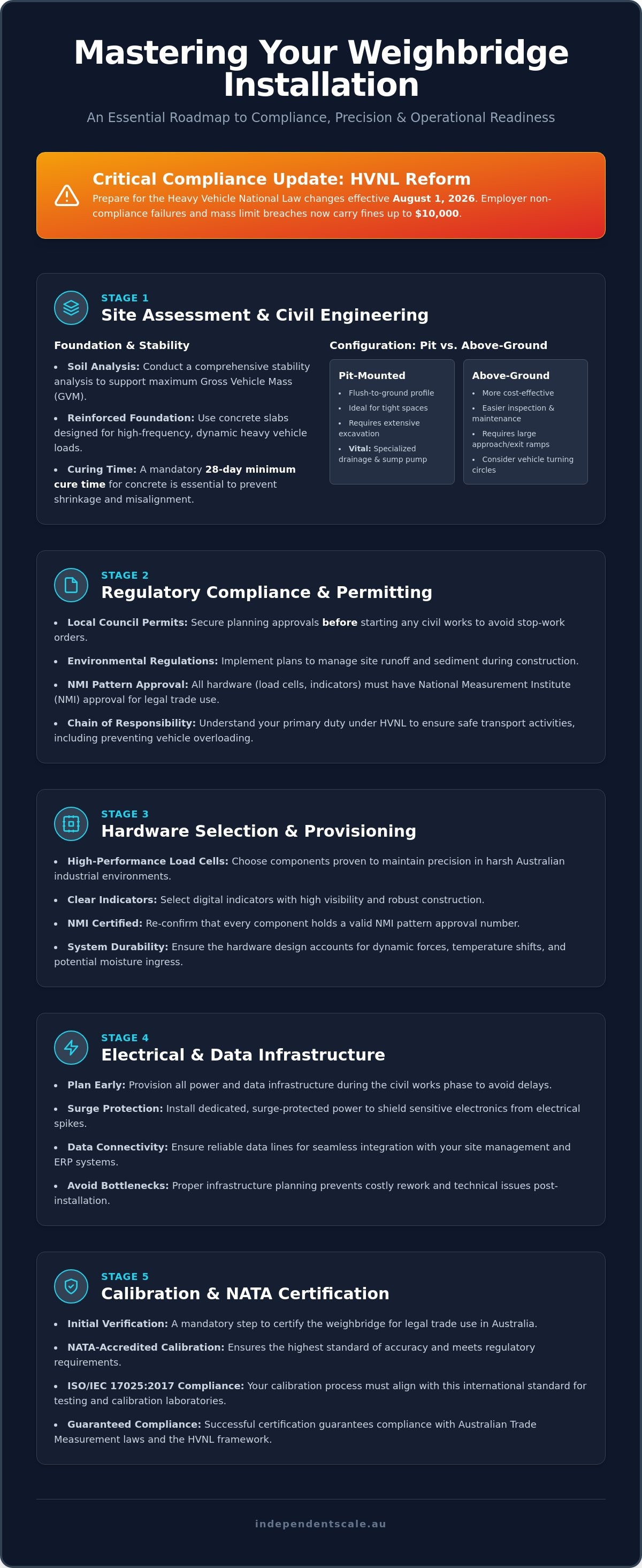
A weighbridge is only as accurate as its foundation. Industrial precision begins with civil engineering and regulatory foresight, not just the hardware. You likely know that a failed inspection or a shifting foundation can derail your operations and trigger significant non-compliance penalties. With the Heavy Vehicle National Law (HVNL) reforms commencing on August 1, 2026, the stakes are higher than ever. Mastering how to prepare for a weighbridge installation is essential to avoid the $10,000 fines now tied to employer compliance failures and mass limit breaches.
We recognize that hidden costs in civil works and project delays caused by poor data provisioning are major risks for any industrial site. This article provides a clear, actionable roadmap to master the critical site, regulatory, and technical requirements for a compliant installation. We'll preview the necessary steps for drainage, foundation stability, and electrical infrastructure. This ensures your system is ready for NATA-accredited calibration to ISO/IEC 17025:2017 standards without the need for costly rework or failed initial inspections.
Key Takeaways
- Conduct a comprehensive soil stability analysis to ensure the foundation supports maximum GVM and choose a configuration that aligns with your site's drainage capacity.
- Master how to prepare for a weighbridge installation by securing local council permits and verifying that all hardware holds National Measurement Institute (NMI) pattern approval.
- Specify high-performance load cells and indicators capable of maintaining precision and visibility within demanding Australian industrial environments.
- Provision surge-protected power and dedicated data infrastructure early to avoid technical bottlenecks and ensure seamless connectivity with site management systems.
- Prioritize NATA-accredited calibration and initial verification to guarantee legal compliance with Australian Trade Measurement laws and the HVNL framework.
Site Assessment and Civil Engineering Readiness
Industrial precision starts with the ground. A weighbridge is a massive structural investment that requires a stable foundation to maintain accuracy over decades of heavy use. Understanding how to prepare for a weighbridge installation begins with a rigorous site assessment. The ground must support both the bridge structure and the maximum Gross Vehicle Mass (GVM) of your fleet without shifting. Soil stability analysis is non-negotiable; if the sub-grade fails, your weighing data will become inconsistent, eventually leading to calibration failures and costly civil repairs.
Choosing the right configuration depends on your site’s operational footprint. A truck scale (weighbridge) can be installed either in a pit or above the ground. Pit-mounted systems offer a flush-to-ground profile. This is ideal for sites where space is at a premium or where vehicles must turn across the platform. However, they require extensive excavation and specialized drainage solutions. Above-ground systems are often more cost-effective and easier to inspect, but they demand significant space for approach and departure ramps.
Pit vs. Above-Ground: Civil Work Differences
Excavation for pit-mounted systems must include safety clearances for technicians to access the load cells for maintenance. For above-ground installations, ramp gradients are the priority. These must be shallow enough to allow heavy vehicles to enter and exit smoothly without shifting their loads. You must also account for vehicle turning circles. If your site layout forces a truck to turn sharply immediately after leaving the bridge, you risk lateral stress on the load-bearing components. Site planners should also consider queuing space to prevent traffic congestion on public roads or internal arterials.
Foundations and Concrete Curing
Finally, drainage is vital for pit-mounted systems. Water ingress is the leading cause of electronic failure in weighing systems. Every pit must include a sump pump or a gravity-fed drainage line to protect the internal components from moisture damage. Ensuring these civil requirements are met is the first step in how to prepare for a weighbridge installation that remains compliant and functional.
Australian Regulatory Compliance and Permitting
Compliance is a critical component of how to prepare for a weighbridge installation. It's not merely a technical requirement; it's a legal mandate. Permanent weighbridge structures generally require local council planning permits. You must secure these approvals before breaking ground to avoid stop-work orders or forced removals. Beyond local government, environmental regulations dictate how you manage site runoff and sediment during the civil works phase. Failure to adhere to these standards can result in significant delays and administrative penalties.
The regulatory landscape is becoming more stringent. The Heavy Vehicle National Law (HVNL) reform, effective August 1, 2026, increases the penalty for failing to ensure driver compliance to $10,000. As a weighbridge operator, you're a party in the "Chain of Responsibility." This means you have a primary duty to ensure transport activities are safe. This duty includes maintaining accurate equipment and having documented procedures for overloaded vehicles. Ensuring your system meets these standards is a core part of your industrial readiness.
NMI Pattern Approval and Trade Use
If your business sells goods by weight, your equipment must comply with the National Measurement Act. Every component, from the load cells to the indicator, must hold a National Measurement Institute (NMI) pattern approval number. This certification proves the equipment design is capable of maintaining accuracy under Australian industrial conditions. Operating a weighbridge for trade requires initial verification by a licensed technician. Using non-verified scales for commercial transactions is a breach of federal law. It's advisable to schedule professional scale calibration early in the commissioning phase to ensure your site is ready for its NMI certificate of verification.
Site Safety and Access Permits
Safety compliance extends to the physical environment surrounding the installation. You must develop a Traffic Management Plan (TMP) to govern vehicle and pedestrian movements during construction. Key safety considerations include:
- Overhead Clearances: Verify that the site is clear of overhead power lines to prevent contact during the crane-in process.
- Underground Services: Use "Dial Before You Dig" services to map water, gas, and data lines before excavation begins.
- Machinery Requirements: WorkCover mandates that all heavy machinery on-site be operated by ticketed personnel with appropriate site-specific inductions.
Following these regulatory steps is the only way to ensure your project stays on track and avoids the hidden costs of non-compliance. Understanding how to prepare for a weighbridge installation means looking beyond the hardware to the legal framework that governs your industry.
Selecting and Provisioning Weighbridge Hardware
Hardware selection is a critical technical phase in how to prepare for a weighbridge installation. While the civil works provide the foundation, the hardware determines the long-term reliability and accuracy of your data. Selecting the correct load cells is the first priority. Digital load cells are increasingly preferred for their superior diagnostic capabilities and resistance to signal interference. Analog systems remain a viable, robust option, but they require high-quality cabling and junction boxes to maintain signal integrity over long distances. Your hardware must align with Australian weighbridge regulations to ensure the entire system achieves NMI pattern approval.
Mounting hardware requires precise alignment. Even a slight deviation in the mounting plates can introduce side-loading forces. These forces lead to weighing errors and premature component wear. You must verify that all mounting assemblies are perfectly level before the final commissioning. For sites where the bridge functions as part of a larger production line, such as a concrete plant, integrating tank and silo weighing assemblies allows for centralized monitoring of raw materials and finished product mass.
The choice of indicators and displays is equally vital. In Australian outdoor environments, high-visibility LED or transflective LCD screens are necessary. These ensure drivers can read weights clearly in direct sunlight. These units must be housed in industrial-grade enclosures to withstand vibration, extreme heat, and moisture ingress.
The Role of Load Cells in Weighbridge Accuracy
Environmental protection is the primary concern for load-bearing electronics. In Australia, equipment must handle extreme dust and intense rainfall. Look for load cells with IP68 or IP69K ratings to ensure they remain hermetically sealed. Lightning and electrical surges are also significant risks for large steel structures. High-quality systems include integrated surge protection to prevent expensive downtime during storm events. For a deeper technical breakdown, consult The Essential Guide to Industrial Load Cells.
Peripheral Equipment and Visibility
Operational efficiency depends on peripheral integration. Remote displays are essential for communicating weight data and safety instructions to drivers. This prevents the need for them to leave the cab, which improves site safety. Automated systems often incorporate boom gates and traffic lights to manage vehicle flow. If your site requires physical documentation, you'll need to provision for ticket-generating kiosks or printers. These must be housed in weather-proof enclosures. Provisioning these peripherals correctly is a final, vital step in how to prepare for a weighbridge installation that meets modern industrial demands.
Electrical and Data Infrastructure Requirements
The electrical and data infrastructure functions as the nervous system of your weighing operation. While previous sections focused on the physical foundation and hardware, this phase ensures that the data generated by the load cells reaches your management system without interference. Provisioning stable, surge-protected power to the weighbridge hut is a fundamental step in how to prepare for a weighbridge installation. Industrial sites often experience heavy electrical noise from nearby motors and machinery. This noise can cause signal drift and inaccurate readings if the system isn't properly isolated.
Grounding and earthing are critical for preventing catastrophic load cell damage. A weighbridge is a large, metallic structure often located in open areas, making it a primary target for lightning strikes. Without a dedicated, low-impedance earthing system, a single strike or a significant power surge can destroy every electronic component in the bridge. You must verify that your electrical contractor understands the specific earthing requirements for precision weighing equipment, which often differ from standard industrial power installations.
Signal integrity over long distances requires specialized components. If your weighbridge hut is located far from the platform, you must install conditioners and transmitters to boost and stabilize the signal. For data cabling, you have several options. Hardwired copper is common but prone to interference. Fibre optic links offer complete electrical isolation and are immune to electromagnetic noise. Wireless links are suitable for sites where trenching for cables is cost-prohibitive.
Power Stability and Surge Protection
Voltage fluctuations are the enemy of precision. Even minor dips or spikes can cause the indicator to display erratic weights, leading to disputes or non-compliance. An Uninterruptible Power Supply (UPS) is mandatory to maintain data integrity during power outages and to filter out line noise. Integrating junction boxes and surge arrestors provides a final layer of defense. These components protect the sensitive load cell bridge from transient voltages that bypass standard circuit breakers.
Data Integration and Software
Modern industrial readiness requires seamless data flow. Your weighbridge should connect directly to your existing ERP or management software to automate ticket generation and inventory tracking. This integration reduces manual entry errors and ensures that trade measurement records are secure and auditable. Remote monitoring capabilities also allow managers to oversee multi-site operations from a central location, ensuring consistency across the entire fleet. Understanding these technical layers is essential when planning how to prepare for a weighbridge installation for long-term reliability.
Protect your investment from electrical failure by exploring our professional range of junction boxes and surge arrestors today.
Post-Installation: Calibration and NATA Certification
The physical completion of civil works and hardware mounting marks the transition to the most critical regulatory phase. Calibration is the final step in how to prepare for a weighbridge installation, ensuring the system provides legally defensible data. For any bridge used in trade, an initial verification by a licensed technician is mandatory under the National Measurement Act. This process confirms the system operates within the maximum permissible errors defined by the National Measurement Institute (NMI). Without this certification, your weighbridge cannot be used for commercial transactions.
Site readiness for the calibration process is often overlooked. You must provide clear, stable access for a heavy calibration truck carrying several tonnes of certified test weights. Any debris, standing water, or construction equipment blocking the approach will delay the process and increase costs. Ensuring the site is clear allows the technician to perform span tests and eccentricity checks efficiently. This phase is vital for identifying any installation errors, such as binding or friction, that could cause weighing inaccuracies before the system goes live.
Understanding NATA vs. Standard Calibration
There is a significant distinction between a basic accuracy check and NATA accredited scale calibration. NATA accreditation specifically assesses technical competence to the ISO/IEC 17025:2017 standard. In Australia, 100% of laboratories providing legally defensible data for critical infrastructure must hold this accreditation. While a standard check confirms the scale is "close enough," a NATA-endorsed certificate provides a documented audit trail required for high-level compliance. For a comprehensive breakdown of these requirements, read Calibration Services: The Authoritative Guide for Australian Industry.
Ongoing Maintenance and Re-verification
Maintaining accuracy requires a proactive schedule. Drift is inevitable in industrial environments due to temperature fluctuations and mechanical wear. Operators should perform daily visual inspections to ensure no stones or debris are wedged between the platform and the pit walls. Under the HVNL reforms starting August 1, 2026, the penalty for compliance failures reaches $10,000, making accuracy a primary financial safeguard. Key maintenance indicators include:
- Zero Return Failures: The indicator doesn't return to zero after a load is removed.
- Inconsistent Readings: Different weights are recorded for the same load in different positions.
- Debris Build-up: Mud or gravel accumulates in the pit or around load cells.
Annual re-verification is a legal necessity for trade-approved systems. This ensures your equipment remains compliant with the "Chain of Responsibility" duties. Planning how to prepare for a weighbridge installation must include a budget and schedule for these recurring NATA assessments, which typically occur on an 18 to 24-month cycle for laboratory-standard equipment. Proactive maintenance prevents the $50,000 fines often associated with WHS breaches caused by inaccurate measurement data.
Securing Long-Term Industrial Operational Accuracy
Successful weighbridge commissioning depends on the precise integration of civil engineering, technical infrastructure, and regulatory foresight. By prioritizing soil stability and ensuring your site meets the National Measurement Institute (NMI) pattern approval standards, you eliminate the risk of costly rework. Mastering how to prepare for a weighbridge installation is the only way to safeguard your operations against the significant penalties associated with the 2026 HVNL reforms and trade measurement non-compliance.
Precision is a continuous requirement, not a one-time event. Maintaining your system through rigorous maintenance and NATA-accredited calibration ensures your data remains legally defensible. Independent Scale Service brings decades of experience in Australian industrial weighing to your project. We're NATA Accredited to ISO/IEC 17025 and serve as compliance experts in AS 1379 standards. Our methodical approach guarantees that your installation meets every technical and legal benchmark from day one.
Contact Independent Scale Service for Expert Weighbridge Installation Support to ensure your facility achieves peak reliability and compliance. We look forward to supporting your site's industrial readiness.
Frequently Asked Questions
How long does a typical weighbridge installation take?
An industrial installation typically requires six to eight weeks from ground-breaking to final commissioning. The most significant portion of this timeline is the 28-day concrete curing period required for structural integrity. The mechanical and electrical assembly of the bridge itself generally takes between two and four business days. Understanding this timeline is a vital component of how to prepare for a weighbridge installation to minimize operational downtime.
Do I need a pit or an above-ground weighbridge for my site?
Selection depends on your site's physical footprint and traffic flow. Pit-mounted bridges are flush with the ground, making them ideal for constrained spaces where vehicles must turn across the platform. Above-ground bridges are easier to maintain and inspect but require approximately five to ten meters of level approach and departure ramps on either side. Your choice will dictate the scope of the required civil works and excavation.
What are the concrete requirements for a weighbridge foundation?
Foundations require high-strength reinforced concrete, typically specified at 32MPa or 40MPa depending on the expected vehicle frequency. The slab must be engineered to withstand the dynamic forces of heavy braking and acceleration. Rushing the installation before the mandatory 28-day cure time can lead to slab cracking or mounting plate misalignment. This misalignment will eventually cause consistent weighing errors and structural instability.
Can I install a weighbridge myself to save on costs?
Self-installation is not recommended for industrial applications. While civil contractors can handle the excavation and concrete, the final mechanical assembly and electrical integration require specialized expertise. Only a licensed technician can perform the initial verification required for trade use under the National Measurement Act. Attempting a DIY installation often leads to failed inspections and expensive structural remediation that far outweighs any initial savings.
How often does an Australian weighbridge need NATA calibration?
Trade-approved weighbridges in Australia require annual re-verification to maintain their legal status. For critical infrastructure, NATA-accredited assessments are typically conducted on an 18 to 24-month cycle to comply with ISO/IEC 17025 standards. Regular quarterly maintenance checks are also recommended to identify drift or debris build-up before they lead to significant inaccuracy or non-compliance penalties. Consistent monitoring is the best defense against measurement errors.
What happens if my weighbridge fails a Trade Measurement inspection?
Failure results in the bridge being "tagged out" of service, meaning it cannot legally be used for commercial transactions. You may also face significant fines, which have increased to $10,000 for certain compliance breaches under the 2026 HVNL reforms. The bridge must be repaired and re-verified by a licensed professional before it can return to service. This process often causes substantial operational delays and loss of revenue.
Do I need surge protection for my weighbridge load cells?
Surge protection is essential for protecting sensitive electronic load cells from lightning strikes and industrial power fluctuations. Because weighbridges are large metallic structures located in open areas, they are highly susceptible to transient voltages. Installing surge arrestors and ensuring proper earthing is a critical technical step in how to prepare for a weighbridge installation. This protection prevents the catastrophic failure of the entire weighing system during storm events.
What is the National Measurement Institute (NMI) pattern approval?
NMI pattern approval is a certification issued by the National Measurement Institute confirming that a weighing instrument's design meets Australian regulatory standards. Every component, including the load cells and indicators, must hold a valid pattern approval number to be used for trade. This ensures that the equipment is capable of maintaining accuracy and reliability under the harsh environmental conditions typical of Australian industrial sites. Using non-approved hardware is a legal breach.
