


How to Calibrate Concrete Batching Plant Weighing Systems for Precise Mix Proportions
A single batch of rejected concrete doesn't just waste raw material; it compromises the structural integrity of your project and risks your compliance with AS 1379-2007 (R2017). With modern batching plants costing up to $1,200,000 in 2026, you can't afford the downtime or the legal liability caused by weighing system drift. You understand that consistent mix proportions are the only way to maintain high-strength applications and keep your audit trails clean for every pour. Dealing with inconsistent strength or confusion over NATA accreditation requirements shouldn't be a recurring obstacle in your daily operations.
Professional concrete batching plant weighing system calibration is the fundamental control mechanism that eliminates these variables. This article provides a masterclass in the step-by-step calibration process required to ensure your plant remains compliant and your proportions remain exact every time. We'll examine the specific requirements of the AS 1379 standard, the necessity of NATA-accredited testing every six months, and the precise gravimetric methods used to certify your scales for maximum accuracy and reduced material waste.
Key Takeaways
- Understand how weighing accuracy dictates the water-cement ratio and compressive strength to prevent rejected batches and structural failures.
- Ensure full compliance with AS 1379-2007 (R2017) by implementing NATA-accredited calibration schedules that meet ISO/IEC 17025 standards.
- Master the technical concrete batching plant weighing system calibration process, including mechanical inspections and tare adjustments for zero-point accuracy.
- Identify and eliminate external weighing errors caused by environmental factors like wind loading on silos and motor-induced vibrations.
- Protect your operational ROI by reducing cement over-batching and avoiding the significant costs associated with site shutdowns and concrete recalls.
The Link Between Calibration and the Mix Proportion of Concrete
Precise weighing is the foundation of quality control in concrete production. To understand what is concrete at its core, you must view it as a carefully balanced chemical reaction. Any deviation in the weight of cement or water directly alters the water-cement ratio, which is the single most important factor determining compressive strength. Professional concrete batching plant weighing system calibration ensures that these ratios remain within the tight margins required for structural safety and project longevity.
Many plant operators attempt to mitigate weighing drift by "over-batching" cement. This practice is a significant financial drain. Since cement is the most expensive component of the mix, even a minor surplus across thousands of cubic meters leads to substantial profit loss. Relying on high-precision load cells and regular calibration is a more cost-effective strategy than compensating for mechanical inaccuracy with raw materials. It's a choice between controlled precision and expensive guesswork.
Site auditors prioritize the mix proportion of concrete because it provides a verifiable trail of quality. If your plant's scales are out of sync, the batch records won't match the design specifications, leading to immediate site rejections. Modern automated systems rely on these weighing inputs to function. If the data is wrong, the entire automation process fails, regardless of how advanced your software might be.
Understanding Batching Tolerances
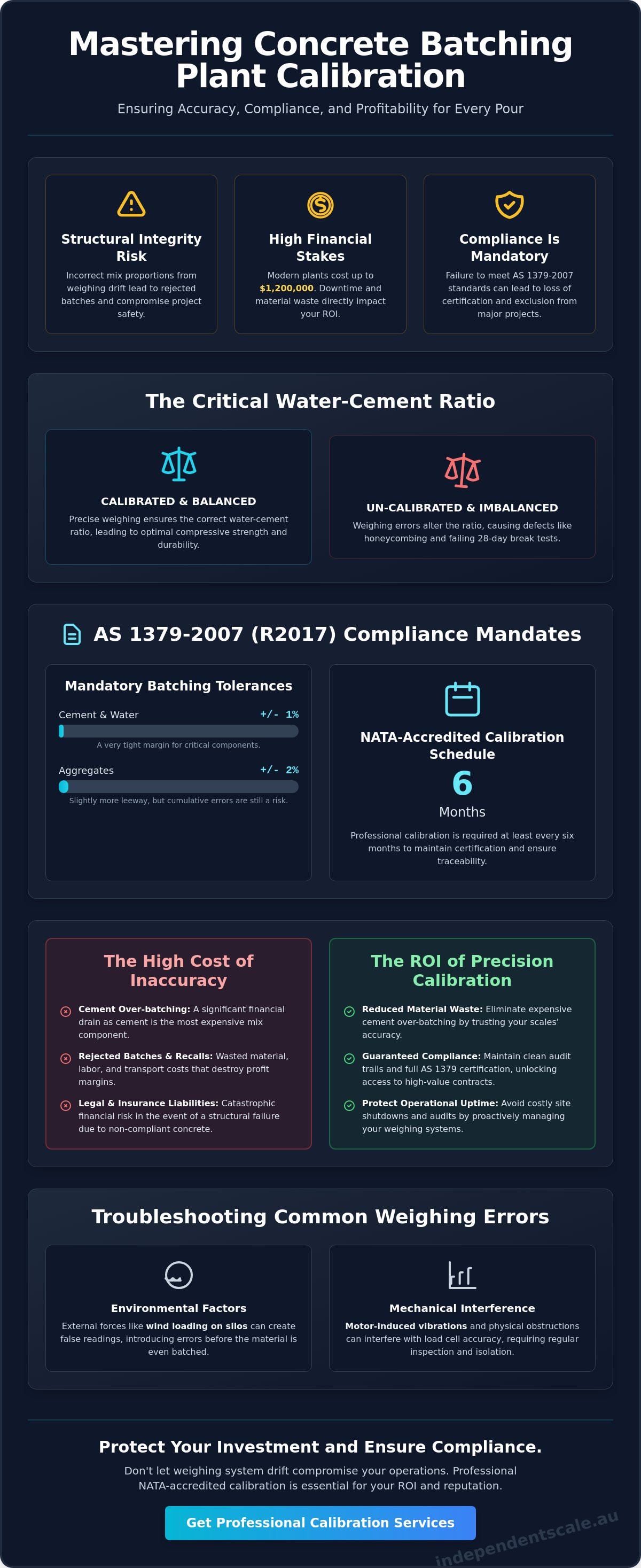
AS 1379-2007 (R2017) specifies strict tolerances for batching to maintain consistency. Typically, cement and water require an accuracy of +/- 1%, while aggregates allow for +/- 2%. While these percentages seem small, cumulative errors across multiple scales can ruin a mix design. You must distinguish between static accuracy, where a scale is accurate while stationary, and dynamic batching precision, which accounts for the flow of material during high-speed production. Both must be verified to ensure a compliant pour.
Consequences of Inaccurate Weighing
Inaccurate weighing leads to severe structural defects like honeycombing and insufficient compressive strength. These issues often remain hidden until a 28-day break test fails, at which point the costs of remediation are extreme. Legal and insurance liabilities for non-compliant concrete supply can bankrupt a provider if a structural failure occurs. A 2% error in cement weighing can invalidate a high-strength mix design, rendering the entire batch unfit for its intended purpose.
Australian Compliance: AS 1379 and NATA Requirements
In Australia, the supply of concrete is strictly governed by AS 1379-2007 (R2017). This standard provides the mandatory framework for any plant operator aiming for commercial viability in the civil construction sector. Adhering to these regulations ensures that the concrete batching plant weighing system calibration meets the rigorous demands of infrastructure projects. Most government contracts, including those managed by state transport authorities, require documented proof of compliance before a single cubic meter is poured. Without these records, your plant is effectively locked out of high-value public works.
The standard mandates that all weighing systems undergo professional calibration at least every six months. For high-volume plants or those operating in extreme temperatures, more frequent testing is often necessary to prevent load cell drift. Failure to maintain this schedule results in an immediate loss of certification. This doesn't just stop production; it triggers expensive audits and can lead to the rejection of batches already delivered to the site. Proactive scheduling is the only way to avoid these operational bottlenecks.
AS 1379 Accuracy Requirements
Accuracy limits are precisely defined to ensure mix consistency across every batch. While the previous section noted specific percentage tolerances, verifying these levels requires an official calibration checklist to cross-reference static and dynamic performance. Preparing for a third-party audit involves maintaining a comprehensive log of all calibration certificates and repair histories. You should also document daily zero-point checks and any tare adjustments made between professional service intervals.
The Value of NATA Traceability
Traceability is the unbroken chain of comparisons linking your plant's scales to national measurement standards. A standard service report lacks the legal weight required for high-stakes projects and insurance coverage. Only a NATA-endorsed certificate, issued under ISO/IEC 17025 accreditation, provides the level of assurance demanded by site auditors. This accreditation proves that the testing equipment used is itself calibrated and that the technician follows a validated procedure. You can learn more about these requirements in our Calibration Services: The Authoritative Guide.
If your plant is approaching its six-month deadline, our experts provide AS 1379 compliant calibration services to keep your facility operational and fully certified.
Step-by-Step: Concrete Batching Plant Scale Calibration Procedure
A methodical approach to concrete batching plant weighing system calibration is the only way to guarantee that your equipment performs to AS 1379 standards. Calibration isn't merely a software adjustment. It's a comprehensive validation of the entire weighing string, from the physical mounting of the hopper to the final signal processed by the controller. Skipping the mechanical phase often leads to "phantom" errors that software cannot fix. You must ensure the environment is stable, with no active loading or discharge occurring during the procedure.
Pre-Calibration Checklist
Before applying any test weights, you must perform a rigorous mechanical audit. Inspect all load cells for physical damage, corrosion, or moisture ingress, as these factors cause signal drift. Hoppers must be entirely empty and free-swinging. Any debris, hardened concrete, or binding in the pivot points will create mechanical resistance that invalidates the calibration results. Check all junction boxes for tight connections and stable signals. A loose wire in a summing circuit can cause intermittent weighing fluctuations that are impossible to calibrate out.
Once the mechanical integrity is confirmed, the zeroing process begins. This involves clearing any "ghost" weights caused by buildup or tare offsets. The system must return to a true zero consistently after every discharge. If the zero point drifts by more than 0.1% of the scale capacity, you must investigate the cause before proceeding to span calibration. A stable zero is the baseline for all subsequent measurements.
Applying Test Loads and Adjusting Span
The gravimetric method is the industry standard for span calibration. You must use NATA-certified test weights that are traceable to national standards. We recommend a 5-point linearity test, applying loads at 20%, 40%, 60%, 80%, and 100% of the scale's typical operating range. This ensures the system is accurate across the full spectrum of your mix designs. During this process, technicians adjust the digital indicator to match the certified weight values exactly. For detailed procedural standards, many global operators refer to the Caltrans Material Plant Quality Program as a benchmark for material plant quality and scale certification.
Linearity testing also reveals hysteresis. This occurs when the scale provides different readings for the same load depending on whether the weight is being added or removed. If hysteresis exceeds the allowable 0.1% tolerance, it usually indicates a mechanical bind or a failing load cell that requires replacement. The final step is a verification trial using a known quantity of material to cross-check the system's dynamic performance against the static test results. This ensures the concrete batching plant weighing system calibration remains accurate under real-world production speeds.
Troubleshooting Common Weighing Errors in the Field
Field troubleshooting requires a technical understanding of how external forces disrupt signal integrity. While the concrete batching plant weighing system calibration procedure establishes a baseline, real-world conditions introduce variables that a static test cannot replicate. In Australia, environmental factors like wind loading and extreme thermal expansion are the most common causes of weighing "noise" and drift. Identifying these issues early prevents the rejection of high-strength batches and maintains your AS 1379 compliance.
Wind loading is a primary culprit for outdoor silos and aggregate hoppers. A 50 km/h gust applies significant lateral force that load cells interpret as vertical weight, creating fluctuating readings that compromise the water-cement ratio. Vibration management is also vital. Motors from mixers and conveyors generate mechanical noise that must be isolated from the scale. If the scale "hunts" for a stable reading during the batching cycle, the digital filtering settings or mechanical isolation mounts likely require adjustment.
Signal integrity is often compromised by electromagnetic interference (EMI) or power surges. High-voltage transients from lightning strikes or large motor start-ups can destroy sensitive summing circuits. Installing surge arrestors is a mandatory defensive measure for regional plants prone to unstable power grids. Shielded cabling must be used throughout the weighing string to ensure the millivolt signals remain clean from the load cell to the controller.
Identifying Load Cell Failure
You must distinguish between a mechanical bind and a genuine load cell failure to minimize downtime. A "dead" cell often outputs a fixed or erratic voltage regardless of the applied load. Use a multimeter to check the bridge resistance; most standard cells measure between 350 and 700 ohms. If the millivolt (mV) output doesn't scale linearly with the force, the internal strain gauge is likely compromised. For a detailed diagnostic guide, read our article on 5 Signs You Need Load Cell Repair.
Mitigating Environmental Factors
The Australian summer presents unique challenges, with ambient temperatures reaching 45°C causing thermal expansion in steel structures. This expansion can bind hoppers that were free-swinging in cooler weather. To stabilize noisy signals, utilize high-quality conditioners and transmitters that filter out high-frequency interference before it reaches the PLC. Wind shields should be installed on all exposed aggregate scales to prevent lateral loading from corrupting the mix proportion of concrete.
If you're experiencing persistent weighing fluctuations that compromise your production, contact our 24/7 emergency team for expert batching plant repair and calibration.
Why Professional NATA Calibration is Essential for ROI
Professional NATA calibration is a strategic investment in your plant's profitability. While the cost of a single service is minor, the return on investment (ROI) is realized through the elimination of material giveaway and the prevention of catastrophic site shutdowns. Every kilogram of cement over-batched due to uncalibrated scales represents a direct hit to your margin. Over a standard production year, these minor inaccuracies aggregate into significant financial losses that far exceed the cost of professional concrete batching plant weighing system calibration.
Beyond material costs, the legal and operational risks are substantial. A concrete recall due to failed strength tests can cost hundreds of thousands of dollars in remediation and lost reputation. Regular calibration serves as your primary defense against these liabilities. It also extends the operational lifespan of your tank and silo weighing assemblies by identifying mechanical wear before it leads to a total system failure. Our 24/7 emergency support ensures that if a load cell fails during a critical 2:00 AM pour, your downtime is kept to an absolute minimum. We don't just fix scales; we protect your production schedule.
The ISS Advantage for Concrete Plants
Independent Scale Service (ISS) brings over 30 years of experience to the Australian construction industry. We currently service 98% of concrete plants across Sydney, providing technical expertise that general scale companies cannot match. Our technicians understand the specific nuances of AS 1379 compliance and the rigorous documentation required for NATA reporting. Our NATA-accredited services to ISO/IEC 17025 provide the ultimate stamp of authority for your plant. We offer a true end-to-end solution, from the initial load cell supply and installation to the final gravimetric certification. This specialized knowledge ensures your plant meets the highest standards of accuracy and reliability demanded by tier-1 contractors like Holcim, Boral, and Hanson.
Next Steps for Plant Managers
Maintaining compliance requires a proactive approach to equipment maintenance. Plant managers should schedule NATA-accredited calibrations during planned downtime to avoid disrupting production schedules. We recommend a comprehensive audit of all weighing systems, including aggregate hoppers, cement silos, and liquid flowmeters, to ensure the entire batching string is synchronized. This methodical verification process provides the certified accuracy required for audit trails and high-strength applications. Don't wait for a failed test result to address your scale accuracy. A proactive audit identifies drift before it becomes a liability for your business.
If your plant is due for its six-month certification, Contact Independent Scale Service for AS 1379 Compliant Calibration to secure your facility's operational integrity.
Securing Your Plant's Certification and Profitability
Maintaining accurate mix proportions is the only way to protect your reputation and ensure long-term structural safety. As established throughout this guide, professional concrete batching plant weighing system calibration every six months is a mandatory requirement under AS 1379-2007 (R2017). By implementing a rigorous testing schedule and addressing environmental interference before it causes signal drift, you eliminate the risk of rejected batches and expensive site remediation. Accurate weighing doesn't just satisfy auditors; it secures your bottom line by preventing cement over-batching across every cubic meter produced.
Independent Scale Service provides the technical competence required for high-stakes industrial weighing. We're NATA Accredited to ISO/IEC 17025 and currently service 98% of concrete plants across Sydney. With over 30 years of experience and emergency 24x7 support available, we ensure your facility remains operational and fully compliant during even the most critical pours. Precision isn't just a technical standard; it's the foundation of your commercial success.
Book Your AS 1379 Compliance Calibration Today to guarantee your plant's accuracy and continued certification.
Frequently Asked Questions
How often should a concrete batching plant be calibrated?
AS 1379-2007 (R2017) requires calibration at least every six months. High-volume facilities or those undergoing structural repairs should increase this frequency to quarterly. Regular testing prevents load cell drift and ensures that your mix proportions remain within the certified tolerances required for tier-1 infrastructure projects across Australia.
What is the allowable weighing tolerance for cement according to AS 1379?
The allowable weighing tolerance for cement is +/- 1.0% of the required batch weight. This strict margin is necessary because cement is the primary binder; any deviation significantly impacts the compressive strength and durability of the finished concrete. Aggregate scales are permitted a slightly wider tolerance of +/- 2.0% under the same Australian standard.
Can I calibrate my own batching plant scales without NATA accreditation?
You cannot perform your own concrete batching plant weighing system calibration if you require a legally defensible audit trail for commercial supply. While internal checks are suitable for daily maintenance, only a NATA-accredited service provider can issue the certificates required for AS 1379 compliance. ISO/IEC 17025 accreditation ensures the testing equipment is traceable to national standards.
What happens if my concrete plant fails an accuracy audit?
Failing an accuracy audit results in an immediate suspension of your plant's certification. This prevents you from supplying concrete to any project requiring AS 1379 compliance, which covers almost 100% of commercial and government works. You'll face the costs of emergency repairs, re-testing, and potential litigation if non-compliant batches were already delivered to a site.
How does wind affect the weighing accuracy of cement silos?
Wind exerts lateral force on outdoor silos, which load cells often interpret as vertical weight. This "wind loading" creates signal noise that can cause a scale to fluctuate by several hundred kilograms during a gust. Installing mechanical wind shields and using advanced signal conditioners are essential for maintaining accuracy in regional or coastal Australian environments where gusts often exceed 50 km/h.
What is the difference between a static calibration and a material test?
Static calibration uses certified test weights to verify the scale's precision while stationary, whereas a material test involves batching actual raw materials. Static tests confirm the gravimetric accuracy of the load cells. Material tests verify the dynamic performance of the system, including the impact of material "inflight" and the timing of discharge gates during high-speed production.
Are digital load cells more accurate than analog systems for concrete batching?
Digital load cells provide superior signal integrity because the analog-to-digital conversion happens inside the cell itself. This makes the system significantly less susceptible to electromagnetic interference and voltage drops over long cable runs. For modern concrete batching plant weighing system calibration, digital systems offer faster troubleshooting and more stable readings in noisy industrial environments.
How long does a full plant calibration typically take?
A full plant calibration typically takes between 4 and 8 hours to complete depending on the number of scales. This timeframe includes the initial mechanical inspection, zero-point adjustments, 5-point linearity testing for all scales, and the generation of compliance documentation. Scheduling this service during planned maintenance downtime is the most efficient way to ensure your facility remains fully operational.
