


Finding an ISO 17025 Accredited Calibrator: The Industrial Guide
An ISO 9001 certificate on a provider's wall doesn't prove they're technically competent to calibrate your specific load cells or hopper scales. In fact, relying on a "certified" lab that lacks a verified technical scope is one of the fastest ways to fail a NATA audit. Many industrial operators lose valuable time vetting providers only to discover the lab's accreditation doesn't cover the specific measurement ranges or precision levels their equipment requires. It's a common point of confusion that leads to significant compliance risks and wasted resources during the procurement process.
This guide simplifies the process of finding an ISO 17025 certified calibrator by showing you exactly how to verify technical competence and audit readiness. You'll learn to distinguish between general quality management and the technical rigour of the ISO/IEC 17025:2017 standard. We'll explain the critical role of NATA in the Australian regulatory landscape and provide a methodical approach to evaluating a provider's Scope of Accreditation. By the end of this article, you'll have the framework needed to select a calibration partner that guarantees measurement traceability and 100% audit compliance.
Key Takeaways
- Distinguish between general quality management under ISO 9001 and the specific technical competence required by the ISO/IEC 17025:2017 standard.
- Streamline the process of finding an ISO 17025 certified calibrator by using the NATA website to verify a provider's current accreditation and technical capabilities.
- Prevent audit failures by matching your equipment's specific measurement range and precision requirements to a laboratory's formal Scope of Accreditation.
- Identify when your industry requires specialized compliance, such as AS 1379 for concrete production or Legal for Trade verification for commercial weighing.
- Ensure 100% audit readiness by selecting a calibration partner with proven expertise in complex industrial systems, including load cells, force gauges, and batching plants.
What is ISO 17025 and Why Does Accreditation Matter?
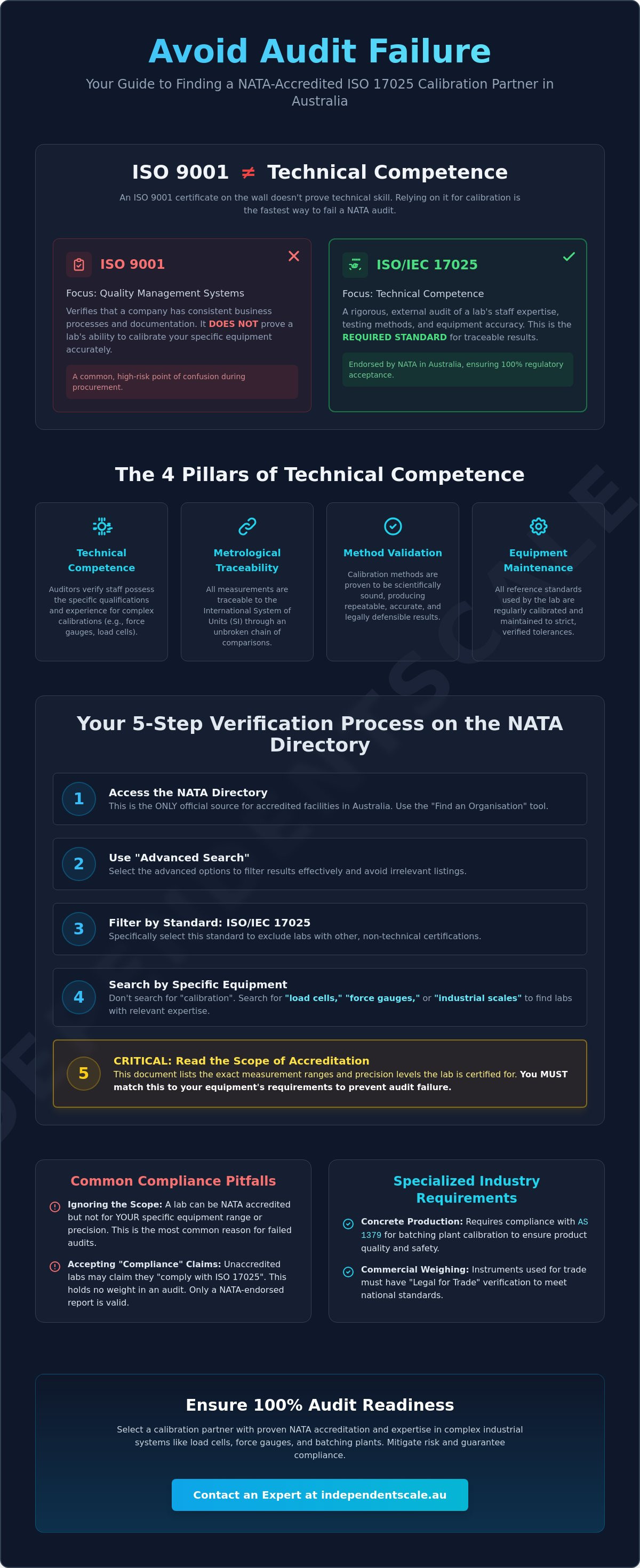
ISO/IEC 17025:2017 is the international standard that specifies the general requirements for the competence of testing and calibration laboratories. While many businesses hold ISO 9001 certification to demonstrate their quality management systems, this doesn't prove technical proficiency in measurement. The process of finding an ISO 17025 certified calibrator requires understanding that accreditation is a more rigorous technical assessment. Unlike ISO 9001, which focuses on business processes, ISO/IEC 17025 requires an external audit of the laboratory's actual testing methods, staff expertise, and equipment accuracy.
In Australia, the National Association of Testing Authorities (NATA) is the primary body granting this accreditation. Claiming "compliance" with the standard is a common tactic for unaccredited labs, but these claims hold no weight during a formal audit. Without a NATA-endorsed report, your records lack legal traceability. This traceability is underpinned by the ILAC Mutual Recognition Arrangement (MRA), which ensures that measurements taken by accredited labs in Australia are recognized by regulatory bodies worldwide. It's a critical layer of protection for any industrial operation.
The Core Requirements of the Standard
Accreditation isn't a one-time achievement; it's a continuous verification of technical capability. The standard focuses on several critical pillars that ensure your equipment performs as expected:
- Technical Competence: Auditors verify that staff possess the specific qualifications and experience to perform complex tasks like force gauge calibration.
- Metrological Traceability: All measurements must be traceable to the International System of Units (SI) through an unbroken chain of comparisons.
- Method Validation: The laboratory must prove that its calibration methods are scientifically sound and produce repeatable, accurate results.
- Equipment Maintenance: All reference standards used by the lab must be regularly calibrated and maintained to strict tolerances.
Benefits for Industrial Site Managers
For site managers, the primary benefit is the mitigation of operational risk. Inaccurate measurements in a concrete batching plant or a silo weighing system can lead to catastrophic structural failures or product liability claims. Using an accredited provider for load cell calibration ensures that your test reports are legally defensible and guaranteed to be accepted by Australian regulators. ISO 17025 remains the definitive benchmark for technical measurement reliability and laboratory competence in 2026. This level of assurance is essential for maintaining a 100% audit-ready status and avoiding the costs associated with re-testing or equipment failure.
How to Find an ISO 17025 Accredited Calibrator in Australia
The process of finding an ISO 17025 certified calibrator starts with the National Association of Testing Authorities (NATA). As the primary accreditation body in Australia, NATA maintains a comprehensive directory of facilities that have proven their technical competence. NATA accredits more than 4,400 facilities across Australia, and 65% of these are specifically accredited to the ISO/IEC 17025 standard. Relying on this directory is the only way to ensure your chosen laboratory holds a valid, current accreditation that will withstand a third-party audit.
When searching for a provider, it's not enough to look for a general "calibration" label. You must search by specific equipment types, such as load cells, force gauges, or industrial scales. Many laboratories hold accreditation for electrical measurements but lack the specialized equipment or expertise required for heavy industrial weighing. Always look for the "NATA Accredited" logo on a provider's website and verify that their accreditation number is clearly displayed on all official documentation and calibration certificates.
Navigational Steps for the NATA Directory
To verify a provider's credentials, follow these methodical steps within the NATA "Find an Organisation" tool:
- Step 1: Access the directory and select the "Advanced Search" option to filter results effectively.
- Step 2: Filter by "Standard" using ISO/IEC 17025 and enter specific keywords such as "weighing" or "force" to narrow the field to relevant specialists.
- Step 3: Locate the facility and download their official "Scope of Accreditation" PDF. This document is the legal record of what the lab is technically authorized to calibrate.
Vetting Local vs. International Accreditation
While the ILAC Mutual Recognition Arrangement (MRA) allows for the international recognition of calibration reports, NATA accreditation remains the gold standard for Australian industrial compliance. Choosing a local calibration service provider offers significant logistical advantages, particularly for on-site services in Sydney or Melbourne. Local experts understand Australian regulatory nuances, such as the specific requirements of AS 1379 for concrete supply, which international providers may overlook.
For site operators managing critical infrastructure, proximity is a key factor in minimizing downtime. Selecting a local specialist for load cell calibration ensures that technical support is available when urgent adjustments are required. This proximity, combined with verified NATA credentials, provides the highest level of assurance for your quality management system and operational continuity.
Reading the Scope of Accreditation: Avoiding Audit Failures
The Scope of Accreditation is the only legal document that defines the specific technical boundaries of a laboratory's expertise. When finding an ISO 17025 certified calibrator, site managers often make the mistake of assuming a "NATA Accredited" logo covers every piece of equipment on their site. This is a critical error. Accreditation is granted for specific measurement ranges and types of equipment; a lab accredited to calibrate laboratory balances may have no legal authority to perform hopper and silo calibration. If your calibration report covers equipment outside the provider's formal scope, the document is technically unendorsed and will fail a NATA or ISO 9001 audit.
Consider the technical requirements of high-capacity systems. A provider might be accredited for industrial weighing devices from 1 kg to 300 kg, yet your facility operates massive mixing systems. For example, Independent Scale Service (NATA Accreditation #3720) holds specific accreditation for hopper weighing systems ranging from 0.25 t to 15 t. This specific designation is required for compliance in heavy industry. You must verify that the provider's accredited "Range of Measurement" actually encompasses the maximum capacity of your hardware. If they test a 10-tonne scale but their scope only reaches 5 tonnes, the upper half of that calibration is effectively unaccredited.
Key Elements of a Scope Document
Understanding the technical jargon within a NATA scope is essential for verifying a partner's capability. Every document is structured around three primary pillars:
- Measurement Category: This identifies the field of metrology, such as "Mass and related quantities" or "Force measurement."
- Range of Measurement: These are the absolute minimum and maximum values the lab is authorized to test. Accuracy claims outside this window are invalid.
- Calibration and Measurement Capability (CMC): This represents the smallest uncertainty a lab can achieve. For instance, a CMC of 0.1% of maximum capacity is a standard benchmark for high-accuracy concrete batching plant calibration.
Questions to Ask Your Potential Calibrator
Before commissioning any work, demand transparency regarding their technical limitations. Use these direct questions to vet their suitability:
- Can you provide a current PDF of your NATA Scope of Accreditation?
- Does your accreditation specifically include on-site services, or is it limited to your laboratory?
- Does your CMC allow for a 4:1 Test Uncertainty Ratio (TUR) for our specific tolerances?
- Are you accredited for the specific load cell calibration ranges required by our equipment?
Verifying these details upfront prevents the costly realization that your calibration records are worthless during an official inspection. A reputable provider will immediately produce their scope and confirm their ability to meet your precision requirements without hesitation.
Industry-Specific Calibration Standards in Australia
Compliance requirements in Australia vary significantly depending on the sector and the intended use of the measurement data. When finding an ISO 17025 certified calibrator, you must ensure the provider understands the specific regulatory landscape of your industry. For many Australian businesses, a generic calibration certificate is insufficient; they require NATA-endorsed reports that reference specific Australian Standards (AS) to maintain legal and operational standing. This is particularly true in high-stakes sectors like construction, manufacturing, and international logistics where measurement error has immediate financial and safety implications.
One critical distinction often overlooked is the difference between Legal for Trade verification and ISO 17025 accreditation. While the National Measurement Institute (NMI) oversees scales used for commercial transactions (where price is determined by weight), ISO 17025 focuses on the technical precision and uncertainty of the measurement itself. In many industrial applications, you may require both to ensure your equipment is accurate for internal quality control and compliant for external trade.
Concrete and Construction Compliance
In the Australian construction industry, AS 1379 (Specification and Supply of Concrete) is the definitive standard. Achieving AS 1379 compliance is impossible without NATA-endorsed calibration reports for all weighing systems. The standard mandates strict accuracy tolerances for batching plants to ensure structural integrity and batch consistency. Independent Scale Service currently services 98% of concrete plants across Sydney and has completed over 2,830 batching plant jobs in the last five years, highlighting the sheer volume of compliance work required in this sector.
Regular hopper and silo calibration is essential to prevent material waste and ensure the final product meets engineering specifications. Industry standard intervals for heavy-duty construction equipment typically require a full NATA calibration every six months, though high-volume sites may require more frequent testing to mitigate the risk of drift. If your site needs to maintain these rigorous standards, you can book professional concrete batching plant services to guarantee your facility remains fully compliant with AS 1379.
Manufacturing and Logistics
For manufacturing facilities, technical traceability is the backbone of the quality management system. Maintaining industrial weighing scale accuracy through ISO 17025 ensures that automated production lines operate within specified tolerances. This is critical when integrated load cells are used for batching ingredients or verifying final product weights for export.
Traceability to international standards is a non-negotiable requirement for export-grade manufacturing. Without a NATA-endorsed report, Australian exporters may face challenges in having their quality documentation accepted by international regulatory bodies. Force measurement standards also play a vital role in safety-critical testing, such as verifying the performance of structural fasteners or safety harnesses. In these scenarios, the technical competence of the calibrator is the only thing standing between a safe operation and a potential structural failure.
Selecting Independent Scale Service for NATA Calibration
Finding an ISO 17025 certified calibrator is the final step in securing your facility's operational integrity and regulatory standing. Independent Scale Service, trading as Zenith Sales and Calibrations Pty Ltd, has maintained NATA accreditation to ISO/IEC 17025 since August 26, 1992. With accreditation number 3720, we provide the technical expertise necessary to meet the most demanding industrial requirements. Our capabilities extend beyond standard weighing, encompassing specialized force gauge calibration and complex system diagnostics that ensure your equipment performs within specified tolerances.
We provide a comprehensive service model that covers the entire lifecycle of your measurement hardware. This includes everything from high-quality load cell supply to full system repairs and NATA-endorsed recalibration. We understand that equipment failure results in immediate financial loss. Our team prioritizes responsive on-site services across Australia to minimize client downtime and restore production as quickly as possible. This commitment to reliability makes us a preferred partner for serious industrial operators who cannot afford compliance gaps.
Why Industrial Leaders Choose Us
Our reputation is built on quantifiable results and deep industry tenure. We currently service 98% of concrete plants across Sydney and have completed over 2,830 batching plant jobs in the last five years. This market dominance is a result of several core strengths:
- Direct Experience: We work extensively with Tier 1 construction and manufacturing clients in Sydney and Melbourne.
- Regulatory Expertise: We possess authoritative knowledge of AS 1379 and the specific requirements of Australian regulatory frameworks.
- Technical Precision: Our on-site calibration capabilities for hopper weighing systems range from 0.25 t to 15 t with a CMC of 0.1% of maximum capacity.
- Efficiency: We provide a no-nonsense approach to technical compliance, focusing on clear reporting and methodical execution.
Get Started with a Compliance Review
Preparing for a NATA or ISO 9001 audit is a high-pressure process. We assist clients by conducting thorough site-wide reviews to identify any equipment that has drifted out of tolerance or lacks current documentation. Our technicians evaluate your entire measurement infrastructure to ensure every device is accounted for and calibrated according to its specific technical scope. This proactive approach eliminates the fear of failing an audit due to improper records or unverified measurement ranges.
If you're unsure if your current provider's credentials match your hardware's requirements, we're here to help. Contact Independent Scale Service today for a verified scope review to ensure your facility meets every technical and regulatory benchmark. We provide detailed quotes for comprehensive site-wide calibration services, allowing you to consolidate your compliance needs with a single, trusted authority.
Secure Your Technical Compliance and Audit Readiness
Securing your industrial facility against audit failure requires a partner with a verified Scope of Accreditation that matches your specific measurement ranges. The process of finding an ISO 17025 certified calibrator is a critical step in maintaining your site's technical integrity and satisfying Australian regulatory bodies. Independent Scale Service brings over 30 years of experience to every task, ensuring your load cells, hopper scales, and batching plants meet the most rigorous precision standards. We focus on providing the technical evidence necessary to pass any NATA or ISO 9001 inspection.
We are NATA Accredited to ISO/IEC 17025 and operate as recognized AS 1379 compliance experts. Our team serves Sydney, Melbourne, and Regional Australia with a focus on minimizing downtime and maximizing accuracy. You've now seen how to evaluate technical scopes and verify credentials; the final step is implementation. Don't leave your compliance to chance. You can Request a NATA-Accredited Calibration Quote Today to ensure your facility remains 100% audit-ready. We're ready to support your technical measurement and calibration needs.
Frequently Asked Questions
What is the difference between ISO 17025 and ISO 9001?
ISO 9001 is a general quality management standard focused on business processes, while ISO 17025 is a technical standard specifically for laboratory competence. A lab can hold ISO 9001 certification without being technically capable of performing accurate measurements. ISO 17025 requires a rigorous external assessment of technical skills, equipment, and methods. It’s the critical distinction when finding an ISO 17025 certified calibrator for industrial precision.
Is a 'Certificate of Calibration' the same as a NATA-endorsed report?
No, a general "Certificate of Calibration" doesn't necessarily prove technical traceability or NATA oversight. A NATA-endorsed report features the NATA logo and a specific accreditation number, signifying that the work was performed within a verified technical scope. Only NATA-endorsed reports are legally recognized as evidence of measurement traceability in Australian regulatory audits and court proceedings.
How do I check if a calibration lab's NATA accreditation is still current?
You should verify status through the NATA "Find an Organisation" directory on the official NATA website. Accreditation status can change, be suspended, or be cancelled, so it’s vital to check the live directory rather than relying on a static wall certificate. The directory also provides the most recent version of the lab's Scope of Accreditation, detailing their current technical limits.
Can an ISO 17025 lab calibrate any type of equipment?
Laboratories are only authorized to calibrate equipment specifically listed on their formal Scope of Accreditation. Accreditation is granted for specific measurement categories, ranges, and uncertainties. For example, a lab accredited for electrical meters cannot legally calibrate high-capacity load cells unless that specific capability is documented in their NATA scope. Always verify the equipment type before commissioning work.
What happens if I use a non-accredited calibrator for my industrial plant?
Using a non-accredited provider exposes your business to significant compliance risks and potential audit failures. Regulatory bodies may reject your quality records, leading to forced shutdowns or costly re-testing of your systems. In sectors like concrete production, unaccredited calibration can invalidate your AS 1379 compliance, creating massive legal liabilities if a structural failure occurs.
Why is the 'Scope of Accreditation' more important than the accreditation itself?
The Scope of Accreditation defines the technical boundaries of what the laboratory is actually proven to do. While a lab may be "accredited," that status is meaningless if it doesn't cover the specific range or precision your equipment requires. The scope document lists the exact measurement categories and uncertainties the lab can handle. It’s the primary tool for finding an ISO 17025 certified calibrator that fits your needs.
How often should industrial weighing equipment be calibrated to ISO 17025 standards?
Calibration frequency depends on equipment usage, environment, and specific industry regulations like AS 1379. For heavy-duty construction and batching plants, six-month intervals are the standard benchmark. However, high-precision manufacturing environments may require quarterly checks to mitigate the risk of measurement drift. A reputable provider will help you establish a schedule based on your equipment's drift history and operational criticality.
