


Concrete Batching Plant Calibration Sydney: The AS 1379 Compliance Guide
Precision calibration isn't just a routine maintenance task; it's the legal foundation of every piece of infrastructure across New South Wales. You understand that a single inaccurate batch doesn't just waste raw materials. It actively risks your standing on major government tenders and can lead to catastrophic audit failures during critical project phases. This guide provides the definitive roadmap to achieving the concrete batching plant calibration Sydney operators require to meet rigorous AS 1379 standards and NATA requirements.
You'll learn how to maintain full regulatory compliance while optimizing your plant's output for maximum accuracy. We will examine the mandatory ±0.4% accuracy thresholds, the necessity of ISO/IEC 17025 accreditation for state and federal contracts, and how digital documentation via cloud portals eliminates audit anxiety. By following this technical framework, you can ensure your facility remains a trusted, compliant authority in the competitive Sydney construction market.
Key Takeaways
- Understand the mandatory requirements of AS 1379 and why NATA ISO/IEC 17025 accreditation is essential for securing state and federal infrastructure contracts.
- Identify the significance of Clause 3.3.2 certification for concrete batching plant calibration Sydney to ensure all weighing equipment maintains the required ±0.4% accuracy.
- Learn the 5-step technical verification process, covering site safety protocols and the incremental load testing of hoppers and silos.
- Reduce operational downtime by coordinating calibration with planned maintenance windows and preparing equipment for full-range testing.
- Utilise cloud-based management portals to maintain documented evidence for audits, including traceable NATA-endorsed certificates and precise as-found data.
Concrete Batching Plant Calibration in Sydney: Why AS 1379 Compliance Matters
AS 1379-2007 serves as the mandatory Australian Standard for the specification and supply of concrete. It dictates the minimum requirements for materials, plant, and equipment. In the context of a Concrete plant, this standard mandates a weighing accuracy of ±0.4%. For Sydney operators, maintaining this level of precision isn't optional. It's the technical framework that ensures structural integrity across the city's built environment. Inaccurate weighing directly compromises concrete strength, leading to structural vulnerabilities and potential project failure.
Non-compliant batching operations face severe legal and financial risks. If a structure fails to meet its specified grade, the calibration history of the plant is the first point of investigation. Without documented evidence of regular concrete batching plant calibration Sydney providers can trust, suppliers are exposed to litigation, liquidated damages, and the loss of operating licenses. Precision measurement is the only defense against these liabilities.
The Role of AS 1379 in the NSW Construction Industry
Sydney's major infrastructure projects, such as the Western Sydney Airport and WestConnex, demand rigorous calibration documentation. Tier 1 contractors and local councils require NATA-endorsed certificates to verify that every cubic metre of concrete meets the design mix. Compliance with AS 1379 is the non-negotiable prerequisite for any concrete supplier seeking to participate in Sydney's major infrastructure tendering processes.
- Regulatory Scrutiny: Government audits focus on traceability to national standards.
- Quality Assurance: Accurate measurement is the only way to guarantee concrete grade specifications.
- NATA Mandates: State contracts typically require ISO/IEC 17025 accreditation to ensure data is technically defensible.
Common Measurement Faults in Concrete Batching
High-volume production cycles inevitably cause drift in weighing systems. Environmental factors unique to Sydney, such as high coastal humidity and heavy industrial dust, can penetrate sensor housings and degrade performance. These faults often go unnoticed without professional testing but lead to significant "material giveaway."
The cumulative cost of poor calibration is substantial. Over-batching by a small percentage might seem minor per load, but across thousands of cubic metres, it results in massive material waste. Conversely, under-batching leads to rejected loads and costly rework. Regular load cell verification prevents these financial drains and ensures your plant operates at peak efficiency.
The Technical Process: 5 Steps to Concrete Plant Accuracy
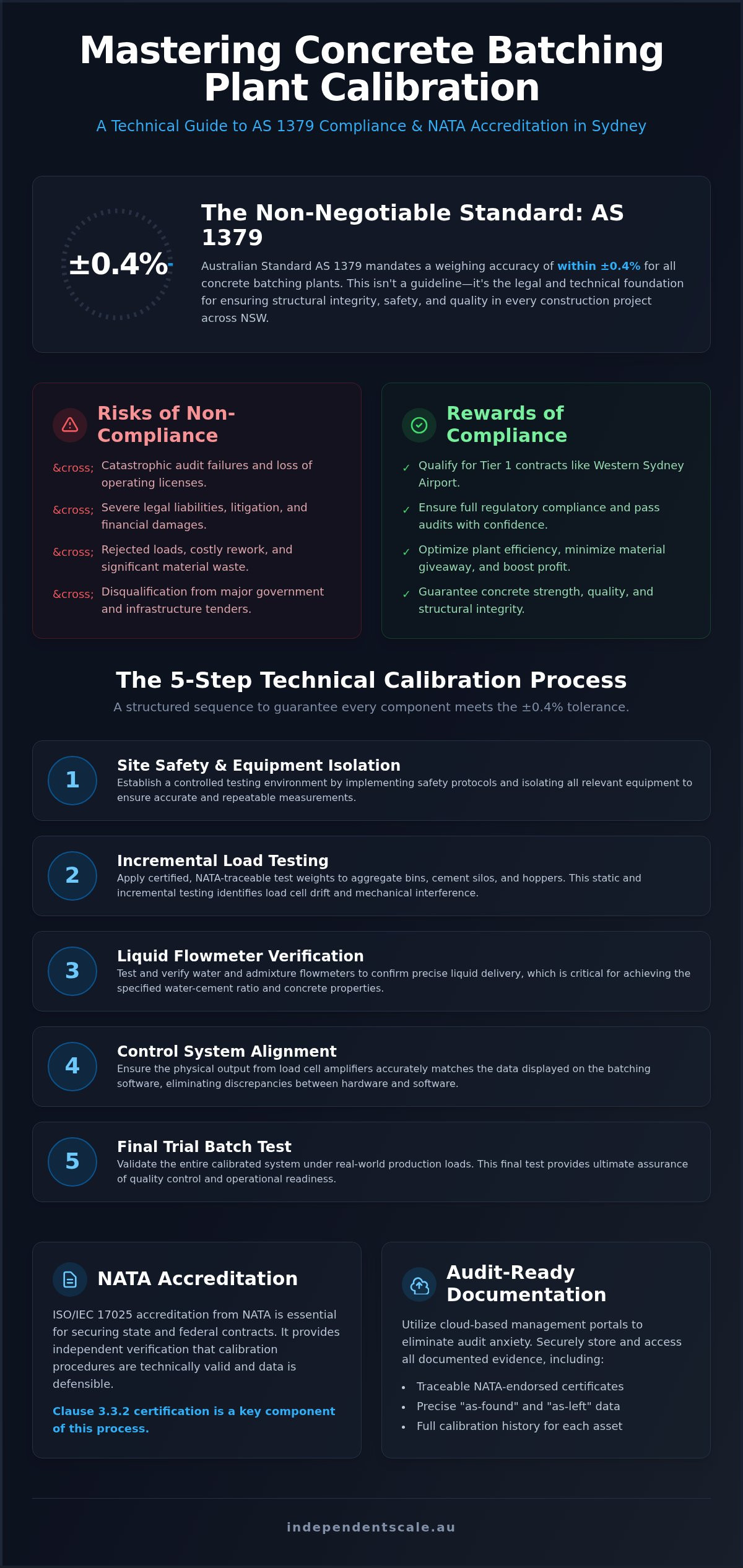
Achieving the precision required for a concrete batching plant calibration Sydney service requires a methodical, five-step technical approach. It starts with site safety and equipment isolation to ensure a controlled testing environment. Technicians then perform static and incremental load testing on all bins. This is followed by liquid flowmeter verification, control system alignment, and a final trial batch test. This structured sequence ensures every component of the measurement chain functions within the mandatory ±0.4% tolerance range.
The final stages involve control system verification and trial batching. Technicians ensure the physical output from the load cell amplifiers matches the data displayed on the batching software. Any discrepancy here leads to consistent batching errors despite accurate hardware. Finally, a trial batch validates the entire system under real-world production loads, providing the final layer of assurance for quality control.
Calibrating Aggregate and Cement Bins
Precision weighing starts with the verification of the plant's primary storage systems. Technicians apply certified test weights to simulate full-scale operating conditions. This process identifies drift in load cells and highlights mechanical interference, such as binding in hopper weighing assemblies or material buildup on scale pivots. Maintaining NATA accreditation ensures these tests are performed using weights traceable to national standards. If you suspect mechanical binding is affecting your readings, consider a professional hopper calibration service to restore accuracy.
Liquid Flowmeter and Admixture Calibration
Volumetric measurement is often insufficient for high-performance concrete mixes. Modern standards demand the liquid flowmeter calibration weighing method. This technique involves weighing the liquid dispensed over a set period to calculate actual flow rates, rather than relying on internal turbine pulses alone. Chemical admixtures must be dispensed within strict AS 1379 tolerances to ensure the chemical balance of the mix remains stable. Precise water-to-cement ratios are critical for achieving the specified structural strength and durability required by Sydney's Tier 1 contractors.
NATA Accreditation and the Significance of Clause 3.3.2
ISO/IEC 17025 accreditation is the international benchmark for testing and calibration laboratories. For any concrete batching plant calibration Sydney provider, this accreditation isn't just a badge of quality; it's a legal necessity for technical defensibility. It ensures that measurement results are traceable to national primary standards, a mandatory requirement under AS 1379-2007 (R2017) Specification and supply of concrete. NATA-endorsed certificates provide the documented evidence required to satisfy auditors and Tier 1 contractors that your plant operates within specified tolerances.
ISO/IEC 17025 vs. General Calibration
General calibration often involves a basic "pass/fail" check using unverified weights. In contrast, NATA-accredited calibration requires a rigorous assessment of measurement uncertainty and environmental variables. This distinction is critical for establishing traceability, which links your plant's accuracy directly to the primary standards held by the National Measurement Institute. You can find a detailed breakdown of these requirements in our ISO 17025 accreditation guide. Without this level of verification, your calibration data lacks the authority needed for state and federal government contracts.
The Independent Scale Advantage: Australia’s Only Clause 3.3.2 Provider
Clause 3.3.2 of AS 1379 is the specific regulatory standard governing the verification of weighing equipment in concrete plants. While many Sydney calibration services claim general proficiency, Independent Scale Service is currently Australia’s only Clause 3.3.2 certified provider. This specific certification is the gold standard for the industry, as it goes beyond standard weighing checks to address the unique complexities of concrete batching environments.
Our 30+ years of NATA accreditation, maintained since 1992, ensures that our technical procedures are refined and utterly reliable. By using the only provider certified for Clause 3.3.2, you eliminate the risk of audit failure. Our certificates are formatted to meet the precise evidentiary needs of AS 1379, streamlining your compliance and protecting your business from the legal and financial liabilities associated with non-compliant batching operations. This level of specialization is why we currently service 98% of concrete plants across the Sydney metropolitan area.
Minimising Downtime: Preparing Your Sydney Plant for Service
Unplanned production stops in a high-volume concrete facility are expensive and disruptive. Efficient concrete batching plant calibration Sydney operations rely on meticulous site preparation to ensure technicians can complete their work within tight maintenance windows. Independent Scale Service leverages a fleet of dedicated calibration trucks and has completed over 2,830 concrete plant jobs in the last 5 years. This experience shows that plants which proactively prepare for a visit reduce their downtime by significant margins. Coordination is essential; you should schedule calibration alongside planned mechanical maintenance to avoid redundant shutdowns.
Emptying all hoppers and silos is a non-negotiable requirement for full-range testing. Technicians must verify the weighing system across its entire capacity to meet AS 1379 standards. If bins contain residual material, the "as-found" data may be skewed, and the "as-left" accuracy cannot be fully guaranteed. Additionally, reviewing previous calibration certificates allows you to identify recurring drift issues. This historical data helps technicians pinpoint whether a specific bin requires mechanical adjustment or if a component is nearing the end of its service life.
Site Readiness Checklist
Safety and accessibility are the primary drivers of a fast calibration turnaround. Your site must meet the following criteria before the calibration truck arrives:
- Electrical Isolation: Strict lockout/tagout (LOTO) procedures must be in place to protect technicians while they work around moving machinery.
- Component Cleaning: Remove heavy concrete build-up from tank and silo weighing assemblies. Material accumulation on pivots or load cell mounts causes mechanical binding and inaccurate readings.
- Access Clearances: Ensure there is clear, stable ground for specialized calibration trucks and the deployment of heavy test weights.
- Operator Availability: A qualified plant operator must be on-site to provide access to the control system and run trial batches.
Leveraging Cloud-Based Calibration Records
Managing paper certificates is a significant administrative burden and a risk during surprise audits. Our cloud-based portal provides instant access to NATA-endorsed certificates for site inspectors and Tier 1 contractors. This digital system allows you to track historical performance, which is vital for predicting load cell repair or replacement needs before a total failure occurs. Automated reminders ensure you never miss an AS 1379 compliance deadline, keeping your facility audit-ready at all times. For a seamless compliance experience, book your next concrete batching plant calibration Sydney with our expert team.
Leading Concrete Plant Calibration Services in Sydney
Independent Scale Service maintains a dominant position in the industry, currently servicing 98% of concrete plants across the Sydney metropolitan area. This market reach is supported by over 2,830 successful concrete plant jobs completed in the last 5 years. Our expertise is trusted by major industry leaders, including Holcim, Boral, and Hanson, who rely on our technical proficiency to maintain their compliance standing. We operate a dedicated fleet of specialized calibration trucks engineered specifically for the demanding environments of batching plants. This infrastructure allows us to provide responsive service across Sydney, Melbourne, and regional Australia, ensuring your facility meets every regulatory requirement without delay.
Our fleet is staffed by qualified technicians who understand the nuances of precision measurement in industrial settings. Whether your operation is a fixed plant in Western Sydney or a temporary setup for regional roadworks, we provide the same level of technical rigor. We focus on solving critical business problems by ensuring your weighing systems are utterly reliable and technically defensible under any audit scenario. This commitment to excellence has made us the trusted authority for concrete batching plant calibration Sydney operators depend on for long-term operational success.
Custom Solutions for Fixed and Mobile Plants
High-capacity metropolitan plants require robust, high-frequency calibration to manage heavy production volumes and maintain the mandatory ±0.4% accuracy. Conversely, mobile batching units on remote Sydney construction sites demand rapid response and portable testing equipment that can handle rugged conditions. We tailor our calibration services to the specific configuration of your facility, whether it's a permanent installation or a temporary site unit. To minimize downtime during service, we maintain a comprehensive spare parts inventory. This includes in-stock indicators and displays, conditioners, and load cells, allowing for immediate on-site repairs if a component fails verification during the audit process.
Request Your AS 1379 Compliance Audit
Achieving full regulatory compliance requires more than a simple equipment check; it requires a methodical assessment of your entire measurement chain. Our team provides detailed consultations on NATA requirements and ISO/IEC 17025 standards as they apply to your specific plant layout. We manage the entire process, from initial diagnosis and mechanical adjustment to the final issuance of NATA-endorsed certificates. This end-to-end service ensures your plant remains operational and audit-ready, protecting your ability to bid on major infrastructure tenders and avoiding the legal risks associated with non-compliant batches.
Contact Independent Scale Service for Sydney Batching Plant Calibration to schedule your AS 1379 compliance audit and verify your equipment to national standards.
Securing Your Plant’s Operational Future
Maintaining AS 1379 compliance is the only way to protect your facility from legal liability and ensure participation in Sydney’s major infrastructure projects. You now have a clear roadmap for achieving the ±0.4% accuracy mandated by national standards. By prioritizing NATA-accredited verification and Clause 3.3.2 certification, you eliminate the uncertainty of audits and the high cost of material waste. These technical protocols are the foundation of a reliable, high-volume production environment.
Independent Scale Service provides the most authoritative concrete batching plant calibration Sydney offers. As Australia's only Clause 3.3.2 certified provider with NATA accreditation dating back to 1992, we're the trusted partner for industry leaders like Holcim, Boral, and Hanson. Our specialized fleet and digital certificate management ensure your plant remains compliant and productive with minimal disruption to your schedule. It's time to solidify your reputation for quality and precision in the NSW construction market. Professional calibration transforms compliance from a regulatory burden into a significant competitive advantage for your batching operations.
Book Your AS 1379 Compliant Calibration Service Today
Frequently Asked Questions
How often should a concrete batching plant be calibrated under AS 1379?
AS 1379-2007 requires that weighing and measuring equipment be verified at intervals not exceeding six months. More frequent testing is often necessary for high-volume metropolitan plants to maintain the mandatory ±0.4% accuracy. Regular verification ensures that your plant remains compliant with Tier 1 contractor requirements and prevents the material giveaway that occurs when sensors drift over time. Consistent scheduling is the only way to guarantee technical defensibility during a surprise audit.
What is the difference between Clause 3.3.2 and standard calibration?
Standard calibration provides a general check of weighing accuracy, whereas Clause 3.3.2 is a specialized certification within AS 1379 specifically for concrete batching equipment. Independent Scale Service is Australia’s only Clause 3.3.2 certified provider. This status ensures your plant meets the precise technical requirements for government infrastructure projects, providing a higher level of regulatory assurance than a general ISO/IEC 17025 check alone. It's the gold standard for Sydney concrete suppliers.
Can you calibrate mobile concrete plants on-site in Sydney?
Yes, we provide on-site concrete batching plant calibration Sydney services for both fixed and mobile batching units. Our fleet of specialized calibration trucks is engineered to access remote construction sites and temporary setups across the metropolitan area. We ensure that mobile plants meet the same rigorous NATA standards as permanent facilities, allowing you to maintain compliance regardless of your project's location. This service is essential for meeting the strict quality controls of major NSW transport projects.
What documents do I need to provide for a NATA calibration audit?
To pass a NATA calibration audit, you must provide current NATA-endorsed certificates for all scales, hoppers, and flowmeters. These documents must include "as-found" and "as-left" accuracy data to demonstrate traceability to national standards. Additionally, you should maintain a record of any mechanical repairs or sensor replacements. Our cloud-based portal simplifies this process by providing instant access to all documented evidence required by site inspectors and Tier 1 project auditors at any time.
How long does a full concrete plant calibration service typically take?
A full calibration service typically takes between four and eight hours, depending on the number of aggregate bins, cement silos, and admixture flowmeters at your facility. Preparation is key to minimizing this window; ensuring all hoppers are empty and the site is clear for our calibration trucks allows technicians to work efficiently. We prioritize responsiveness and structured workflows to ensure your plant returns to production as quickly as possible, reducing costly downtime for your operation.
Does Independent Scale Service provide spare parts like load cells during calibration?
Yes, we maintain a comprehensive inventory of industrial weighing components to support our clients. This includes high-quality load cells, indicators, displays, and conditioners from leading manufacturers. If a component fails verification during the calibration process, our technicians can often perform an immediate repair or replacement. This proactive approach prevents extended downtime and ensures your plant achieves AS 1379 compliance during a single service visit, avoiding the need for a secondary call-out.
What happens if my concrete plant fails an AS 1379 compliance test?
If a plant fails an AS 1379 compliance test, our technicians immediately begin a diagnostic process to identify the fault. Common issues include mechanical binding, material buildup, or load cell drift. Once the fault is corrected through mechanical adjustment or component replacement, we re-test the system to verify it meets the ±0.4% accuracy threshold. We do not issue a NATA-endorsed certificate until the equipment performs within specified tolerances, ensuring your legal and technical compliance.
How do I access my calibration certificates after the service is complete?
All NATA-endorsed certificates are uploaded to our secure cloud-based management portal immediately following the completion of the service. You can access, download, and print these documents from any device, providing a centralized repository for your audit history. This system eliminates the risk of lost paperwork and ensures you can provide instant proof of compliance to site inspectors. It's a methodical solution for managing the complex documentation required in the Sydney construction industry.
