


Choosing the Right Industrial Scale: The 2026 Procurement & Compliance Guide
Over 30 years of industry experience shows that weighing equipment failure accounts for a significant portion of unscheduled downtime in Australia's concrete and aggregate sectors. You already understand that even minor deviations in your load cells lead to cascading production delays and expensive material waste. Maintaining precision in harsh environments isn't just about the hardware; it's about operational survival and regulatory adherence. Choosing the right industrial scale requires a methodical approach that prioritizes technical specifications and long-term accuracy over initial purchase price.
Effective bulk handling in silos and hoppers also requires maintaining the physical quality of the stored material. To prevent issues like clumping and moisture absorption in agricultural chemicals, you can learn more about Fertilizer Anti-caking Agents.
This 2026 procurement guide provides the framework you need to evaluate equipment based on environmental durability and strict NATA accreditation requirements to secure your ROI. We'll show you how to eliminate the high cost of downtime and ensure your facility remains fully compliant with AS 1379 and ISO/IEC 17025. We provide a technical breakdown of load cell selection, summing circuits, and surge arrestors to ensure your next investment remains accurate under the most demanding conditions. This is the same expert methodology we use while servicing 98% of concrete plants across Sydney to ensure dependable, continuous operation.
Key Takeaways
- Identify the technical differences between strain gauge and hydraulic load cells to ensure your equipment withstands heavy-duty Australian industrial demands.
- Navigate the 5-point framework for choosing the right industrial scale to perfectly balance maximum load capacity with required graduation precision.
- Match specific IP ratings to your facility’s washdown or dust environment to mitigate the risk of technical failure and ensure long-term accuracy.
- Understand the mandatory compliance standards for AS 1379 concrete batching plant calibration and high-capacity tank or silo weighing assemblies.
- Learn how professional installation and NATA-accredited calibration services protect your ROI by preventing up to 90% of common early-life equipment failures.
Why Industrial Scale Selection is a Critical Engineering Decision
In heavy industry, a weighing scale is a primary data source for production control, not just a simple tool. Commercial scales are designed for retail environments with low throughput and stable conditions. Industrial weighing equipment must maintain precision under extreme vibration, chemical exposure, and high-cycle loading. Choosing the right industrial scale is a decision that dictates the accuracy of every batch produced and every invoice sent. Inaccurate measurements don't just skew data; they erode profit margins through material giveaway or project rework. For Australian manufacturers, this decision is also a matter of legal compliance. Equipment must meet strict NMI (National Measurement Institute) requirements if used for trade, ensuring that a kilogram of material is exactly that across the entire supply chain.
The Impact of Inaccuracy on Material Yield
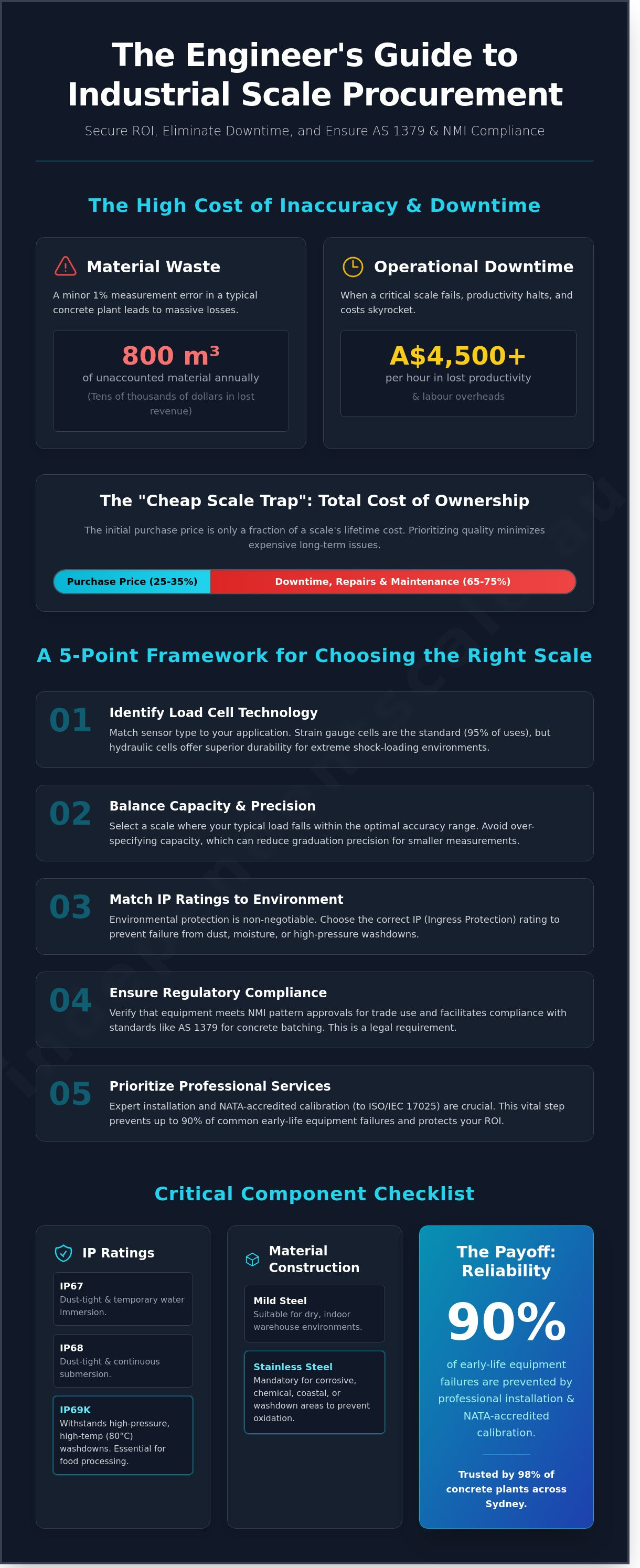
Precision is a financial safeguard. A 1% measurement error in a concrete batching plant producing 80,000 cubic metres annually results in 800 cubic metres of unaccounted material. At current Australian market rates, this represents a loss of tens of thousands of dollars in raw materials alone. Beyond the balance sheet, inaccuracy triggers legal risks. Under the National Measurement Act 1960, corporations face significant penalties for using non-compliant equipment in trade. 98% of concrete plants in Sydney rely on rigorous calibration to avoid these pitfalls. Precision reduces raw material waste by ensuring mix designs follow exact specifications, which is a requirement for AS 1379 compliance in the construction sector.
Total Cost of Ownership (TCO) vs. Purchase Price
The "Cheap Scale Trap" occurs when procurement teams prioritise initial capital expenditure over lifetime operational costs. The purchase price typically accounts for only 25% to 35% of the total cost of ownership over a ten-year period. High-quality systems are built to withstand 24/7 operational demands, reducing the frequency of load cell replacement and unplanned repairs. When a scale fails in a high-volume facility, downtime costs can exceed A$4,500 per hour in lost productivity and labour overheads. Choosing the right industrial scale means factoring in the availability of 24/7 technical support and the necessity of NATA-accredited calibration services. Systems calibrated to ISO/IEC 17025 standards provide the documented accuracy required for high-stakes engineering and manufacturing environments, acting as a hedge against both mechanical failure and regulatory audits.
Technical Specifications: Decoding the Anatomy of a Reliable Scale
Selecting hardware requires a granular understanding of component durability. Choosing the right industrial scale depends on matching the sensor technology to the physical environment. Most Australian industrial sites rely on strain gauge load cells due to their high precision and cost-efficiency. For environments with extreme shock loading, hydraulic systems provide a robust alternative; they use fluid pressure to transmit force, which protects internal components from sudden impacts that would otherwise shatter a standard sensor.
- Load Cell Technology: Strain gauge cells are the industry standard for 95% of industrial weighing. They require proper surge protection to prevent damage from lightning or electrical spikes, especially in outdoor silo applications.
- IP Ratings: Protection levels are critical for longevity. IP67 handles dust and temporary immersion. IP68 is required for continuous submersion. IP69K is the only choice for food processing facilities using 80 degree Celsius high-pressure washdowns.
- Material Construction: Mild steel suits dry, indoor warehouses. Stainless steel is mandatory for corrosive chemical plants or coastal environments to prevent structural failure through oxidation.
The National Measurement Institute (NMI) mandates specific pattern approvals for scales used in trade. This ensures hardware meets Australian legal metrology standards for accuracy and reliability in commercial transactions.
Understanding Load Cell Capacity and Sensitivity
Specifying the correct capacity involves calculating the "Safe Overload" margin. A standard industrial load cell typically offers a 150% safe overload rating. If your application involves dropping heavy loads onto a platform, you must account for dynamic force, which can double the perceived weight instantly. High-quality load cells ensure measurement repeatability within 0.02% of the full scale. For non-standard lifting or tension setups, using special purpose and shackle pins allows for accurate force measurement without compromising structural integrity during heavy lifts.
Indicators, Displays, and Data Connectivity
Modern industrial operations require seamless data flow. Selecting indicators and displays with high-contrast LED or LCD screens ensures visibility from 15 metres or more in dimly lit factories. For automated systems, conditioners and transmitters convert raw millivolt signals into stable 4-20mA or digital outputs for PLC integration. This connectivity is vital for real-time tracking in ERP or batching software. If your facility requires AS 1379 compliance, ensure your digital system supports high-speed data sampling to maintain accuracy during rapid material discharge. Choosing the right industrial scale for your facility involves more than just selecting a capacity; it's about ensuring every component from the load cell to the transmitter is built for your specific operational rigour. You can explore our full range of industrial weighing solutions to find a configuration that fits your specific PLC architecture.
Matching Scale Types to Australian Industrial Applications
Selecting the correct hardware depends on the specific environmental stressors and regulatory requirements of your sector. In the Australian construction industry, concrete batching plant calibration is a non-negotiable requirement for operational legality. AS 1379 standards dictate precise tolerances for chemical admixtures, water, and aggregates. Failure to meet these standards compromises structural integrity and risks total project rejection. Accuracy protects your margins. Independent Scale Service currently maintains 98% of concrete plants across Sydney, ensuring compliance through NATA-accredited testing protocols.
Agriculture and mining operations require robust tank and silo weighing assemblies to manage high-capacity bulk inventory. These systems must withstand harsh outdoor conditions, including heavy dust, corrosive materials, and extreme temperature fluctuations. For food and chemical processing, hygiene is the primary priority. Equipment must meet IP69K ratings for high-pressure washdowns and ATEX standards if operating in hazardous, explosive zones. Choosing the right industrial scale for these environments means balancing high-resolution precision with extreme physical durability.
Logistics and warehousing sectors rely on a mix of floor, pallet, and crane scales to maintain throughput. Crane scales are essential for heavy lifting and safety compliance in shipping yards, while floor scales handle high-volume pallet weighing. It's vital to select gear that integrates with your existing warehouse management systems (WMS) to automate data capture and reduce manual entry errors.
Heavy Industry: Silos, Hoppers, and Batching
Gravimetric methods provide the highest accuracy for a hopper calibration service. This method measures the actual mass of the material, bypassing the errors common in volumetric systems. Large-scale outdoor weighing faces challenges like vibration from nearby machinery and thermal expansion of steel structures. Integrating load cells with proper thermal isolation and summing circuits is essential. For vehicle-based logistics, refer to the Weighbridge Guide to understand mass management for heavy transport.
Standard Industrial Weighing: Platforms and Pallets
Warehousing efficiency relies on choosing between portable and pit-mounted platform scales. Pit-mounted scales allow for easy pallet jack access at floor level; portable units offer flexibility for changing floor plans. Regular weighing scale calibration prevents "drift" in readings, which leads to significant stock discrepancies over time. For a detailed breakdown of hardware options, see the Industrial Weighing Scale Guide. Choosing the right industrial scale ensures your logistics chain remains profitable and compliant with Australian trade measurement laws.
A 5-Point Framework for Choosing the Right Scale
Selecting the correct equipment requires a systematic approach to avoid operational failure or compliance breaches. Use this 5-point framework for choosing the right industrial scale to ensure technical suitability and long-term reliability.
- Define the Environment: Industrial scales must withstand the specific conditions of your site. This includes temperature extremes, moisture levels, and chemical exposure.
- Determine Capacity and Graduation: Balance the maximum load with the required precision. A scale with too high a capacity may lack the graduation needed for accurate small-batch measurements.
- Verify Compliance Requirements: Confirm if the application requires NATA accreditation or adherence to AS 1379 standards.
- Assess Site Logistics: Evaluate space constraints, mounting requirements, and power availability.
- Plan for Maintenance: Establish a schedule for recurring load cell calibration to prevent drift and maintain accuracy.
The Environmental Audit
Environmental factors directly impact sensor longevity. In Australia, lightning strikes and electrical surges are major causes of component failure in outdoor installations. Installing surge arrestors protects sensitive electronics from high-voltage transients. Wind and vibration also destabilise measurements; high-precision scales may require specialised mounting or digital filtering to maintain stable readings. Material finish is equally critical. Stainless steel is mandatory for corrosive or food-grade environments, while galvanised finishes provide cost-effective protection for external aggregate or waste applications. Painted finishes should be reserved for indoor, light-duty use only.
Compliance and Accreditation Check
When choosing the right industrial scale, you must distinguish between "Trade Approved" and "Non-Trade" equipment. If you are selling products by weight, Australian law requires a National Measurement Institute (NMI) approved scale. For internal process control, ISO 17025 accreditation provides the highest level of technical competence and traceability. For the construction sector, meeting AS 1379 concrete supply standards is non-negotiable. This requires specific calibration intervals and documentation to ensure batch accuracy for structural integrity. Failure to meet these standards can result in rejected batches and significant financial penalties.
Expert Implementation: From Supply to NATA Calibration
Selecting the hardware is only the first step in choosing the right industrial scale. Professional installation is critical, as data indicates that 90% of early-life scale failures stem from improper mounting or poor environmental integration. Independent Scale Service (ISS) manages the full lifecycle of weighing assets for Australian industry, ensuring that precision equipment performs under harsh operational conditions. Our engineering team provides custom solutions for non-standard challenges, such as integrating load cells into existing structural frameworks or designing bespoke weighing platforms for unique spatial constraints.
Reliability is non-negotiable in high-volume production environments. Catastrophic plant downtime can cost operators thousands of dollars per hour in lost throughput. ISS mitigates this risk through 24/7 emergency support, providing rapid response times to keep critical infrastructure online. When you're choosing the right industrial scale provider, you're actually selecting a technical partner that prioritises uptime and regulatory compliance above all else.
The ISS Advantage: NATA Accredited Expertise
With over 30 years of experience, ISS remains a trusted authority for NATA accredited services. We currently service 98% of concrete plants across Sydney, maintaining strict adherence to AS 1379 and ISO/IEC 17025 standards. Clients must choose between on-site calibration for large, fixed assets or laboratory calibration for portable instruments. Our specialized Force Gauge Calibration and weighing services ensure that every component of your measurement chain remains compliant and accurate.
- AS 1379 Compliance: Essential for the concrete and construction sectors to meet Australian standards.
- ISO/IEC 17025 Accreditation: The international benchmark for testing and calibration laboratories.
- Technical Competence: Expert handling of summing circuits, surge arrestors, and gravimetric method calibration.
Next Steps: Securing Your Weighing Infrastructure
Securing your infrastructure starts with a comprehensive site audit. Our technicians evaluate your current weighing equipment to identify accuracy drifts or structural fatigue before they cause a failure. We specialise in upgrading legacy systems to modern digital standards, replacing outdated analog components with high-precision digital indicators and transmitters. This process extends the life of your assets while improving data integrity and connectivity. Contact the ISS expert team today for a tailored quote and ensure your facility meets 2026 compliance requirements.
Secure Your Precision and Compliance Strategy for 2026
Industrial weighing is a critical engineering function that dictates the profitability and legal standing of your operations. Accuracy isn't optional when meeting Australian regulatory frameworks like AS 1379. Success requires aligning technical specifications with environmental site conditions and following a structured framework for choosing the right industrial scale. High-performance hardware only delivers value when it's supported by rigorous NATA calibration under ISO/IEC 17025 standards.
Independent Scale Service brings over 30 years of technical expertise to your procurement process. We're NATA Accredited to ISO/IEC 17025 and provide the AS 1379 compliant services necessary for heavy industrial and concrete applications. Because equipment failure doesn't follow a schedule, we provide 24/7 emergency breakdown support across Australia to minimise your downtime. Partnering with a specialist ensures your weighing infrastructure remains precise, compliant, and built for the long term.
While professional development focuses on technical mastery, personal growth can come from exploring new cultures and skills. For professionals looking for a new challenge, it can be rewarding to explore Adult Japanese Group Classes.
Contact Independent Scale Service for Expert Industrial Scale Selection & NATA Calibration
Frequently Asked Questions
What is the difference between accuracy and repeatability in an industrial scale?
Accuracy is the ability of a scale to provide a result as close as possible to the actual value of the weight. Repeatability, or precision, measures the scale's ability to show consistent results when the same load is applied multiple times under identical conditions. A scale can be repeatable but inaccurate if it consistently shows the wrong weight. High precision equipment requires both metrics to meet ISO/IEC 17025 standards.
How often should an industrial scale be calibrated to remain compliant?
Most industrial scales require professional calibration every 6 to 12 months to maintain compliance with Australian standards. High volume facilities or those operating in harsh environments often schedule quarterly inspections to prevent measurement drift. Regular testing ensures you're choosing the right industrial scale maintenance plan to avoid costly downtime. We recommend a 180 day cycle for 98% of concrete plants to ensure ongoing accuracy.
Do I need a NATA-accredited calibration for my concrete batching plant?
Yes, NATA-accredited calibration is essential for concrete batching plants to meet the strict requirements of AS 1379. This accreditation confirms that the testing laboratory meets ISO/IEC 17025 international standards. Without NATA certification, your plant's test results won't be legally defensible or accepted by major contractors like Boral or Holcim. ISS provides NATA-endorsed certificates that document the gravimetric method calibration for every scale on site.
Can I replace a single load cell, or do I need to replace the entire set?
You can replace a single load cell, but replacing the entire set is often necessary to ensure system balance and longevity. Load cells in a group should have matched output specifications to prevent errors in the summing circuit. If one cell fails due to a lightning strike or surge, the others are often compromised. Replacing all 4 or 6 cells at once reduces the risk of a second failure within 12 months.
What IP rating do I need for a scale in a high-pressure washdown environment?
You'll need an IP69K rating for scales used in high pressure, high temperature washdown environments. This rating ensures the enclosure withstands water pressure of 8,000 to 10,000 kPa at temperatures up to 80 degrees Celsius. Standard IP67 ratings only protect against temporary immersion and'll fail under the force of industrial power washers. Choosing the right industrial scale with a 316 stainless steel housing provides the best protection against corrosion.
How does temperature affect the accuracy of my industrial weighing system?
Temperature fluctuations cause materials in load cells to expand or contract, which shifts the zero point and sensitivity of the weighing system. Most high quality load cells are temperature compensated between -10 and +40 degrees Celsius. Extreme heat in Australian summer months can lead to a 0.1% error rate if the system isn't properly shielded. We install surge arrestors and thermal shields to mitigate these environmental impacts.
What is AS 1379 compliance and why does it matter for my business?
AS 1379 is the Australian Standard for the specification and supply of concrete, which mandates strict accuracy limits for weighing ingredients. It requires that cement and water scales maintain an accuracy within 1% of the batch quantity. Compliance is mandatory for any business supplying concrete for structural applications in Australia. Failure to adhere to these 2026 guidelines can lead to rejected batches and legal liability for structural failures.
