


Certified Calibration Services: The 2026 Industrial Compliance Guide
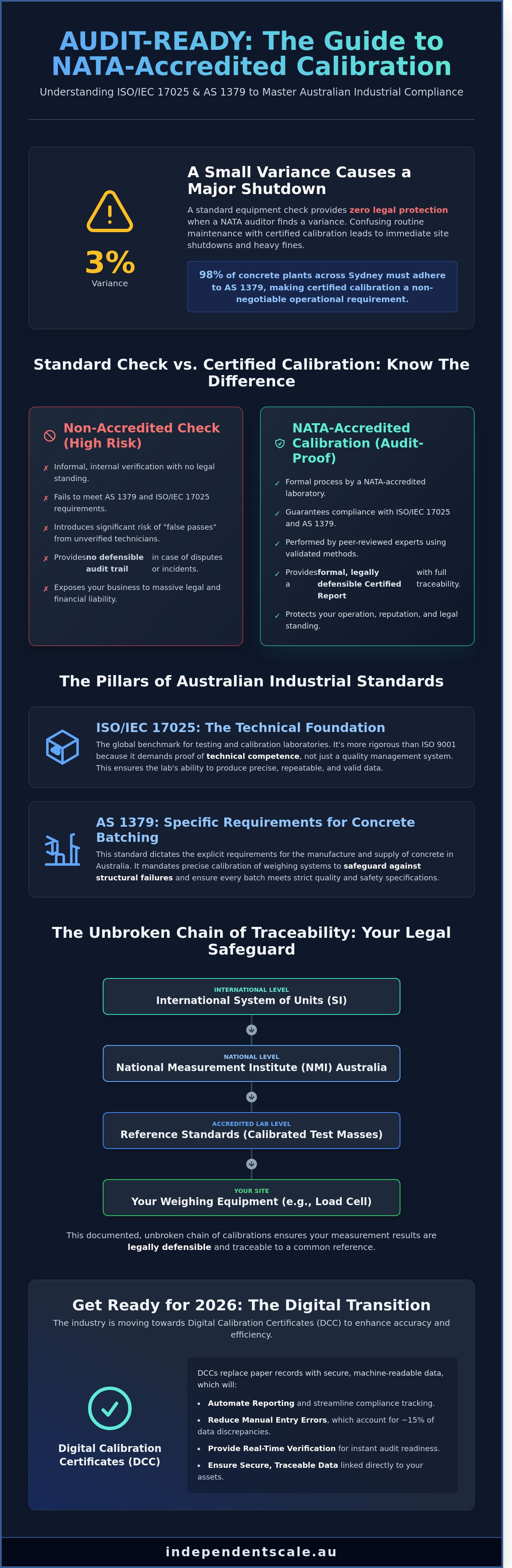
A standard equipment check provides zero legal protection when a NATA auditor identifies a 3% variance in your batching plant. In the Australian industrial sector, confusing routine maintenance with certified calibration services is a risk that leads to immediate site shutdowns and heavy fines. You already know that maintaining accuracy across your load cells and weighing systems is essential for operational integrity. With 98% of concrete plants across Sydney requiring strict adherence to AS 1379, the gap between "working" and "compliant" remains a constant pressure for site managers.
This guide ensures your facility masters the complexities of NATA accreditation, AS 1379 standards, and ISO/IEC 17025 protocols to keep your equipment audit-ready. You'll learn how to implement gravimetric method calibration and secure traceable documentation without sacrificing production hours. We'll examine the technical requirements for 2026 compliance and provide a structured roadmap for achieving full legal and safety certification through methodical, expert-led testing.
Key Takeaways
- Understand how ISO/IEC 17025 and AS 1379 standards provide the essential technical framework for industrial compliance and weighing accuracy in Australia.
- Learn why NATA-accredited certified calibration services are critical for maintaining the traceable accuracy required by major infrastructure and mining projects.
- Discover the specific requirements for concrete batching plants to meet the rigorous "98% of Sydney" reliability benchmark through precise equipment calibration.
- Identify the necessary preparation steps, including diagnostic testing of indicators and summing circuits, to ensure your weighing systems are fully audit-ready.
- Leverage over 30 years of industry expertise to streamline your maintenance schedules and guarantee total compliance with 2026 industrial regulations.
What Are Certified Calibration Services in the Australian Context?
In the Australian industrial sector, certified calibration services refer to a formal verification process conducted by a laboratory accredited by the National Association of Testing Authorities (NATA). This process confirms that a piece of weighing or measurement equipment performs within defined tolerance limits. What is calibration? At its core, it's the comparison of a device under test against a reference standard of known accuracy. For 2026 compliance, simply "checking" a scale is insufficient for high-stakes industries like construction, mining, and pharmaceuticals. A certified calibration provides a formal report inclusive of measurement uncertainty, environmental conditions, and traceability data.
NATA serves as the authority that assesses the technical competence of laboratories. In Australia, using certified calibration services ensures your equipment meets the rigorous requirements of ISO/IEC 17025. This isn't a mere administrative formality. For the 98% of concrete plants across Sydney that must adhere to AS 1379, certified calibration is a mandatory operational requirement. By 2026, the push for digital traceability means every measurement must be linked to the International System of Units (SI) to maintain global trade and safety standards.
- Calibration Check: An informal, internal verification that equipment is "close enough" for non-critical tasks.
- Certified Calibration Report: A legal document issued by an accredited body that proves accuracy and provides a defensible audit trail.
The Importance of Traceability and NIST Standards
Traceability ensures that your measurement results are part of an unbroken chain of comparisons leading back to national standards held by the National Measurement Institute (NMI) or international bodies like NIST. Without this chain, a measurement has no legal standing in an Australian court. Certified services protect your business against massive legal liability if equipment failure leads to structural defects or safety incidents. Traceability is the property of a measurement result whereby the result can be related to a reference through a documented unbroken chain of calibrations, each contributing to the measurement uncertainty, as mandated by the National Measurement Act 1960.
NATA vs. Non-Accredited Services
Choosing a non-accredited "scale technician" introduces significant risk to your compliance profile. Non-accredited providers don't undergo the rigorous peer review required to prove their technical competence or the accuracy of their reference weights. This can lead to "false passes" where equipment is incorrectly certified as accurate. NATA accreditation guarantees that the personnel are experts who follow validated methods. For a deeper look at how these standards impact your facility, see our Calibration Services: The Authoritative Guide for Australian Industry. In high-pressure environments, the cost of a failed audit or a product recall far outweighs the price of professional accreditation.
The Standards: Understanding ISO/IEC 17025 and AS 1379
Industrial compliance in Australia rests on two primary pillars. For plant operators, certified calibration services aren't just a regulatory checkbox; they're a safeguard against structural failure and legal liability. These standards ensure that every gram of material is accounted for and every load cell performs within its specified tolerance.
ISO/IEC 17025: The Technical Foundation
ISO/IEC 17025 is the global benchmark for testing and calibration laboratories. It's more rigorous than ISO 9001 because it requires a laboratory to demonstrate technical competence, not just a management system. The National Measurement Institute (NMI) establishes the framework that ensures these measurements align with national standards. This accreditation is vital for load cell calibration because it verifies the laboratory's ability to produce precise, repeatable data under strict environmental controls.
The principles of ISO/IEC 17025 are recognized internationally, ensuring that industries in neighboring countries also have access to high-quality calibration. For example, in New Zealand, CPS (NZ) Ltd is a key provider of accredited instrumentation calibration and related equipment sales.
By 2026, the industry will see a full transition toward Digital Calibration Certificates (DCC). These certificates replace paper records with machine-readable data, allowing for automated reporting and real-time compliance tracking. This shift reduces manual entry errors, which currently account for approximately 15% of data discrepancies in industrial settings.
AS 1379: Specific Requirements for Concrete Batching
While ISO 17025 governs the laboratory, AS 1379 dictates the specific requirements for the manufacture of concrete in Australia. It's a mandatory standard that defines how batching plants must operate to ensure structural integrity. Compliance requires regular verification of all weighing equipment, typically at intervals not exceeding 6 months. The accuracy tolerances are strict:
- Cement and Cementitious Materials: Must be accurate to within +/- 1% of the batch quantity.
- Water: Requires accuracy within +/- 1% to maintain the correct water-to-cement ratio.
- Aggregates: Must be within +/- 2% for individual batchers.
Failing to meet these tolerances can lead to compromised concrete strength and project rejection. For a detailed breakdown of these requirements, refer to our guide to AS 1379 compliance.
Total compliance for a concrete batching plant requires the intersection of both standards. We use the gravimetric method, using physical NATA-traceable weights, to verify the entire weighing system. This method tests the load cells, summing circuits, and indicators as a single unit. It's the most reliable way to guarantee your plant meets the stringent 2026 industrial benchmarks. If your equipment is due for its 6-month check, booking a certified calibration service now will prevent costly downtime during peak production periods.
Critical Applications for Certified Calibration in 2026
In 2026, the margin for error in Australian industrial weighing has disappeared. Precision isn't just a goal; it's a regulatory mandate. Certified calibration services provide the technical framework required to operate in high-stakes sectors where a fraction of a percent determines project success or failure. From Sydney's infrastructure boom to the mining hubs of Western Australia, accurate data is the only way to maintain compliance and profitability.
Concrete and Infrastructure Projects
Major contractors like Holcim, Boral, and Hanson don't just prefer certified reports; they demand them as a condition of site access. We maintain the "98% of Sydney" standard of reliability by ensuring plants remain compliant with AS 1379. If a batching plant's scales are off by even 1%, the structural integrity of the concrete mix is compromised. This leads to batch rejections and massive liability risks on tier-one projects. Professional concrete batching plant calibration services ensure that every gram of cement and aggregate is accounted for, protecting the contractor's reputation and the public's safety.
Heavy Industry: Silos, Hoppers, and Tanks
Calibrating large-scale tank and silo weighing assemblies presents unique technical challenges that standard scale companies can't handle. On-site verification often requires specialized hydraulic force systems or NATA-traceable test weights to simulate high-capacity loads. For mining and bulk handling operations, inventory accuracy is the difference between a profitable quarter and a significant financial write-down. Our hopper calibration service uses gravimetric methods to verify accuracy across the entire weighing range. This prevents material loss during bulk transfers and ensures that inventory data remains beyond reproach during audits.
Logistics, Transport, and Manufacturing
The role of weighbridge calibration has become central to Chain of Responsibility (CoR) laws. Overloaded vehicles lead to heavy fines and increased road wear, making regular certification essential for transport hubs. In the manufacturing sector, high-speed automated lines rely on load cells to provide consistent data. If a sensor drifts, the entire production run can fail quality control. Certified calibration services eliminate this risk by providing a documented trail of accuracy that satisfies both ISO/IEC 17025 requirements and internal quality benchmarks. It's a methodical approach to preventing downtime and ensuring that every product leaving the factory meets its weight specifications.
Beyond material and vehicle management, modern industrial sites also leverage data for personnel safety and site management. Understanding people flow is crucial for compliance with safety regulations and optimizing operations. For those interested in this area, footfall.au provides an overview of current people counting technologies and solutions used across Australia.
The Calibration Process: What to Expect and How to Prepare
Executing certified calibration services requires a methodical approach to ensure every weighing system meets the rigorous standards of ISO/IEC 17025 and AS 1379. The process isn't a simple check; it's a technical procedure that validates the entire measurement chain. Our technicians follow a structured five-step protocol to guarantee accuracy and compliance for industrial weighing infrastructure.
- Step 1: Initial Assessment. Technicians perform diagnostic testing on summing circuits and signal health. This identifies electronic faults before physical weight is applied.
- Step 2: Environmental Stabilization. Equipment must reach thermal equilibrium. We clean all mechanical components to ensure material buildup doesn't skew the results.
- Step 3: Multi-point Testing. Using NATA-certified test masses, we perform a series of weight applications. This checks for linearity, repeatability, and hysteresis across the scale's range.
- Step 4: Adjustment and Re-testing. If errors exceed allowable tolerances, technicians calibrate the instrument and re-test to secure compliant "as-left" data.
- Step 5: Certification. ISS issues formal NATA-endorsed certificates. These documents provide the legal proof of accuracy required for 2026 industrial audits.
Preparing Your Site for a Calibration Technician
Operational downtime is minimised when sites are prepared before our arrival. You must ensure clear, safe, and unobstructed access to all indicators and displays to allow for rapid interface testing. Hoppers and silos should be pre-cleaned. Residual material buildup directly affects tare weight and can mask underlying load cell drift. Safety is a non-negotiable priority, so ensure all Lock-out/Tag-out (LOTO) protocols are ready for implementation during load cell and mounting assembly inspections.
Dealing with Repairs and Faults During Calibration
Testing often reveals hardware failures like surge arrestor degradation or moisture ingress in the cabling. Having spare junction boxes and surge arrestors on hand prevents a failed calibration from turning into an extended plant shutdown. NATA reporting standards require the inclusion of "as-found" data to document the equipment's state upon arrival and "as-left" data to prove it was returned to a compliant state. This transparency is critical for maintaining your quality management system history and ensuring 100% compliance during external audits.
Ensure your weighing equipment remains accurate and compliant by booking your next certified calibration services with our NATA-accredited team. Schedule an AS 1379 compliance audit today.
Independent Scale Service: Australia’s Authority in Certified Calibration
Independent Scale Service (ISS) brings over 30 years of technical experience to the Australian construction and weighing sectors. We've built our reputation on precision and a no-nonsense approach to industrial compliance. Our technicians provide certified calibration services that are NATA Accredited to ISO/IEC 17025. We ensure every piece of equipment we touch is fully compliant with AS 1379, the benchmark for concrete production in Australia. This level of accreditation isn't just a badge; it's a guarantee that your measurements will withstand the most rigorous regulatory audits.
Operational downtime costs money. We mitigate this risk through our 24/7 emergency support, ensuring that critical industrial operations stay online. Our strategic service coverage spans Sydney and Melbourne, with a mobile fleet capable of reaching regional Australia to support large-scale infrastructure projects. We're the first call for firms that demand reliability over rhetoric.
Our Proven Track Record with Industry Leaders
There's a reason we service 98% of concrete plants across Sydney. Our team specializes in both electrical and mechanical fault diagnosis, allowing us to solve problems that others overlook. We've managed high-stakes projects for industry giants like Holcim, Boral, and Hanson. In these environments, we maintain batching accuracy within the strict tolerances required for Tier 1 infrastructure. We don't just identify errors; we calibrate summing circuits and inspect surge arrestors to ensure long-term stability. Our history with these major players proves we're equipped for the most demanding environments in the country.
Comprehensive Weighing Solutions
Our capabilities extend well beyond basic testing. We're a full-service provider for the weighing industry. We supply high-durability hardware, including special purpose and shackle pins designed for heavy-duty tension and lifting applications. For facilities requiring advanced data integration, we offer custom conditioners and transmitters. These components are essential for converting raw load cell signals into usable data for complex PLC systems.
Reliable data is the backbone of your compliance strategy. Don't leave your facility's accuracy to chance. Contact our team today to schedule a NATA-certified audit or to book your next round of certified calibration services. We'll ensure your plant meets every Australian standard with documented precision.
Future-Proof Your Operations with Technical Precision
Maintaining industrial compliance in 2026 requires more than simple checks; it demands rigorous adherence to AS 1379 and ISO/IEC 17025 standards. Accurate weighing systems are the foundation of operational safety and legal certainty across Australia's infrastructure projects. Independent Scale Service provides the technical expertise necessary to eliminate measurement drift and ensure every batch meets exact specifications. We're NATA Accredited to ISO/IEC 17025 and currently service 98% of Sydney's concrete plants, proving our reliability in high-stakes environments.
Don't let equipment failure or audit non-compliance stall your productivity. Our team offers emergency 24/7 support to keep your facility running without interruption. By investing in certified calibration services, you're protecting your margins and your reputation. We bring over 30 years of field experience directly to your site, ensuring your scales perform to the highest Australian benchmarks. It's time to secure your plant's accuracy for the year ahead.
Book Your NATA-Certified Calibration Service Today
Frequently Asked Questions
Is NATA accreditation mandatory for all industrial scales in Australia?
NATA accreditation isn't mandatory for every industrial scale, but it's essential for trade-approved equipment and high-risk sectors like concrete production. If you're selling products by weight, the National Measurement Institute (NMI) requires verification by a licensed technician. For companies following ISO/IEC 17025 standards, certified calibration services provide the necessary traceability to national standards. Non-trade scales used for internal process control might only require standard calibration based on your internal quality management system.
How often should a concrete batching plant be calibrated under AS 1379?
AS 1379:2007 specifies that weighing systems in concrete batching plants must undergo calibration every 6 months. This biannual schedule ensures the accuracy of cement, water, and aggregate measurements within the 1% to 2% tolerance limits defined by the standard. Independent Scale Service manages these schedules for 98% of concrete plants across Sydney. Regular testing prevents batch errors that could compromise structural integrity and lead to costly A$50,000 plus rework on construction sites.
What is the difference between a calibration certificate and a verification report?
A calibration certificate records the actual performance of a scale against known masses, while a verification report confirms the device meets specific legal requirements for trade. Calibration identifies the degree of error and provides traceability. Verification is a "pass or fail" assessment required by the National Measurement Act 1960 for any scale used to determine price. Most industrial sites require both to maintain full compliance with ISO/IEC 17025 and NMI regulations.
Can calibration be performed on-site for large silos and hoppers?
On-site calibration is the standard procedure for large silos and hoppers because these structures are fixed and cannot be transported. Technicians use high-capacity test weights or gravimetric methods to verify load cell accuracy in situ. This process accounts for environmental factors like wind loading and pipe stiffness that affect weighing precision. Independent Scale Service utilizes specialized heavy-duty vehicles to deliver up to 20 tonnes of certified weights directly to your facility for these complex procedures.
What happens if my weighing equipment fails a NATA calibration test?
If equipment fails a NATA calibration test, it's immediately flagged as non-compliant and must be adjusted or repaired before being re-tested. Our technicians perform on-the-spot troubleshooting, checking summing circuits and load cell integrity to resolve the issue. You'll receive a report detailing the "as found" and "as left" data. Using certified calibration services ensures that any adjustments bring the equipment back within the specific tolerances required by AS 1379 or ISO/IEC 17025.
How does ISO/IEC 17025 differ from ISO 9001 for calibration services?
ISO/IEC 17025 is a technical standard that proves a laboratory's competence to produce valid results, whereas ISO 9001 is a general quality management system. A NATA-accredited lab must meet ISO/IEC 17025 requirements, which involve rigorous peer review of technical processes and equipment. ISO 9001 focuses on business processes and customer satisfaction but doesn't guarantee the technical accuracy of calibration data. For industrial compliance, always choose a provider with ISO/IEC 17025 accreditation for your weighing assets.
What information must be included in a certified calibration report?
A certified calibration report must include the unique identification of the equipment, the specific method used, and the environmental conditions during testing. It also requires a statement of measurement uncertainty and evidence of traceability to national standards. You'll find the NATA endorsement logo on reports from accredited providers, confirming the data meets international criteria. These documents are essential for audits and must be retained for at least 7 years under most Australian industrial regulations.
Does Independent Scale Service provide 24/7 emergency calibration repairs?
Yes, Independent Scale Service provides 24/7 emergency repairs and calibration services to minimize client downtime. You can reach our rapid response team at any hour for critical failures in concrete plants, silos, or weighbridges. With over 30 years of experience, we understand that a single hour of downtime can cost an industrial facility thousands of dollars. Our technicians arrive equipped with the necessary components to perform immediate repairs and restore your equipment to full compliance.
