


24/7 Weighbridge Support Australia: Technical Repair & Emergency Maintenance
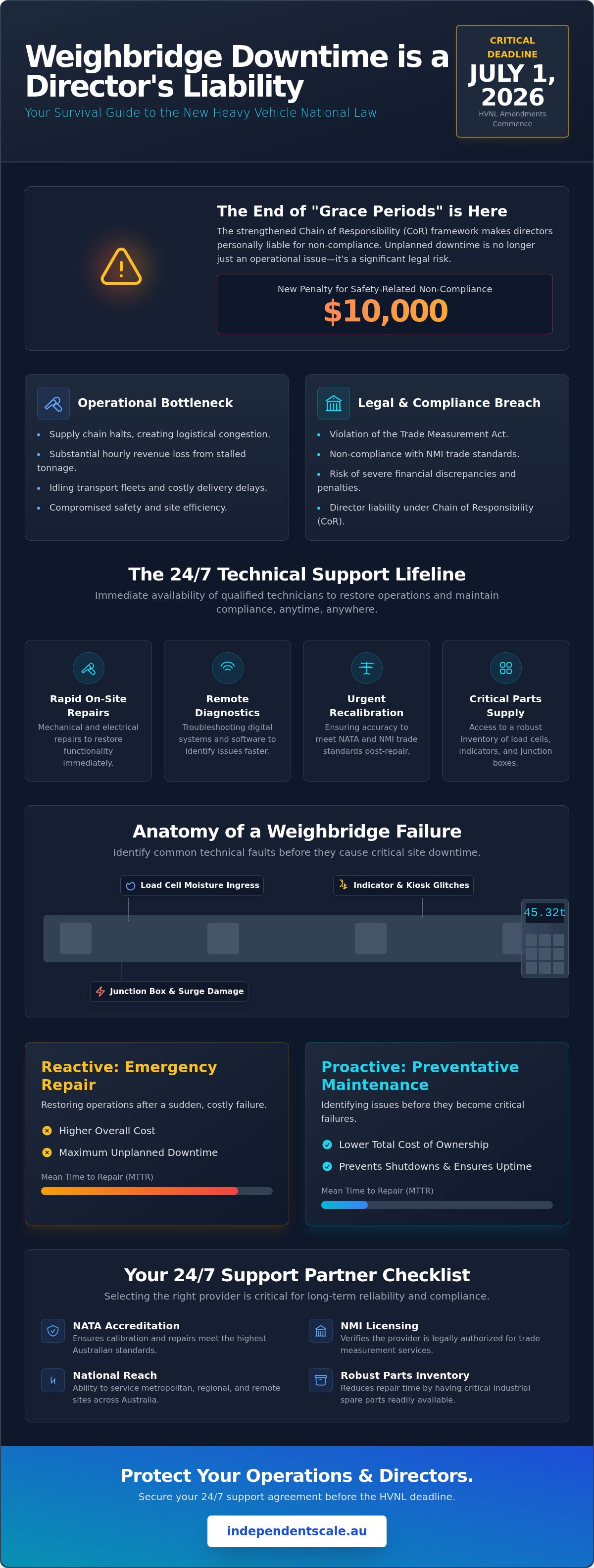
With the Heavy Vehicle National Law (HVNL) amendments commencing on July 1, 2026, the era of compliance grace periods for industrial weighing is officially over. You likely recognize that even a single hour of unplanned downtime doesn't just halt your site operations; it exposes your directors to significant personal liability under the strengthened Chain of Responsibility (CoR) framework. When a system failure occurs, securing reliable emergency weighbridge repair Australia wide is no longer a luxury. It's a critical risk management strategy to avoid the new $10,000 penalties for safety-related non-compliance.
This guide demonstrates how to secure 24/7 technical support to eliminate operational delays and ensure your equipment consistently meets NATA and NMI trade standards. You'll learn the technical requirements for AS 1379 compliance, the necessity of precision load cell calibration, and how preventative maintenance protects your commercial interests. We'll also detail how the immediate restoration of weighing capabilities prevents financial discrepancies and maintains the integrity of your industrial operations under the new two-tier accreditation framework.
Key Takeaways
- Define the scope of technical 24/7 support, including remote diagnostics and on-site repairs for private industrial systems.
- Understand how emergency weighbridge repair Australia services protect your operations from legal liabilities under the Trade Measurement Act.
- Identify common technical faults like load cell moisture ingress and indicator glitches before they've caused significant site downtime.
- Establish criteria for selecting providers, focusing on NATA accreditation, NMI licensing, and a robust inventory of industrial spare parts.
- Learn how rapid response times and expert calibration ensure your equipment's long-term reliability and compliance with Australian standards.
What Does 24/7 Weighbridge Support in Australia Include?
Technical 24/7 support is a specialized service designed for industrial sites where weighing operations are continuous. It's vital to distinguish this from public weighbridge access. While many public sites offer 24/7 automated weighing for drivers, technical support refers to the immediate availability of qualified technicians to perform an emergency weighbridge repair Australia wide. This service encompasses rapid on-site mechanical repairs, remote diagnostics of digital weighing systems, and urgent recalibration to maintain trade standards.
A truck scale (weighbridge) is a high-precision instrument subjected to extreme environmental stress and heavy axial loads. In sectors such as mining, waste management, and bulk logistics, a malfunction directly halts revenue streams and compromises safety. Comprehensive support covers all critical failure points, ensuring that the entire weighing chain remains operational. This includes:
- Precision load cell supply and replacement.
- Digital indicators and displays troubleshooting.
- Junction box integrity and surge protection.
- Automation software and unattended kiosk hardware.
Emergency Repair vs. Preventative Maintenance
Reactive support is inherently more costly than scheduled monitoring. While emergency call-outs are necessary to restore operations after a sudden failure, preventative maintenance utilizes remote telemetry to identify drifting measurements before a total shutdown occurs. 24/7 support contracts provide guaranteed response times that standard business hour agreements don't offer. This level of service is essential for sites like concrete batching plants where AS 1379 compliance must be maintained around the clock to meet construction deadlines.
The Scope of National Support
Service availability varies significantly across the Australian landscape. Metropolitan hubs like Sydney, Melbourne, and Brisbane benefit from higher technician density and streamlined parts logistics. Regional and remote sites, particularly in the mining sectors of Western Australia and Queensland, face greater logistical hurdles. A service provider with a national reach is a necessity for large-scale fleet operators. It ensures that emergency weighbridge repair Australia is accessible regardless of the site's proximity to a capital city, maintaining consistent NMI compliance across all assets.
Why Round-the-Clock Support is Critical for Logistics and Compliance
An inoperable weighbridge is a bottleneck that halts the entire supply chain. In high-volume environments like quarries or waste transfer stations, every hour of downtime translates to lost revenue and logistical congestion. Under the National Heavy Vehicle Law (NHVL), operating with faulty weighing equipment isn't just an operational failure; it's a legal risk. The July 1, 2026, amendments to the Heavy Vehicle National Law (HVNL) strengthen the Chain of Responsibility (CoR), making directors and executives personally liable for safety breaches. Ensuring access to emergency weighbridge repair Australia wide is a necessary safeguard against these liabilities, particularly as penalties for safety risks are set to rise to $10,000.
The Trade Measurement Act requires all weighbridges used for trade to be accurate and verified. If a load cell fails at 2 AM, continuing operations without a functioning scale violates NMI standards. This can result in severe financial discrepancies and legal penalties. Prompt technical intervention ensures that site managers don't have to choose between halting production and risking non-compliance. Technical competence in these moments is non-negotiable for maintaining the integrity of industrial operations.
Impact on Revenue and Operational Efficiency
For a large-scale quarry, the hourly loss from a stalled weighbridge can be substantial. It's not just the direct loss of tonnage; it's the cost of idling transport fleets and delayed delivery schedules. Specialized industrial technicians focus on reducing the Mean Time to Repair (MTTR) by arriving with the correct components and diagnostic tools. 24/7 technical support acts as an insurance policy for logistics hubs, ensuring that throughput remains constant even during unexpected hardware failures. This responsiveness is what separates a reliable facility from one prone to costly bottlenecks.
Meeting AS 1379 and ISO 17025 Standards
Compliance requires more than just a quick fix. When critical components like load cells are replaced, the system must remain within NATA-accredited tolerances. Utilizing expert calibration services ensures that repairs meet the rigorous requirements of AS 1379 and ISO 17025. This is especially vital for concrete batching plants, where precision is essential for structural integrity and regulatory adherence.
Emergency repairs must be performed by technicians who understand NMI trade-legal status. Replacing a part without proper verification could void your site's certification. To maintain full legal compliance after a component failure, you should schedule professional weighing scale calibration immediately following any major repair. This methodical approach ensures that your long-term reliability isn't compromised by short-term fixes, keeping your business within the strict boundaries of Australian trade law.
Common Faults in 24/7 Automated Weighbridge Systems
Automated weighbridge systems operate without constant human supervision. This lack of oversight means technical faults often progress from minor discrepancies to total system failure before being detected. Identifying these issues early is critical for maintaining site throughput. When these systems fail, emergency weighbridge repair Australia services must address the specific vulnerabilities of unmanned kiosks and high-frequency hardware. Effective diagnostics prevent minor glitches from escalating into multi-day operational shutdowns.
Environmental stress is a significant contributor to component degradation. Australian conditions, characterized by extreme thermal expansion and pervasive dust, accelerate the wear on electronic weighing components. Fine particulates can infiltrate enclosures, causing overheating or short circuits in sensitive circuitry. These factors make regular technical assessments essential for maintaining the precision required by the National Measurement Institute (NMI).
Load Cell and Junction Box Vulnerabilities
Load cells are the most vulnerable components in any industrial weighing installation. Moisture ingress in industrial load cells or junction boxes often manifests as erratic readings or a failure to return to zero. Lightning strikes and power surges also pose a constant threat to 24/7 outdoor installations. The integration of high-quality surge arrestors is a technical necessity for protecting these assets. Load cell drift occurs when environmental or mechanical stress causes a scale's zero point or span to shift gradually, resulting in cumulative weighing inaccuracies that compromise trade-legal compliance.
Indicator and Peripheral Failures
Unattended kiosks rely on robust indicators and displays to guide drivers through the weighing process. In high-use environments, touchscreens and physical buttons are prone to mechanical fatigue. Peripheral failures also frequently disrupt operations, including:
- Thermal printer jams or hardware malfunctions.
- RFID reader connectivity drops.
- Boom gate synchronization errors.
- Cloud-based data sync failures due to modem instability.
Effective 24/7 support must extend beyond simple component replacement. It requires comprehensive hardware and electrical diagnostics to identify the root cause of connectivity issues or peripheral glitches. Technicians must be equipped to troubleshoot the entire automation ecosystem to ensure the site remains fully operational. Addressing these faults promptly minimizes the risk of inaccurate load readings and financial discrepancies.
How to Choose a 24/7 Weighbridge Support Provider
Selecting a technical partner for emergency weighbridge repair Australia requires a methodical evaluation of their regulatory credentials and logistical readiness. A provider's ability to respond quickly is irrelevant if they lack the legal authority to certify your equipment for trade or the specific components required for your system. Industrial operators must prioritize providers who demonstrate a deep understanding of National Measurement Institute (NMI) requirements and possess the infrastructure to support remote or high-volume sites.
Technical competence must be verified through established industry markers. When evaluating a potential service partner, ensure they meet the following criteria:
- Current NMI licensing for trade measurement verification.
- Documented response time guarantees for your specific geographic region.
- Comprehensive diagnostic capabilities covering load cells, indicators, and automation software.
- A proven track record with high-profile industrial or corporate clients.
The Importance of NATA Accreditation
NATA accreditation is the benchmark for technical competence in Australia. Only NATA-accredited laboratories should perform emergency calibrations following a major repair. This ensures that the measurement results are traceable and meet international standards. There is a direct technical link between force gauge calibration and weighbridge accuracy; both require precise reference standards and controlled procedures to ensure reliability. Your provider must have the capability to issue valid, legally recognized certificates on-site immediately following the repair to prevent further operational delays.
Stock Availability and Technical Expertise
A technician's effectiveness is limited by the parts they carry. A reliable 24/7 provider maintains a robust inventory of critical components, including tank and silo weighing assemblies and various load cell models. This stock availability is what allows for a first-time fix rather than a temporary patch. Technicians must also possess dual expertise in electrical and mechanical faults. They should be able to troubleshoot a complex software integration issue as efficiently as a mechanical structural failure. When interviewing a provider, ask specific questions about their 24/7 dispatch protocols and their ability to provide remote diagnostic support before a technician even arrives on-site.
Ensuring your weighing equipment remains compliant and operational requires a partner with national reach and specialized expertise. For immediate technical assistance and NATA-accredited service, contact Independent Scale Service to secure your industrial weighing reliability.
Independent Scale Service: Your Partner for 24/7 Weighing Reliability
Independent Scale Service provides a national technical support network dedicated to maintaining the operational integrity of industrial weighing infrastructure. Our technical teams understand that an equipment failure isn't merely a mechanical issue; it's a critical threat to your site's productivity and legal standing. By providing emergency weighbridge repair Australia wide, we ensure that unplanned downtime is minimized through rapid diagnostic intervention and the immediate deployment of qualified technicians. Our service model is built on technical competence and a deep understanding of the high-pressure environments found in mining, logistics, and heavy manufacturing.
Reliability in industrial weighing requires more than just reactive fixes. It demands a partner capable of performing NATA-accredited calibrations and NMI trade verifications under urgent conditions. We maintain a comprehensive inventory of high-quality weighing components, including specialized load cell supply options, to facilitate first-visit resolutions. This commitment to stocking critical hardware ensures that your facility doesn't remain offline while waiting for international shipping or regional parts transfers.
Specialised Industrial Support
Our expertise extends to the most demanding industrial applications, including concrete batching plant calibration. These facilities require strict adherence to AS 1379 standards to ensure structural material consistency. We offer tailored maintenance contracts for high-volume industrial sites that prioritize preventative care alongside emergency response. To enhance system transparency, we integrate advanced conditioners and transmitters into existing setups. These components allow for precise signal processing and remote monitoring, often enabling our technicians to identify potential faults before they result in a complete system shutdown.
Get Started with Professional Support
Ensuring your weighing systems are prepared for the 2026 HVNL amendments begins with a professional assessment. We offer comprehensive audits of current weighbridge systems to identify vulnerabilities in load cell health, cabling integrity, and software data management. Our technical teams based in Sydney and Melbourne are equipped to provide immediate assistance for critical breakdowns or scheduled compliance verifications. Whether you operate a single site or a national fleet of weighbridges, our structured approach to technical service provides the assurance that your measurements remain accurate and trade-legal.
Contact Independent Scale Service today to request a comprehensive quote for 24/7 technical support and emergency weighbridge repair Australia wide.
Secure Your Operational Compliance and Reliability
Operational continuity in the Australian industrial sector depends on the precision and availability of weighing infrastructure. As the Heavy Vehicle National Law amendments take effect on July 1, 2026, the technical burden on site managers to maintain accurate, trade-legal systems has never been higher. Proactive technical support ensures that your equipment remains within NATA-accredited tolerances while protecting your executive team from the legal risks associated with Chain of Responsibility breaches. Accessing expert emergency weighbridge repair Australia wide is the only way to mitigate the high cost of unplanned downtime and safety-related penalties.
Independent Scale Service provides the specialized technical competence required for high-stakes weighing environments. Our facility is NATA Accredited to ISO/IEC 17025 and NMI Licensed for Trade Verification, ensuring that every repair and calibration meets the highest regulatory standards. We maintain deep expertise in AS 1379 compliance for concrete batching plants and provide a robust supply chain for critical load cell components. You can rely on our methodical approach to keep your site operational and compliant under the most demanding conditions.
Contact Independent Scale Service for 24/7 Emergency Weighbridge Support to ensure your operations never miss a measurement. We look forward to securing your site's weighing reliability.
Frequently Asked Questions
Does a weighbridge need to be open 24/7 to be considered public?
No, a weighbridge is classified as public based on its National Measurement Institute (NMI) license status, not its operating hours. While many automated public weighbridges offer 24/7 access for heavy vehicle drivers, others operate only during specific facility hours. The critical factor is whether the site is verified and registered to provide weighing services to the general public for a fee.
What is the response time for emergency weighbridge repair in Australia?
Response times for emergency weighbridge repair Australia wide are typically determined by your specific Service Level Agreement (SLA) and geographic location. In metropolitan regions like Sydney or Melbourne, technicians can often be dispatched quickly, while regional or remote sites may face longer travel times. You should verify your provider's guaranteed response windows for after-hours and weekend call-outs to ensure they meet your site's operational requirements.
Can I still use my weighbridge if one load cell is failing?
No, you shouldn't continue operations if a load cell is failing. Even one faulty component compromises the system's ability to distribute load weight accurately across the deck. This failure leads to significant measurement errors, which can result in overloaded vehicles or financial discrepancies. Continuing to use a faulty system also risks violating trade-legal verification standards and voiding your NMI compliance.
How often should a 24/7 automated weighbridge be calibrated?
Industrial weighbridges used in 24/7 automated environments should be calibrated at least once every 12 months to meet standard regulatory expectations. However, high-volume sites or those operating in harsh environments often require quarterly or bi-annual testing to maintain precision. Regular calibration prevents measurement drift and ensures that the system remains compliant with the National Measurement Act and AS 1379 standards.
What certifications are required for a technician to repair a trade-legal weighbridge?
Technicians must hold a valid license from the National Measurement Institute (NMI) to perform repairs and verifications on trade-legal weighbridges. For calibration services to be recognized for high-level compliance, the service provider should be NATA accredited to ISO/IEC 17025. These credentials serve as a technical guarantee that the technician is competent to restore the scale to legal-for-trade tolerances.
How does weather affect the accuracy of a 24/7 outdoor weighbridge?
Extreme Australian weather conditions directly impact weighing accuracy through thermal expansion and moisture ingress. High temperatures cause the steel deck to expand, potentially binding against the frame if clearances aren't maintained. Additionally, heavy rain or humidity can lead to moisture in junction boxes or load cell cables, causing signal instability and erratic weight readings that require technical intervention.
Is remote support available for weighbridge software issues?
Yes, remote support is frequently available for diagnosing software, connectivity, and automation kiosk issues. Modern weighing indicators and cloud-based data systems allow technicians to interrogate the system remotely to identify faults without a physical site visit. While mechanical failures still require on-site emergency weighbridge repair Australia, remote diagnostics can significantly reduce the total downtime for digital glitches.
What are the consequences of operating a non-compliant weighbridge?
Operating a non-compliant weighbridge can lead to severe legal and financial consequences. Under the 2026 Heavy Vehicle National Law (HVNL) amendments, safety-related breaches can result in penalties of up to $10,000. Beyond fines, inaccurate weighing leads to incorrect billing, loss of customer trust, and potential personal liability for company directors under the strengthened Chain of Responsibility (CoR) framework.
