


Truck Scale Maintenance Checklist: The 2026 Industrial Guide to Accuracy
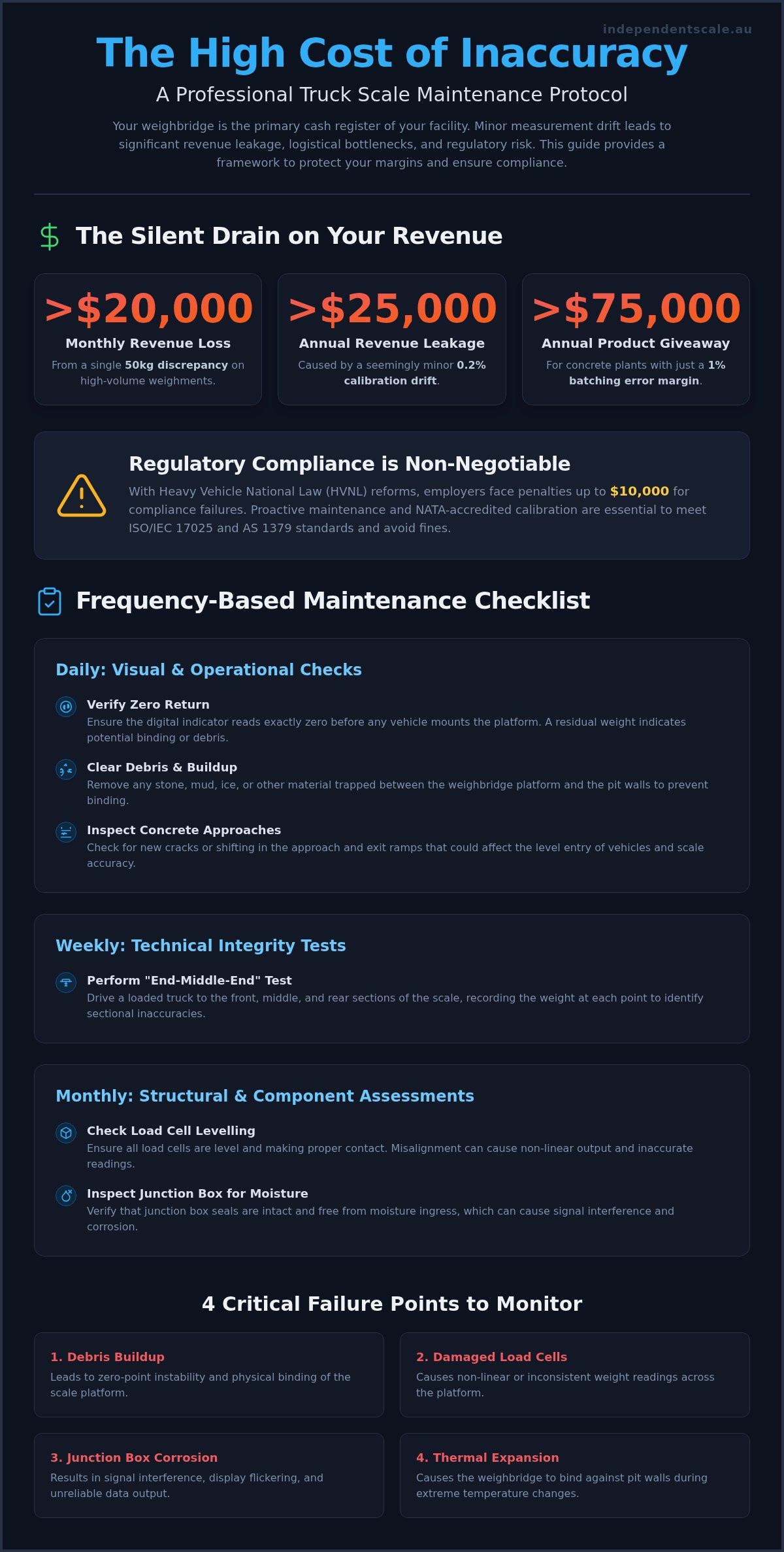
A single 50kg discrepancy on your weighbridge can silently drain over $20,000 from your monthly revenue. In high-volume industrial environments, your truck scale is the primary cash register of the facility. You already understand that even minor measurement drift leads to significant revenue leakage and logistical bottlenecks. With the Heavy Vehicle National Law (HVNL) reforms effective as of August 1, 2026, the demand for precision is no longer optional. Employers now face penalties of up to $10,000 for compliance failures, making rigorous equipment oversight a financial necessity.
This professional truck scale maintenance checklist provides a frequency-based framework to protect your margins and ensure NATA compliance. We've designed this guide to help you achieve zero revenue leakage while meeting the strict ISO/IEC 17025 standards and AS 1379 requirements for concrete batching plants. You'll learn how to implement a methodical inspection routine that extends equipment lifespan and guarantees seamless regulatory audits. We will cover daily debris management, monthly structural assessments, and the technical requirements for NATA-accredited calibration to keep your operations running without interruption.
Key Takeaways
- Treat your weighbridge as an industrial cash register where every kilogram of measurement drift represents direct revenue leakage.
- Follow a structured truck scale maintenance checklist categorized by daily, weekly, and monthly tasks to maintain operational integrity.
- Monitor the mechanical integrity of the system by ensuring load cells are levelled and junction boxes remain protected from moisture ingress.
- Proactively manage thermal expansion and debris buildup to prevent the weighbridge from binding against pit walls during extreme temperature swings.
- Validate your internal maintenance routines with NATA-accredited calibration to meet ISO/IEC 17025 and AS 1379 compliance requirements.
The High Cost of Inaccuracy: Why Maintenance is Your Best ROI
Truck scale maintenance isn't merely a cleaning task; it's a proactive strategy designed to defend measurement integrity. Every industrial weighbridge functions as the primary cash register for your facility. If the equipment is inaccurate, your financial reporting is inherently compromised. Utilizing a rigorous truck scale maintenance checklist ensures that these precision instruments operate within defined tolerances. An inaccurate scale is a broken till, and the costs of neglect accumulate quickly across high-volume operations.
Quantifying the risk reveals the true stakes of calibration drift. A variance of just 0.2% can result in over A$25,000 in annual revenue leakage for a standard bulk facility. For high-volume Australian concrete plants, a 1% margin of error in batching accuracy can lead to over A$75,000 of product giveaway annually. Beyond direct financial loss, poor maintenance significantly shortens the lifespan of sensitive components. Protecting your investment in load cells requires a commitment to removing debris and moisture that cause mechanical stress and electrical failure.
The Financial Impact of Calibration Drift
Calibration drift is the gradual loss of accuracy due to environmental and mechanical stress. These small errors don't stay small; they compound over thousands of weighments throughout the year. While the cost of proactive maintenance is predictable, the cost of emergency repair downtime is often catastrophic. Unplanned outages cause logistics bottlenecks that ripple through your entire supply chain. Proactive sites identify measurement trends early, preventing the need for expensive, last-minute component replacements. Common areas where revenue leakage occurs include:
- Zero-point instability caused by debris under the platform.
- Non-linear output from damaged or misaligned load cells.
- Signal interference from corroded junction box connections.
- Binding of the weighbridge against pit walls due to thermal expansion.
Regulatory Consequences of Neglect
Poor maintenance practices almost certainly lead to failed NATA audits and legal liabilities. For concrete producers, concrete batching plant calibration to AS 1379 standards is a mandatory requirement for quality assurance. The regulatory landscape became even more demanding on August 1, 2026, with the Heavy Vehicle National Law (HVNL) reforms. Employers now face revised penalties of up to $10,000 for failing to ensure driver and vehicle compliance. Maintaining an audit-ready maintenance log is the only way to prove due diligence. A documented truck scale maintenance checklist provides the factual evidence needed to satisfy NATA inspectors and avoid the heavy fines associated with non-compliant weighing systems.
Frequency-Based Maintenance Protocol: Daily, Weekly, and Monthly Tasks
Effective weighbridge oversight requires a structured hierarchy of inspection tasks that go beyond annual servicing. Integrating a frequency-based truck scale maintenance checklist into your wider weighbridge management strategy is the most effective way to prevent unplanned downtime. Operators serve as the first line of defense; their ability to identify early warning signs like display flickering or zero-point instability is critical for maintaining measurement integrity.
Daily Visual and Operational Checks
Daily inspections focus on the immediate operational environment. Every shift should begin with a verification that the digital indicator returns to exactly zero before a vehicle enters the platform. If the display shows a residual weight, it often indicates "binding" caused by debris trapped in the gaps. Operators must remove any buildup of stone, mud, or ice between the platform and the pit walls. Additionally, inspect the concrete approaches for new cracks or shifting that could impact the level entry of heavy vehicles.
Weekly Technical Integrity Tests
The "End-Middle-End" test is the industry standard for identifying sectional inaccuracies. Drive a loaded vehicle onto the front, middle, and rear sections of the scale, recording the weight at each position. According to technical tolerances outlined in NIST Handbook 44, these readings should be identical. If you detect a variance exceeding your defined tolerance, check the load cell mounts for debris. If the mounting area is clear but the weight variance persists, schedule a professional weighing scale calibration immediately to prevent further revenue leakage. During this weekly check, also inspect load cell cables for signs of rodent damage or abrasion.
Monthly Sub-Deck and Environmental Inspections
Monthly tasks require a more invasive look at the sub-deck and pit environment. Accumulation of water in the pit is a primary cause of load cell failure; verify that all drainage systems and pumps are fully functional. Examine the T-section rubbers and seals for displacement or wear that might allow debris to enter the pit. You must also verify the physical clearance between the weighbridge and the pit wall. Environmental factors can cause steel structures to expand, leading to mechanical binding that creates significant weighing errors. Ensure all cover plates are secure and fasteners haven't loosened due to the vibration of constant heavy traffic.
Sub-Deck and Mechanical Integrity: Load Cells and Junction Boxes
The operational accuracy of a weighbridge depends entirely on the technical health of its "brains"—the load cells and summing junction boxes. While visual surface checks are necessary, the integrity of the sub-deck components determines whether the signal reaching the indicator is representative of the true mass. Any comprehensive truck scale maintenance checklist must prioritize the mechanical alignment and electrical protection of these sensitive transducers to prevent measurement drift.
Load Cell Health and Signal Stability
Load cells require precise vertical alignment to function within their specified accuracy class. If a load cell is even slightly tilted, it introduces cosine errors that lead to non-linear weight readings. Operators should inspect for "bottoming out," a condition where debris accumulates under the load cell stands, preventing the transducer from deflecting properly. You must also monitor for corrosion on the mounts; surface oxidation can eventually lead to structural failure or binding. For high-stakes environments, digital load cells provide a distinct advantage by allowing for remote diagnostics, pinpointing the exact cell experiencing signal degradation before it causes a total system failure. The use of high-quality conditioners and transmitters further stabilizes these signals, ensuring that the analog-to-digital conversion remains immune to local electrical noise.
Junction Box and Wiring Security
The junction box is the most vulnerable point for moisture ingress and environmental damage. A critical step in any truck scale maintenance checklist is verifying that the NEMA or IP-rated seals are intact. Moisture inside the enclosure causes "ghosting"—erratic weight readings that fluctuate even when the scale is empty. Beyond moisture, Australian industrial sites face significant risks from lightning strikes and power surges. Integrating surge arrestors within the junction box provides a necessary layer of protection for the entire electrical circuit. During inspections, technicians should focus on the following technical points:
- Check for loose terminal connections that can cause intermittent signal loss or fluctuations.
- Verify that all grounding straps are properly bonded to the common ground point to prevent static interference.
- Ensure that cable conduits are sealed and free from standing water that could wick into the enclosure.
- Inspect internal desiccant bags and replace them if they show signs of saturation or color change.
Proper grounding is not optional. Without it, the accumulation of static electricity from moving vehicles can discharge through the load cells, causing permanent damage to the internal strain gauges. Maintaining these sub-deck components ensures that your calibration remains stable between professional service intervals and reduces the risk of catastrophic component failure during storm events.
Mitigating Australian Environmental Hazards: Thermal Expansion and Moisture
Australian industrial sites face unique environmental stressors that directly impact weighbridge geometry. In regions like Sydney and Melbourne, extreme temperature swings and heavy seasonal rainfall create mechanical challenges that a standard truck scale maintenance checklist must address. While previous sections focused on debris and mechanical wear; this section examines the physical changes in the weighbridge structure itself due to thermal and hydraulic forces.
Managing Thermal Expansion and Binding
Steel is a highly reactive material. A 30-metre steel weighbridge can expand by several millimetres when exposed to 40°C heat. If the clearance between the platform and the pit wall is insufficient; the bridge will bind. Binding prevents the scale from moving freely; leading to erratic weight readings or a persistent failure to return to zero. You must include the inspection of bumper bolts in your routine. These bolts should be adjusted to allow for seasonal expansion while still preventing excessive lateral movement that could damage load cells. If you notice the digital indicator "hanging" on a weight after a truck departs; physical binding is the likely culprit.
- Maintain a minimum 10mm gap between the bridge and the pit wall.
- Adjust longitudinal and lateral bumper bolts as temperatures shift between summer and winter.
- Check that T-section rubbers haven't become pinched or distorted by platform expansion.
Corrosion Control and Drainage
Pit-mounted scales act as natural collection points for water. Without functional drainage; the sub-deck components are essentially submerged. This is particularly hazardous in coastal Australian environments where salt-laden air accelerates the corrosion of steel structures and load cell mounts. Every pit-mounted system requires an automatic sump pump with a high-water alarm. You should also consider the chemical profile of your site. In quarries or industrial processing plants; chemical runoff can degrade concrete foundations and corrode cabling conduits. These same environmental principles apply to tank and silo weighing assemblies; where moisture ingress is the leading cause of signal instability.
Don't wait for a total system failure during the next storm event. If your pit drainage is failing or your bridge is binding; contact Independent Scale Service for immediate technical support to restore your system's accuracy and reliability.
Professional NATA Calibration: Closing the Loop on Compliance
A rigorous internal truck scale maintenance checklist is the foundation of weighing accuracy; however, it cannot replace professional calibration services. While daily and weekly checks identify mechanical failures and debris buildup, they don't provide the legal or technical validation required for trade or high-stakes industrial contracts. Professional calibration serves as the final audit, confirming that your equipment performs within the strict tolerances defined by the National Measurement Institute (NMI) and international standards.
The Role of NATA Accreditation in Risk Management
Audit readiness depends on the accreditation of your service provider. Auditors look for the NATA logo on your calibration reports because it signifies compliance with ISO/IEC 17025. This standard is the international benchmark for testing and calibration laboratories, ensuring the traceability of every measurement to national standards. There's a fundamental difference between a "check" and a "NATA-certified calibration." An internal check verifies repeatability, but only a NATA-endorsed certificate provides the legal evidence of accuracy required to defend your revenue and safety records during a regulatory inspection.
AS 1379 Compliance for Concrete Producers
For the construction and materials sector, concrete batching plant calibration under AS 1379 is a mandatory operational requirement. This standard dictates specific measurement tolerances for aggregates, cement, and water. Given the high-volume nature of concrete production, even a minor drift can lead to non-compliant batches that compromise structural integrity. Independent Scale Service specializes in these specialized calibrations, providing the technical documentation necessary to satisfy quality assurance managers and infrastructure project lead contractors.
Preparing for a Professional Service Visit
To minimize downtime during a scheduled calibration, you must ensure your site is prepared for the technician's arrival. Efficient testing relies on the technician being able to deploy certified weights and test trucks without delay. Follow these steps to prepare your facility:
- Ensure the weighbridge platform is completely clean and the pit is free of standing water.
- Clear a path for the heavy test vehicle to access both ends of the scale easily.
- Have your previous maintenance logs and the most recent calibration certificates ready for the technician to review.
- Coordinate with site logistics to ensure the scale is taken out of service for the duration of the testing.
- Verify that the digital indicator is powered on and functioning correctly before the service begins.
By closing the loop with professional NATA-accredited service, you transform your maintenance routine from a simple cleaning task into a comprehensive risk management strategy. This ensures your industrial cash register remains accurate, compliant, and profitable throughout 2026 and beyond.
Securing Your Industrial Revenue for 2026 and Beyond
Maintaining a weighbridge requires more than occasional cleaning; it demands a systematic technical approach. Implementing a rigorous truck scale maintenance checklist is the most effective method to mitigate measurement drift and avoid the $10,000 penalties associated with the 2026 HVNL reforms. By prioritizing sub-deck integrity and managing environmental stressors like thermal expansion, you extend the lifespan of your load cells and ensure consistent zero-point stability. Internal routines provide the first line of defense, but NATA-accredited validation is the only way to satisfy rigorous ISO/IEC 17025 and AS 1379 audits.
Independent Scale Service offers nationwide coverage, including Sydney and Melbourne, providing the technical competence required for high-volume industrial sites. As specialists in concrete batching plant calibration and industrial weighing systems, we ensure your equipment remains a reliable cash register. Request a NATA-Accredited Calibration Service from Independent Scale Service today to protect your margins and guarantee compliance. It's the only way to ensure your facility stays profitable and audit-ready.
Frequently Asked Questions
How often should a truck scale be professionally calibrated in Australia?
Industrial truck scales should be professionally calibrated every 6 to 12 months depending on usage volume and environmental conditions. For facilities operating under AS 1379 compliance for concrete batching, more frequent intervals are necessary to maintain quality standards. Regular professional service ensures that your truck scale maintenance checklist remains valid and that measurement drift doesn't lead to significant revenue leakage or regulatory penalties under the 2026 HVNL reforms.
What is the "end-middle-end" test and how do I perform it?
The "end-middle-end" test is a sectional weight verification used to identify inaccuracies in specific load cell groups. To perform it, drive a loaded vehicle onto the front, middle, and rear sections of the weighbridge independently, recording the weight at each position. These readings should be identical within specified tolerances. Discrepancies between sections usually indicate mechanical binding, debris buildup under the platform, or a failing load cell mount that requires technical intervention.
Can I use a high-pressure washer to clean my weighbridge?
High-pressure washers should be used with extreme caution and never directed at load cells, junction boxes, or cable entries. While the platform requires regular cleaning, high-pressure water can penetrate IP-rated seals, leading to moisture ingress and signal instability. It's safer to use low-pressure hoses and manual tools to remove debris from the gaps and sub-deck areas. Always ensure the pit drainage is clear before beginning any washing routine to prevent component submersion.
What are the signs that my truck scale load cells are failing?
Failing load cells often exhibit erratic weight fluctuations, a failure to return to zero, or non-linear readings where weight accuracy changes with the load size. You might also notice "ghosting" where the indicator shows weight on an empty scale. Physical signs include visible corrosion on the mounts or damage to the protective potting. If your truck scale maintenance checklist reveals consistent sectional inaccuracies during the end-middle-end test, it's a strong indicator of transducer degradation.
How does thermal expansion affect weighbridge accuracy in summer?
Thermal expansion causes the steel weighbridge structure to physically lengthen in high temperatures, common during Sydney and Melbourne summers. If the clearance between the platform and the pit walls is insufficient, the bridge will bind against the concrete. This binding creates mechanical resistance that prevents the load cells from sensing the full weight, resulting in significant under-weighing. Proper adjustment of bumper bolts is essential to allow for this seasonal expansion without compromising structural safety.
Is NATA accreditation mandatory for all industrial truck scales?
NATA accreditation is not legally mandatory for every industrial scale, but it is the industry standard for risk management and quality control. For businesses involved in trade measurement or those requiring AS 1379 compliance for concrete production, NATA-endorsed calibration to ISO/IEC 17025 is essential. It provides a legally traceable audit trail that protects the business against compliance failures and ensures that measurements are recognized by regulatory bodies and high-profile corporate clients.
What should I do if my scale is not returning to zero?
If your scale fails to return to zero, first inspect the gaps between the platform and the pit walls for trapped debris or stones. This "binding" is the most common cause of zero-point instability. If the gaps are clear, check for water accumulation in the pit or moisture inside the junction box. If the problem persists after cleaning and draining, it likely indicates a shift in load cell alignment or an internal electrical fault requiring professional diagnosis.
How do I prevent rodent damage to my scale wiring?
Rodent damage is prevented by installing all load cell cabling within flexible stainless steel conduits or using cables with anti-rodent braiding. You should also ensure that all entry points into junction boxes and indicators are tightly sealed with proper cable glands. Regular inspections of the sub-deck area should include checking for nesting materials or chew marks. Eliminating standing water and food sources near the weighbridge pit also reduces the likelihood of rodent activity in the vicinity.
