


Truck Scale Maintenance Checklist: The 2026 Industrial Guide to Accuracy
A single millimetre of debris buildup or a 0.2% calibration variance can result in over A$25,000 in annual revenue leakage for a high-volume Australian site. You understand that weighbridge accuracy isn't just a regulatory requirement; it's the baseline for your operational profitability. This 2026 industrial guide provides a rigorous truck scale maintenance checklist designed to eliminate unplanned downtime and ensure your equipment consistently meets NATA accreditation standards. By implementing this frequency-based framework, you'll protect your investment in sensitive load cells and summing circuits while maintaining full compliance with ISO/IEC 17025 and AS 1379.
We've structured this resource to remove the ambiguity surrounding technical maintenance and NATA-accredited requirements. You'll gain a clear understanding of the specific intervals needed for gravimetric method calibrations and surge arrestor inspections. This article previews the essential daily, monthly, and annual procedures required to satisfy auditors and extend the lifespan of your weighing infrastructure.
Key Takeaways
- Quantify the financial risk of measurement errors and learn why treating your weighbridge as a "cash register" is vital for protecting annual revenue.
- Identify critical technical protocols for sub-deck inspections and load cell monitoring to ensure measurement accuracy matches structural integrity.
- Implement specific strategies to mitigate Australian environmental hazards, including thermal expansion in Sydney and Melbourne and dust management in regional quarries.
- Utilise our comprehensive truck scale maintenance checklist to establish a frequency-based framework that prevents costly downtime and mechanical failure.
- Understand the necessity of NATA-accredited calibration to meet AS 1379 standards and maintain legal compliance for concrete production and industrial weighing.
The Fundamentals of a Truck Scale Maintenance Program
In 2026, a preventative maintenance program for vehicle scales is a data-driven strategy designed to eliminate unplanned downtime and financial leakage. It's no longer sufficient to react only when a system fails. Modern industrial sites treat their weighbridge as a precision instrument rather than a static piece of yard equipment. A robust truck scale maintenance checklist serves as the primary defense against measurement drift and regulatory non-compliance.
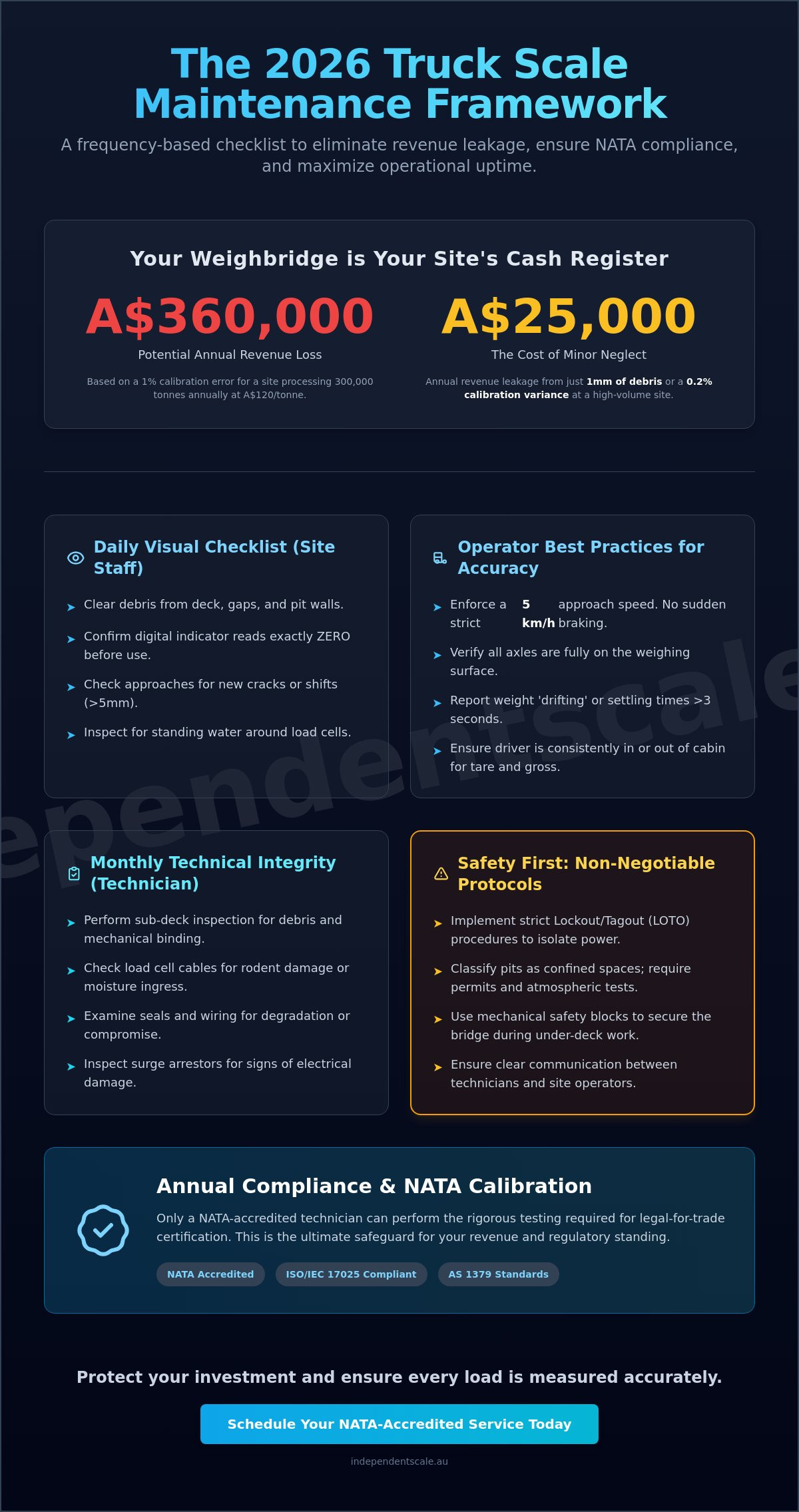
Industry experts often refer to the weighbridge as the site's "Cash Register." This analogy is grounded in hard mathematics. For a facility processing 300,000 tonnes of material annually at an average value of A$120 per tonne, a minor 1% calibration error results in A$360,000 of lost revenue or over-delivered product. Understanding Truck scale fundamentals is the first step in recognizing that accuracy directly dictates the bottom line. Even a variance that seems negligible on a single load compounds into a massive fiscal deficit over a standard financial year.
Operational integrity requires a clear distinction between routine site housekeeping and technical weighing scale calibration. While site staff manage daily cleanliness, only NATA-accredited technicians can perform the rigorous testing required for ISO/IEC 17025 compliance. These professionals inspect critical components like summing circuits and surge arrestors to ensure the system remains within legal-for-trade tolerances. Relying solely on visual checks without periodic NATA certification leaves a business vulnerable to heavy fines and commercial disputes.
Safety is the non-negotiable foundation of any maintenance activity. Weighbridge pits are frequently classified as confined spaces, requiring specific permits and atmospheric testing before entry. Site managers must establish strict lockout/tagout (LOTO) procedures to isolate all power sources. This prevents the accidental activation of digital indicators or the movement of vehicles while technicians are working near or under the platform. Mechanical safety blocks are essential to prevent the bridge from shifting during load cell inspections.
Daily Visual Inspection Checklist
- Clear all tree limbs, rocks, and compacted dirt from the weighbridge platform and the gaps between the deck and the pit wall.
- Confirm the digital indicator reads exactly zero before any vehicle approaches the scale.
- Examine concrete approaches for new cracks or shifting; even a 5mm shift in the transition slab can cause significant impact loading and weighment errors.
- Check for standing water in the pit or around the load cells, as moisture is the leading cause of signal interference.
Operator Best Practices for Accuracy
- Enforce a strict 5 km/h approach speed and prohibit sudden braking while the vehicle is on the platform to protect internal sensors.
- Verify that all axles are fully supported by the weighing surface before the operator records the final stable reading.
- Train staff to report "drifting" weights or indicators that take more than three seconds to settle, as these are early signs of load cell failure.
- Ensure the driver is out of the cabin or remains in the cabin consistently for both the tare and gross weights to maintain consistency.
Weekly and Monthly Technical Integrity Protocols
Effective weighbridge management requires looking beyond the concrete or steel surface. A comprehensive truck scale maintenance checklist must prioritise sub-deck inspections to prevent mechanical binding. Debris, such as packed mud, gravel, or spilled product, often accumulates in the clearance gaps between the deck and the pit walls or frame. This physical interference causes weight shunting, where the force is diverted away from the sensors, leading to significant under-registration of loads. Without clear space for the deck to move, even the most expensive system will fail to provide legal-for-trade accuracy.
Load cells serve as both the structural brawn and the measurement brains of the system. These components endure constant high-tonnage cycles while maintaining millivolt-level precision. Technicians must inspect these areas for cable degradation during monthly rounds. In Australian industrial environments, moisture ingress and rodent activity are the primary causes of signal failure. Exposed wiring or compromised seals lead to erratic weight fluctuations or "ghosting" on the indicator. If physical damage is detected, sourcing high-quality load cell supply and repair services is the only way to restore NATA-compliant accuracy and ensure the system remains within its specified tolerance.
The Weekly End-Middle-End Test
This simple diagnostic procedure identifies sectional inaccuracies before they result in costly compliance breaches or inventory loss. Use a loaded vehicle with a known, consistent weight for this test to ensure repeatability.
- Step 1: Weigh the loaded vehicle at the far end of the scale and record the reading.
- Step 2: Move the vehicle to the centre of the deck and record the weight.
- Step 3: Position the vehicle at the opposite end and compare all three results.
Interpret these findings strictly. A deviation of ±2 divisions between any two positions indicates a potential load cell failure or mounting issue. For a scale with 20kg increments, a 40kg variance requires immediate professional intervention to maintain AS 1379 standards. Consistent results across all three points confirm that the summing circuit is balanced correctly.
Junction Box and Summing Circuit Health
The summing circuit is the secondary point of failure in most industrial weighing systems. Monthly inspections should focus on the integrity of junction boxes. Check that all cable glands are tight and that internal desiccant packs haven't reached saturation. Moisture inside the enclosure will cause "drifting" weights that refuse to stabilise, particularly during humid mornings or after heavy rain.
Lightning strikes and power surges represent a high risk for Australian sites. Inspect surge arrestors and grounding straps for signs of scorching or corrosion. Finally, verify the output signal at the conditioners and transmitters located in the control room. Ensuring these components are free from dust and heat stress prevents data loss between the scale and the PLC. For sites requiring high-frequency throughput, maintaining a regularly scheduled calibration is essential for long-term reliability and operational uptime.
Structural and Mechanical Health Assessments
A common operational error is assuming that if the platform appears level, the weighing system is functional. This misconception ignores the complex mechanical interactions occurring beneath the deck. A level platform is a surface-level observation, not a diagnostic result. A comprehensive truck scale maintenance checklist must prioritse structural integrity to ensure NATA-accredited accuracy remains consistent over time. If the underlying structure is compromised, calibration adjustments are merely temporary fixes for permanent mechanical failures.
Inspect the leading edges of the concrete foundations for signs of spalling or reinforcement corrosion. In high-traffic Australian sites, the constant impact of heavy vehicles causes concrete to fracture, which leads to load cell misalignment. Structural shifting of just 5mm can result in weight discrepancies that exceed allowable tolerances. Monitor the T-grip moulding and side frame clearance. Debris caught in these gaps creates friction, which "shunts" the weight away from the sensors. For more technical specifications on installation standards and clearance requirements, refer to our weighbridge guide.
Fasteners and Cover Plates
Mechanical vibration from daily vehicle throughput inevitably loosens fasteners. Inspect all manhole covers and access plates for missing or loose bolts. Loose plates aren't just a noise nuisance; they're a significant site safety hazard that can damage vehicle tyres or cause personnel injury. Ensure all anti-slip surfaces are intact to maintain compliance with site safety protocols. Lubricate all moving mechanical parts, specifically check rod assemblies and bumper bolts, according to manufacturer specifications to prevent seizing and metal fatigue.
Pit Drainage and Water Management
Water is the primary cause of premature load cell failure. For pit-mounted scales, a failed sump pump leads to load cell submersion, which often results in total system failure. Test pumps weekly to ensure they activate before water levels reach sensitive electronic components. You don't want to discover a pump failure after a heavy Sydney downpour has already flooded the pit.
Accumulations of silt and mud must be cleared regularly. When debris becomes packed between the scale deck and the pit wall, it creates a "bridge" that supports part of the vehicle's weight. This mechanical bypass results in "dead spots" where the scale fails to register the full load accurately. Regular cleaning prevents these issues and ensures your equipment remains compliant with AS 1379 standards. Eliminating build-up is the most cost-effective way to prevent "ghost" weights and ensure every kilogram is accounted for during trade.
Managing Environmental Hazards in the Australian Climate
Australia’s extreme weather patterns directly impact weighbridge performance and structural integrity. In Sydney and Melbourne, temperature fluctuations of 20°C within a single day are common, causing significant physical movement in steel weighbridges. Professional operators must include climate-specific inspections in their truck scale maintenance checklist to account for these environmental variables. Beyond temperature, regional quarry operations in the Hunter Valley or the Pilbara face constant dust ingress, while coastal facilities deal with salt-induced oxidation that compromises electronic components.
Thermal Expansion and Binding
High temperatures cause steel decks to expand significantly. When the deck expands, it can "bind" against the concrete frame or approach. This physical contact prevents the load from being fully transferred to the load cells, resulting in inaccurate, non-linear readings. Technicians must regularly inspect and adjust bumper bolts to ensure the scale remains free-floating. A 5mm gap can prevent a 500kg error during summer peaks when steel temperatures often exceed 55°C. Monitoring these clearances is a critical step for maintaining NATA-accredited accuracy levels throughout the year.
Corrosion and Chemical Exposure
Facilities located within 5km of the coast or those operating in high-humidity regions require aggressive corrosion management. Salt air accelerates the degradation of shackle pins and load cell mounts. In specialized environments, such as concrete batching plant services, load cells are frequently exposed to harsh chemical additives and constant moisture. Protecting these components involves applying specialized marine-grade coatings to exposed steelwork and ensuring summing circuits are housed in IP68-rated stainless steel enclosures. Failure to manage corrosion leads to "ghosting" or drifting weights that disrupt AS 1379 compliance.
Dust mitigation is equally vital for regional Australian operations. Fine particulate matter from quarrying or grain handling can pack into the pits, creating a physical bridge between the scale and the ground. This "shimming" effect absorbs weight and causes under-recording. Regular high-pressure cleaning and pit inspections ensure the weighing mechanism remains unobstructed.
The "Flash Flood" protocol is the final pillar of environmental management. Following extreme rain events, which are increasingly common across Queensland and New South Wales, you must re-verify scale accuracy. Even if the electronics appear functional, silt buildup in the pit or moisture in the junction box can cause intermittent signal loss. A post-flood calibration check ensures the system hasn't suffered subterranean damage or shifts in the foundation.
Compliance and Professional NATA Calibration
A routine truck scale maintenance checklist is an effective tool for identifying physical obstructions and visible wear, but it cannot replace the technical rigour of a NATA accredited calibration. While site staff can clear debris or check for loose bolts, they lack the specialised test masses and gravimetric methods required to certify accuracy. For businesses involved in concrete production, adhering to AS 1379 standards is a legal necessity. This standard requires precise batching accuracy to ensure structural integrity; even a 1% deviation in weight can lead to non-compliant product and significant financial liability.
The value of ISO/IEC 17025 accreditation becomes apparent during commercial or legal disputes. If a client challenges a weight reading or a regulatory body audits your site, a NATA-endorsed calibration report provides the only definitive proof of equipment competence in Australia. It confirms that your scale has been tested against traceable standards in a controlled manner. Transitioning from basic maintenance to professional calibration services ensures your business remains protected against litigation and revenue loss.
Preparing for a Professional Service Visit
Maximising the efficiency of a technician’s visit helps keep operational costs down. Site managers should ensure the weighbridge is completely clean and the approach is clear for the heavy service vehicle. Technicians require at least 3 metres of unobstructed space around the platform to deploy test weights safely. It's also vital to provide historical maintenance logs. These records allow the technician to perform a trend analysis, identifying if specific load cells or summing circuits are degrading over time. To avoid site disruption, schedule these visits during off-peak hours or planned maintenance windows.
The Independent Scale Service Advantage
Independent Scale Service (ISS) leverages 30+ years of experience in the Australian industrial weighing sector. We currently service 98% of concrete plants across Sydney, providing a level of technical proficiency that generalists cannot offer. We understand that a malfunctioning scale stops production. That's why we provide 24/7 emergency support for critical breakdowns, ensuring your site is back online with minimal delay. Our technicians are experts in identifying the root causes of inaccuracy, from environmental interference to component fatigue.
Don't risk non-compliance or inaccurate billing.
Book your NATA accredited weighbridge calibration today to guarantee your equipment meets the highest Australian standards.
Secure Your Operational Accuracy and Regulatory Compliance
Maintaining technical integrity requires a disciplined approach to structural and environmental monitoring. By implementing a rigorous truck scale maintenance checklist, operators mitigate risks associated with load cell drift and mechanical wear caused by the harsh Australian climate. Precision isn't just about hardware; it's about adhering to strict weekly and monthly protocols that identify failures before they cause costly downtime. Compliance with AS 1379 standards remains a critical requirement for industrial leaders across the country.
Independent Scale Service provides the authoritative expertise required to maintain these high standards. We've spent over 30 years refining our industrial weighing processes and currently service 98% of concrete plants across Sydney. As a provider NATA Accredited to ISO/IEC 17025, we deliver the precise gravimetric method calibrations and technical assessments needed for legal and operational certainty. Our technicians are available around the clock to resolve critical issues and keep your facility moving.
Contact Independent Scale Service for 24/7 Emergency Repairs and NATA Calibration to ensure your equipment remains accurate and fully compliant with all industrial regulations. Your facility's long-term reliability starts with professional maintenance.
Frequently Asked Questions
How often should a truck scale be calibrated in Australia?
You should calibrate your truck scale every 6 to 12 months to comply with National Measurement Institute (NMI) requirements for trade-use equipment. High-volume sites processing over 100 vehicles daily often require quarterly inspections to maintain precision. Adhering to a strict truck scale maintenance checklist ensures your equipment remains accurate and legally compliant under Australian trade measurement laws.
What is the most common cause of truck scale inaccuracy?
Debris buildup and environmental contamination are the primary causes of weighing errors in industrial environments. Dirt, stones, and slurry often wedge between the weighbridge deck and the foundation walls, causing mechanical binding that prevents the scale from moving freely. This physical interference accounts for approximately 60% of reported inaccuracies. Regular cleaning of the gap between the scale and the pit wall is essential to prevent these errors.
Can I clean my truck scale with a high-pressure hose?
You shouldn't use high-pressure water directly on sensitive electronic components such as load cells, junction boxes, or cabling. While the steel or concrete deck can withstand pressure washing, a direct 3000 PSI blast can compromise IP68 or IP69K seals on sensors. This leads to moisture ingress and total component failure. Use low-pressure water for general debris removal and ensure all drainage systems are clear to prevent water from pooling around the electronics.
What is the difference between a pit-mounted and above-ground truck scale maintenance?
Pit-mounted scales require intensive cleaning of the underground cavity to prevent debris from touching the underside of the deck, which often involves confined space entry protocols. Above-ground scales are easier to inspect visually but require more frequent checks on the approach ramps and side clearance. Both designs must be included in your truck scale maintenance checklist to ensure the 10mm to 20mm gap between the scale and fixed structures remains unobstructed.
How does AS 1379 affect my maintenance schedule?
AS 1379 specifies the requirements for the specification and manufacture of concrete, which includes mandatory weighing accuracy standards. For concrete batching plants in Australia, this standard requires weighing equipment to be calibrated every 6 months to a tolerance of 0.2% of the full scale. ISS services 98% of concrete plants across Sydney, ensuring these facilities meet the precise benchmarks required for industry certification.
What should I do if my weighbridge indicator shows an "Error" code?
Check for physical obstructions under the deck and inspect all visible cables for rodent damage or fraying immediately. If the error persists after a system reboot, it typically indicates a failed load cell or a fault within the summing circuit. Don't attempt to open the junction box yourself. You should contact an expert for 24x7 emergency support to diagnose the specific error code and perform a gravimetric method calibration to restore accuracy.
Is NATA accreditation mandatory for all truck scales?
NATA accreditation to ISO/IEC 17025 isn't legally mandatory for every scale, but it's required for businesses that demand the highest level of technical competence and documented traceability. For trade-approved scales used to sell goods by weight, you must use a Verifier licensed by the NMI. ISS provides NATA-accredited services to ensure your equipment meets the most rigorous industrial standards for reliability across Australia.
How long does a professional truck scale inspection take?
A standard professional inspection typically takes between 2 and 4 hours depending on the scale's condition and site accessibility. This timeframe includes a comprehensive visual check, debris clearance, and testing with a certified test truck carrying 30 tonnes of calibrated weights. Complex repairs or full recalibrations to meet AS 1379 standards might extend this window. Efficient scheduling ensures your site experiences minimal downtime while every component is verified.
