


Truck Scale Installation Cost 2026: The Complete Australian Pricing Guide
A truck scale is a 20-year industrial asset, but the initial installation price is a fraction of the total compliance cost if you select the wrong hardware. With the Heavy Vehicle National Law (HVNL) updates effective August 1, 2026, ensuring your site meets new mass limits, such as the 17-tonne tandem axle group maximum, is no longer optional. Many operators focus solely on the upfront purchase price, overlooking how poor component selection leads to frequent weighbridge repair services and technical downtime.
You likely recognize that civil works and foundations represent a significant variable that can quickly inflate a project budget by A$10,000 to A$50,000 depending on soil conditions and drainage requirements. This guide provides a comprehensive breakdown of weighbridge installation costs for 2026, covering everything from site preparation to NATA accreditation fees and ISO/IEC 17025 standards. You will gain a realistic turnkey budget and understand the technical drivers, such as IP68 load cells and AS 1379 compliance, that justify investing in high-quality hardware to protect your operational bottom line.
Key Takeaways
- Identify the 2026 turnkey budget requirements for Australian industrial sites, distinguishing between equipment-only purchases and full-service installations.
- Understand why civil works and foundation engineering typically represent 30% to 50% of your total project expenditure.
- Select high-specification load cells and digital indicators to ensure long-term accuracy and reduce the necessity for emergency weighbridge repair services.
- Navigate the mandatory NATA accreditation and trade-measurement verification processes required under the National Measurement Act.
- Evaluate the total cost of ownership by weighing initial capital outlay against the potential revenue loss from a 1% measurement error.
What is the Average Truck Scale Installation Cost in 2026?
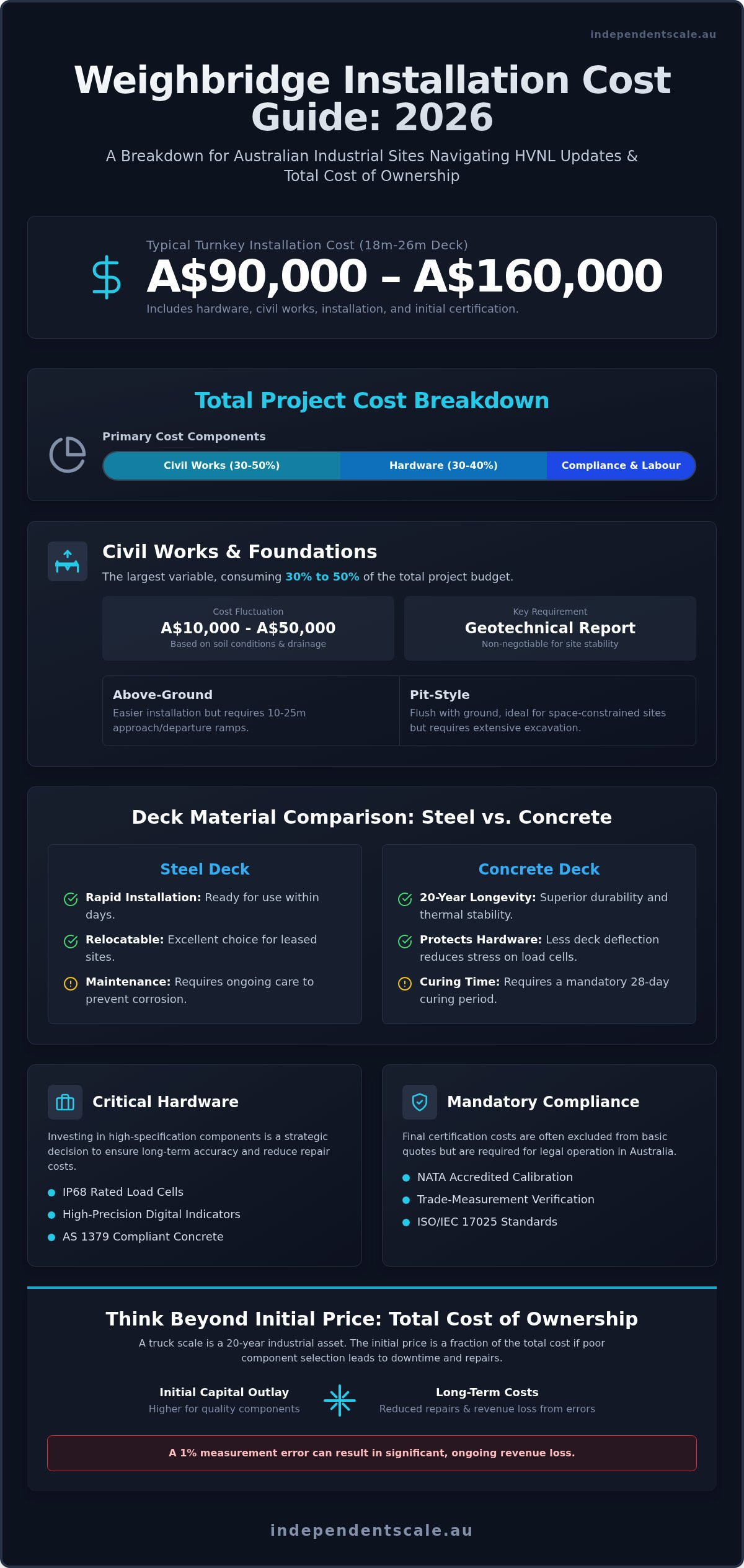
Budgeting for a Truck scale (weighbridge) in 2026 requires looking beyond the initial purchase price. For a standard industrial site in Australia, turnkey installation costs typically range from A$90,000 to A$160,000. This figure varies based on deck length, which typically ranges from 18 metres for standard semi-trailers to 26 metres for B-double configurations. Inflationary pressures on structural steel and high-strength concrete in New South Wales and Victoria have increased base material costs by a measurable margin over the last 24 months. Operators must also account for the specific technology used; digital systems offer higher precision but require a larger initial investment compared to traditional analog setups.
Total project costs are driven by three primary variables: deck dimensions, construction material, and the level of automation required. A standard 18m x 3.5m weighbridge is the baseline for most Australian transport hubs. However, sites handling larger vehicle combinations often require 26m decks to accommodate full B-double sets in a single weighment. Choosing high-quality components at this stage is a strategic decision. It directly impacts the frequency of required weighbridge repair services over the asset's 20-year lifespan.
Basic Equipment vs. Turnkey Solutions
Most "basic" quotes are deceptive because they often exclude civil foundations, which can account for 20% to 30% of the total budget. These entry-level prices rarely include the final NATA-accredited calibration or trade-measurement verification required for legal operation. Opting for a turnkey solution provides single-point accountability for both mechanical and civil works. While the upfront cost is higher, it significantly reduces the likelihood of future weighbridge repair services caused by foundation shifts or poor integration between the scale and its indicators. Turnkey providers manage the entire process, from soil testing to final compliance certification.
Steel Deck vs. Concrete Deck Cost Factors
The choice of deck material is a critical factor for long-term site efficiency and maintenance costs. Steel decks offer rapid installation and are often ready for use within days of delivery. They're an excellent choice for leased sites because they can be dismantled and relocated. However, they require ongoing maintenance to prevent corrosion, especially in humid or coastal environments. In contrast, concrete decks are the preferred choice for 20-year longevity in Sydney and Melbourne. While they require a mandatory 28-day curing period before heavy traffic can commence, their thermal stability and durability are superior. Concrete decks generally experience less deck deflection, which protects the internal load cells from unnecessary mechanical stress and helps maintain calibration accuracy in the variable Australian climate.
Civil Works and Foundations: The Largest Variable in Weighbridge Pricing
Foundation engineering represents the most significant variable in any installation project, often consuming 30% to 50% of the total budget. Unlike the fixed price of a steel deck, civil costs fluctuate based on site-specific geotechnical conditions. A professional geotechnical report is a non-negotiable upfront expense. It identifies soil load-bearing capacity and the presence of reactive clay, which is particularly prevalent in regional Victoria and parts of New South Wales. If the concrete piers aren't poured to the correct depth and specification, the structure will eventually shift. This instability causes measurement drift and premature mechanical wear, necessitating expensive weighbridge repair services to restore legal accuracy. Ensuring the slab is level within millimetres is critical for maintaining correct load distribution across all sensors.
For those managing large-scale industrial projects that require expert earthworks and civil engineering, you can check out McMahons Civil and Contracting PTY LTD to ensure your site preparation meets the highest standards.
Pit-Style vs. Above-Ground Weighbridges
The choice between a pit-style and an above-ground design is often dictated by available real estate. Pit-style installations are flush with the ground, making them ideal for space-constrained urban sites in Sydney or Melbourne where vehicle turning circles are limited. However, they require extensive excavation, reinforced concrete retaining walls, and often, confined space access certifications for maintenance. In contrast, above-ground weighbridges are easier to install but require 10 to 25-metre approach and departure ramps to meet heavy vehicle gradient standards. In urban environments where land is at a premium, the cost of deep excavation for a pit is often justified by the operational space saved. Conversely, regional sites with ample room usually opt for above-ground designs to minimize civil expenditure and simplify access for visual inspections.
Drainage and Environmental Compliance
Pit-style scales introduce hidden costs related to water management and environmental protection. You must integrate automated pump systems and silt traps to prevent the pit from flooding, which would otherwise destroy sensitive electronic components. Compliance with local council runoff regulations in major Australian hubs is mandatory to prevent industrial contaminants from entering the stormwater system. In reactive clay areas common across the Victorian landscape, foundations must be engineered to withstand significant soil expansion and contraction. Proper drainage protects the structural integrity of the site and ensures the equipment remains ready for NATA (National Association of Testing Authorities) accredited calibration. Ensuring your foundation is built to last is the most effective way to avoid recurring weighbridge repair services caused by environmental degradation and structural settling. If you're unsure about your site's foundation requirements, consulting with a specialist for professional weighing scale calibration and assessment can prevent costly engineering errors.
Critical Hardware Costs: Load Cells, Indicators, and Integration
Hardware selection determines your maintenance cycle and long-term reliability. Load cells are the primary driver of accuracy. While they represent approximately 20% of the initial capital outlay, industry data suggests they account for 76% of the total cost of ownership over the asset's life. Low-quality sensors are the leading cause of emergency weighbridge repair services. High-specification, stainless steel load cells with IP68 or IP69K ratings are essential for Australian conditions, providing protection against the high-pressure cleaning and dust ingress common in quarrying and heavy transport environments.
Analog vs. Digital Load Cells: The Cost Gap
Analog systems have a lower entry price, but they transmit weak millivolt signals that are susceptible to electromagnetic interference and moisture. Digital load cells convert the signal at the sensor level, providing a more robust data stream. Research indicates that a high-quality IP68-rated compression load cell typically starts from A$2,298.27. While this represents a higher upfront cost than generic analog alternatives, the diagnostic advantages are substantial. Digital technology allows for individual cell monitoring, which facilitates faster fault diagnosis during routine weighbridge repair services. To protect these sensitive components, industrial sites must budget for high-quality junction boxes and surge arrestors. These secondary components are critical for preventing catastrophic damage from lightning strikes or power surges, which are frequent causes for unplanned hardware replacement.
Indicators and Peripheral Systems
The weight indicator is the interface between your hardware and your business data. While a basic digital indicator might suffice for simple weight checks, modern logistics firms in Sydney and Melbourne increasingly require advanced indicators and displays that offer RFID driver kiosks and automated ticket printing. Integration with existing Enterprise Resource Planning (ERP) systems allows for real-time inventory tracking and automated billing. Peripheral hardware like remote displays and traffic control lights adds to the initial cost but improves site safety and throughput speed. Investing in a system with robust data logging capabilities ensures compliance with Chain of Responsibility (CoR) laws and reduces the administrative burden of manual record-keeping. These peripheral systems should be selected based on their compatibility with high-compliance standards to ensure your site remains operational under the latest NHVR mass management regulations.
Australian Compliance and NATA Certification Costs
Legal verification is a mandatory requirement under the National Measurement Act 1960 for any equipment used for trade. In Australia, the National Measurement Institute (NMI) mandates that every weighbridge used to determine the price of goods must be verified by a licensed servicing licensee. This verification is a distinct process from the initial installation. It ensures the scale operates within the maximum permissible error (MPE) limits. If a system fails an inspection, it must be removed from service until professional weighbridge repair services restore its accuracy and it passes re-verification. Neglecting these standards exposes your business to significant legal penalties and the risk of industrial litigation.
The Role of NATA Accreditation
NATA accreditation to ISO/IEC 17025 is the global benchmark for technical competence in calibration and testing. For high-precision industrial and mining operations, this accreditation is a non-negotiable requirement for data integrity. Maintaining this level of compliance involves specific costs; NATA currently requires a one-time application fee of A$2,814.24 per site and an annual administration fee of A$2,139.90. These fees cover the rigorous auditing process required to maintain measurement traceability. While these costs add to the initial project budget, they provide the legal assurance that your measurements will hold up under forensic or regulatory scrutiny. For a technical analysis of these standards, refer to our Calibration Services Guide.
AS 1379 Compliance for Construction
The concrete production sector must adhere to the specific weighing requirements outlined in AS 1379. This standard governs the specification and supply of concrete, requiring high-precision measurement for every batch component. Independent Scale Service specialises in concrete batching plant calibration to help producers maintain these tight tolerances. Inaccurate scales lead to out-of-spec batches, which often result in total job site rejections and expensive disposal fees. The financial risk of a single rejected pour far outweighs the cost of regular maintenance. During a National Measurement Institute (NMI) audit, any discrepancy can lead to immediate site closure. Proactive weighbridge repair services and scheduled NATA-accredited calibrations are essential for avoiding these operational bottlenecks and ensuring long-term profitability.
To ensure your facility meets all Australian regulatory requirements, schedule your NATA-accredited weighing scale calibration with our technical team today.
Total Cost of Ownership: ROI, Maintenance, and Weighbridge Repair Services
Calculating the return on investment for a weighbridge requires a shift from viewing it as a capital expense to seeing it as a revenue-protection asset. For a quarry processing 500,000 tonnes of material annually at a conservative price of A$30 per tonne, a mere 1% measurement error results in A$150,000 of lost revenue or unaccounted product every year. This financial leak often exceeds the entire cost of the initial installation within the first 12 months of operation. High-quality systems engineered for 20-year lifespans mitigate these risks, whereas budget alternatives frequently succumb to structural fatigue and environmental ingress, leading to recurring and costly weighbridge repair services.
Preventative Maintenance Budgeting
Proactive budgeting for annual maintenance is essential for preserving measurement traceability and equipment longevity. Industrial sites should allocate funds for quarterly inspections that include debris removal, structural cleaning, and mechanical checks of the bumper bolts and load cell mounts. Accumulated silt or stones in a pit-style scale can cause mechanical binding, which introduces significant weighing errors. Regular weighing scale calibration ensures the system maintains its zero-point and span accuracy under varying load conditions. For operators in Melbourne and Sydney, partnering with a service provider that maintains a strong local presence reduces travel surcharges and ensures a rapid response when technical issues arise.
The True Cost of Downtime
The hourly cost of a non-functional weighbridge at a high-volume transport hub involves more than just the price of a technician. It includes the cost of redirected fleet movements, driver standing time, and potential contract penalties for missed delivery windows. Specialised diagnostic tools now allow technicians to identify individual load cell drift or cable degradation before these issues escalate into a total system failure. By investing in scheduled load cell calibration and preventative weighbridge repair services, businesses shift from a reactive "break-fix" model to a high-availability operational strategy. This methodical approach to maintenance ensures your site remains compliant with NHVR regulations and trade-measurement laws while protecting your commercial bottom line.
Independent Scale Service provides the technical expertise and NATA-accredited precision required to manage your weighing assets for the long term. Contact Independent Scale Service for a custom quote on your next installation or maintenance contract.
Securing Your Industrial Weighing Infrastructure for 2026
Successful truck scale installation in the current Australian market requires precise alignment between civil engineering, hardware selection, and regulatory compliance. As established, the foundation and civil works represent the most significant cost variable, often accounting for up to 50% of the total project expenditure. Prioritising high-specification components like IP68-rated load cells and NATA-accredited calibration to ISO/IEC 17025 standards is the only way to protect your site from measurement drift. It's the most effective method for avoiding the high costs associated with industrial non-compliance.
Effective asset management involves transitioning from a reactive mindset to a proactive maintenance strategy. This approach significantly reduces the necessity for emergency weighbridge repair services and prevents the revenue loss associated with 1% weighing errors. Independent Scale Service operates as a dedicated partner for sites across Sydney, Melbourne, and regional Australia, providing specialized AS 1379 compliance for concrete batching and heavy transport sectors. Ensuring your equipment is verified for trade today protects your operational throughput for the next two decades.
Take the first step toward a high-precision, compliant weighing solution. Request a Professional Weighbridge Installation Quote to secure your facility's accuracy and reliability. Your operational integrity remains our primary focus.
Frequently Asked Questions
How much does a basic truck scale cost in Australia in 2026?
Total investment for a weighbridge system in Australia typically ranges from A$25,000 to A$250,000. This variance depends on deck size, material, and automation features. The initial purchase price covers the structural deck and weighing hardware but often excludes civil works and final trade verification. Budgeting should account for the fact that the weighbridge structure itself represents approximately 35% of the initial capital outlay.
What is the difference between a pit-style and above-ground weighbridge cost?
Pit-style weighbridges generally incur higher initial civil costs due to extensive excavation, reinforced retaining walls, and mandatory drainage systems. While they save space, they require confined space access for maintenance. Above-ground models are typically more cost-effective to install but require 10 to 25-metre approach ramps. These ramps increase the total site footprint significantly. The choice depends on available real estate versus excavation budget.
Do I need NATA accreditation for my new truck scale?
NATA accreditation to ISO/IEC 17025 is mandatory for sites requiring high-precision measurement and forensic data integrity. While all trade-use scales must be verified by a licensed servicing licensee, NATA certification provides an additional layer of technical assurance. This is critical for mining, export, and high-volume industrial sectors. It ensures that your calibration results are traceable to national standards and legally defensible in regulatory audits.
How long does it take to install a full truck scale system?
A standard turnkey installation typically requires four to six weeks from site preparation to final commissioning. If you select a concrete deck, you must allow for a mandatory 28-day curing period before the structure can support heavy vehicle traffic. Steel decks offer a faster alternative, often becoming operational within days of the foundation reaching structural maturity. Project timelines vary based on soil stability and local council permit approvals.
What are the most common hidden costs in truck scale installation?
Can I use my existing foundation for a new truck scale to save money?
Utilizing an existing foundation is possible only if a geotechnical assessment confirms the structural integrity and levelness of the slab. Most modern weighbridges have specific load point requirements that may not align with older designs. If the foundation has shifted or cracked, installing new hardware will lead to measurement errors. This technical mismatch frequently results in premature mechanical failure and the need for immediate weighbridge repair services.
How often should a truck scale be calibrated to maintain accuracy?
Weighbridges used for trade must be verified at least annually by a licensed servicing licensee to comply with National Measurement Institute (NMI) requirements. High-volume sites or those operating in harsh environments often require quarterly or bi-annual calibrations to maintain precision. Regular testing identifies load cell drift early. This proactive approach prevents the 1% measurement errors that can lead to significant annual revenue losses in bulk commodity sectors.
Does the 2026 budget need to account for specific Australian standards like AS 1379?
Facilities involved in concrete production must ensure their weighing systems adhere to AS 1379 standards. This regulation mandates strict accuracy tolerances for batching components. Compliance requires specialized calibration procedures and documentation that go beyond standard trade verification. Budgeting for these specific standards is essential for concrete plants to avoid batch rejections and maintain their standing as a compliant supplier in the Australian construction industry.
