


Trade Certified Scales for Australian Businesses
A scale used to weigh goods sold by weight must be an approved type suited to its purpose. In Australia, trade certified scales carry an NMI Approval number, and the National Measurement Institute administers the country’s trade measurement laws. Approval is the starting point; inspection, verification and ongoing servicing all matter for reliable compliance.
For businesses, a scale that appears accurate is not enough when its reading determines what a customer pays. The scale must be an approved type for trade use and kept in suitable working order. This guide explains what trade approval means, how inspection and verification work, and what to consider when arranging calibration or repairs.
You’ll also learn when trade measurement rules apply, what to expect during an inspection, and how servicing can support dependable weighing performance. The aim is a clear, practical guide to Australian requirements for businesses that sell goods by weight.
Key Takeaways
- Confirm a scale’s NMI Approval number and suitability for its intended trade use before relying on it for sales by weight.
- Keep weighing equipment clean and in good working order, and ensure customers can see the weight and price information where required.
- Understand what trade measurement inspectors assess so you can maintain compliant weighing practices and records.
- Learn how verification, calibration and repair address different aspects of instrument performance and compliance.
- Consider force gauge calibration or other relevant industrial weighing services when equipment performance needs attention.
What is a Trade Approved Scale?
A trade-approved scale is an approved weighing instrument used in transactions where goods are sold by weight. In Australia, the National Measurement Institute (NMI) administers trade measurement laws.
Legal-for-Trade Requirements
A business needs an approved scale when weight determines the price of goods in a transaction. This applies to retail and wholesale sales, such as selling produce by the kilogram or charging for bulk materials by weight. The instrument must be an approved type and suitable for its intended purpose.
Businesses selling goods by measurement must comply with trade measurement laws. The same requirements can apply to businesses that manufacture, pack, import or sell pre-packaged goods. By contrast, loader weight data used only internally does not require Legal for Trade certification. Consider how the weight is used, who relies on it, and whether it determines a sale price.
Approval, Certification and Verification Authorities
Approval applies to an instrument type, not simply to a scale that appears accurate. Approving authorities conduct pattern approval testing for certain instruments used for trade or regulatory purposes. An instrument type that passes receives an NMI Approval number, identifying it as having completed the relevant approval process.
Approval, certification and verification are separate steps. Approval and certification are separate steps, and requirements can depend on the instrument and its intended use. Accredited Personnel can test and certify equipment bearing an NMI Approval number for legal trade use. Verification tests an instrument’s performance rather than approving its design. Include the approval identification and certification records in your equipment review.
Scale Differences, Markings and Costs
A regular scale may provide useful readings, but accuracy alone does not make it trade-approved. For example, a platform scale used to set a customer’s charge by weight must be an approved type suitable for that purpose. A scale used only to monitor stock internally has a different role. The intended transaction determines which requirements apply.
What markings and certificates must trade scales display in Australia? The key identifier is the instrument’s NMI Approval number. A certificate of accuracy can be issued only for an NMI-approved scale type, and Accredited Personnel can test and certify approved equipment for legal trade use. Keep the relevant certification evidence with the instrument’s records.
How much do trade certified scales cost in Australia? Purchase cost depends on capacity, platform design, features and suitability for the intended transaction. Service pricing depends on the instrument and work required, and is provided after a quote request. Compare the scale’s approved purpose and configuration, not only its purchase price.
Trade measurement inspections and compliance
Australian trade measurement requirements apply wherever measurement determines a transaction’s price. To be ready for inspection, keep equipment, operating practices and transaction records consistent.
Trade Measurement Inspections
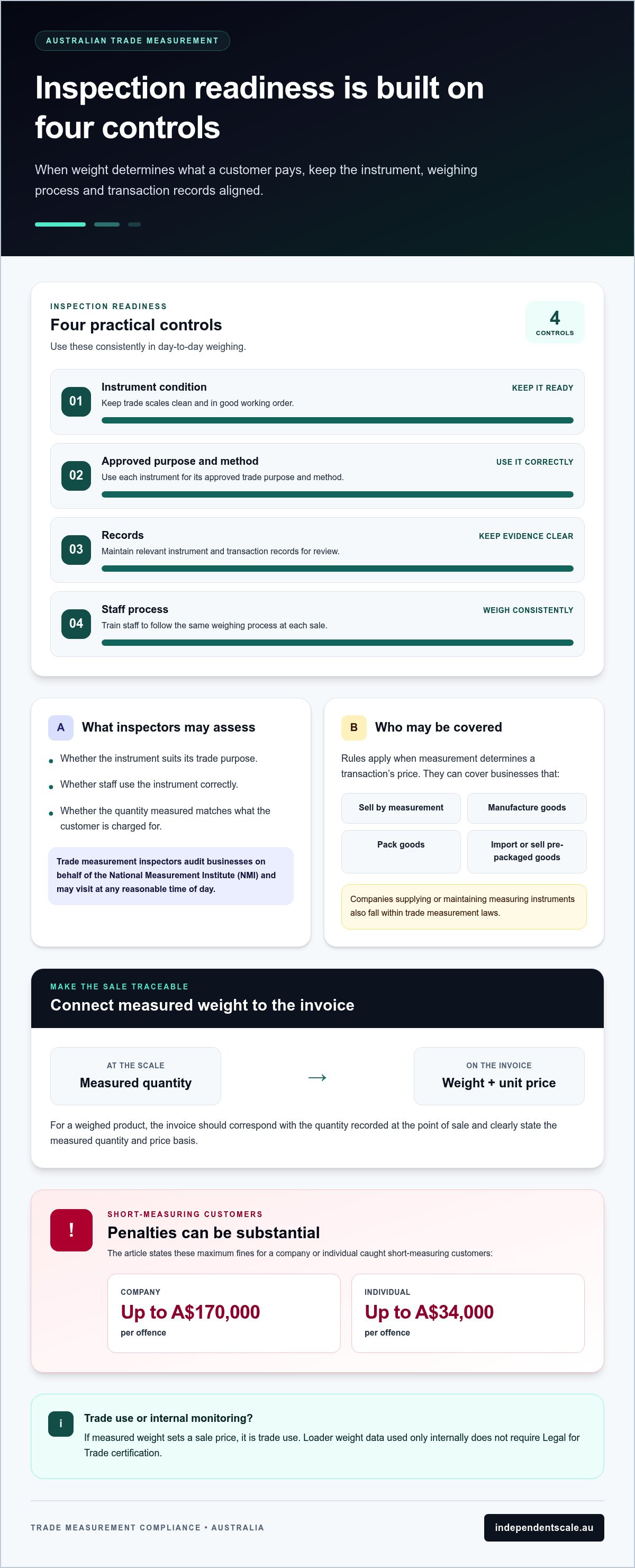
Trade measurement inspectors audit businesses on behalf of the National Measurement Institute (NMI) and may visit at any reasonable time of day. An assessment can examine whether instruments suit their trade purpose and whether staff use them correctly. For example, a scale used to price bulk goods must measure the quantity charged to the customer.
Compliance extends beyond retailers weighing products at a counter. Australian businesses selling goods by measurement must comply, as must businesses manufacturing, packing, importing or selling pre-packaged goods. Companies supplying or maintaining measuring instruments also fall within trade measurement laws. The National Trade Measurement Regulations 2009 set out which products may be sold by number, linear measurement or area measurement.
Prepare for an inspection through consistent operating controls:
- Keep trade scales clean and in good working order.
- Use each instrument for its approved purpose and method.
- Maintain relevant instrument and transaction records for review.
- Train staff to follow the same weighing process at each sale.
These requirements matter in industrial settings too. When a measured quantity sets a wholesale price, the transaction is still trade use. Internal monitoring is different: loader weight data used only internally does not require Legal for Trade certification.
Compliance, Invoicing and Penalties
For invoicing, record the measured quantity and price basis clearly. An invoice for a weighed product should correspond with the quantity recorded at the point of sale. For example, if an industrial customer is charged by weight, the invoice should state the weight and applicable unit price. This makes the transaction traceable if the measurement is questioned.
What penalties apply for using unverified or inaccurate trade scales in Australia? A company caught short-measuring customers can be fined up to A$170,000 per offence. An individual can be fined up to A$34,000. These penalties relate to short-measuring customers; inspectors assess compliance with trade measurement standards.
Trade-approved scales support obligations under the Retail Trade Agreement (1987). The relevant risk is not simply an instrument fault. Incorrect use, poor condition or a mismatch between the measured quantity and the charge can undermine a transaction. Review the scale’s condition, staff procedure and invoice record together.
Where a weighing instrument needs performance attention, industrial scale calibration can support consistent measurement practices. Calibration is not a substitute for trade approval or an inspector’s verification. Keep those compliance steps distinct in your equipment records.
Instrument verification by licensed technicians
Verification checks whether a weighing instrument performs accurately for its intended trade use. In Australia, authorised National Measurement Institute (NMI) technicians conduct verification using certified calibration weights and equipment. This is separate from pattern approval, which assesses instrument types. An approval number identifies the approved type; verification assesses the individual instrument’s performance.
For trade transactions, verification provides evidence that a scale’s measurements are suitable for use. An instrument can carry an NMI Approval number yet still need attention if damage, wear or adjustment affects its operation. For example, assess a platform scale moved between work areas before staff rely on it to charge customers. Treat approval and the instrument’s condition as separate checks.
A practical preparation sequence helps the assessment run clearly:
- Identify the scale and record its NMI Approval number.
- Describe its trade purpose, such as weighing goods for sale.
- Make the instrument accessible and ready for testing.
- Provide previous verification or service records for review.
- Record the assessment outcome with the scale’s equipment history.
During verification, authorised NMI technicians use certified weights and equipment to test the instrument, comparing its measured response with the known weight applied. The technician assesses whether the scale performs accurately for its intended use. Keep the equipment stable and clear of obstructions so the test reflects the scale rather than its installation conditions.
Certification by Accredited Personnel is another relevant pathway. Equipment bearing an NMI Approval number can be tested and certified by Accredited Personnel for legal trade use. The instrument type must have NMI approval before a certificate of accuracy can be issued. Keep approval identification and certification documents together so staff can distinguish model approval from evidence relating to the individual instrument.
Verification findings can guide maintenance decisions. If a scale does not perform accurately, investigate its condition before relying on readings for transactions. Damage, movement or installation changes can affect performance. A technical assessment can help determine whether adjustment, repair or further testing is appropriate. Record completed work and retain the instrument’s associated documentation.
Verification does not replace correct daily operation. Staff should use the scale for its approved purpose and keep it in good working order. An industrial weighing instrument used in a transaction, for example, needs both reliable performance and suitable trade approval. Clear records connect the instrument, its approval number, verification evidence and operational history.
Keep the compliance distinctions clear: NMI pattern approval concerns the instrument type, verification concerns the instrument’s performance, and certification documents the outcome for legal trade use. These records support a traceable process when a business reviews weighing equipment used in Australian trade.
Measurement requirements for food, fuel and other goods
Australian trade measurement obligations depend on how a product is sold. If measurement determines the price, the transaction can fall under trade measurement laws. Retail and wholesale sales both count. The National Trade Measurement Regulations 2009 also set out which products may be sold by number, linear measurement or area measurement. For a business, the first step is identifying the sale basis for each product.
Food sales show how these obligations work in practice. Most unpackaged seafood sold in Australia must be sold by weight. A trader weighing seafood over the counter must make the scale visible to customers. Its display must show the weight, price per kilogram and total price, so customers can see how the amount payable relates to the measured quantity.
Before weighing, use a simple transaction check:
- Confirm the scale is clean and in good working order.
- Check the display reads zero before placing goods on it.
- Ensure the customer can see the measurement and price details.
- Separate the product’s weight from its packaging material.
- Confirm the displayed total matches the amount charged.
Packaging matters because customers should pay for the product, not its packaging. For example, when seafood is weighed in a container, the container’s weight should not be included in the product charge. A visible zero reading before weighing helps customers see the starting point. Clean equipment and correct use also support dependable measurement at the counter.
Fuel and other goods require businesses to identify the relevant measurement basis rather than assume every product follows the same method. A product may be sold by weight, number, linear measurement or area measurement, as set out for applicable products in the National Trade Measurement Regulations 2009. For example, a sale priced by length uses a different measurement basis from seafood priced by weight, whereas specialty items such as collectable coins and banknotes catalogued on renniks.com are sold by piece and condition rather than bulk mass. The transaction’s pricing method is the key distinction.
Pre-packaged goods carry obligations throughout the supply chain. Businesses that manufacture, pack, import or sell them must comply with trade measurement laws and ensure every batch meets legal measurement requirements. Batch controls therefore matter alongside point-of-sale weighing. A trader handling both packaged products and loose goods should consider the requirements for each sale method separately.
Industrial and wholesale transactions are also covered when measurement sets the price. A business charging for bulk material by weight should treat weighing as part of the transaction, not merely an internal check. By contrast, loader weight data used only internally does not require Legal for Trade certification. Classifying each measurement as customer-facing or internal helps determine the appropriate compliance approach.
Calibration, repair and certification services
Calibration, repair and certification address different instrument needs. Calibration assesses measurement performance against known reference values. Repair addresses faults or damage. Certification records an assessment outcome for a defined purpose. For Australian trade use, keep these activities distinct from instrument approval and verification.
A calibration assessment can show whether readings differ from reference values across an instrument’s working range. For example, a platform scale may give consistent readings at one load but drift at another. Recording test results helps identify which measurement points are affected. Depending on the findings, the next step may be adjustment, further investigation or repair.
Repair is relevant when components, wiring, load cells or mechanical parts affect reliable weighing. Faults can cause unstable readings, failure to return to zero or inconsistent results under repeated loads. Record the symptom, when it occurs and any recent installation changes. This information helps focus the technical assessment and documents why work was needed.
Calibration does not itself grant legal-for-trade status. Approval requirements may apply before a certificate of accuracy can be issued. Accredited Personnel can test and certify equipment bearing an NMI Approval number for legal trade use. Verification is a separate assessment conducted by authorised NMI technicians using certified calibration weights and equipment. Keep the relevant records distinct.
For a useful service record, note the instrument’s identity, intended use, test conditions and results. Add any adjustments or repairs, then retain calibration documentation with the equipment history. For example, records for a scale used in a customer transaction should connect its measurement performance to the instrument in service. Clear documentation also helps staff identify when another assessment is appropriate.
Service requirements depend on the instrument and its operating conditions. A scale exposed to regular movement or harsh industrial use may need attention if its performance changes. A batching system may require assessment across its weighing process, while a load cell fault may call for component-level investigation. Match the work to the fault and application rather than treating every issue as routine calibration.
Before arranging work, identify the instrument, describe its use and gather previous service records. Explain the observed issue, such as drift, unstable readings or damage, to give the technician a clear starting point. For trade use, keep approval and verification requirements in view: calibration records alone do not replace those steps.
For a weighing instrument that needs performance assessment, arrange weighing scale calibration and keep the resulting records with its service history.
Independent Scale Service: Force Gauge Calibration
Independent Scale Service provides force gauge calibration for businesses needing force measurement equipment assessed. The company also provides concrete batching plant calibration, industrial weighing scale services, and hopper and silo calibration.
Use these services when instrument performance needs attention, calibration records are required, or weighing equipment needs assessment for an industrial application. For example, batching plant calibration addresses measurement across a production process, while force gauge calibration focuses on force measurement instruments. Calibration supports equipment performance records, but it does not replace NMI approval or trade verification required for legal trade use.
For relevant technical support, explore force gauge calibration. Contact Independent Scale Service to discuss your equipment requirements.
Set a Clear Maintenance Path for Your Equipment
Make equipment care part of your operating plan. Assign responsibility for service records, fault reporting and decisions about when instruments need attention. This helps your team respond consistently when production requirements or measurement processes change.
For businesses managing trade certified scales in Australia, the next step is to match technical support to the equipment involved. Independent Scale Service offers load cell supply, load cell calibration and repair, and force gauge calibration. These services can support businesses addressing load cell performance, repair needs or force measurement requirements.
When discussing a service requirement, have the instrument type, application and observed issue ready. This provides a practical starting point and helps identify the relevant work. The right support depends on the equipment and the task it performs.
Contact Independent Scale Service to discuss your equipment requirements and plan the next step with confidence.
Frequently Asked Questions
What does trade certified scales mean in Australia?
The term describes weighing equipment assessed for transactions where weight determines the price. For example, a business charging customers by the kilogram needs equipment suitable for that trade purpose. According to the National Measurement Institute, scale types must be approved before a certificate of accuracy can be issued. These stages are related but distinct. A certificate or calibration record alone does not establish that every scale is approved for every trade application.
Which Australian laws and standards apply to scales used for trade?
Australia’s National Measurement Institute administers trade measurement laws. The National Trade Measurement Regulations 2009 identify products that may be sold by number, linear measurement or area measurement. Trade measurement requirements apply to retail and wholesale transactions when measurement determines price. For concrete batching plant calibration, AS 1379 is relevant to that industrial application, but it isn’t a general trade-scale approval standard. Apply requirements according to the instrument and transaction.
How can I check whether a scale is NMI approved for trade use?
Start with the scale’s identification markings and locate its NMI Approval number. Compare the number and instrument details with the approval documentation for that scale type. Check that the scale’s intended use matches its approved purpose, rather than relying on appearance or a general accuracy claim. Keep the identification and supporting documents with the equipment records, especially if the scale is moved or assigned to a different transaction.
How do I get trade scales verified in Australia, and who can verify them?
Arrange verification through an authorised NMI technician, who uses certified calibration weights and equipment to assess the individual instrument’s performance. Before the visit, identify the scale, its use and any performance concerns. Keep it accessible and provide its approval details and relevant records. Accredited Personnel can also test and certify equipment bearing an NMI Approval number for legal trade use. Certification and verification are related compliance processes, but they are not interchangeable.
How often must trade scales be inspected or reverified in Australia?
The Australian trade measurement requirements described here do not establish one universal re-verification interval for every scale. An inspector may visit a business at any reasonable time of day. Keep instruments clean, in good working order and used for their intended purpose. Arrange a technical assessment if readings become unstable, the scale is damaged or its installation changes. These actions support ongoing control without assuming a one-time test covers every future condition.
Where can I find licensed scale verifiers and NMI-approved scale models in Australia?
Verification is carried out by authorised NMI technicians; Accredited Personnel can also test and certify equipment bearing an NMI Approval number. Confirm that the approval number applies to the exact instrument type and intended use. Independent Scale Service provides industrial weighing scale services for industrial applications. Assess the scale’s specific approval status alongside its intended trade use.
