


The Importance of Accurate Concrete Mix Ratios in Industrial Construction
Can a minor calibration error in your batching plant lead to total structural failure? In industrial construction, the importance of accurate concrete mix ratios isn't just a matter of best practice; it's a critical safety requirement. You know that even a slight imbalance in the water-to-cement ratio or aggregate weight can compromise the compressive strength of a slab. These inconsistencies often lead to expensive rework, material wastage, and severe legal liabilities if the project fails to meet Australian building codes. Precise batching is the only way to mitigate these risks effectively.
This guide demonstrates why precision in concrete batching is the fundamental pillar of structural integrity. You'll discover how industrial weighing accuracy ensures your operations remain compliant with AS 1379 standards. We'll examine the technical necessity of NATA-accredited calibration for hoppers and silos, the role of high-quality load cells in maintaining mix consistency, and how rigorous measurement protocols protect your bottom line from the costs of non-compliance. Precise measurement is not an option. It's a requirement for operational viability and long-term structural durability in the Australian industrial sector.
Key Takeaways
- Understand the fundamental importance of accurate concrete mix ratios and how they directly influence the structural integrity of industrial slabs and footings.
- Learn how high-precision load cells and weight transmitters provide the necessary data to ensure batching computers meet strict design specifications.
- Identify the financial impact of weighing uncertainty, including the hidden costs of over-designing mixes to compensate for inaccurate equipment.
- Master the regulatory landscape of AS 1379 and why NATA accreditation to ISO/IEC 17025 is the mandatory benchmark for calibration services.
- Discover the professional calibration protocols used to detect mechanical binding and load cell drift before they result in non-compliant concrete.
What is a Concrete Mix Ratio and Why is Precision Critical?
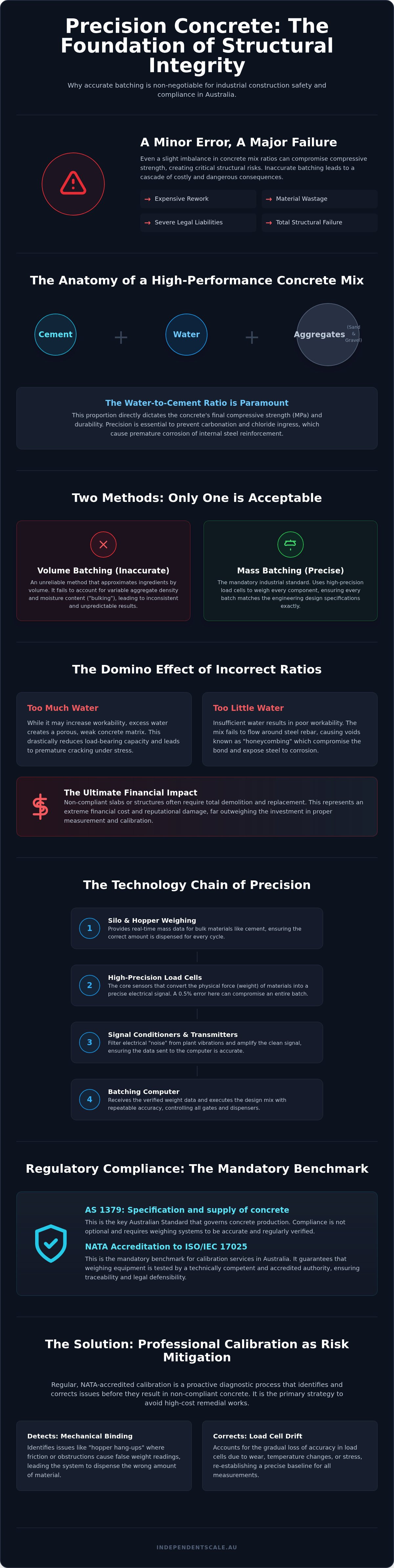
A concrete mix ratio is the specific mass-based proportion of cement, water, and aggregates required to achieve a targeted performance profile. While domestic projects might use simple volumetric approximations, industrial applications demand high-precision measurement of every component. Concrete performance is governed primarily by the water-cement ratio, which directly dictates the final compressive strength measured in Megapascals (MPa). If the ratio is off by even a small margin, the chemical reaction of hydration is compromised. This results in a material that lacks the density required for heavy industrial loads. The importance of accurate concrete mix ratios is most evident when considering that precise proportions prevent carbonation and chloride ingress in 2026, preserving the steel reinforcement within the matrix from premature corrosion.
The Difference Between Volume and Mass Batching
Standard industrial practice relies exclusively on mass batching to ensure consistency. Measuring by volume is inherently inaccurate because it doesn't account for the variable density of aggregates or the "bulking" of sand. Mass batching utilizes high-precision load cells to ensure every kilogram of material matches the engineering design. Moisture content in aggregates is a critical variable; wet sand weighs more but contributes less solid material to the mix. If you don't compensate for this moisture through accurate weighing, the error ripples through the entire curing process. This leads to unpredictable shrinkage and significant strength deficits.
Consequences of Incorrect Ratios on Structural Integrity
Imprecise ratios create immediate structural liabilities in high-load environments. A surplus of water might increase workability, but it drastically reduces load-bearing capacity and leads to premature cracking. Conversely, insufficient water results in poor workability, which causes honeycombing in reinforced concrete where the mix fails to flow correctly around steel bars. These defects aren't just aesthetic issues; they represent severe safety risks. The financial impact is often extreme. Non-compliant slabs frequently require total demolition and replacement. Professional calibration is a necessary risk-mitigation strategy to avoid these high-cost remedial works.
How Batching Plant Technology Translates Ratios into Reality
Modern batching plants rely on a sophisticated chain of precision components to execute design mixes with repeatable accuracy. The importance of accurate concrete mix ratios is realized through the deployment of high-specification industrial load cells. These sensors function as the eyes of the system, converting mechanical force into electrical signals. These signals are then processed by indicators and transmitters before being relayed to the batching computer. Without this hardware, achieving the narrow tolerances mandated by AS 1379-2007 is impossible. If the sensors are out of sync, the computer's commands result in a flawed physical product.
Inventory management and ratio control also depend heavily on tank and silo weighing assemblies. These systems provide real-time data on cement and fly ash levels, ensuring that the correct mass is dispensed for every cycle. If these readings are inaccurate, the resulting mix will deviate from the intended proportions. Mechanical friction within the hopper assembly is a frequent cause of false ratio readings. If a hopper "hangs up" due to mechanical binding, the load cell records a weight that doesn't reflect the actual material dispensed into the mixer. This discrepancy leads to inconsistent batch quality and potential structural liability.
Load Cell Accuracy and Signal Integrity
Batching environments are notoriously harsh. Constant vibration from heavy motors and aggregate conveyors can introduce significant electrical noise into the weight signal. This necessitates the use of high-quality conditioners and transmitters to filter and amplify the data before it reaches the control room. It's a technical reality that a 0.5% error in a load cell can compromise an entire batch by shifting the chemical balance beyond acceptable engineering margins. Reliable signal integrity is the only way to ensure the digital ratio programmed into the system matches the physical output on the ground.
Hopper and Silo Mechanical Maintenance
Precision electronics are useless if the mechanical structure of the plant is compromised. Scale mounts must remain completely free from concrete buildup and debris to prevent binding. Worn shackle pins or misaligned supports shift the weight distribution, causing uneven loading on the sensors. Regular inspections are vital. Engaging a professional hopper calibration service ensures that both the electrical and mechanical components function as a single, accurate unit. Maintaining your plant's weighing hardware through NATA-accredited calibration is the most effective way to safeguard your project from the risks of mix deviation.
Nominal vs. Design Mixes: Avoiding Costly Over-Batching
Industrial construction relies on performance-based design mixes rather than the prescriptive nominal mixes used in domestic projects. Design mixes are engineered to hit specific compressive strength targets while optimizing material usage. The importance of accurate concrete mix ratios becomes clear when you consider the safety margins engineers apply to compensate for equipment uncertainty. If a plant's weighing system is uncalibrated, operators often over-design by adding extra cement to guarantee the concrete reaches its required MPa rating. This practice ensures structural safety but results in significant material wastage and unnecessary expense.
The Financial Impact of Batching Inaccuracy
This wastage is often called the Cement Tax. Even a 2% over-batching error across a year of production can lead to substantial financial losses. In the regulatory and environmental climate of 2026, excessive cement usage is also a liability for carbon footprint reporting. Precision calibration allows plants to operate with leaner, more accurate mix designs that meet specifications without surplus material. Maintaining these tight tolerances is a core requirement for profitability. You can find more information on achieving these standards in our guide to AS 1379 compliance.
Standard Concrete Grades and Their Weighing Requirements
Different concrete grades, from standard N20 and N25 to high-performance S-grade, demand varying levels of measurement precision. S-grade concrete often incorporates specialized chemical additives that require precise dosing through liquid flowmeter calibration. To maintain control during the batching cycle, operators utilize advanced indicators and displays. These units provide real-time weight data, allowing for immediate intervention if a dispense cycle deviates from the design mix. Accurate displays are the final safeguard in ensuring that the theoretical ratio matches the physical output.
Regulatory Compliance: AS 1379 and NATA Standards in Australia
In the Australian construction industry, adherence to AS 1379 is the mandatory benchmark for the specification and supply of concrete. This standard defines the permissible tolerances for every constituent material in a mix. The importance of accurate concrete mix ratios is codified here; if your plant can't prove its batching accuracy, your output is legally non-compliant. For Tier 1 projects, the stakes are even higher. Supplying non-compliant concrete to a major infrastructure site can lead to immediate contract termination, massive financial penalties, and long-term litigation. Structural integrity isn't just an engineering goal; it's a contractual obligation backed by Australian law.
Traceability is the cornerstone of this regulatory framework. It's not enough to simply state that a mix is correct; you must have the data to back it up. This data must come from equipment that has been calibrated against known standards. When a batching plant fails to meet these requirements, the entire supply chain is compromised. Engineers rely on these ratios to predict the lifespan of the structure. If the measurement hardware is inaccurate, those predictions are worthless. This is why regulatory bodies and project managers demand rigorous documentation for every piece of weighing equipment on site.
Understanding AS 1379 Calibration Intervals
AS 1379 mandates specific testing frequencies for all scales and dispensers. A basic "check" doesn't satisfy the requirements for a certified plant audit. Only a NATA-certified calibration ensures your equipment meets the rigorous standards required for industrial supply. Most plants require full calibration every six months to maintain their certification. Review the full requirements on our Concrete Batching Plant Calibration Service page.
The Role of NATA in Risk Management
NATA accreditation to ISO/IEC 17025 is the benchmark for technical competence. A NATA-endorsed report provides documented traceability, linking measurements back to national standards. This verification is essential for risk mitigation during structural audits to prove the importance of accurate concrete mix ratios was maintained. In the industrial sector, ISO/IEC 17025 accreditation is non-negotiable for weighing service providers because it guarantees that calibration data is technically valid and legally defensible.
Ensure your plant remains operational and audit-ready by booking a NATA-accredited AS 1379 calibration to verify your weighing accuracy today.
Ensuring Mix Accuracy with Professional Calibration
Professional calibration is the final safeguard for any industrial batching facility. A standard technician visit involves a systematic evaluation of the entire weighing chain, from the physical load cells to the digital control room output. The importance of accurate concrete mix ratios is maintained through rigorous testing that identifies issues like load cell drift or mechanical binding before they result in a batch failure. Independent Scale Service provides these specialized services across Sydney and Melbourne, ensuring that major infrastructure projects have access to NATA-accredited expertise. By implementing a scheduled preventative maintenance program, operators can significantly reduce unscheduled downtime and avoid the legal risks associated with non-compliant concrete supply.
Diagnosing potential failures requires a methodical approach. Technicians look for signs of load cell fatigue and environmental interference that could skew weight signals. When drift is detected, it often indicates that a sensor is nearing the end of its operational life or that moisture has compromised the junction box. Addressing these technical discrepancies early prevents the compounding errors that lead to structural instability. Reliability in industrial construction isn't a result of chance; it's the outcome of precise, documented maintenance protocols.
Comprehensive Weighing Diagnostics
A comprehensive diagnostic check goes beyond a simple weight test. Technicians evaluate load cells for linearity, hysteresis, and repeatability to ensure the system performs consistently across its full capacity range. In many cases, aging plants can be revitalized by upgrading legacy hardware with modern indicators and accessories. This technical refresh improves signal clarity and data logging capabilities, which are essential for meeting 2026 reporting standards. For a deeper technical understanding of these components, refer to The Essential Guide to Industrial Load Cells.
Next Steps for Plant Operators
Plant operators should begin by auditing their current calibration certificates to ensure they meet the intervals required by AS 1379. Preparing your site for a NATA technician involves ensuring all hoppers are empty and that there's clear access to scale mounts and junction boxes. This preparation minimizes on-site time and allows for a more efficient calibration process. If your equipment is approaching its expiry date or showing signs of inconsistency, you should Book a Concrete Batching Plant Calibration Service to secure your compliance status and protect your project's structural integrity.
Securing Your Batching Plant’s Structural and Regulatory Future
Precision in industrial weighing is the only reliable method to guarantee the importance of accurate concrete mix ratios. By moving beyond volumetric estimates and embracing mass-based batching, plant operators protect their projects from structural failure and costly material wastage. Maintaining a calibrated plant ensures that every batch meets the performance-based design mixes required for Tier 1 infrastructure. It also mitigates the severe legal risks associated with non-compliant supply in the Australian market.
As compliance experts for AS 1379, Independent Scale Service provides the technical competence required for high-stakes industrial environments. We are NATA accredited to ISO/IEC 17025, offering specialized calibration and repair services across Sydney, Melbourne, and regional Australia. Our technicians ensure your load cells and dispensers operate within the strict tolerances mandated by national standards. Don't leave your structural integrity to chance. Ensure Your Plant Meets AS 1379 Standards with NATA-Accredited Calibration to maintain operational excellence and profitability. Accurate batching is the foundation of every successful industrial build.
Frequently Asked Questions
What is the most common concrete mix ratio for industrial slabs?
Industrial slabs typically require a design mix rather than a standard nominal ratio. While a 1:2:3 ratio of cement, sand, and stone is a common baseline for general work, industrial applications usually specify a mass-based design to achieve compressive strengths of 32MPa or 40MPa. These mixes are engineered based on specific load requirements and environmental exposure, making precise weighing of every component essential for performance.
How does the water-cement ratio affect concrete strength?
The water-cement ratio is the primary factor determining the compressive strength and durability of the cured concrete. A lower ratio results in a denser, stronger material with reduced permeability. If the water content is too high, it creates microscopic voids within the matrix as it evaporates, which significantly weakens the structure. Maintaining this ratio depends entirely on the accuracy of your plant's liquid flowmeters and aggregate scales.
Why is AS 1379 compliance important for Australian concrete plants?
AS 1379 is the mandatory Australian standard for the specification and supply of concrete. Compliance ensures that the produced concrete meets the minimum engineering requirements for safety and structural integrity. For plant operators, adhering to this standard provides a legal defense and satisfies the rigorous audit requirements of Tier 1 construction projects. It establishes a uniform benchmark for quality across the national supply chain.
How often should a concrete batching plant be calibrated?
To maintain AS 1379 compliance, batching plants generally require a full NATA-accredited calibration every six months. However, more frequent testing is necessary if the plant is relocated, undergoes significant mechanical repair, or if operators notice inconsistencies in batch yields. Regular intervals are a critical risk-mitigation strategy to prevent the supply of non-compliant material and avoid the high costs associated with structural rework.
Can a faulty load cell affect the durability of concrete?
A faulty load cell directly compromises the durability of the concrete by misreporting the mass of raw materials. This leads to an imbalance in the matrix, which underscores the importance of accurate concrete mix ratios for long-term performance. Even a small measurement error can result in increased porosity, making the concrete susceptible to carbonation and chloride ingress, which eventually leads to the corrosion of internal steel reinforcement.
What is the difference between nominal mix and design mix concrete?
Nominal mixes are prescriptive and follow fixed proportions of ingredients, typically used for low-strength or domestic applications. Design mixes are performance-based and are calculated by engineers to hit specific MPa targets. Design mixes account for the moisture content and density of specific aggregates, requiring high-precision weighing equipment and professional calibration to ensure the theoretical design is accurately translated into the physical batch.
What are the risks of using too much water in a concrete mix?
Excessive water increases the workability of the wet mix but leads to severe long-term defects. The primary risks include increased drying shrinkage, surface dusting, and extensive cracking. Furthermore, surplus water reduces the bond strength between the cement paste and the steel reinforcement. This compromise in the internal bond reduces the overall load-bearing capacity of the slab, making it unsuitable for heavy industrial machinery or high-traffic environments.
How do I know if my batching plant scales are inaccurate?
Signs of inaccuracy include inconsistent batch volumes, "drifting" weight displays that don't return to zero, or cured concrete samples failing MPa compression tests. You might also notice mechanical binding where the scale reading hangs or jumps suddenly during the dispense cycle. If any of these symptoms occur, you should immediately book a NATA-accredited technician to perform a diagnostic check and verify the system's linearity and repeatability.
