

Silo Weighing Systems Australia: The Complete Guide to Accuracy and Compliance
Your silo weighing system is telling you there's enough material to run the next batch. It's wrong. For operations relying on bulk solid measurement across concrete batching, mining, or food processing, an inaccurate silo reading isn't a minor inconvenience; it's a production stoppage, a failed audit, or a costly material shortfall. Silo weighing systems Australia-wide face a compounding challenge: harsh environmental conditions that degrade sensor performance, and regulatory frameworks like AS 1379 and ISO/IEC 17025 that demand documented, traceable accuracy.
You already know that getting this right matters. Inaccurate inventory data disrupts batching schedules, inflates material waste, and puts NATA compliance directly at risk. Those pressures are real, and they're shared by operations managers and quality engineers across every major Australian industrial sector.
This guide delivers a complete, practical breakdown of how to implement and maintain silo weighing systems that achieve precise mass measurement of bulk solids, satisfy AS 1379 and ISO/IEC 17025 audit requirements, and reduce the sensor failures that cause unplanned downtime. From load cell selection and installation to NATA-accredited calibration and ongoing compliance, here's what you need to know.
Key Takeaways
- Mass-based measurement using load cells delivers significantly greater accuracy than level-based methods, making it the industry standard for critical bulk solid inventory control.
- Silo weighing systems Australia-wide must meet specific compliance requirements under AS 1379 and ISO/IEC 17025, and understanding these standards is essential before selecting any system or calibration provider.
- Bolt-On Strain Gauge and Direct Support Load Cell systems serve different structural scenarios, and choosing the wrong technology for your silo configuration directly impacts measurement reliability.
- Preventative maintenance and NATA-accredited calibration are not optional add-ons — they are the primary defence against load cell drift, sensor failure, and costly unplanned downtime.
- Selecting a local Australian partner with a verified NATA accreditation scope and proven sector experience is a measurable factor in audit outcomes and long-term system performance.
What Are Silo Weighing Systems and Why Are They Essential?
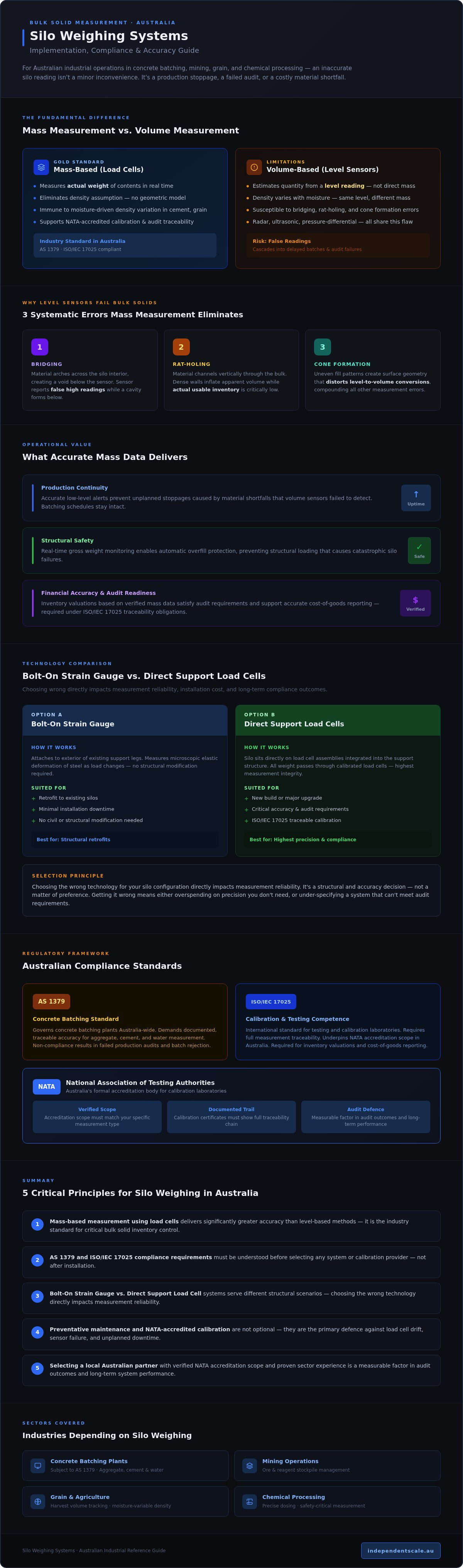
Silo weighing is the direct measurement of bulk material mass using load cells or strain gauges mounted to a silo's support structure. Rather than estimating what's inside a vessel, the system measures the actual weight of the vessel's contents in real time. In 2026, mass-based silo weighing is the undisputed gold standard for bulk inventory management across Australian industry.
The industries depending on this technology span the full width of the Australian industrial economy: concrete batching plants operating under AS 1379, mining operations managing ore and reagent stockpiles, grain and agricultural facilities tracking harvest volumes, and chemical processing plants where precise dosing is a safety requirement. Each sector carries its own tolerance thresholds and compliance obligations, but the underlying need is identical: know exactly what's in the silo, at all times.
The Difference Between Mass and Volume Measurement
Volume-based measurement, whether by ultrasonic, radar, or pressure-differential sensors, calculates material quantity from a level reading. The critical flaw in that approach is density variation. Bulk solids don't behave like liquids. Cement absorbs ambient moisture and compacts under its own weight. Grain density shifts with moisture content. A level sensor reporting 60% capacity in a cement silo after a humid night may be representing a materially different mass than the same reading on a dry afternoon.
Level sensors also generate systematic errors that mass measurement eliminates entirely:
- Bridging: Material arches across the silo interior, creating a void below the sensor's detection point and reporting false high readings.
- Rat-holing: Material channels vertically through the bulk, leaving dense walls that inflate apparent volume while actual usable inventory is critically low.
- Cone formation: Uneven fill patterns create surface geometry that distorts level-to-volume conversions.
For Australian supply chains where material shortfalls cascade into delayed batch production, missed delivery windows, and downstream contractor penalties, these errors carry direct financial consequences. Mass measurement removes the density assumption entirely. The load cells measure what's there, not what a geometric model predicts should be there.
Operational Benefits for Australian Industrial Sites
Precise mass data delivers measurable operational improvements across three critical areas:
- Production continuity: Accurate low-level alerts prevent unplanned stoppages caused by material shortfalls that volume sensors failed to detect.
- Structural safety: Real-time gross weight monitoring enables automatic overfill protection, preventing the structural loading that causes catastrophic silo failures.
- Financial accuracy: Inventory valuations based on verified mass data satisfy audit requirements and support accurate cost-of-goods reporting, a requirement for operations subject to ISO/IEC 17025 traceability obligations.
For operations considering a transition or upgrade, tank and silo weighing assemblies designed for direct load cell integration provide the structural foundation that makes reliable mass measurement achievable from the outset.
Types of Silo Weighing Systems: Bolt-On vs. Load Cells
Two fundamentally different technologies dominate silo weighing systems Australia-wide: bolt-on strain gauge sensors and direct support load cell assemblies. Choosing between them isn't a matter of preference; it's a structural and accuracy decision with direct consequences for measurement reliability, installation complexity, and long-term compliance outcomes. Getting this choice wrong means either overspending on precision you don't need or under-specifying a system that can't meet your audit requirements.
Bolt-On Strain Gauge Systems
Bolt-on strain gauges attach directly to the exterior surface of a silo's existing support legs. They measure the microscopic elastic deformation of the steel as load changes, converting that structural deflection into a weight signal without any modification to the silo's support structure. No lifting. No structural alteration. The silo stays operational during installation.
That's the primary advantage: rapid deployment on existing infrastructure at a lower upfront cost than a full load cell retrofit. For operations where inventory monitoring is the primary objective and batching-grade precision isn't a regulatory requirement, bolt-on systems deliver acceptable performance.
The limitations are real and shouldn't be minimised:
- Reduced accuracy: Bolt-on gauges measure secondary structural strain, not direct load. Signal quality is inherently lower than a system measuring force at the primary load path.
- Temperature sensitivity: Steel support legs expand and contract with ambient temperature changes. Without active temperature compensation, this thermal drift introduces measurement error that compounds over time, particularly in exposed outdoor installations common across Australian mining and agricultural sites.
- Structural variability: Uneven leg loading caused by settlement, wind loading, or eccentric fill patterns can skew readings in ways that are difficult to compensate for during calibration.
Direct Support Load Cell Assemblies
Direct support systems integrate load cells into the silo's primary load path, meaning every kilogram of material weight passes directly through the sensing element. There's no inference from secondary structural behaviour. The measurement is direct, and the accuracy reflects that.
For concrete batching operations governed by AS 1379, or any process where batching tolerances are tight and audit documentation is mandatory, this technology isn't optional. It's the specification. Tank and silo weighing assemblies built around direct load cell integration provide the structural mounting hardware and sensor geometry needed to achieve consistent, repeatable measurements across high-capacity industrial silos. Paired with purpose-built load cells rated for the specific vessel capacity and environmental conditions, these assemblies form the technical backbone of any high-accuracy silo weighing installation.
Installation does require lifting the silo to insert the load cell modules beneath each support point, which adds project complexity. For new builds, that's a straightforward specification decision. For retrofits, it requires planning around production schedules. The trade-off is a system that consistently outperforms bolt-on alternatives on accuracy, long-term stability, and calibration traceability.
The selection framework is direct: if your operation requires documented measurement traceability under ISO/IEC 17025 or AS 1379 compliance, specify direct support load cells. If you're monitoring bulk inventory on an existing structure where precision tolerances are wider, bolt-on strain gauges are a cost-effective starting point. When in doubt about which configuration suits your structural constraints, consulting a provider with verified NATA accreditation scope for silo weighing will clarify the compliance requirements before you commit to a technology.
Compliance Standards for Silo Weighing in Australia
Regulatory compliance isn't a background consideration for silo weighing systems Australia-wide. It's a primary engineering requirement. Two frameworks define what acceptable measurement performance looks like in Australian industrial contexts: AS 1379 for concrete production, and ISO/IEC 17025 for calibration laboratory competence. Operating outside these frameworks doesn't just create audit risk; it creates legal and insurance exposure that can't be absorbed by a production budget.
AS 1379 Compliance for Concrete Batching Plants
AS 1379, the Australian Standard for the specification and supply of concrete, sets binding accuracy requirements for every weighing system involved in concrete production. Aggregate, cement, water, and admixture batching are all subject to defined tolerance limits. Exceeding those tolerances doesn't produce a warning; it produces non-conforming product. In a regulated supply chain, that means rejected batches, project delays, and documented quality failures that follow an operation through every subsequent tender.
The standard requires that batching plant weighing systems are calibrated at defined intervals using traceable reference standards. A weighing system that hasn't been calibrated to AS 1379 requirements isn't compliant, regardless of how recently it was installed or how accurate it appeared during commissioning. Concrete batching plant calibration performed by a qualified provider ensures the system meets current standard requirements and that calibration records are available for inspection. For a detailed breakdown of what AS 1379 demands at each stage of the calibration process, the Concrete Batching Plant Calibration: A Complete Guide to AS 1379 Compliance covers the full technical and documentary requirements.
The Importance of NATA Accredited Calibration
NATA accreditation under ISO/IEC 17025 is the formal recognition that a calibration laboratory operates a technically competent quality management system with measurement traceability to national standards. A NATA-endorsed calibration certificate isn't just a piece of paper; it's a legally defensible record that the measurement was performed under controlled conditions, with verified reference equipment, by personnel whose competence has been independently assessed.
The distinction between a routine calibration check and a NATA-accredited load cell calibration is significant in an audit context. A standard check confirms a reading matches a reference at a point in time. A NATA-accredited calibration documents measurement uncertainty, traceability chain, environmental conditions, and technician qualification. Auditors under ISO/IEC 17025 and AS 1379 require the latter.
Non-compliance carries consequences that extend beyond audit findings:
- Insurance liability: Industrial insurers increasingly require documented calibration traceability for process weighing equipment. A claim arising from a batch failure linked to an uncalibrated system may be disputed on those grounds.
- Contractual exposure: Supply contracts referencing AS 1379 compliance place the burden of proof on the supplier. Without NATA-accredited calibration records, that proof doesn't exist.
- Regulatory action: Repeated non-conformances identified during third-party audits can trigger mandatory corrective action notices with defined resolution timelines.
When preparing for an audit, documentation requirements are non-negotiable: current calibration certificates with NATA endorsement, calibration intervals that match the standard's requirements, and a clear chain of traceability from your on-site load cells back to national measurement standards. If any link in that chain is missing, the audit will find it.
Maintenance, Calibration, and Repair of Silo Scales
A silo weighing system installed to specification will drift. That's not a flaw in the technology; it's a physical reality. Load cells experience fatigue under cyclic loading, cable insulation degrades in industrial environments, and structural changes in aging silos alter the mechanical conditions that calibration was originally performed under. The difference between operations that maintain audit-ready accuracy and those that don't is a structured preventative maintenance program, not luck.
Common Faults in Silo Weighing Systems
Environmental exposure is the primary driver of premature failure across silo weighing systems Australia-wide. Moisture ingress into junction boxes is the single most common electrical fault. When humid air cycles through an unsealed enclosure, condensation builds on terminal strips and cable connections, introducing leakage resistance that corrupts the millivolt signals load cells produce. The reading doesn't fail catastrophically; it drifts slowly, which makes it harder to detect without systematic checking. Lightning strikes present a different failure mode: a single transient surge can destroy multiple load cell bridge circuits simultaneously, taking an entire silo offline without warning.
Mechanical binding is equally damaging and far easier to overlook. Silos settle. Support structures shift. Pipework connected to silo inlets and outlets can develop rigid contact points that partially support the vessel's weight independent of the load cells, effectively removing that portion of the load from the measurement. The system reads light, the operator assumes inventory is lower than it is, and ordering decisions are made on corrupted data. Checking for binding is a mandatory step before any calibration is considered valid.
On the electronic side, indicator malfunctions and signal noise from nearby variable speed drives or welding equipment introduce errors that present as erratic readings or zero instability. These faults are diagnosable with basic signal tracing but require a technician who understands load cell bridge circuits, not just the indicator's user interface.
The Calibration Process: Step-by-Step
On-site calibration of a silo weighing system follows a defined sequence. Shortcutting any step produces a certificate that documents a procedure, not a verified measurement.
- Step 1: Zero check and binding inspection. The silo is emptied as completely as practical, all connected pipework and flexible couplings are inspected for rigid contact, and the system is zeroed. Any mechanical restriction identified at this stage must be corrected before proceeding. A zero performed on a bound silo is meaningless.
- Step 2: Span verification using test masses or substitution. For smaller silos, certified test masses are applied in increments to verify linearity across the operating range. For high-capacity vessels where physical test masses aren't practical, the substitution method uses a verified reference vessel and material transfer to establish known load points. Both methods must use masses traceable to national standards.
- Step 3: Linearity adjustment via conditioners and transmitters. Signal conditioning equipment is adjusted to correct any non-linearity identified during span verification. This step requires access to the transmitter's calibration parameters and a technician qualified to interpret the load cell's rated output against the applied reference load.
- Step 4: NATA-traceable certification. The completed calibration is documented with measurement uncertainty, environmental conditions, reference equipment identification, and technician credentials. This is the record that satisfies AS 1379 and ISO/IEC 17025 audit requirements.
Repairs to load cells, cabling, or junction box components should be completed before calibration, not after. Calibrating a system with a degraded component produces a certificate tied to a transient condition that won't hold once the component's performance continues to deteriorate.
For operations that can't absorb extended downtime, having a repair and recalibration provider with stocked components and on-site capability is a practical necessity. Contact Independent Scale Service for load cell calibration to schedule a site assessment and establish a maintenance interval that keeps your system audit-ready between formal calibration events.
Selecting an Australian Partner for Silo Weighing Solutions
The calibration certificate is only as reliable as the provider who issued it. For silo weighing systems Australia-wide, the technical requirements covered in previous sections — load cell selection, AS 1379 compliance, NATA-accredited calibration — all depend on a service partner who can execute them on-site, under real industrial conditions, with the documentation that satisfies auditors. A distributor who ships equipment and hands off responsibility doesn't meet that standard. An end-to-end partner who supplies, installs, calibrates, and maintains the system does.
Local expertise isn't a convenience factor; it's an operational one. When a load cell fails mid-shift at a concrete batching plant or a junction box fault corrupts silo readings before a scheduled delivery, response time is measured in production hours lost. Independent Scale Service operates across Sydney, Melbourne, and regional Australian industrial hubs, meaning fault diagnosis and repair aren't subject to interstate logistics delays. That geographic reach directly reduces downtime exposure for operations that can't afford to wait.
Evaluating any provider's NATA accreditation scope requires more than confirming they hold accreditation. The scope must specifically cover the calibration activities relevant to your equipment: on-site load cell calibration, silo and hopper weighing systems, and the measurement ranges applicable to your vessel capacity. Accreditation for a different measurement discipline doesn't transfer. Before engaging a provider, request their current NATA schedule and verify the scope against your system's requirements.
Comprehensive Supply and Integration
Australian silos aren't uniform. Support leg geometry, vessel capacity, structural age, and connection configurations vary significantly across concrete, mining, and agricultural installations. Independent Scale Service supplies tank and silo weighing assemblies configured to match existing structural constraints, rather than requiring sites to modify infrastructure to suit off-the-shelf hardware. Integration with PLC and SCADA systems is handled through compatible conditioners and transmitters and indicators and displays, delivering real-time mass data directly into existing plant control architecture without requiring parallel monitoring infrastructure.
Urgent Repair and Responsive Service
Fault diagnosis requires stocked components, not back-ordered lead times. Independent Scale Service maintains inventory across load cells, indicators, and ancillary hardware, so repairs don't wait on supply chains. When a system fault is identified, the path from diagnosis to recalibration is direct.
For operations ready to establish or review their calibration program, the next step is straightforward: request a hopper or silo calibration service to schedule a site assessment. A provider with verified NATA accreditation scope, demonstrated AS 1379 compliance experience, and genuine on-site capability across Australia's major industrial regions isn't a commodity. It's the difference between a calibration certificate that holds up under audit and one that doesn't.
Build a Silo Weighing System That Holds Up Under Audit
Accurate mass measurement, the right technology for your structural configuration, and NATA-accredited calibration aren't separate considerations. They're a single compliance framework. Silo weighing systems Australia-wide succeed or fail based on how well those three elements work together, and the gaps between them are exactly where audit findings and production failures originate.
The core principles are clear: direct load cell measurement outperforms volume-based methods for critical inventory control, AS 1379 and ISO/IEC 17025 set non-negotiable documentation standards, and preventative maintenance is what keeps a compliant system compliant between calibration events.
Independent Scale Service is NATA accredited to ISO/IEC 17025, holds demonstrated AS 1379 compliance expertise, and serves concrete batching, mining, and industrial operations across Sydney, Melbourne, and regional Australia. When your next audit requires verified calibration records, the time to act is before the audit notice arrives.
Frequently Asked Questions
How accurate are bolt-on silo weighing systems compared to load cells?
Bolt-on strain gauge systems typically achieve accuracy in the range of 0.5% to 2% of full scale, depending on structural conditions and temperature stability. Direct support load cell assemblies consistently deliver tighter tolerances, often 0.1% or better under controlled installation conditions. The gap widens on exposed outdoor sites where thermal cycling affects steel support legs, introducing drift that bolt-on systems can't fully compensate for without active temperature correction hardware.
Does my silo weighing system need NATA calibration to be compliant?
For operations subject to AS 1379 or ISO/IEC 17025 audit requirements, NATA-accredited calibration isn't optional. Standard calibration checks confirm a reading against a reference but don't document measurement uncertainty, traceability chain, or technician qualifications. Auditors under both frameworks require that documented evidence. A calibration certificate without NATA endorsement won't satisfy the traceability requirements those standards mandate.
Can you install load cells on an existing silo without emptying it?
Direct support load cell installation requires lifting the silo to insert load cell modules beneath each support point, which means the vessel needs to be empty or at minimal load during installation. Attempting installation under load risks both structural safety and accurate shimming of the cell assemblies. For retrofit projects, scheduling installation during a planned production shutdown or material rundown is the standard approach to managing both safety and downtime.
How often should a silo weighing system be calibrated in Australia?
AS 1379 sets defined calibration intervals for concrete batching plant weighing systems, and those requirements take precedence for compliant operations. For silo weighing systems Australia-wide outside concrete batching, calibration frequency depends on the application's accuracy requirements, the operating environment, and the equipment manufacturer's specifications. As a practical baseline, annual calibration is standard for most industrial silo installations, with additional checks warranted after any structural modification, repair, or significant impact event.
What is the difference between AS 1379 and ISO/IEC 17025 for weighing?
AS 1379 is a product standard governing the specification and supply of concrete. It sets specific accuracy tolerances for batching plant weighing equipment and defines when calibration must occur. ISO/IEC 17025 is a laboratory competence standard that governs how calibration is performed and documented. In practice, AS 1379 tells you what performance your weighing system must achieve; ISO/IEC 17025 defines the credentialing requirements for the provider who verifies it. Both apply simultaneously to concrete batching operations.
Can silo weighing systems be integrated with existing inventory software?
Yes. Modern silo weighing systems output real-time mass data via standard industrial protocols, typically 4-20mA analogue signals, Modbus, or digital fieldbus interfaces, depending on the signal conditioners and transmitters specified. Most plant SCADA and ERP inventory platforms accept these inputs directly. Integration complexity depends on your existing control architecture, but a system built around compatible conditioners and transmitters can deliver live weight data to inventory software without requiring parallel monitoring infrastructure.
What happens if a load cell fails in a multi-cell silo system?
A single load cell failure in a multi-cell configuration doesn't always cause a complete system outage. Many weighing indicators can be configured to calculate total vessel weight from the remaining active cells using a known geometric relationship between support points. However, this is a diagnostic workaround, not a reliable measurement state. Accuracy degrades, and the system should be flagged for urgent repair. Operating on a reduced cell count for extended periods introduces asymmetric loading errors that compound over time.
How do environmental factors like wind and heat affect silo weighing accuracy?
Wind loading applies lateral force to a silo structure, which introduces dynamic signal noise into load cell outputs. Most industrial load cell systems use signal averaging to filter transient wind effects, but sustained high winds on exposed sites can still affect zero stability. Heat affects both the load cells themselves and the steel support structure. Quality load cells include built-in temperature compensation, but extreme ambient temperature swings on unshaded outdoor silos in Australian conditions can push readings outside calibrated tolerance if compensation ranges aren't matched to the site's thermal environment during specification.
