


Silo Calibration Services Australia: The Definitive Guide to Industrial Accuracy
An uncalibrated silo is a liability that compromises both your product quality and your bottom line. In high-output environments, even a 1% margin of error in bulk weighing leads to significant inventory discrepancies and production bottlenecks. Securing expert silo calibration services Australia is the only way to mitigate these risks while meeting stringent regulatory demands. You understand that stopping a production line for maintenance is often as costly as the inaccuracy itself. Balancing the need for technical precision with the hard reality of operational schedules is a constant challenge for plant managers across the country.
This guide provides the definitive technical roadmap to achieving NATA-traceable accuracy with minimal operational disruption. We'll examine the requirements of ISO/IEC 17025:2017, the logistics of on-site load cell testing, and the critical role of specialized weighing assemblies in maintaining long-term system reliability. By following these industry-standard protocols, you can ensure your facility remains compliant with AS 1379-2007 (R2017) while protecting your equipment from premature wear. We'll outline exactly how to maintain your competitive edge through methodological, precise calibration processes that prioritize your facility's uptime and regulatory standing.
Key Takeaways
- Identify the technical advantages of weight-based monitoring over simple level measurement for maintaining inventory precision.
- Learn the specific applications for direct mass and substitution calibration methods based on silo capacity and structural constraints.
- Ensure full compliance with AS 1379 and ISO/IEC 17025 by securing NATA-accredited silo calibration services Australia for your facility.
- Master the mechanical preparation and zero-point calibration steps required to reduce on-site service time and prevent production bottlenecks.
- Understand the role of high-quality weighing assemblies and load cell maintenance in securing long-term industrial measurement reliability.
The Critical Role of Silo Calibration in Australian Industry
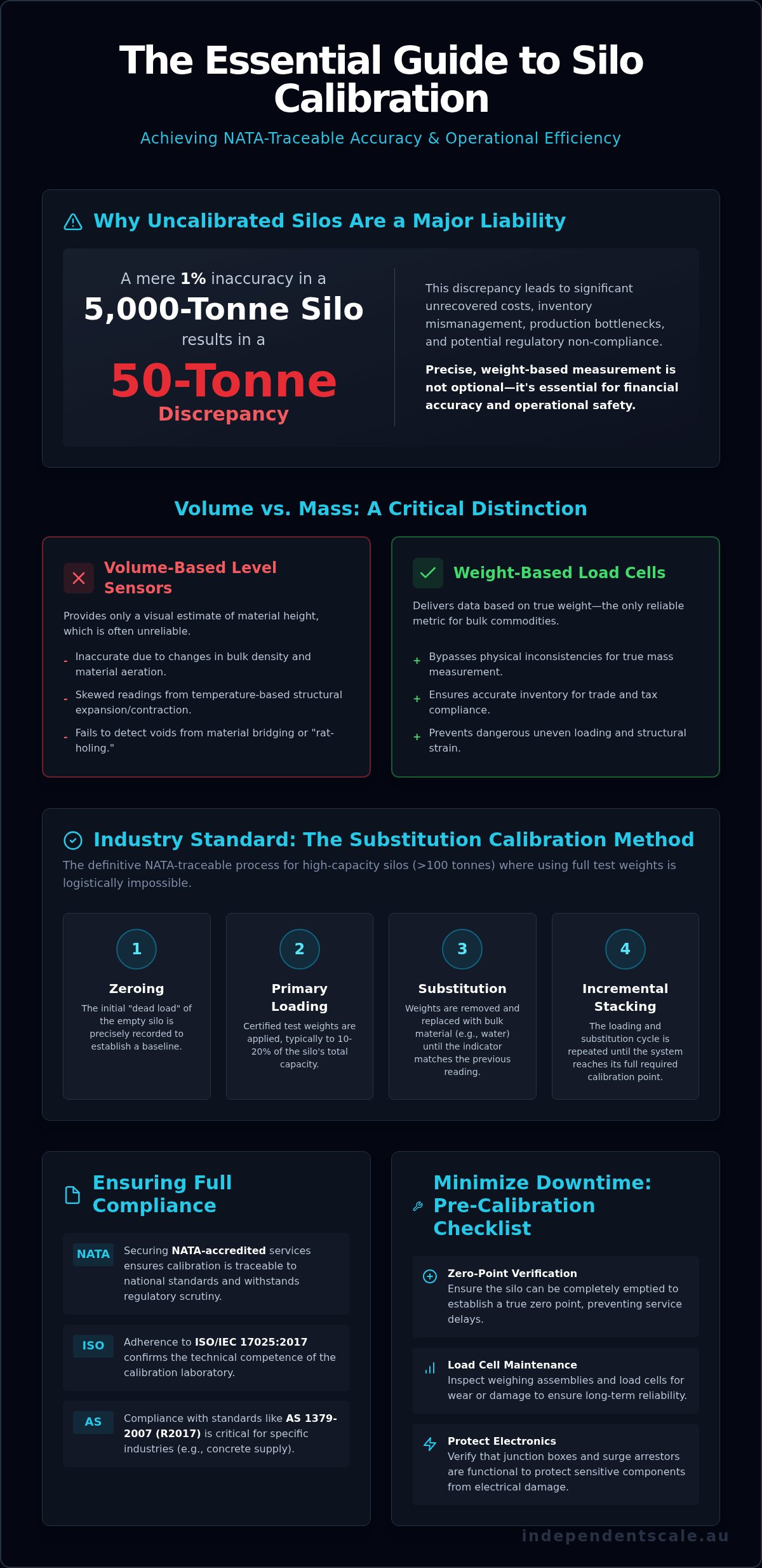
Accurate inventory management in heavy industry relies on the distinction between volume and mass. While level sensors provide a visual estimate of material height, they fail to account for changes in bulk density or material aeration. Professional silo calibration services Australia ensure that operators receive data based on true weight, which is the only reliable metric for high-volume commodities like cement, grain, or minerals. In the volatile Australian climate, temperature fluctuations cause structural expansion and contraction that can skew sensor readings. Additionally, material bridging or "rat-holing" often creates voids that lead level sensors to report incorrect volumes. Weight-based monitoring through calibrated load cells bypasses these physical inconsistencies.
To understand the fundamental technical requirements, one must ask What is Calibration? in the context of industrial metrology. It's the process of ensuring that every component of the weighing assembly is functioning within its specified tolerance.
Inventory Management and Financial Accuracy
Silo calibration is the verification of a weighing system against known standards. This process is mandatory for trade compliance and precise tax reporting on bulk inventory. High-performance indicators and displays provide the interface for this data, allowing for real-time tracking of material flow. A mere 1% inaccuracy in a 5,000-tonne silo results in a 50-tonne discrepancy. For industries operating on thin margins, these errors represent significant unrecovered costs and potential production bottlenecks. It's essential to maintain a rigorous testing schedule to prevent these financial leaks from affecting the bottom line.
Operational Safety and Structural Integrity
Structural failure is a catastrophic risk when weighing systems drift out of tolerance. Uneven loading causes eccentric forces that strain the silo's support structure. Regular testing ensures that all load cells are providing balanced outputs, which prevents the resonant vibrations known as "silo hum." Protecting these sensitive electronics requires robust junction boxes and surge arrestors to mitigate the effects of lightning strikes and power surges. Routine calibration identifies drifting or failing components before they cause a structural collapse or a dangerous overfill event. Implementing routine silo calibration services Australia is a critical risk mitigation strategy for any facility handling bulk solids.
Methods of Silo and Hopper Calibration
Selecting the correct methodology for silo calibration depends entirely on the system's capacity and physical accessibility. Professional silo calibration services Australia utilize three primary techniques to ensure NATA-traceable results that withstand regulatory scrutiny. These methods range from applying physical masses to simulating force through hydraulic systems. Maintaining signal integrity throughout these procedures requires high-performance conditioners and transmitters to eliminate electronic noise and ensure a stable reading during the incremental loading process.
The Substitution Method Explained
The Substitution Method is the industry standard for high-capacity Australian silos exceeding 100 tonnes, where using full test weights is logistically impossible. This process maintains accuracy by combining a known quantity of certified weights with a bulk substitute material, such as water or gravel. The procedure follows a methodical sequence:
- Zeroing: The technician records the initial "dead load" of the empty silo.
- Primary Loading: Certified weights are applied, typically to 10% or 20% of the silo's capacity.
- Substitution: The weights are removed and replaced with the substitute material until the indicator matches the previous reading.
- Incremental Stacking: This cycle repeats until the system reaches the required calibration point.
This methodology ensures that measurements remain traceable to the standards set by Australia's National Measurement Institute (NMI) without the prohibitive cost of transporting hundreds of tonnes of steel weights to regional sites.
Direct Weight Verification
For smaller, high-accuracy hoppers used in precise batching, technicians apply Direct Weight Verification. This involves hanging or placing certified test weights directly onto the weighing assembly. For suspended systems, the use of special purpose and shackle pins is mandatory to ensure the load is applied safely and vertically. Direct verification provides the highest level of confidence in the system's linearity and repeatability. Site managers should determine calibration intervals based on throughput volume; however, an annual verification is the standard for maintaining compliance in most industrial sectors. If your facility manages high-precision ingredients, arranging a dedicated hopper calibration service is the most efficient way to secure these tolerances.
In cases where physical weights cannot be applied due to structural constraints, technicians use force simulation kits. These hydraulic systems apply a controlled force to the load cells that mimics the weight of the material. While highly efficient, simulation requires expert oversight to ensure the simulated force accurately reflects real-world loading conditions. Regardless of the method, the goal remains the same: a verified, reliable measurement that supports operational precision.
Compliance Standards: NATA, ISO 17025, and AS 1379
Regulatory adherence in industrial weighing isn't a matter of choice; it's a requirement for operational legality and safety. In Australia, the framework for precision measurement is governed by ISO/IEC 17025:2017. This international standard specifies the requirements for the competence, impartiality, and consistent operation of calibration laboratories. When contracting silo calibration services Australia, facility managers must verify that their provider operates under these rigorous benchmarks to ensure that all data produced is technically valid and globally recognized.
The Importance of NATA Traceability
There's a critical distinction between a basic service report and a NATA-endorsed calibration certificate. A service report merely indicates that a technician performed a check, whereas a NATA-endorsed certificate provides metrological traceability. This confirms that the measurements are linked to national standards through an unbroken and documented chain of comparisons. NATA accreditation is the highest tier of measurement authority in Australia.
Major infrastructure projects in Sydney, Melbourne, and regional hubs increasingly demand NATA-traceable data to satisfy strict quality assurance protocols. By adhering to NATA Accreditation Standards, industrial facilities demonstrate a level of technical competence that is essential during legal disputes or commercial audits. Research indicates that over 72% of industrial enterprises now prioritize accredited calibration providers to mitigate risk and ensure the integrity of their supply chain data.
AS 1379 Compliance for Concrete Plants
For the Australian construction and masonry industries, AS 1379-2007 (R2017) is the definitive standard for the specification and supply of concrete. This standard mandates specific accuracy requirements for all batching equipment. Cement and water hoppers must maintain extremely tight tolerances, while aggregate hoppers are subject to defined, though slightly broader, accuracy limits. Failure to meet these requirements can lead to structural weaknesses in the final concrete product, creating significant liability for the supplier.
Mandatory calibration frequencies are a core component of AS 1379. Most concrete batching plants require a comprehensive system audit every six months, or immediately following any significant repair to the weighing assembly or load cells. Preparing for a Main Roads or government audit requires organized, accurate documentation that proves consistent compliance. Independent Scale Service specializes in concrete batching plant calibration, ensuring that cement, water, and aggregate weighing systems pass every audit. Maintaining these standards is the only way to remain on approved supplier lists for large-scale government and civil engineering contracts.
Minimising Downtime: Preparing for a Calibration Visit
Efficiency in industrial maintenance is determined by the quality of preparation. Professional silo calibration services Australia require specific site conditions to execute NATA-accredited testing without unnecessary delays. Site managers can reduce service hours significantly by ensuring the facility is ready before technicians arrive. The primary objective is to eliminate external variables that compromise measurement integrity. This proactive approach ensures that the technician's time on site is focused exclusively on precision testing rather than troubleshooting mechanical interference.
Pre-Calibration Site Checklist
A methodical approach to site readiness prevents failed calibration attempts due to structural issues. Use the following checklist to prepare your facility:
- Material Evacuation: The silo must be completely empty to establish a true zero-point calibration. Residual material causes dead load errors that skew the entire linearity curve.
- Mechanical Isolation: Verify that the silo is isolated from structural vibrations and wind interference. Ensure all load cell mounts are free of rust and mechanical binding.
- Environmental Stability: Check that external piping and flex-connections don't exert vertical force on the weighing assembly.
- Scheduling: Ensure the hopper calibration service is scheduled during a low-production window to avoid operational bottlenecks.
Site access is a critical logistical factor. Technicians often require space for mobile cranes or trucks to position heavy test weights. Ensuring clear, safe access to the weighing points and the indicator interface is mandatory for operational safety. Additionally, electrical health is paramount. Technicians will inspect options and accessories like cabling and connectors for signs of ingress or fraying that could cause signal drift during the test. Identifying these issues before the calibration begins prevents the need for a second visit.
The Calibration Workflow
A standard calibration follows a three-stage workflow designed for maximum transparency and traceability. The process begins with "As Found" testing. This records the system's performance exactly as it was running prior to any intervention, providing essential data for your quality audit trail. If the "As Found" data shows deviations outside of the AS 1379 or ISO 17025 tolerances, the technician proceeds to the adjustment phase.
During adjustment, the weighing indicator is linearized across multiple points to correct for span errors. The final stage is the "As Left" verification. This is a repeat of the initial test to confirm that the system now operates within the specified accuracy limits. This structured approach ensures that you receive a NATA-traceable report that stands up to government or corporate scrutiny. To ensure your next audit is successful, book a comprehensive load cell calibration before your next major production cycle begins.
Professional Silo Solutions by Independent Scale Service
Independent Scale Service provides high-capacity weighing solutions that prioritize technical precision and regulatory adherence. We deliver comprehensive silo calibration services Australia wide, supporting critical infrastructure and manufacturing sectors in Sydney, Melbourne, and regional hubs. Our methodology is built on decades of field expertise and a deep understanding of the structural requirements for industrial storage vessels. We don't just verify numbers; we ensure the mechanical and electronic health of your entire weighing system. This commitment to technical excellence is why leading Australian firms trust our expert technicians for their most sensitive measurement tasks.
Full-Service Weighing Support
Our capabilities extend from the initial engineering and supply of premium tank and silo weighing assemblies to ongoing NATA-accredited maintenance. For facilities with legacy infrastructure, we specialize in troubleshooting complex electrical faults and signal drift in aged systems. This often involves the replacement of fatigued components or the recalibration of high-precision load cell calibration assemblies to restore factory-standard accuracy. We understand that a failing load cell isn't just an inventory issue; it's a structural risk that requires immediate professional intervention.
For operators in the construction sector, specialized knowledge is required to maintain the specific tolerances of concrete production. You can find detailed technical requirements in our Concrete Batching Plant Calibration guide, which breaks down the necessities for AS 1379 compliance. We provide the technical documentation and NATA-traceable reports needed to satisfy government audits and corporate quality assurance protocols. Our team manages the entire process so you can focus on production targets without the fear of non-compliance.
Contact Us for On-Site Calibration
Maintaining year-round compliance requires a methodical approach to system maintenance. We offer customized maintenance contracts that align with your production cycles, ensuring that your equipment is tested and adjusted before critical bottlenecks occur. Our mobile technicians are equipped with certified test weights and hydraulic simulation kits to handle any site configuration, regardless of geographic location. We prioritize responsiveness because we know that every hour of downtime represents lost revenue for your business.
To secure the long-term reliability of your weighing assemblies, it's essential to partner with a provider that understands the nuances of Australian industrial standards. We provide the authoritative silo calibration services Australia demands for modern industrial accuracy. You can Request a Silo Calibration Quote today to receive a detailed technical proposal for your metro or regional site. Our technicians are available to discuss your specific site requirements and provide a solution that ensures total measurement confidence.
Securing Long-Term Measurement Accuracy and Compliance
Precision in industrial weighing is the foundation of operational efficiency and inventory control. Maintaining NATA-traceable standards ensures that your facility avoids the financial penalties associated with inaccurate batching and the safety risks of structural overloads. By utilizing specialized silo calibration services Australia, you secure a verified audit trail that meets the rigorous demands of ISO/IEC 17025 and AS 1379. Methodical preparation and regular maintenance cycles are the most effective ways to minimize downtime and protect your weighing assemblies from premature failure.
Independent Scale Service provides no-nonsense technical expertise across Sydney, Melbourne, and regional Australia. As AS 1379 compliance specialists, we ensure your concrete batching plants and storage silos operate within specified tolerances year-round. Our team is NATA accredited to ISO/IEC 17025, providing the authoritative documentation your business requires for legal and commercial standing. Book Your NATA-Accredited Silo Calibration Today to ensure your site's precision remains uncompromised.
Frequently Asked Questions
How often should an industrial silo be calibrated in Australia?
Standard industrial silos typically require annual calibration to maintain inventory accuracy and system reliability. For concrete batching plants, AS 1379 mandates a stricter six-month interval to ensure product quality. High-throughput facilities may require more frequent testing to address mechanical wear or vibration-induced drift. Regular silo calibration services Australia ensure that inaccuracies are identified before they impact production quality or lead to significant inventory discrepancies during financial stocktakes.
What is the difference between silo level sensors and silo weighing scales?
Level sensors measure the height of material within a vessel, which is often inaccurate due to material bridging, aeration, or density changes. Weighing scales utilize load cells to measure the actual mass of the silo and its contents. Mass-based measurement is the only definitive way to track inventory by weight, which is essential for trade compliance and precise batching. Level sensors are better suited for high-level alarms rather than financial inventory accounting.
Do I need NATA accreditation for my silo calibration?
NATA accreditation to ISO/IEC 17025 is required for any facility that must prove metrological traceability for government audits or high-spec infrastructure projects. While a standard service report verifies function, a NATA certificate provides the legal standing required for compliance. Most Australian industrial contracts specifically mandate NATA-endorsed data to ensure the technical competence of the calibration provider and the validity of the results across the entire weighing range.
Can you calibrate a silo while it is full of material?
No, a silo must be empty to establish an accurate zero-point calibration. Starting with a full silo prevents the technician from identifying dead-load errors or mechanical binding in the weighing assembly. For high-capacity systems, we use the substitution method, which involves zeroing the empty vessel and then incrementally adding certified weights and substitute material to build a linear accuracy curve. This ensures the system is accurate from zero to its maximum capacity.
What Australian standards apply to concrete batching plant silos?
AS 1379-2007 (R2017) is the primary standard governing the specification and supply of concrete in Australia. It mandates specific accuracy tolerances for cement, water, and aggregate weighing systems. Compliance with this standard is a prerequisite for supplying material to major civil engineering and government projects. Independent Scale Service specializes in ensuring that all plant components meet these rigorous accuracy requirements and pass mandatory six-monthly audits to maintain their operational certification.
How long does a typical silo calibration take on-site?
A standard on-site calibration usually takes between four to eight hours depending on the silo's capacity and the chosen methodology. Direct mass calibration for smaller hoppers is faster, while the substitution method for 100-tonne silos requires more time for incremental loading and stabilization. Providing clear site access and ensuring the silo is empty before the technician arrives are the most effective ways to minimize the duration of the service visit.
What happens if my silo fails a calibration test?
If a system fails, our technicians perform a diagnostic audit to identify the root cause, such as mechanical binding or a drifting load cell. We then carry out the necessary repairs or electronic adjustments to bring the system back within specified tolerances. Once the fault is corrected, a final verification is performed to confirm the system is compliant. We provide a full report detailing the errors found and the corrective actions taken during the visit.
Do you provide silo calibration services in regional Victoria and NSW?
Yes, we provide comprehensive silo calibration services Australia wide, including regional Victoria and New South Wales. Our mobile teams are equipped to reach remote industrial sites from our primary hubs in Sydney and Melbourne. We manage the logistics of transporting certified test weights and specialized equipment to regional locations, ensuring that remote facilities maintain the same high standards of compliance and accuracy as metropolitan plants without excessive logistical delays. For those operating in Western Australia, local agricultural hubs like Gidge Rural offer the essential supplies and regional expertise needed to support productive farm and property management.
