


Silo Calibration Service: The 2026 Guide to Compliance and Accuracy
Is your facility still operating under the outdated AS 1379-2007 standard, or have you transitioned to the mandatory requirements of AS 1379:2026? Maintaining bulk inventory accuracy while meeting strict NATA accreditation standards is a constant challenge for industrial plants across Sydney and Melbourne. You likely find that the high downtime associated with traditional dead weight testing is unsustainable, yet the regulatory pressure and production waste from inaccurate load cells are equally unacceptable. Engaging a professional silo calibration service is no longer just a maintenance task; it's a critical requirement for legal and operational compliance in the current Australian industrial landscape.
We understand that precision measurement is the backbone of your production reliability. This guide provides the technical roadmap to mastering your weighing systems, ensuring you achieve a certified NATA calibration report with minimal operational disruption. We'll analyze the specific updates within AS 1379:2026, the advantages of high-precision force calibration methods, and how to maintain ISO/IEC 17025:2017 standards to ensure long-term reliability for your silo load cells and batching plants. By focusing on technical competence and methodical testing, you can eliminate inventory discrepancies and satisfy every regulatory audit.
Key Takeaways
- Understand the updated requirements of AS 1379:2026 and why NATA ISO/IEC 17025 accreditation is the mandatory benchmark for legal compliance in Australian industrial sectors.
- Evaluate the technical advantages of force calibration over traditional dead weight testing to significantly reduce facility downtime and eliminate the logistical costs of transporting test weights.
- Identify and mitigate mechanical binding and environmental factors, such as wind loading, that compromise the precision of your silo calibration service.
- Quantify the financial impact of load cell inaccuracies, where a 1% margin of error in high-capacity silos leads to substantial production waste and annual profit loss.
- Access specialized technical support across Sydney, Melbourne, and regional Australia, including 24-hour breakdown services to maintain continuous operational reliability.
Why Silo Calibration is Essential for Australian Industrial Operations
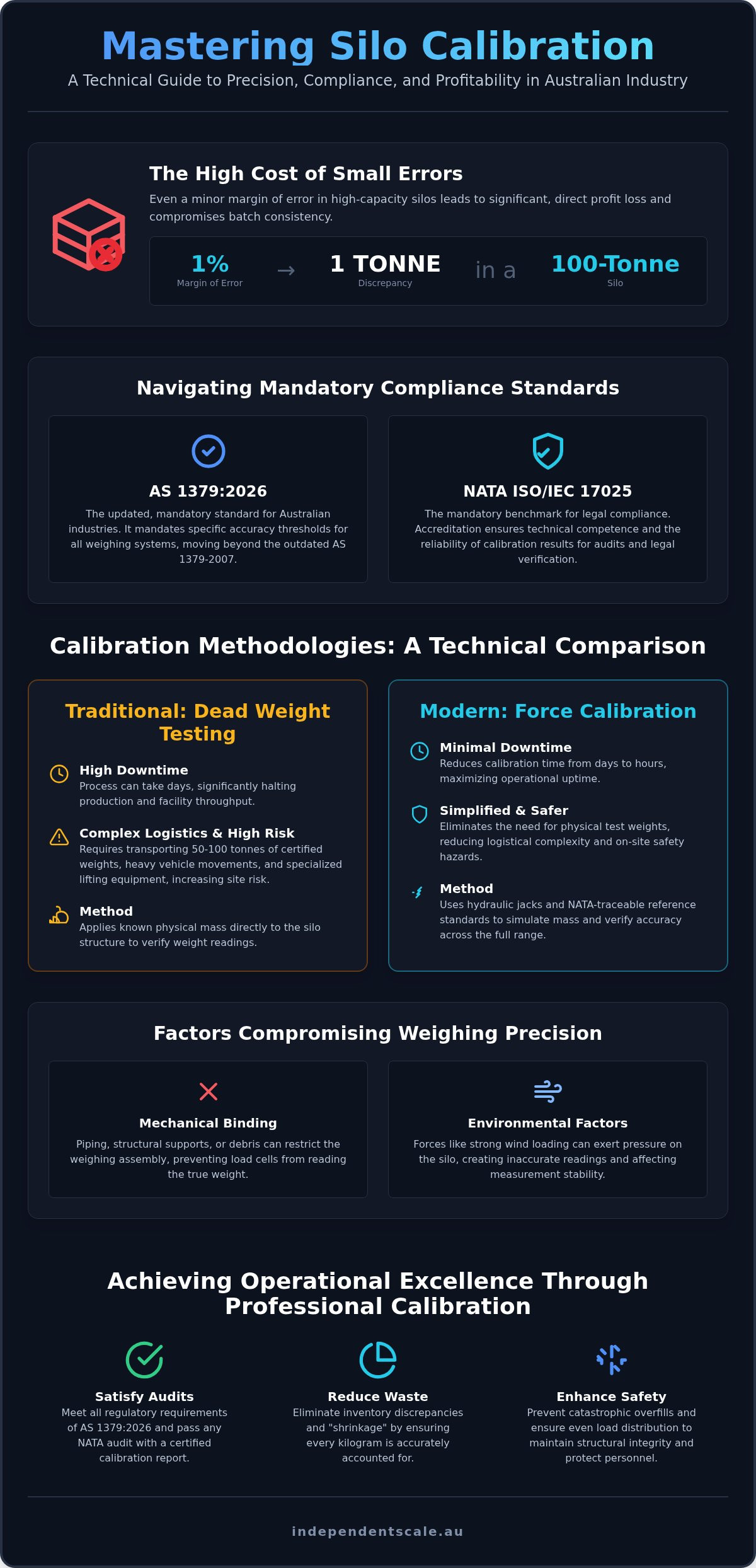
In high-capacity industrial environments, precise measurement isn't optional. Calibration for silos is the rigorous technical process of verifying that the entire weighing assembly, including load cells and digital indicators, accurately translates physical force into a precise mass reading. Without a routine silo calibration service, measurement drift is inevitable. Consider the financial implications of a seemingly minor 1% margin of error. In a 100-tonne cement silo, this represents a one-tonne discrepancy. Across a single production year with multiple refills, these invisible losses directly erode annual profit margins and compromise batch consistency.
Reliable data is the foundation of industrial compliance. Australian industries, particularly those involved in concrete production and bulk material handling, must adhere to strict regulatory frameworks. The update to AS 1379:2026 mandates specific accuracy thresholds for weighing systems. Failing to meet these standards doesn't just risk operational efficiency; it exposes the business to legal liability and audit failures. Professional calibration ensures your facility operates within these legal parameters while maintaining the technical integrity of your weighing infrastructure.
Inventory Management and Waste Reduction
Accurate real-time tracking of bulk materials like minerals, grain, or cement is vital for lean manufacturing. Discrepancies between the weight of material delivered and the weight recorded in storage often lead to significant financial "shrinkage." In the context of bulk storage, inventory shrinkage is defined as the quantifiable gap between documented procurement volumes and the actual physical stock held, typically caused by measurement inaccuracies or mechanical binding. Utilizing high-quality tank and silo weighing assemblies ensures that every kilogram is accounted for, reducing waste and optimizing the supply chain.
Operational Safety and Overfill Prevention
Calibration Methodologies: Comparing Force vs. Dead Weight Testing
Selecting the appropriate silo calibration service requires a technical evaluation of operational downtime against precision requirements. Traditional dead weight testing involves applying physical mass to the silo structure. While this method remains a fundamental reference, the logistical burden is significant. Transporting 50 to 100 tonnes of certified test weights to regional sites in Australia requires multiple heavy-vehicle movements and specialized lifting equipment. This increases site risk and extends downtime from hours to days.
Modern industrial sites in 2026 increasingly transition to force calibration. This method utilizes hydraulic jacks and reference standards to simulate material mass. By applying a controlled force directly to the tank/silo weighing assemblies, technicians can verify accuracy across the entire weighing range without the need for physical weights. All reference equipment used in this process must maintain NATA traceability to ensure the results satisfy AS 1379:2026 requirements. For facilities prioritizing throughput, force calibration offers a superior balance of speed and technical accuracy.
Force Calibration: Push-Up, Push-Down, and Pull-Down
Technical execution varies based on silo design and ground clearance. The 'Push-Up' method is the most common, where hydraulic jacks are positioned beneath the vessel's support structure to apply upward force. In scenarios with restricted clearance, the 'Pull-Down' method utilizes anchors to apply force from below. The precision of these systems relies on high-accuracy reference load cells integrated into the hydraulic circuit. These reference cells detect force increments with high resolution, allowing for a multi-point calibration curve that identifies non-linearity in the weighing system. If you require a fast, reliable audit of your system, consider booking a NATA-accredited load cell calibration to minimize production interruptions.
The Logistics of Dead Weight Testing
Despite the efficiency of force methods, dead weight testing remains necessary for specific applications. It is often the preferred method for the initial commissioning of new weighing systems where structural deflection characteristics are unknown. However, the logistics for existing sites are complex. Key challenges include:
- Site Access: Regional Australian locations often have limited access for the heavy-duty trucks required to transport massive test weights.
- Safety Risks: Manual handling and crane movements associated with positioning tonnes of weights increase the potential for workplace incidents.
- Cost: The price of mobilization for a full dead weight set often exceeds the cost of the calibration service itself.
For routine compliance and 24-hour breakdown support, force-based methodologies provide the most efficient path to NATA certification.
Navigating Compliance: AS 1379 and NATA ISO/IEC 17025 Standards
Compliance in the Australian industrial sector is governed by rigorous technical standards that ensure measurement reliability and public safety. For facilities operating bulk storage systems, a silo calibration service must align with both industry-specific regulations and international laboratory standards. Utilizing non-certified weighing equipment in critical sectors like construction or infrastructure development carries severe legal risks. If a structure fails due to incorrect batching ratios, the absence of a NATA-endorsed calibration certificate can lead to massive litigation and the immediate cessation of operations.
A valid NATA-endorsed calibration certificate is more than a simple checklist. It must contain specific technical data points, including the uncertainty of measurement, environmental conditions during the test, and a clear statement of traceability to national primary standards. This documentation serves as your primary evidence of due diligence during regulatory audits or quality inspections by Tier-1 contractors. Without this level of detail, your measurement data lacks the legal standing required for high-stakes industrial projects.
AS 1379 Requirements for Concrete Batching
The recently updated AS 1379:2026 provides the mandatory framework for the specification and supply of concrete in Australia. This standard dictates precise accuracy tolerances for all weighing components within a batching plant. For instance, cement weighing systems must generally maintain an accuracy of ±1% of the required mass, while aggregate systems are held to ±2%. High-output facilities are typically required to perform these verifications every six months to account for mechanical wear and load cell drift. For a deeper technical breakdown, refer to our Concrete Batching Plant Calibration Guide to ensure your site meets these updated 2026 benchmarks.
The Importance of NATA Accreditation
NATA accreditation to ISO/IEC 17025:2017 is the global benchmark for technical competence in calibration laboratories. While many providers offer a 'standard' calibration, this often lacks the rigorous oversight and equipment traceability required for legal compliance. NATA-accredited providers undergo regular peer reviews of their methodologies, staff proficiency, and equipment maintenance schedules. This oversight ensures that the reference standards used on your site are themselves accurately calibrated against national primary standards. Major Australian contractors now mandate NATA-certified weighing for all subcontractors to mitigate project risk and ensure structural integrity across the supply chain.
Troubleshooting and Maintaining Silo Weighing Assemblies
Accurate weighing requires a frictionless environment. Mechanical health is the primary determinant of system reliability. When mechanical binding occurs, structural components like rigid pipe connections or debris buildup between the silo and its frame absorb part of the load. This masks the true weight and leads to significant measurement errors. Identifying these friction points is the first step in any technical audit.
Environmental factors in regional Australia frequently compromise load cell signals. Wind loading exerts lateral forces that can shift the center of gravity, creating false readings. Temperature fluctuations also cause structural expansion. If mounting assemblies aren't correctly aligned, this expansion induces parasitic stress on the sensors. Signal integrity is often further degraded by electrical noise from nearby industrial motors. Utilizing high-quality conditioners and transmitters is essential to filter this interference and maintain a clean data stream.
Load Cell Health and Fault Diagnosis
Aged load cells often exhibit 'zero shift', where the signal fails to return to zero when the vessel is empty. This usually indicates permanent physical deformation of the internal strain gauge. 'Span error' is another common failure, representing a loss of sensitivity at higher capacities. Moisture ingress is a frequent cause of signal drift in humid coastal regions. Protecting your electronics with robust junction boxes and surge arrestors prevents voltage spikes and environmental damage from causing premature system failure.
Structural Integrity and Mounting
Structural alignment must be verified periodically. Silos must remain plumb and level to ensure force is applied vertically through the load cell axis. Stay rods and check links are critical components; they prevent lateral movement or tipping without introducing vertical friction that would skew weight data. Technicians must verify that all mounting bolt torque settings comply with original manufacturer specifications during every quarterly maintenance inspection. If your system shows signs of drift or mechanical binding, book a professional silo calibration service to restore precision and compliance.
Pre-Calibration Checklist
Before the technician arrives to perform a silo calibration service, follow this checklist to ensure efficiency:
- Clear all debris and material buildup from beneath the silo legs and weighing assemblies.
- Inspect all flexible couplings and bellows for stiffness or signs of perishing.
- Verify the integrity of all cable runs and conduit for physical damage.
- Ensure the silo is either completely empty or at a stable, known weight for the baseline reading.
Professional Silo Calibration Services in Sydney, Melbourne, and Regional Australia
Local expertise is the primary differentiator in maintaining industrial weighing accuracy. Australian environmental conditions, from the extreme heat of regional mining sites to the high humidity of coastal construction hubs, directly impact load cell performance. Independent Scale Service has operated since 1992, providing over 30 years of specialized experience in the Australian market. This tenure ensures that every silo calibration service is executed with a deep understanding of local regulatory pressures and structural challenges. Our technicians don't just provide a certificate; they provide a comprehensive technical audit that secures your facility's operational continuity.
Minimizing downtime is a core priority for high-output production cycles. We offer a 24-hour breakdown service to act as a safety net for our clients, ensuring that unexpected weighing failures don't halt your entire supply chain. Whether you require an initial hopper calibration for a new installation or a recurring maintenance schedule for a multi-silo facility, our team delivers technical proficiency without fluff or delay.
Our End-to-End Calibration Process
Every engagement follows a structured, methodical workflow designed for safety and precision. We begin with a comprehensive site audit and a detailed Safe Work Method Statement (SWMS) to mitigate on-site risks. Our NATA-qualified technicians then execute either Force or Dead Weight calibration based on your specific site requirements and the methodologies discussed previously in this guide. Upon completion, we provide immediate digital reporting and NATA-endorsed compliance certification. This streamlined process ensures your data is audit-ready before our team even leaves the site.
Serving Sydney, Melbourne, and Beyond
Our operational reach extends across Sydney, Melbourne, and the most remote regional industrial corridors. We maintain a fleet of mobile calibration units specifically equipped to service heavy industrial sites in the Mining, Agriculture, and Construction sectors. These units carry the necessary reference standards and hydraulic equipment to perform high-capacity testing in any environment. This geographic flexibility ensures that regional facilities receive the same level of technical competence and NATA-accredited oversight as those in major metropolitan hubs. To secure your facility's accuracy and compliance, Request a comprehensive silo calibration quote today.
Securing Your Industrial Accuracy and Compliance
Maintaining bulk inventory precision requires a methodical approach to mechanical integrity and regulatory adherence. By transitioning to high-precision force testing and adhering to the updated AS 1379:2026 standards, your facility can eliminate production waste while satisfying rigorous NATA audits. A professional silo calibration service ensures your weighing systems remain reliable under the demanding conditions of the Australian industrial sector. Independent Scale Service provides the technical expertise and 24-hour emergency breakdown support necessary to minimize downtime and protect your operational margins. Our NATA-accredited (ISO/IEC 17025) technicians deliver the specialized oversight required for major infrastructure and construction projects across Sydney, Melbourne, and regional Australia. Don't let measurement drift compromise your site's safety or legal standing. We're ready to help you maintain a precise and compliant operation.
Book Your NATA-Accredited Silo Calibration Service today to ensure your facility meets every technical and regulatory benchmark for 2026.
Frequently Asked Questions
How often should an industrial silo be calibrated for AS 1379 compliance?
AS 1379:2026 mandates that weighing systems in concrete batching plants undergo verification at least every six months. High-output facilities or those operating in harsh regional environments often require more frequent checks to maintain the strict accuracy thresholds of ±1% for cement and ±2% for aggregates. Regular scheduling ensures your plant remains compliant with Australian standards and avoids the legal risks associated with non-certified production cycles.
What is the difference between silo calibration and silo verification?
Calibration is the technical process of comparing a weighing system's output against a known reference standard and adjusting it to eliminate identified errors. Verification is a periodic check to confirm the system still operates within its specified tolerance without making any adjustments to the electronics. While verification confirms current accuracy, a comprehensive silo calibration service involves the formal adjustment and NATA-endorsed certification of the entire load cell assembly for long-term reliability.
Can you calibrate a silo while it is still full of material?
No, a silo cannot be accurately calibrated while it contains material. Technical procedures require the vessel to be completely empty to establish a true zero baseline before applying known forces or test weights. Attempting to calibrate a loaded silo masks mechanical binding and prevents technicians from identifying non-linearity across the full weighing range. Facilities should plan for material depletion or transfer before the scheduled arrival of the calibration team.
What are the signs that my silo load cells are failing?
Common indicators of failing load cells include zero drift, where the indicator doesn't return to zero when the vessel is empty, and inconsistent readings during identical batching cycles. You may also notice non-linearity, where measurement errors increase proportionally with the material load. Physical signs such as moisture ingress in junction boxes or visible corrosion on the sensor body often precede total electrical failure and require immediate technical intervention.
How long does a typical silo calibration service take?
A standard silo calibration service typically takes between four and six hours per vessel, depending on site access and the chosen methodology. Force calibration using hydraulic jacks is generally faster than traditional dead weight testing because it eliminates the time-consuming movement of physical mass. Complex sites with multiple silos or restricted clearance may require additional time for technical setup and safety risk assessments before the actual testing begins.
What is NATA accreditation, and why does my business need it?
NATA accreditation to ISO/IEC 17025:2017 is the formal recognition that a laboratory possesses the technical competence to perform specific tests. Your business needs it because major Tier-1 contractors and regulatory bodies in Australia mandate NATA-endorsed certificates as proof of measurement traceability. It provides legal assurance that your equipment is calibrated using methods that meet international standards, protecting your operation against project liability and potential audit failures.
Are there specific requirements for silos used in the food and beverage industry?
Silos in the food and beverage industry must meet strict hygiene and material standards alongside weighing accuracy. Load cells and mounting assemblies should be constructed from high-grade stainless steel to withstand caustic clean-in-place procedures. While the weighing principles remain identical, the calibration process must account for specialized sanitary fittings and ensure no contaminants are introduced during testing. Compliance with HACCP or FSANZ guidelines often necessitates these specific technical considerations.
What happens if my silo fails its calibration test?
If a silo fails its calibration test, the technician identifies the specific cause, such as mechanical binding, electrical interference, or a damaged load cell. The system must be repaired or adjusted before a re-test is performed to confirm compliance. You cannot legally issue NATA-endorsed documentation for a system that falls outside the required tolerances. In high-output environments, our 24-hour breakdown support ensures repairs are executed immediately to minimize production downtime.
