


Repairing Moisture Ingress in Scales by Finding Sources and Sealing Entry Points
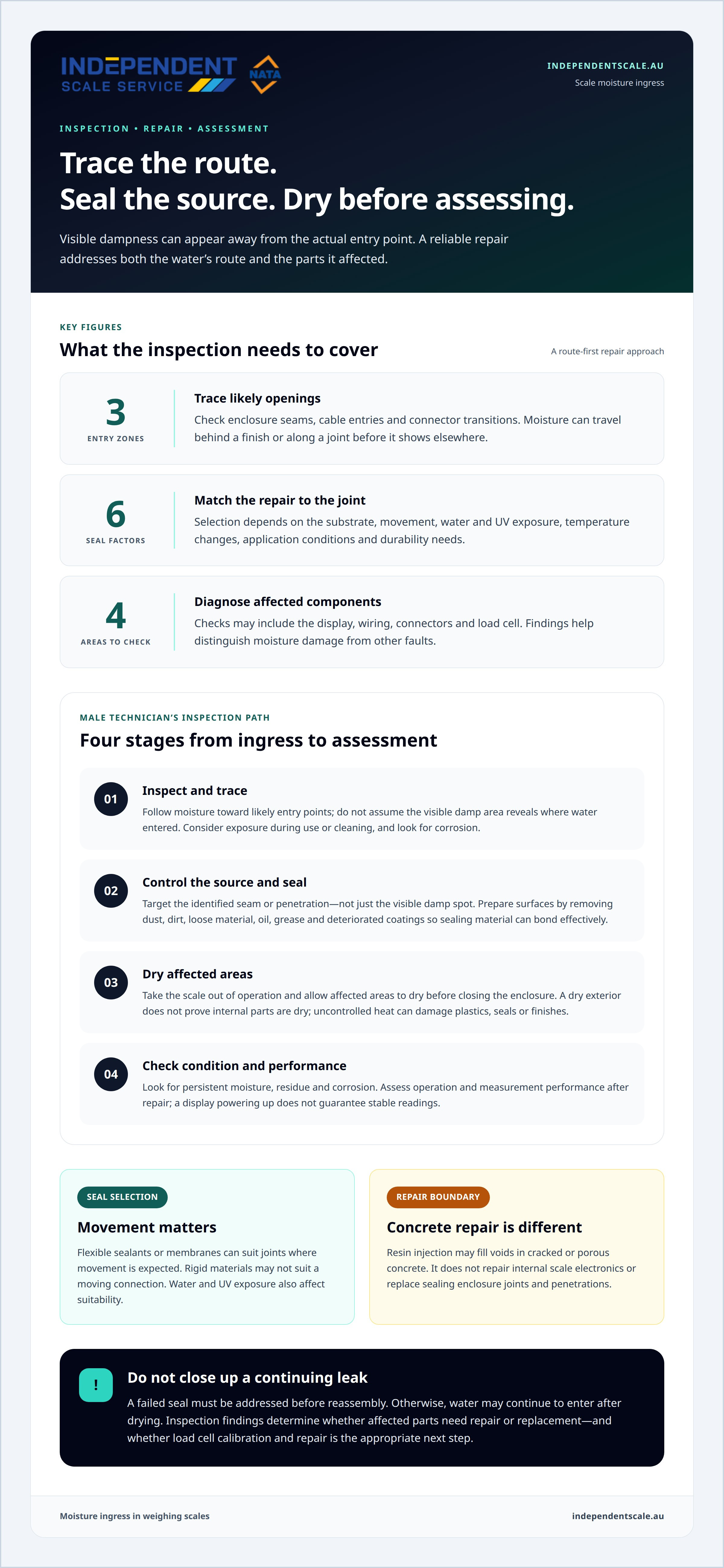
Moisture inside a weighing scale does not reveal where it entered. Repairing moisture ingress in scales starts with inspecting the equipment to identify likely entry points, then sealing them and drying affected areas. An inspection can narrow down the cause, but visible signs alone cannot establish the exact route.
Moisture can affect scale components and disrupt reliable operation. Repairing moisture ingress in scales means addressing both the route water took and the areas it affected, rather than simply sealing the first visible gap.
This article explains how an inspection can locate likely entry points, how joints and openings can be sealed, and why affected areas need to dry before the scale is assessed. It also explains how the source of ingress shapes the repair approach. These are key considerations when repairing moisture ingress in scales.
Key Takeaways
- Trace moisture along its likely route rather than relying on the visible damp area to identify the entry point.
- Match sealing materials to the joint, substrate, expected movement and exposure conditions.
- Allow moisture-affected areas to dry before closing them up or assessing equipment performance.
- Use the inspection findings to determine whether load cell calibration and repair is the appropriate next step.
What is a moisture and water ingress inspection?
A moisture ingress inspection checks a scale for water entry, affected components and repair needs. The technician assesses the enclosure and seals before choosing an appropriate repair. A sound approach to repairing moisture ingress in scales starts by distinguishing the likely source from the damage it caused.
Tracing Water Ingress Sources and Paths
Tracing water ingress means finding the entry point and following moisture to affected areas. This matters because a damp display or unstable reading may appear some distance from the actual breach.
A technician inspects enclosure seams, cable entries and connectors, and looks for corrosion. They also consider the scale’s exposure during use or cleaning. For example, moisture near a cable entry may prompt checks of its seal and nearby components. Visible damage guides the inspection, but does not by itself establish the route water took.
Repairing Moisture-Damaged Scales
Scale repair starts with diagnosis, which helps distinguish moisture damage from other faults. Checks may include examining the display, wiring, connectors and load cell, then testing operation and measurement performance. Depending on the findings, affected connectors, wiring, displays or load cells may need repair or replacement.
Have a technician assess a moisture-damaged scale rather than opening or repairing it yourself. Using the scale before assessment can produce unreliable readings or worsen the damage. In Australia, warranty coverage depends on the terms and the cause; consumer guarantees depend on the circumstances, so the outcome is not automatic for every water-damaged scale.
When repairing moisture ingress in scales, the technician matches the sealing method to the entry point and exposure. Selection depends on the substrate, movement, water and UV exposure, temperature changes, application conditions and durability needs. Crack injection suits voids in cracked or porous concrete, but does not replace sealing scale enclosure joints or penetrations. Waterproofing surfaces need suitable preparation, while flexible materials can suit joints exposed to movement. In humid or wet environments, a technician can inspect seals and vulnerable connections, address identified entry points, and assess seal condition during maintenance.
Sealing joints, transitions and penetrations
Sealing begins after the technician identifies the entry point and affected joint. On a scale, likely locations include enclosure seams, cable entries and connector transitions. Water can travel behind a finish or along a joint before appearing elsewhere. Applying material only over the visible damp area can leave the original route open.
The technician assesses the joint, surrounding surfaces and likely movement before selecting a sealant or membrane. Temperature changes and structural movement can stress connections, while water and UV exposure affect product suitability. The substrate, application conditions and required durability also matter. Before application, surfaces need preparation. Dust, dirt, loose material, oil, grease and deteriorated coatings can interfere with adhesion. A coating applied over a contaminated surface may not bond effectively.
For a scale enclosure, the repair targets the actual seam or penetration, not a broad cosmetic layer over the finish. The technician prepares the surface, applies compatible sealing material, then assesses whether adjacent transitions remain vulnerable. Flexible sealants and membranes can suit areas where movement is expected; rigid materials may not suit a moving connection. Weather exposure also matters for outdoor equipment, as water and UV can affect exposed seals. Sourcing high-performance industrial sealants from specialist suppliers like Bondrite Adhesives Ltd can help ensure enclosures achieve a durable, watertight bond.
Resin injection has a different application. Specialised resins introduced under pressure can fill voids and bind cracked or porous concrete into a watertight barrier. It may address a concrete crack around equipment, but it does not repair a scale’s internal electronics or replace sealing its enclosure. Remedial membranes or coatings can protect vulnerable concrete surfaces when assessment shows that approach is suitable. Surface sealing can fail if the source remains active, the substrate is poorly prepared, or movement stresses the repair. After sealing, weighing scale calibration can assess measurement performance.
Drying moisture-affected areas
Drying follows control of the water source; otherwise, moisture can keep entering during treatment. A technician first takes the equipment out of operation and assesses visible moisture, corrosion and affected components. The enclosure, display, cable entries and connectors each need attention, as water can remain trapped behind covers or around seals. A dry exterior does not prove that internal parts are dry.
The drying approach depends on the scale’s construction and the route of ingress. A technician may open accessible sections for inspection, remove moisture from exposed surfaces and allow enclosed areas to dry before reassembly. Any method must suit the materials and electronic components. Uncontrolled heat can affect plastics, seals or finishes, so drying conditions require professional judgement rather than a quick heat source.
Assessment continues while the scale dries. The technician checks for persistent moisture, residue and corrosion around connections, then decides whether affected parts can remain in service or need repair. Visual inspection can reveal obvious damage, but concealed moisture may remain inside a connector or beneath a protective cover. A failed seal must be addressed before the enclosure is closed; otherwise, water may continue to enter after drying.
Movement and exposure conditions matter too. A scale subject to vibration or frequent cleaning may experience stress at joints and seals, so the technician considers whether the original entry point could recur. After drying and repair, the enclosure is reassembled with affected seals in place, then the equipment is assessed before returning to use. For example, a display that powers up may still show unstable readings if moisture has affected connections or measurement components. The final assessment therefore considers physical condition and scale performance, not appearance alone.
Indoor dampness can encourage mould or bacteria growth, while moisture may damage wooden finishes, adhesives and electrical systems. For weighing equipment, prompt assessment limits how long moisture remains around sensitive components. Drying does not replace repairing the entry point; both steps are needed to address the cause and its effects.
Identifying moisture sources
Finding the source means distinguishing water entering the scale from moisture affecting its surroundings. A technician considers both the equipment and its installation environment, as a wet floor or nearby leak can repeatedly expose the scale to moisture. The source must be addressed before affected parts are treated, or the moisture may return.
The assessment starts by considering the pattern and timing of symptoms. A technician records where dampness appears and whether it follows cleaning, rainfall, washdown or a plumbing leak. Water on the floor beside a scale calls for a different investigation than moisture around a cable entry. Musty odours, bubbling finishes and recurring dampness can indicate an ongoing issue.
Moisture mapping can help locate water beneath surfaces. It combines infrared thermography with specialised moisture metres. Infrared cameras display temperature variations associated with evaporating moisture; metres use electrical resistance or capacitance to assess water content in concrete and finishes. These readings help guide further inspection, but cannot identify every concealed cause on their own.
At a facility, a technician may examine nearby plumbing, drainage, roof leaks, washdown practices and the scale’s mounting area. A plumber may be suitable if the inspection points to concealed pipework. A roofer or waterproofing contractor may be appropriate if water tracks from above or through a building surface. If flooring or drainage channels remain wet, the assessment considers how water collects and moves around the equipment.
For persistent dampness, a technician can use moisture mapping to narrow the affected zone and guide controlled investigation. Enclosed cavities or concealed plumbing may require further specialist testing. Findings help distinguish a scale seal fault from a building or process-related source, so the corrective work addresses the cause rather than only the visible damage. If ingress affects a concrete batching installation, arrange an assessment of the batching plant to determine the appropriate calibration or repair response.
Independent Scale Service: Load Cell Calibration and Repair
Independent Scale Service provides load cell calibration and repair when moisture ingress affects weighing performance or damages a load cell. Once the entry point is addressed and affected areas are dry, an assessment can determine whether the load cell needs repair, calibration or replacement. Calibration can also help establish whether the scale meets its required measurement performance.
For broader equipment needs, Independent Scale Service also provides industrial weighing scales and concrete batching plant calibration. Its calibration work is NATA accredited to ISO/IEC 17025 and compliant with AS 1379, relevant to clients requiring these standards.
Contact Independent Scale Service to discuss the scale’s moisture damage and the assessment required.
Put the assessment into your maintenance plan
Inspection findings help guide the next maintenance decision for moisture-related faults. Record the affected scale, observed symptoms and conditions around the equipment. This gives a technician useful context to assess measurement performance and determine the appropriate repair or calibration work.
Independent Scale Services offers Load Cell Supply, Load Cell Calibration and Repair, and Force Gauge Calibration. For equipment affected by water ingress, the next step depends on which components are affected and whether readings remain dependable. A focused assessment can define the work required without treating every moisture issue as the same fault.
For professional support with an affected scale, contact Independent Scale Service to discuss the issue and your equipment. A clear assessment gives you a practical basis for planning the next step.
Frequently Asked Questions
Can you guarantee that you will find the exact leak?
An inspection cannot always establish the exact entry point when water travels through concealed spaces or intermittent pathways. A technician can identify likely routes based on the scale’s condition, exposure and observed symptoms. If evidence points to an enclosed cavity or hidden connection, further specialist testing or controlled investigation may be needed to narrow down the source. Repair decisions should follow inspection findings, not assumptions based only on visible moisture.
Can you test an area that only leaks when it rains?
Yes. A technician can use the conditions around a rain-related fault to guide the assessment. Note when the scale shows symptoms, how long rainfall lasted and where moisture appears afterwards. These observations can help distinguish rain-linked ingress from washdown or plumbing exposure. If the fault cannot be reproduced during inspection, recorded observations and evidence of the affected area can still guide further investigation.
What causes moisture ingress in weighing scales?
Common causes include damaged enclosure seals, poorly sealed cable entries, compromised connectors and cracks in nearby structures that expose equipment to water. Cleaning or washdown can also reveal weaknesses where water reaches joints or penetrations. Outdoors, rain exposure may contribute; indoors, a nearby plumbing leak or wet flooring may be relevant. The actual cause depends on the scale’s location, condition and exposure.
How do technicians safely dry and repair moisture-damaged scales?
Technicians first make the equipment safe to inspect, then examine affected areas for water, residue and corrosion. They determine whether connectors, wiring, the display or load cell need repair or replacement. The drying method must suit the scale’s materials and components; uncontrolled heat can damage seals or plastic parts. After moisture is removed and the source addressed, the technician assesses operation before the scale returns to use.
How long should scales dry after moisture ingress, and which drying methods are safe for a technician to use?
There is no single drying period that suits every scale. The time depends on how far moisture travelled, whether it is trapped inside the enclosure and which materials are affected. A technician assesses the internal condition before deciding when reassembly is appropriate. Controlled drying suited to the equipment is preferable to uncontrolled heat, which can damage seals, plastics or electronic components.
How can technicians recalibrate scales after repairing moisture damage?
After repair and drying, a technician assesses whether the scale’s readings remain accurate and repeatable. Calibration compares the instrument’s response with suitable reference loads across its operating range, with adjustments made where the equipment allows. The technician can also assess zero stability and response under load. If the load cell or indicator remains faulty, calibration alone will not fix the underlying hardware problem.
