


Preventative Maintenance for Industrial Scales: A Guide to Compliance and Reliability
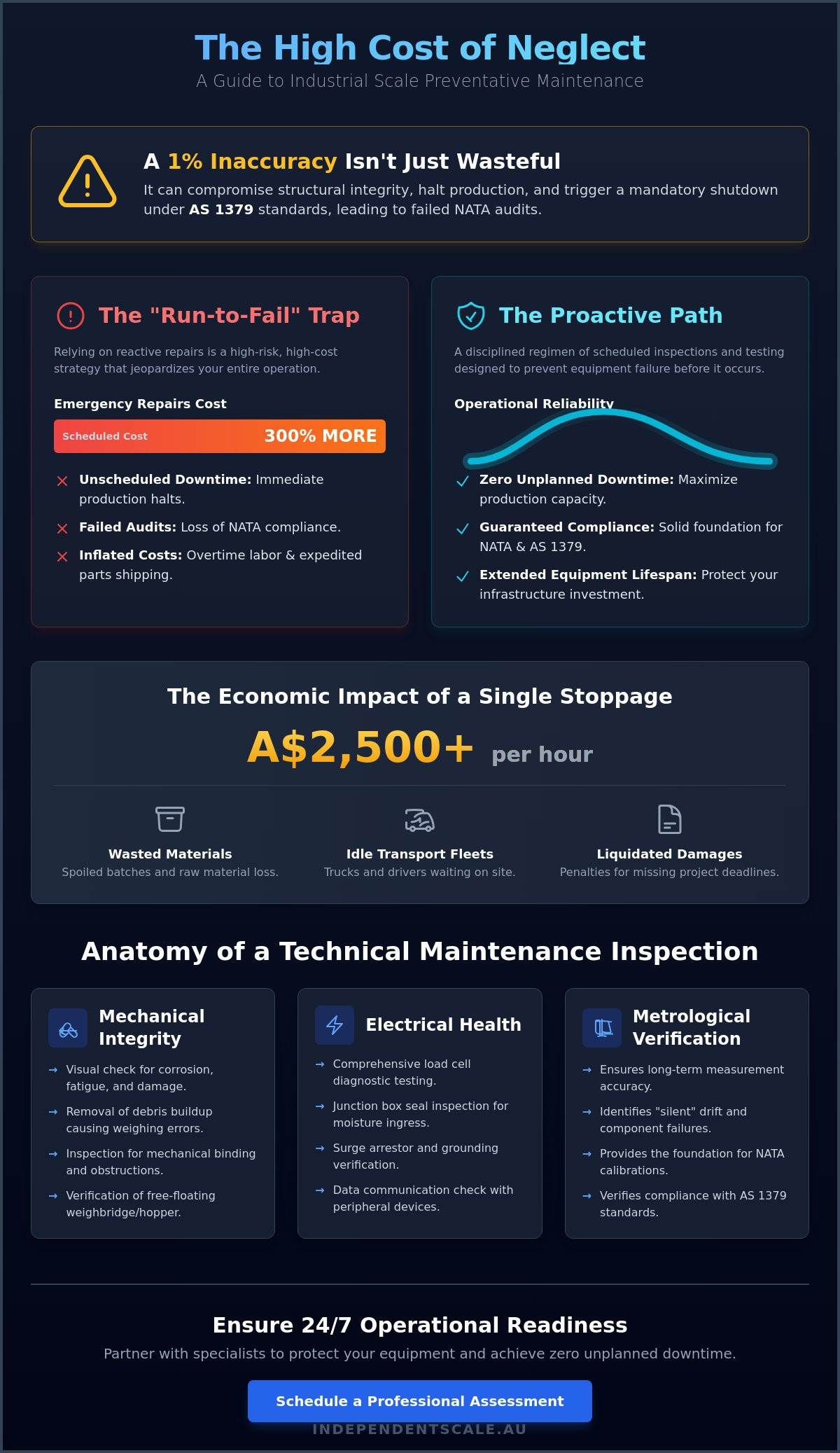
A 1% inaccuracy in your batching system doesn't just waste material; it can compromise the structural integrity of an entire project and trigger a mandatory shutdown under AS 1379 standards. With over 30 years of experience servicing 98% of concrete plants across Sydney, we've seen how unscheduled downtime leads to immediate production halts and failed NATA audits. Implementing a rigorous program for preventative maintenance for industrial scales is the only way to mitigate these risks before they impact your bottom line. You know that precision is not a one-time event but a continuous requirement for operational success.
Reliable data is the backbone of your operation, yet maintaining accuracy across thousands of weighing cycles is a constant technical challenge. This guide explains how a structured service schedule ensures your equipment remains NATA-compliant and operationally sound. You'll learn the technical requirements for AS 1379 compliance, the critical role of protecting load cells from environmental wear, and the specific steps required to achieve zero unplanned downtime. We provide a methodical breakdown of calibration frequencies and diagnostic checks that extend the lifespan of your weighing infrastructure and ensure continuous reliability.
Key Takeaways
- Understand why reactive "run-to-fail" repairs cost significantly more than scheduled servicing and how to protect your equipment from avoidable downtime.
- Discover the essential technical steps for effective preventative maintenance for industrial scales, including visual structural assessments and mechanical hygiene protocols.
- Learn how rigorous maintenance routines ensure compliance with AS 1379 standards and provide the necessary foundation for successful NATA-accredited calibrations.
- Develop a tiered maintenance schedule that balances daily operator visual checks with thorough monthly internal inspections for maximum reliability.
- Identify the critical role of professional maintenance partnerships in maintaining 24/7 operational readiness across high-capacity Australian industrial sites.
What is Preventative Maintenance for Industrial Scales?
Preventative maintenance (PM) for high-capacity weighing systems is a disciplined regimen of scheduled inspections, adjustments, and testing designed to prevent equipment failure. It moves beyond simple cleaning; it involves a systematic technical review of the mechanical, electrical, and metrological components of a scale. In the Australian industrial sector, many facilities fall into the "Run-to-Fail" trap. Relying on reactive repairs is a high-risk strategy; industry data indicates that emergency repairs typically cost 300% more than scheduled maintenance due to expedited shipping for parts, overtime labour rates, and lost production capacity. A robust program for preventative maintenance for industrial scales distinguishes between three critical areas. Mechanical maintenance focuses on the physical integrity of mounts, check rods, and weighbridge structures. Electrical testing examines the health of load cells, summing circuits, and surge arrestors. Finally, metrological verification ensures the system remains accurate. The Intersection of Maintenance and Calibration is where technical reliability meets legal metrology. This technical foundation is essential for maintaining AS 1379 compliance and meeting the rigorous documentation requirements of ISO/IEC 17025.The Core Objectives of a Maintenance Program
The primary goal is ensuring measurement traceability and accuracy over the long term. Industrial environments are harsh; vibration, temperature fluctuations, and debris accumulation cause gradual drift that standard operations might not detect. PM identifies "silent" component failures, such as a single failing load cell in a multi-cell system, before it stops production entirely. Furthermore, these checks protect the structural integrity of hoppers and silos by identifying corrosion or binding in the weighing assembly that could lead to catastrophic structural failure or inaccurate batching.Economic Impact: Maintenance vs. Downtime
The financial consequences of equipment failure are severe. For a concrete batching plant in Sydney or Melbourne, the hourly cost of a total stoppage can exceed A$2,500 when factoring in wasted materials, idle transport fleets, and liquidated damages on Tier 1 infrastructure projects. Implementing preventative maintenance for industrial scalesTechnical Components of a Scale Maintenance Inspection
Effective preventative maintenance for industrial scales requires a systematic approach to both physical and electronic components. A standard inspection begins with a visual structural assessment to identify corrosion, structural fatigue, or debris accumulation. In high-output environments like concrete batching plants, material buildup around hopper scales often leads to significant weighing errors. Even 5kg of dried concrete on a 2000kg aggregate hopper creates a persistent offset that compromises AS 1379 compliance. Technicians must ensure that the weighbridge or scale platform is completely free-floating and unobstructed.
Professional technicians examine the mechanical hygiene of the system, focusing on the clearance between moving parts and the frame. We verify that peripheral equipment, including printers, remote displays, and transmitters, communicates correctly with the primary indicator. This ensures data integrity across the entire site network and prevents communication failures during peak production hours.
Mechanical Integrity and Environmental Factors
Mechanical binding is a primary cause of non-linearity in weighing systems. This occurs when physical obstructions or misaligned tank mounts prevent the load cell from receiving the full gravitational force of the load. During a technical inspection, we check all load cell assemblies for freedom of movement. In Australian conditions, moisture ingress in junction boxes and surge arrestors is a common failure point. High humidity or high-pressure cleaning can degrade seals, leading to signal drift and erratic readings. Ensuring these enclosures remain airtight is vital for maintaining Professional Maintenance Solutions and long-term reliability.
Electrical and Signal Diagnostics
The electrical health of a scale is determined by the consistency of the millivolt (mV) output from each individual load cell. Technicians use high-precision multimeters to test for balance across the summing circuit. If one cell in a four-cell system shows a variance of more than 0.1mV/V, the entire platform's accuracy is compromised. We also inspect cabling for UV degradation, mechanical abrasion, or damage from rodent interference, which is prevalent in rural and industrial storage facilities. For more technical details on these components, refer to our Guide to Industrial Load Cells.
Regular technical audits prevent the 15% increase in downtime typically seen in neglected weighing systems. If your facility requires an audit to meet strict regulatory standards, consider our AS 1379 compliant calibration services to ensure your equipment remains within legal tolerances.
The Intersection of Maintenance and Calibration Compliance
Calibration confirms the accuracy of a weighing instrument at a specific point in time. However, calibration without prior maintenance is often a futile exercise. If a scale has worn load cell mounts, debris build-up in the pit, or corroded summing circuits, the calibration won't hold. Effective preventative maintenance for industrial scales ensures the hardware is mechanically sound before the NATA-accredited technician applies certified weights. This proactive approach prevents the scenario where a scale passes a test on Monday but drifts out of tolerance by Wednesday due to mechanical instability.
AS 1379 Compliance for Concrete Plants
In the Australian construction sector, AS 1379 specifies the requirements for the specification and supply of concrete. For the 98% of Sydney concrete plants serviced by ISS, adherence to this standard is non-negotiable. Compliance requires accuracy checks at intervals not exceeding 6 months, or more frequently if the plant's volume warrants it. These inspections must cover both the mechanical condition of the weighing hoppers and the accuracy of the scale indicators. You can find specialized support through our Concrete Batching Plant Calibration Services to meet these AS 1379 mandates. Documentation must be exhaustive; it should prove that every batching component remains within the permitted tolerances defined by the standard.
Traceability and NATA Documentation
There's a critical distinction between a basic service report and a NATA calibration certificate. A service report confirms that preventative maintenance for industrial scales was performed, detailing tasks like cleaning and parts replacement. A NATA certificate, issued under ISO/IEC 17025, provides a legally defensible, traceable link to national measurement standards. NATA accreditation is the gold standard for AU industry because it verifies the technical competence of the laboratory and the equipment used. Maintenance logs and calibration records protect your business through the collection of "as-found" and "as-left" data:
- As-found data: Records the accuracy of the scale before any adjustments are made. This is vital for audits to prove that products weighed since the last service were within specification.
- As-left data: Confirms the accuracy of the scale after maintenance and adjustment have been completed.
- Traceability: Ensures every measurement can be traced back to the Australian primary standard, which is essential for ISO 9001 quality management systems.
In legal disputes or product recalls, these records provide the objective evidence required to prove due diligence. Without a traceable maintenance history, a business has no way to verify that its weighing equipment was functioning correctly at the time of production. Maintenance logs act as a technical diary, demonstrating that the equipment has been managed according to manufacturer specifications and Australian regulatory requirements.
Creating an Industrial Scale Maintenance Schedule
A structured maintenance regime is the only way to ensure 100% operational uptime and strict regulatory compliance. Implementing consistent preventative maintenance for industrial scales follows a four-tier hierarchy designed to identify mechanical wear and electronic drift before they cause total system failure. This methodical approach protects your capital investment and ensures your data remains legally defensible.
Site staff must perform daily visual inspections. This involves checking for debris build-up under the scale platform and ensuring the indicator returns to zero after every batch. Weekly checks should include a basic shift test using a known weight to verify consistency across different sections of the scale. These tasks don't require technical expertise but are essential for catching physical obstructions early.
Tier 2: Monthly Internal Inspections and CleaningA deeper internal inspection is required every 30 days. Operators should clean the load cell assemblies and check for signs of moisture ingress in junction boxes. Removing accumulated dust or chemical residue prevents mechanical binding, which is a primary cause of weighing errors in harsh Australian industrial environments.
Tier 3: Quarterly Professional Preventative MaintenanceEvery 90 days, a qualified technician should conduct a technical audit. This service includes testing summing circuits, checking cable insulation for wear, and verifying the integrity of junction boxes and surge arrestors. This tier focuses on the electronic health of the system that operators cannot see.
Tier 4: Annual NATA-Accredited CalibrationThe final tier is a comprehensive diagnostic and calibration performed to ISO/IEC 17025 standards. This annual service ensures the system meets the strict requirements of AS 1379 for concrete batching or other relevant Australian standards. It provides the necessary certification for quality audits and trade-legal requirements.
Determining Your Maintenance Frequency
Maintenance intervals aren't universal across all industries. A scale in a clean, temperature-controlled warehouse requires less frequent intervention than a weighbridge in a humid, corrosive quarry. If your site processes over 450 weighments per day, monthly professional inspections are often necessary to maintain a ±0.1% accuracy tolerance. For lower-volume sites where ±1.0% is acceptable, bi-annual checks might suffice. Always adjust your schedule based on the severity of chemical exposure and dust levels to prevent premature component failure. High-vibration environments often require quarterly checks to ensure fasteners haven't loosened.
Operator Checklists for Daily Success
Empowering site staff with a clear checklist reduces the risk of unplanned downtime significantly. Daily checks should focus on the zero return after every batch. If the indicator shows a drift of more than 2 scale divisions when the platform is empty, it usually signifies a mechanical bind or an electronic fault. Staff should also inspect for scale binding caused by spilled material or stones wedged in the clearance gaps. These simple steps ensure the system remains reliable between professional service visits. You can find more details on equipment standards in our industrial weighing scale guide. Effective preventative maintenance for industrial scales starts with these small, disciplined actions at the operator level.
For expert assistance in establishing a compliant schedule, book a professional weighing scale calibration today.
Professional Maintenance Solutions for Australian Industry
Independent Scale Service (ISS) maintains a dominant presence in the Australian construction sector. Currently, 98% of Sydney concrete plants rely on ISS for their weighing requirements. This trust is built on technical proficiency and a deep understanding of AS 1379 standards. We provide comprehensive preventative maintenance for industrial scales that integrates supply, repair, and NATA-accredited calibration into a single, efficient workflow. Our service model prioritises uptime above all else. While scheduled visits form the backbone of long-term reliability, our 24/7 emergency support ensures that unexpected faults don't halt production during critical pours. We offer customised maintenance contracts designed for the specific throughput and environmental conditions of each plant. This isn't a one-size-fits-all approach. It's a technical partnership aimed at total system reliability and compliance.
Expertise in Heavy Industrial Weighing
Our technicians possess extensive experience servicing major industry players including Holcim, Boral, and Hanson. We understand the high-stakes nature of AU construction projects where batch accuracy is non-negotiable. Beyond basic mechanical checks, we provide advanced technical diagnostics for complex PLC and indicator systems. This technical depth allows us to troubleshoot communication errors between the scale and the batching software before they cause a system-wide shutdown. For specialised requirements, our team performs NATA-accredited Load Cell Calibration Services to ensure every component meets ISO/IEC 17025 requirements. We've spent over 30 years refining these processes for the harshest industrial environments.
The ISS Advantage: More Than Just a Sticker
Effective preventative maintenance for industrial scales requires more than a compliance label. ISS provides detailed post-inspection reports that offer actionable data on equipment health. We don't just fix what's broken; we identify wear patterns in summing circuits and surge arrestors. Our proactive load cell replacement strategies are designed to swap out degrading components before they fail during peak season. This data-driven approach prevents the high costs associated with emergency repairs and lost batches. We focus on maintaining the integrity of your entire production line, ensuring every measurement is precise and every record is audit-ready. If you need to discuss a tailored service plan for your facility, you can Contact Our Expert Team for a technical consultation.
Secure Your Site’s Operational Reliability and Compliance
Implementing a rigorous regime of preventative maintenance for industrial scales is the only way to ensure long-term accuracy and regulatory compliance. Technical inspections must cover critical components like summing circuits and surge arrestors to prevent sudden system failures. Relying on a reactive repair model leads to unbudgeted downtime and potential breaches of ISO/IEC 17025 standards. Independent Scale Service brings over 30 years of Australian industrial experience to every site inspection. We're NATA Accredited to ISO/IEC 17025, ensuring your weighing equipment meets the strictest national requirements. Our contract clients also benefit from emergency 24/7 support to keep operations running around the clock. This level of technical oversight is essential for heavy industries where measurement precision directly impacts the bottom line. Don't leave your site's productivity to chance when professional maintenance solutions are available. We'll help you build a schedule that keeps your facility compliant and functional every day of the year.
Request a Preventative Maintenance Quote for Your Site
Protect your equipment and maintain your competitive edge with a service schedule built for Australian conditions.
Frequently Asked Questions
How often should industrial scales undergo preventative maintenance?
Most industrial scales require professional servicing every 6 to 12 months to maintain operational reliability. For high-volume facilities like concrete plants operating under AS 1379, quarterly inspections are the industry standard to prevent measurement drift and ensure continuous accuracy. If your equipment runs 24/7, you'll likely need more frequent checks to avoid unexpected downtime.
Can my own team perform preventative maintenance on our scales?
Your team can manage basic housekeeping like clearing debris, but technical preventative maintenance for industrial scales must be performed by qualified technicians. Professionals use NATA-accredited test weights and specialised diagnostic tools to check summing circuits and load cell integrity. Internal staff often lack the specific equipment needed to identify electrical faults before they cause a total system failure.
What is the difference between scale maintenance and scale calibration?
Maintenance focuses on the physical health of the hardware, while calibration is the formal process of verifying accuracy through preventative maintenance for industrial scales. Maintenance includes cleaning, lubricating, and adjusting mechanical parts to prevent wear. Calibration compares the scale's output against a known standard to ensure it meets ISO/IEC 17025 requirements for legal and commercial accuracy.
What are the signs that my scale needs immediate maintenance?
Inconsistent readings or weights that "drift" while a load is stationary are primary indicators of a problem. If your scale fails to return to a zero balance or shows a variance of more than 0.5% between consecutive weighments, it's a sign of mechanical binding or load cell damage. You should call a technician immediately if you see physical corrosion on the mounts or frayed cabling.
Does preventative maintenance help with AS 1379 compliance?
Regular maintenance is a core requirement for meeting AS 1379 standards in the Australian concrete industry. This standard mandates specific accuracy tolerances for batching plants, and documented service logs provide the evidence required during NATA audits. Without these records, you can't prove your equipment meets the mandatory ±1% to ±3% tolerance bands required for different material types.
What happens if we skip maintenance and the scale fails an audit?
Failing a NATA or trade measurement audit can result in an immediate "Stop Use" order under the National Measurement Act 1960. This leads to total operational shutdown and potential fines that vary depending on the severity of the non-compliance. Beyond legal penalties, inaccurate scales lead to significant material wastage, which often costs businesses thousands of dollars in lost revenue every month.
How long does a typical professional maintenance visit take?
A standard maintenance visit for a single platform scale typically takes between 90 minutes and 3 hours. Larger systems, such as 18-metre weighbridges or complex batching plants with multiple load cells, often require a full 8-hour day to complete. We focus on being efficient to minimise your downtime, but we don't rush the critical electrical and mechanical diagnostics.
Can preventative maintenance extend the life of my load cells?
Routine inspections prevent the 25% of load cell failures that are caused by debris build-up and moisture ingress. By checking cable seals and surge protection during every visit, you avoid the high cost of replacing components that would otherwise fail prematurely. It's a small investment that protects the most expensive parts of your weighing system from environmental stress and electrical surges.
