


NATA Accredited Scale Calibration Sydney: Industrial Compliance Guide 2026
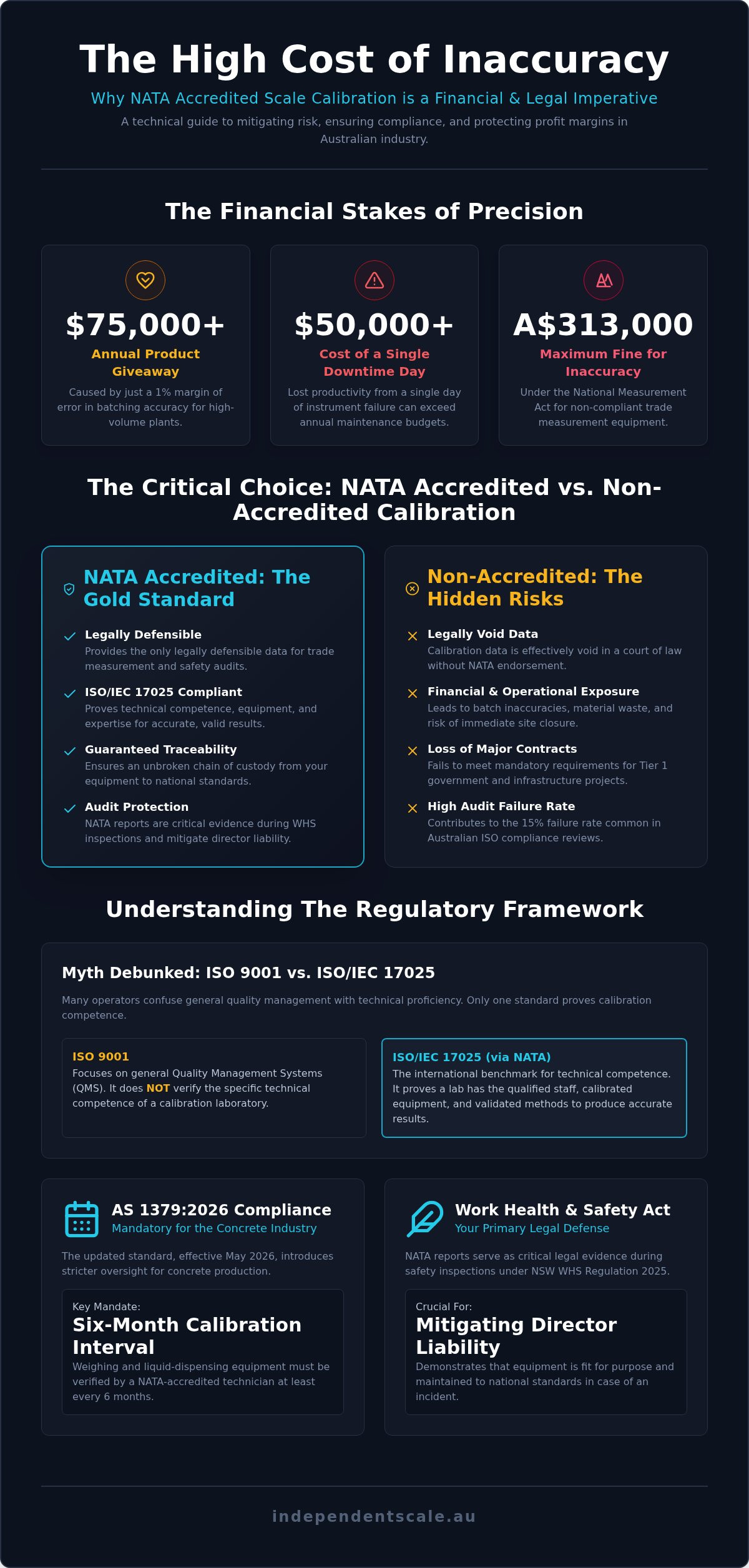
A 1% margin of error in batching accuracy can result in over $75,000 of product giveaway annually for high-volume Australian concrete plants. Precision is a legal and financial necessity, not a technical preference. Securing NATA accredited scale calibration Sydney is the most effective strategy to mitigate the risk of heavy fines under the National Measurement Act and prevent the material waste that erodes profit margins.
Industrial leaders understand that a single day of instrument downtime can cost an operation more than $50,000 in lost productivity. This guide ensures your facility achieves total regulatory compliance while minimising operational interruptions. We provide a technical framework for audit protection and certified measurement accuracy by reviewing the mandatory requirements of the Work Health and Safety Regulation 2025 and the updated AS 1379:2026 standard. You'll also learn how to address the 15% failure rate common in Australian ISO compliance reviews and the specific six-month calibration intervals required for modern batching plants.
Key Takeaways
- Identify specific legal obligations under the National Measurement Act 1960 to mitigate the risk of regulatory penalties and operational failure.
- Understand why NATA accredited scale calibration Sydney is a technical requirement for industries operating under ISO/IEC 17025 and AS 1379:2026 frameworks.
- Compare on-site mobile calibration with laboratory services to determine the most efficient logistics for maintaining high-capacity industrial equipment.
- Follow a comprehensive site preparation checklist to ensure technicians have safe, unobstructed access to hoppers, silos, and pits for accurate testing.
- Leverage specialized expertise in concrete batching plant calibration and load cell supply to protect against batching inaccuracies and material waste.
Why NATA Accredited Scale Calibration is Mandatory for Sydney Industry
Compliance with the National Measurement Act 1960 is a non-negotiable requirement for Sydney's industrial sector. In 2026, the legal landscape demands absolute traceability for every gram or tonne measured in trade. Standard calibrations often fail to meet the rigorous requirements of the National Association of Testing Authorities (NATA). Securing NATA accredited scale calibration Sydney provides the only legally defensible data for trade measurement and safety audits. It's the difference between a verified asset and a legal liability.
The financial implications of non-compliance are severe and immediate. Current penalties under the National Measurement Act can reach A$313,000 for inaccurate trade measurement. Many operators confuse ISO 9001 with technical proficiency. While ISO 9001 focuses on general quality management systems, it doesn't verify the specific technical competence of a laboratory. Only NATA accreditation to ISO/IEC 17025 proves a technician has the equipment, environment, and expertise to deliver accurate results. Without this, your calibration data is effectively void in a court of law.
Regulatory Compliance and NSW WHS Standards
The Work Health and Safety Regulation 2025 (NSW) places a heavy burden of proof on site operators. NATA reports serve as critical legal evidence during safety inspections in the Sydney construction and manufacturing sectors. These reports demonstrate that equipment is fit for purpose and maintained to national standards. This documentation is vital for mitigating director liability. If a measurement error leads to a structural failure or workplace accident, a certified calibration report is your primary defense. It proves you've taken every reasonable step to ensure equipment accuracy.
The Cost of Non-Accredited Calibration
Choosing non-accredited services introduces hidden operational risks that far outweigh any initial savings. Without the traceability provided by NATA accredited scale calibration Sydney, you face significant financial exposure. Standard checks lack the "uncertainty of measurement" data required for high-precision applications. Relying on unverified data leads to several critical failures:
- Inaccurate batching in concrete production, leading to product giveaway or structural weakness.
- Risk of audit failure and immediate site closure by NSW regulators.
- Material waste in chemical mixing due to unverified load cell performance.
- Loss of Tier 1 government contracts that mandate weighing scale calibration with NATA endorsement.
Traceability is the backbone of industrial integrity. Every test mass used must link back to the national primary standard held by the National Measurement Institute. Non-accredited providers cannot guarantee this chain of custody. For facilities requiring concrete batching plant calibration, falling outside the AS 1379:2026 accuracy requirements can stop a project instantly. Precision is the only way to protect your site from these avoidable costs.
The Technical Standard: ISO/IEC 17025 and AS 1379 Compliance
ISO/IEC 17025:2017 represents the international benchmark for the technical competence of testing and calibration laboratories. For Sydney industrial sites, this standard ensures that measurements aren't just numbers but are scientifically valid and reproducible. To understand the broader context of these requirements, it's helpful to review What is NATA Accreditation? and how it underpins Australian industrial integrity. Without this specific accreditation, a laboratory hasn't proven its ability to produce technically valid results, regardless of their other quality management certifications.
The release of AS 1379:2026 on May 22, 2026, introduced stricter oversight for the concrete industry. This standard supersedes the 2007 version and mandates that weighing and liquid-dispensing equipment be verified at least every six months. For high-volume producers, NATA accredited scale calibration Sydney is the primary method to ensure these assets meet the required tolerances. Precision in this area isn't optional; it's a core requirement for any business operating under modern infrastructure frameworks.
AS 1379 and Concrete Batching Accuracy
AS 1379:2026 specifies precise accuracy requirements to maintain structural integrity and batch consistency. Cement and other binders require a weighing accuracy of ±0.4%. Water measurement must remain within ±2.0%, while chemical admixtures allow for a tolerance of ±5.0%. Our Concrete Batching Plant Calibration Services are designed to meet these exact benchmarks through rigorous testing of hoppers, admixtures, and water meters. Adhering to these intervals prevents the 1% margin of error that can lead to significant annual product giveaway.
Traceability and ISO/IEC 17025 Framework
Traceability is the unbroken record of comparisons to international standards. This chain ensures that every test mass used on your site is linked back to the national primary standards held by the National Measurement Institute (NMI). NATA-endorsed reports provide a critical data point that standard service certificates lack: the Uncertainty of Measurement (UoM).
UoM represents the range within which the true value of a measurement lies. In high-precision industrial contexts, knowing this range is essential for risk management and quality control. A NATA report documents the specific procedures, technician training, and environmental conditions present during testing. This level of detail is a prerequisite for government-tier work and Tier 1 construction projects. If you're managing complex industrial assets, professional weighing scale calibration ensures your facility remains compliant with the latest 2026 standards and NATA accredited scale calibration Sydney protocols.
On-Site vs. Laboratory Calibration for Sydney Operations
Choosing the correct service delivery model is essential for maintaining operational continuity. For high-capacity industrial equipment, the logistics of transport often present a greater risk than the calibration itself. NATA accredited scale calibration Sydney providers typically offer mobile units to address these challenges. This approach eliminates the need to dismantle complex systems like silos or concrete batching plants, which would otherwise result in catastrophic downtime. A single day of instrument failure can cost an Australian operation more than $50,000 in lost productivity, making on-site response a financial priority.
The Australia's peak measurement body emphasizes that environmental factors like local gravity, structural vibration, and temperature influence measurement accuracy. On-site calibration ensures these variables are integrated into the final uncertainty calculation. While laboratory calibration is suitable for portable precision instruments, it's rarely viable for the heavy assets found in Sydney's manufacturing and construction hubs. By testing equipment in its installed state, you account for the structural interference that lab-based tests simply cannot replicate.
Logistical Benefits of Mobile Calibration
Mobile calibration units provide a 45% reduction in equipment turnaround time by performing tests at the point of use. This method is particularly effective for Load Cell Calibration and Repair, as it prevents the mechanical stress associated with shipping sensitive components. Technicians verify the entire weighing chain under actual load conditions, ensuring that interference from hoppers or silos is identified and corrected. This real-world verification is the only way to guarantee the ±0.4% accuracy required for cement batching under the AS 1379:2026 standard.
Calibration Method Comparison Table
The following table outlines the technical and logistical differences between service delivery models for Sydney metro and regional NSW operations.
| Feature | On-Site Mobile Service | Laboratory Calibration |
|---|---|---|
| Response Time | 24/7 availability for Sydney metro | Scheduled intake; 3-7 day lead times |
| Asset Type | Silos, Hoppers, Concrete Plants | Force gauges, portable test weights |
| Downtime | Minimised via scheduled site visits | Extended; requires backup equipment |
| Traceability | NATA endorsed with UoM | NATA endorsed with UoM |
Scheduling calibration for 24/7 industrial facilities requires a strategic approach. High-volume operations should utilize mobile services during planned maintenance windows to avoid the productivity loss associated with instrument failure. For Sydney-based clients, responsive mobile units provide the necessary agility to maintain compliance without halting production lines. If your facility operates under the ISO/IEC 17025 framework, NATA accredited scale calibration Sydney remains the only method that provides the necessary legal and technical assurance for your weighing assets.
Site Preparation Checklist for NATA Calibration Technicians
Efficiency during a site visit directly impacts your operational bottom line. Proper preparation ensures your NATA accredited scale calibration Sydney is completed without unnecessary delays or technical errors. Measurement accuracy depends on the physical state of the equipment; even minor debris on a load cell can introduce a significant measurement bias. Site managers must ensure that technicians have immediate, safe access to all weighing components, including those located in pits or at height on silos. We recommend gathering all previous calibration reports and equipment manuals before the technician arrives to streamline the verification process.
Physical Equipment Preparation
Physical readiness is the foundation of a successful audit. Technicians cannot provide an accurate assessment if the hardware is fouled by industrial waste or mechanically obstructed. Follow these three steps to prepare your equipment:
- Step 1: Isolate the weighing equipment from all power sources and mechanical interference. This prevents accidental activation during testing and ensures the scale is only measuring the applied test masses.
- Step 2: Clean all load cell mounting points and shackle pins. Build-up of concrete, dust, or grease creates mechanical binding, which prevents the load cell from deflecting correctly under weight. This is vital for hopper calibration service accuracy.
- Step 3: Ensure test weight access paths are clear and unobstructed. Technicians require a flat, stable surface to move heavy test masses to the equipment. For silo and hopper systems, this means clearing the area directly beneath the vessel.
Administrative and Safety Requirements
Safety and documentation are equally critical for compliance. Technicians cannot begin work without proper clearance and a stable environment. All site-specific safety inductions should be coordinated before the technician's arrival to prevent operational downtime. Excessive wind or vibration from nearby machinery can also destabilize readings during NATA accredited scale calibration Sydney, increasing the uncertainty of measurement. To ensure your site meets all technical requirements, consult our detailed guide on Preparing Your Equipment for NATA Calibration. If your facility is ready for verification, you can book your Sydney industrial calibration today to maintain full compliance with WHS 2025 standards.
Independent Scale Service: Sydney’s Authority in NATA Accredited Calibration
Independent Scale Service (ISS) delivers the technical proficiency required for Sydney’s most demanding industrial environments. With 98% of concrete plants in the Sydney metropolitan area relying on our technicians, we're the primary authority for NATA accredited scale calibration Sydney. Our expertise isn't limited to simple verification; we provide a complete lifecycle of support for weighing infrastructure, from initial supply to complex diagnostics and repair. We understand that in heavy industry, precision is the only protection against the high costs of material waste and regulatory penalties.
Our team possesses an intimate understanding of the AS 1379:2026 and ISO/IEC 17025:2017 standards. This knowledge ensures your facility doesn't just meet a minimum requirement but operates at peak efficiency. We prioritize reliability and technical competence, providing a no-nonsense service model that focuses exclusively on solving critical business problems. Responsiveness is a core differentiator. We recognize that instrument failure can cost upwards of $18,000 per hour for major infrastructure projects. Our mobile field technicians are available 24/7 to provide immediate support, ensuring your Sydney operations remain compliant and productive.
Specialised Industrial Weighing Solutions
We provide comprehensive support for every component of your weighing system. Our technicians are specialists in the diagnostic and repair of high-capacity assets, ensuring that your data remains legally defensible under the National Measurement Act. Our solutions include:
- Expertise in tank and silo weighing assemblies to ensure accurate inventory management and batch consistency.
- Advanced diagnostics for junction boxes and surge arrestors to prevent electrical failures from compromising measurement data.
- Supply of high-quality industrial indicators and displays designed for durability in harsh Sydney construction and manufacturing environments.
- Specialized force gauge calibration and load cell repair services to maintain the integrity of your testing equipment.
Booking Your Sydney Calibration Service
Requesting a technical site assessment in the Sydney metro area is the first step toward total audit protection. We develop customized maintenance schedules for high-volume operations to ensure that the six-month intervals mandated by AS 1379:2026 are never missed. Our methodical approach guides you from a general compliance need to a specific, evidence-based solution. By partnering with a seasoned expert, you minimize equipment downtime and secure the certified accuracy required for Tier 1 project participation. Contact Independent Scale Service for NATA Accredited Calibration in Sydney to schedule your next verification and secure your site's compliance status.
Securing Your Industrial Compliance for 2026 and Beyond
Maintaining regulatory integrity requires more than basic equipment checks. Adhering to the NATA accredited scale calibration Sydney protocols outlined in this guide is the most effective way to protect your operation against the $313,000 penalties associated with the National Measurement Act. By prioritizing ISO/IEC 17025 standards and the updated six-month verification intervals of AS 1379:2026, you ensure your data is legally defensible and your batching remains precise. Mobile service units eliminate the logistical risks of transport, providing the necessary responsiveness to keep your production lines moving without interruption.
Independent Scale Service remains the trusted authority for heavy industrial and construction sectors. As specialists in AS 1379 compliance with mobile service across Sydney and regional NSW, we provide the technical expertise necessary to solve your most critical measurement problems. Don't let inaccurate data or expired certifications threaten your site's productivity or legal standing. Request a NATA Accredited Calibration Quote for Your Sydney Site today to confirm your equipment's accuracy. Our methodical approach ensures your facility stays ahead of evolving standards while minimizing operational downtime.
Frequently Asked Questions
What is the difference between NATA and non-NATA accredited calibration?
NATA accreditation to ISO/IEC 17025 proves a laboratory's technical competence and specific expertise in precision measurement. While non-NATA checks might verify that a scale is functioning, they don't provide the legally defensible Uncertainty of Measurement data required for trade. NATA reports ensure every test mass is traceable to national primary standards, which is a non-negotiable requirement for government-tier work and high-precision Sydney industrial sites.
How often should industrial scales be calibrated for AS 1379 compliance?
The AS 1379:2026 standard mandates that all weighing and liquid-dispensing equipment in concrete batching plants be verified for accuracy at least every six months. Adhering to this interval is essential for maintaining the required ±0.4% accuracy for cement and binders. High-volume operations in Sydney often schedule more frequent checks to prevent the 1% margin of error that causes significant annual product giveaway and financial loss.
What are the penalties for using uncalibrated scales for trade in Sydney?
Under the National Measurement Act 1960, the maximum penalty for using inaccurate weighing equipment for trade can reach A$313,000 in 2026. Beyond these direct financial fines, Sydney businesses face the risk of immediate site closure under WHS 2025 regulations and the permanent loss of Tier 1 construction contracts. Certified NATA accredited scale calibration Sydney provides the necessary audit protection to mitigate these severe regulatory and operational risks.
Can load cells be calibrated on-site at a concrete batching plant?
Load cells are regularly calibrated on-site using specialized mobile units. This method is technically superior for concrete batching plants because it tests the entire weighing chain under actual operational loads and environmental conditions. On-site verification identifies mechanical interference from hoppers or silos that laboratory testing cannot replicate. This responsive approach reduces equipment turnaround time by 45% or more, ensuring your facility maintains total compliance without halting production.
What documentation is included in a NATA calibration report?
A comprehensive NATA report includes the calculated Uncertainty of Measurement, which defines the range within which the true value lies. It also documents the specific environmental conditions, technician training, and equipment serial numbers used during the session. Crucially, it provides an unbroken record of traceability to national primary standards held by the National Measurement Institute. This detailed documentation serves as essential legal evidence during safety audits and ISO compliance reviews.
Does ISO 9001 certification replace the need for NATA accreditation?
ISO 9001 certification doesn't replace NATA accreditation because it only focuses on general quality management systems rather than specific technical competence. While ISO 9001 ensures a business follows consistent processes, NATA accreditation to ISO/IEC 17025 verifies that a laboratory has the equipment and expertise to deliver scientifically valid results. For legally defensible measurement data in the Sydney construction sector, NATA accreditation is the only recognized standard for technical proficiency.
How long does a typical NATA accredited scale calibration take?
A standard NATA accredited scale calibration Sydney session typically takes two to four hours per instrument, depending on the complexity of the asset. Complex concrete batching plants require additional time to verify multiple hoppers, chemical admixtures, and water meters against AS 1379:2026 benchmarks. Our mobile technicians prioritize efficiency and responsiveness to minimize your site's downtime, often performing calibrations during planned maintenance windows to avoid any loss in productivity.
Are NATA calibration services available for regional NSW sites?
Independent Scale Service provides NATA accredited calibration across the Sydney metropolitan area and all regional NSW sites. Our mobile field technicians are equipped to perform on-site testing for silos, hoppers, and load cells at remote industrial facilities. This localized service model eliminates the risks and costs associated with transporting high-capacity weighing equipment. We're committed to providing 24/7 availability to ensure that regional operations maintain the same high compliance standards as city-based sites.
