


NATA Accredited Calibration in Sydney: The 2026 Compliance Guide for Industry
A "traceable" calibration certificate is often the single point of failure that results in a failed ISO/IEC 17025 audit for Sydney industrial facilities. You already know that precise weighing is the backbone of your production, yet the technical distinction between basic servicing and NATA accredited calibration Sydney can remain dangerously unclear. This risk often leads to costly equipment downtime or, worse, a total breach of AS 1379 compliance during a surprise inspection. With over 30 years of experience servicing 98% of concrete plants across Sydney, we understand the pressure of maintaining these rigorous standards.
This guide delivers the technical roadmap to master NATA accreditation and ensure your weighing results are legally defensible through 2026. You'll learn how to secure compliant results that pass any third-party audit while maintaining your facility's operational rhythm. We break down the specific ISO/IEC 17025 standards and provide a clear framework for eliminating the confusion between traceable and NATA-endorsed certificates. This is the exact methodology required to protect your facility from the high costs of non-compliance and unplanned outages.
Key Takeaways
- Understand the critical distinctions between ISO/IEC 17025 and AS 1379 to ensure your facility meets mandatory 2026 industrial compliance standards.
- Learn how to secure professional NATA accredited calibration Sydney services tailored specifically for the localized requirements of the construction and manufacturing sectors.
- Identify the specific operational risks and legal scenarios where NATA-accredited results are required over standard traceable calibration.
- Utilise a technical on-site preparation checklist to streamline inspections and ensure power stability and equipment access before a technician arrives.
- Discover how to minimise costly downtime by leveraging 24/7 emergency support from experts who service 98% of Sydney’s concrete batching plants.
Understanding NATA Accredited Calibration for Sydney Industries
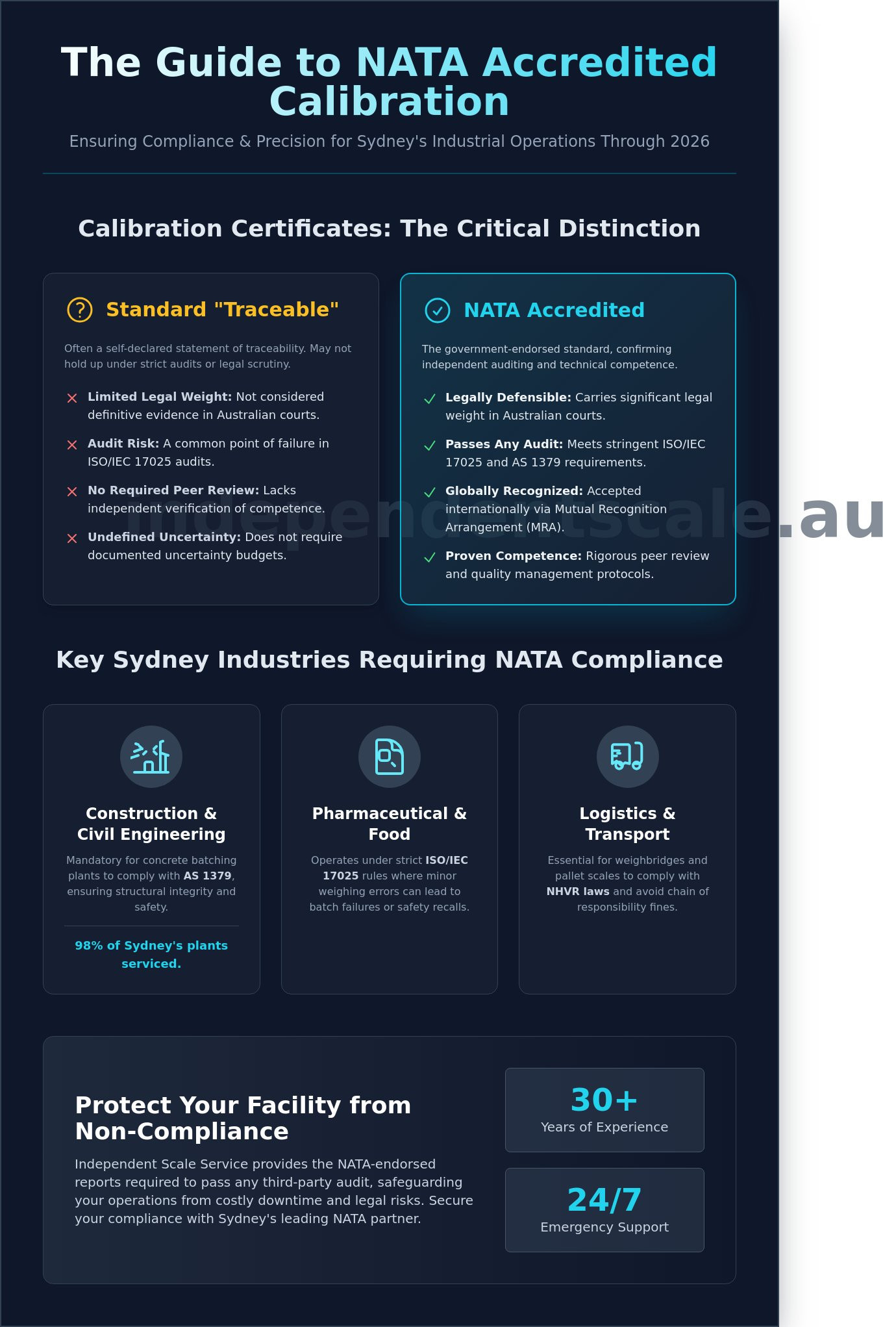
NATA (National Association of Testing Authorities) acts as the sole government-appointed body for laboratory accreditation in Australia. For industrial operators, securing NATA accredited calibration Sydney isn't just a preference; it's a fundamental requirement for maintaining legal and technical compliance. While many providers claim their equipment is "traceable to national standards," this is often a self-declared statement. NATA accreditation confirms that a facility has been independently audited and meets the stringent requirements of ISO/IEC 17025. This distinction is vital during high-stakes audits or legal proceedings. A NATA-endorsed certificate carries significant legal weight in Australian courts, providing definitive evidence that measurement data is accurate and technically sound.
The difference between standard calibration and NATA-endorsed service involves the level of oversight. Standard "traceable" calibrations don't require the same rigorous peer review or documented uncertainty budgets. In contrast, NATA-accredited providers must demonstrate a high level of technical competence and adhere to strict quality management protocols. For Sydney businesses, using a localized accredited service ensures that equipment remains compliant with Australian standards while minimizing the downtime associated with transporting sensitive instruments long distances. Independent Scale Service (ISS) brings over 30 years of experience to this process, ensuring that every report meets the exacting demands of NSW regulators.
The Role of NATA in the Australian Quality Infrastructure
NATA is a central pillar of the Australian standards and conformance framework. It maintains a formal partnership with the National Measurement Institute (NMI) to ensure all industrial measurements align with national primary standards. Through the Mutual Recognition Arrangement (MRA), NATA-endorsed reports are recognized globally, which is essential for Sydney manufacturers exporting products to international markets. NSW regulators specifically look for the NATA logo on weighing reports to verify that the testing was performed by a competent, accredited laboratory. This logo functions as a universal stamp of authority, confirming that the calibration process is transparent and repeatable.
Key Industries in Sydney Requiring Mandatory NATA Calibration
Several sectors in the Greater Sydney region face mandatory compliance requirements that dictate the use of NATA-accredited services. These include:
- Construction and Civil Engineering: Concrete batching plants must comply with AS 1379. This requires precise hopper calibration service to ensure structural integrity. ISS currently services 98% of concrete plants across Sydney to meet these standards.
- Pharmaceutical and Food Manufacturing: These industries operate under strict ISO 17025 requirements where even minor weighing errors can lead to batch failures or safety risks.
- Logistics and Transport: Accurate weighing scale calibration for weighbridges and pallet scales is essential to comply with National Heavy Vehicle Regulator (NHVR) laws and avoid significant fines.
Maintaining NATA accredited calibration Sydney ensures that these industries avoid the costs of non-compliance. When a report features the NATA emblem, it tells auditors and clients that the measurements are beyond reproach. This level of certainty is critical for high-volume manufacturing and infrastructure projects where accuracy is the primary driver of safety and profitability.
Technical Standards: ISO/IEC 17025 and AS 1379 Explained
Industrial accuracy isn't a matter of opinion. It relies on adherence to specific, rigorous frameworks that dictate how equipment must perform under load. In Australia, the two primary benchmarks are ISO/IEC 17025 and AS 1379. These aren't interchangeable. Each serves a distinct purpose in ensuring your weighing systems meet regulatory and safety requirements.ISO/IEC 17025: More Than Just Accuracy
ISO/IEC 17025 is the global standard for testing and calibration laboratories. While ISO 9001 focuses on general management systems, ISO/IEC 17025 requires proof of technical competence. It's the difference between having a tidy office and having a technician who understands the physics of load cell deflection. The National Association of Testing Authorities (NATA) provides the accreditation that verifies a laboratory's ability to produce precise, repeatable results. Without this accreditation, a calibration report lacks the legal weight required for high-stakes industrial applications. For a deeper look at how these standards impact your operations, consult our calibration services guide.AS 1379 Compliance for Sydney Concrete Plants
For the construction sector, AS 1379 is the mandatory standard for the specification and manufacture of concrete. This standard is critical for Sydney concrete batching plant operators. It mandates strict tolerances for the weighing of cement, water, and aggregates. Key requirements under AS 1379 include:- Gravimetric Method Calibration: Weighing systems must be calibrated using physical weights, not just electronic simulation.
- Mandatory Intervals: Scales must undergo testing at intervals not exceeding 12 months, or more frequently if the plant's output is high.
- Accuracy Limits: Aggregate scales must maintain accuracy within 2% of the batch weight, while cement and water scales must stay within 1%.
The Role of Uncertainty of Measurement
Every measurement has a margin of doubt. In NATA accredited calibration Sydney, this is quantified as "Uncertainty of Measurement." It's a statistical value that tells you the range within which the true value lies. If a scale shows 1,000kg with an uncertainty of 1kg, the actual weight could be anywhere from 999kg to 1,001kg. Ignoring uncertainty leads to cumulative errors in batching. Over a year, a 0.5% error in a high-volume plant can result in tonnes of wasted material or, worse, structurally unsound concrete. Independent Scale Service builds these calculations into every report. We align our internal procedures with national benchmarks to ensure your results are legally defensible and technically sound. If your current certificates don't clearly state the uncertainty values, it's time to review your calibration provider.Choosing Between NATA and Standard Traceable Calibration
Deciding between NATA and standard traceable calibration depends on your regulatory environment and the level of risk your facility manages. While standard calibration is often less expensive, it lacks the formal endorsement required for high-risk or trade-legal applications. For businesses requiring NATA accredited calibration Sydney, the extra investment covers a rigorous assessment of the laboratory's technical competence under ISO/IEC 17025. Standard certificates confirm a reading at a specific point in time, but they don't always provide the calculated measurement uncertainty necessary for high-precision industrial processes. These NATA-endorsed reports provide a legal safeguard by ensuring all measurements are traceable to national standards maintained by the National Measurement Institute (NMI).
The long-term ROI of NATA-endorsed reports is found in liability reduction. In the event of a structural failure or a commercial dispute, a NATA certificate serves as definitive evidence of due diligence. Many Australian insurers now offer lower premiums to facilities that exclusively use NATA-accredited services, as it reduces the probability of undetected measurement drift. A standard certificate might satisfy a basic internal check, but it won't hold the same weight in a court of law or during a heavy-vehicle mass limit investigation.
- NATA Certificates: Include measurement uncertainty, environmental conditions, and a NATA corporate logo.
- Standard Certificates: Often only list "as found" and "as left" data without a formal uncertainty budget.
- Compliance: NATA is mandatory for AS 1379 concrete production and most export contracts.
Risk Assessment: When "Traceable" is Sufficient
Standard traceable calibration is often sufficient for internal reference scales used to monitor non-critical inventory. If a measurement error doesn't impact safety, product quality, or legal trade, the lower cost of standard service is justifiable. However, if you're operating in a Sydney facility where a 0.5% error in a batching scale could lead to a A$60,000 product recall, the risk of non-accredited service is too high. You should consult with a specialist on weighing scale calibration to map out which assets require the highest level of certification and which can remain on a standard schedule.
The Audit Trail: Preparing for Third-Party Inspections
NATA reports simplify the job of a quality auditor by providing a pre-verified chain of custody for all measurement data. When presenting non-NATA reports to NSW government inspectors, businesses often face delays because the inspector must manually verify the technician's qualifications and the master weights' traceability. This process is time-consuming and prone to failure. Because load cell accuracy is the foundation of site safety, auditors look for the NATA emblem as a "green light" for compliance. Without it, you risk non-conformance reports that can halt production for days.
Preparation Checklist for On-Site NATA Calibration in NSW
Successful NATA accredited calibration Sydney requires more than a simple booking. It demands a methodical preparation process to ensure compliance with ISO/IEC 17025 standards and to avoid costly delays. Sydney industrial sites present unique logistical challenges, from congested transport corridors to strict site induction protocols. Technicians require pre-arranged parking for heavy vehicles and immediate access to equipment to maintain the schedule. High-risk environments, such as concrete batching plants or chemical facilities, necessitate current Safe Work Method Statements (SWMS) and specific PPE, including high-visibility gear and steel-capped boots.
Technical readiness is equally vital. All weighing surfaces must be cleaned of debris or product buildup before the technician arrives. Power stability is a critical factor; fluctuating voltage can interfere with sensitive electronic components. Ensure that all systems are powered on and stabilized for at least 30 minutes prior to testing. This preparation ensures that the gravimetric method or force testing yields accurate, repeatable data without environmental interference.
Site Access and Environmental Controls
Precision is sensitive to external variables. Technicians must manage wind, vibration, and temperature fluctuations that can skew results. You must ensure clear access for heavy test weights and calibration vehicles. A pre-check of weighing equipment helps identify obvious mechanical faults. If a load cell is visibly damaged or a mounting is loose, these issues should be rectified before the NATA test begins to prevent a failure result. In Sydney’s industrial zones, nearby heavy machinery can cause ground vibration, so plan to pause conflicting operations during the calibration window.
Documentation and Staff Coordination
Efficiency depends on having documentation ready for inspection. This includes previous calibration certificates, equipment manuals, and maintenance logs. A designated site contact must be present who understands the plant’s operational flow and lockout/tag-out procedures. For force gauge testing, ensure all special purpose pins and shackles are accessible and in good condition. Having these components ready prevents delays in testing tension or compression accuracy. Clear communication between the site contact and the technician ensures that all AS 1379 requirements are met without compromising safety.
Minimising downtime is a priority for Sydney plants operating on tight production cycles. Scheduling calibration during planned maintenance windows or utilizing 24x7 emergency services ensures that compliance doesn't halt production. Independent Scale Service understands the urgency of these environments, currently servicing 98% of concrete plants across the Sydney metropolitan area. Proper preparation reduces the time a scale is "out of service," allowing your facility to return to full operational capacity faster.
Why Independent Scale Service is Sydney’s Leading NATA Partner
Independent Scale Service (ISS) has spent three decades refining industrial weighing standards across New South Wales. We currently service 98% of concrete plants within the Sydney metro area. This market dominance isn't accidental. It's the result of providing technical competence that meets the rigorous demands of AS 1379 and ISO/IEC 17025. When high-volume facilities face unexpected downtime, our 24/7 emergency support team responds to minimize the financial impact of production halts. We manage the entire lifecycle of weighing equipment, from the initial supply of tank and silo assemblies to the final NATA certification.
Our team provides a seamless path to compliance for Sydney businesses. We understand that a calibration certificate is only as good as the technical work behind it. By maintaining NATA accreditation to ISO/IEC 17025, we guarantee that all industrial weighing equipment we service meets both national and international benchmarks. This commitment to precision ensures that your facility avoids the legal and financial risks associated with inaccurate measurements or audit failures.
Expertise in Heavy Industrial Weighing
Specialization is the core of our operations. ISS focuses on the complex environments of concrete batching plants, hoppers, and large-scale industrial silos. Our technicians don't just read digital displays. They perform sophisticated in-house diagnostics for complex load cell and indicator faults. This technical depth is why Sydney's major infrastructure players, including Holcim, Boral, and Hanson, rely on us for their NATA accredited calibration Sydney requirements.
In-house diagnostic capabilities allow us to identify summing circuit issues or surge arrestor failures that generalist providers might miss. We utilize the gravimetric method for high-capacity systems, ensuring that even the largest silos maintain the tight tolerances required for modern construction materials. Our experience with Sydney's specific industrial landscape means we arrive on-site prepared for the unique challenges of your facility.
The ISS Advantage: More Than Just a Certificate
Predictive maintenance programs are a key differentiator for our clients. We don't wait for a system to fail or an audit to be scheduled. Our programs are designed to identify and rectify potential measurement drifts before they result in non-compliance. This proactive approach saves our clients thousands in potential rework and lost production time. It's a methodical strategy that prioritizes operational continuity.
Senior technicians at ISS offer direct access to years of field experience. You won't be dealing with entry-level staff who are unfamiliar with the nuances of AS 1379. Our experts understand the relationship between mechanical stability and electronic accuracy. Choosing ISS means securing a partner that views NATA accredited calibration Sydney as a critical component of your business's success rather than a mere administrative hurdle.
Book your NATA Accredited Calibration with Independent Scale Service today to ensure your facility meets every regulatory benchmark with absolute precision.
Secure Your 2026 Industrial Compliance Standards
Maintaining strict adherence to AS 1379 and ISO/IEC 17025 is a technical necessity for Sydney’s heavy industry. As we move toward 2026, the requirement for precision in gravimetric method calibration and load cell accuracy remains a non-negotiable operational baseline. Independent Scale Service provides the technical expertise required to navigate these rigorous standards, currently servicing 98% of Sydney concrete plants. Our status as a facility NATA Accredited to ISO/IEC 17025 ensures every measurement meets international benchmarks, effectively eliminating the risks associated with non-compliant weighing equipment.
Securing a reliable partner for NATA accredited calibration Sydney prevents costly downtime and regulatory discrepancies. With a 24/7 emergency response team and over 30 years of field experience, ISS handles the complexities of on-site verification so your facility stays productive. It's essential to verify your equipment’s accuracy before audit cycles begin to ensure continuous site certification. We look forward to supporting your site's ongoing technical accuracy and compliance needs.
Request a NATA Accredited Calibration Quote for Your Sydney Site
Frequently Asked Questions
What is the difference between NATA and ISO 17025 calibration?
NATA is the authority that grants accreditation, while ISO/IEC 17025 is the international standard used to evaluate a laboratory's technical competence. A NATA-endorsed report serves as formal evidence that the calibration process meets all ISO/IEC 17025 requirements. It's the highest level of weighing assurance available in Australia.
How often do I need NATA accredited calibration for my concrete plant in Sydney?
Concrete batching plants must undergo calibration every 6 months to remain compliant with AS 1379 standards. This biannual schedule ensures that all weighing elements, including cement and aggregate hoppers, maintain the precision required for high-grade concrete production. Skipping these 182 day intervals can lead to significant compliance failures during audits.
Can NATA calibration be performed on-site at my facility?
Yes, NATA accredited calibration Sydney services are almost always performed on-site to verify equipment in its actual operating environment. Technicians utilize mobile test units and certified weights to calibrate weighbridges, silos, and hopper scales without removing them from the production line. This on-site approach reduces downtime and ensures the equipment is accurate under real-world conditions.
Is NATA accreditation mandatory for all industrial scales in Australia?
NATA accreditation isn't mandatory for every scale, but it's essential for trade-legal applications and industries governed by AS 1379 or ISO 9001. The National Measurement Act 1960 requires specific accuracy levels for any scale used to determine price. Approximately 98% of Sydney's heavy industrial sites require NATA accredited calibration Sydney to satisfy their quality management systems.
What happens if my equipment fails a NATA calibration test?
If a scale fails, the technician issues a report stating the equipment is non-compliant and identifies the specific error margin. The scale must be adjusted, repaired, or recalibrated before it's returned to service. A NATA certificate is only issued once the device passes all tests within the strict tolerances defined by ISO/IEC 17025.
How long does a typical NATA calibration visit take for a batching plant?
A standard visit for a Sydney batching plant with 3 to 5 scales typically takes between 4 and 6 hours. This timeframe includes the setup of certified weights, incremental loading tests, and the completion of technical data sheets. Larger facilities with complex summing circuits or more than 6 scales may require a full 8 hour day.
How much more does NATA calibration cost compared to standard testing?
NATA calibration usually costs 20% to 40% more than a basic service check because of the rigorous documentation and equipment traceability required. This investment covers the technician's specialized training and the maintenance of NATA-certified reference standards. It's a necessary cost for businesses that need legally defensible results for regulatory compliance.
Does Independent Scale Service provide 24/7 emergency calibration in Sydney?
Independent Scale Service provides 24/7 emergency support to all industrial clients across the Sydney region. Technical teams respond to critical weighing failures at any hour to ensure production continues with minimal interruption. This service is vital for 24 hour concrete plants and logistics hubs that can't afford unscheduled downtime.
