


Mobile Weighbridge Calibration Melbourne: The 2026 Industrial Compliance Guide
Inaccurate bulk material measurements don't just skew your inventory; they expose your entire operation to the rigorous penalties of the updated National Measurement Act 1960. You understand that every minute of operational downtime during testing erodes your bottom line, yet non-compliance with Chain of Responsibility (CoR) regulations is a risk no Melbourne industrial site can afford to take. Securing a precise mobile weighbridge calibration Melbourne is a technical necessity that safeguards your revenue and legal standing simultaneously.
This guide provides the authoritative roadmap to mastering on-site calibration requirements for 2026. You'll learn how to maintain full NATA-certified compliance while ensuring minimal disruption to your site traffic. We'll examine the April 1, 2026 legislative updates to National Measurement Guidelines, the critical role of ISO/IEC 17025 standards, and the specific protocols required for legal-for-trade verification. By following this methodical approach, you can transition from reactive maintenance to a precise, compliant weighing infrastructure that stands up to NMI scrutiny.
Key Takeaways
- Learn how ISO/IEC 17025 and NATA accreditation function as the essential benchmarks for technical accuracy in industrial weighing.
- Understand the regulatory distinctions between routine maintenance and legal-for-trade verification enforced by the National Measurement Institute.
- Optimise your operational flow by scheduling mobile weighbridge calibration Melbourne directly at your site to reduce logistics bottlenecks.
- Master the technical requirements necessary to satisfy Chain of Responsibility obligations so you don't face significant non-compliance penalties.
- Discover how specialized load cell repair and component supply extend the service life of your industrial weighing infrastructure.
Understanding Mobile Weighbridge Calibration in Melbourne’s Industrial Sector
Mobile weighbridge calibration for Victorian industrial standards is the on-site verification and adjustment of heavy-capacity weighing systems using certified test masses to ensure alignment with National Measurement Institute (NMI) tolerances. Unlike smaller industrial scales that can be transported to a laboratory, industrial weighbridges require specialized mobile units equipped with high-capacity test masses and hydraulic lifting gear to perform testing at the point of operation. This on-site precision service is fundamental for Melbourne’s logistics hubs, where high-capacity weighing solutions must handle constant throughput without forcing vehicles to detour to external public weighbridges.
Melbourne’s industrial sector, stretching from the Port of Melbourne to the expansive Dandenong South distribution corridor, relies on these systems for bulk material transport and accurate billing. If a system is out of tolerance, the resulting measurement errors directly impact profit margins in quarries, recycling centers, and shipping ports. To understand the mechanical fundamentals of these systems, one should ask, What is a Weighbridge? technically speaking, it's a platform scale designed to weigh entire vehicles and their contents by measuring the force exerted on load cells. Regular mobile weighbridge calibration Melbourne services ensure these force measurements remain within legal-for-trade limits.
The Necessity of Accuracy in Heavy Industry
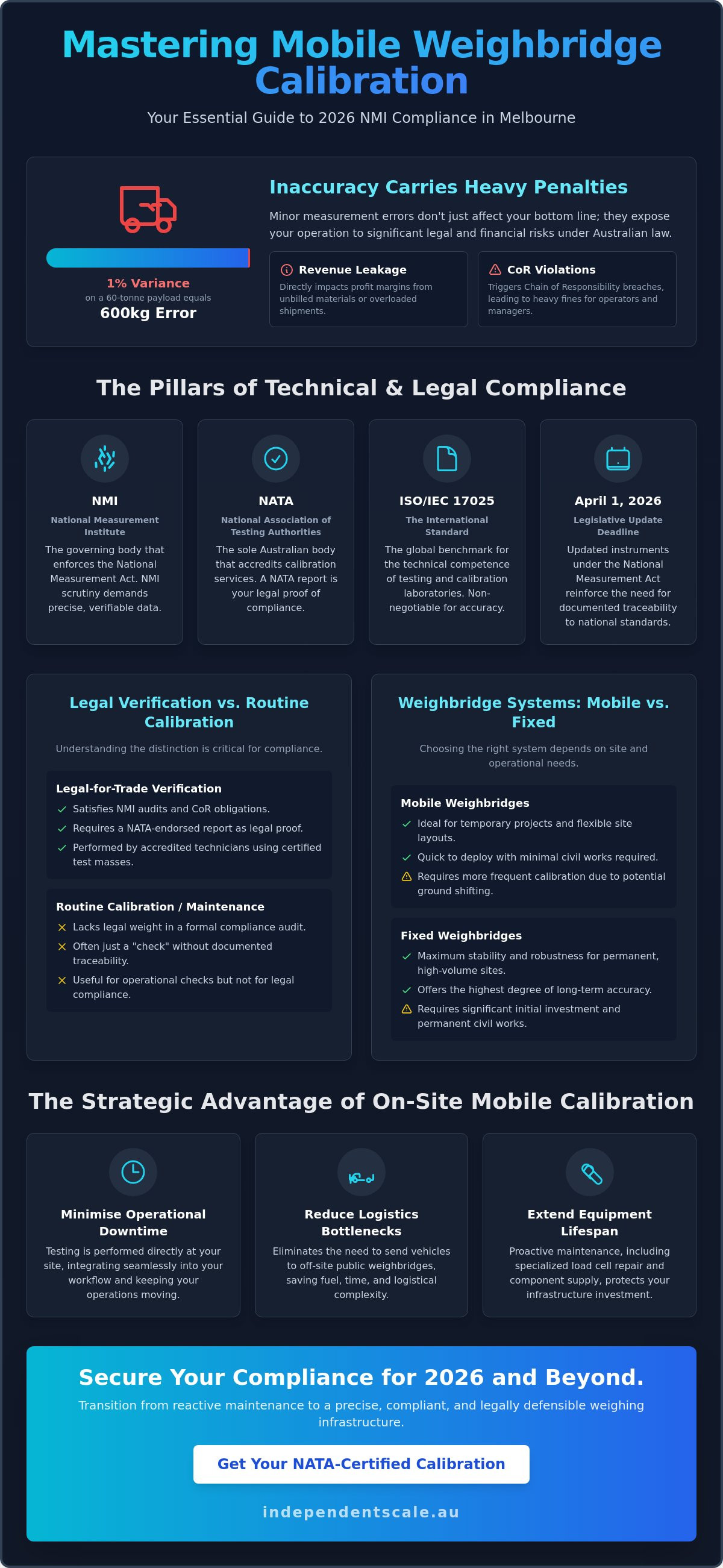
Measurement accuracy is the primary safeguard against revenue leakage and legal liability. In Melbourne’s industrial environments, environmental factors such as high humidity near the coast and heavy dust in inland quarries can degrade load cell calibration and sensitivity over time. Even a 1% variance on a 60-tonne payload results in 600kg of unbilled or overloaded material. This discrepancy compromises vehicle safety on Victorian roads and triggers Chain of Responsibility (CoR) violations that carry heavy financial penalties for operators and site managers alike.
Mobile vs. Fixed Weighbridge Systems
The choice between mobile and fixed systems depends on site longevity and operational flexibility. Fixed systems are typically in-pit or surface-mounted installations designed for permanent, high-volume traffic, offering maximum stability but requiring significant civil works. Mobile systems, featuring modular and portable designs, are ideal for temporary construction projects, short-term mining sites, or locations where infrastructure cannot be permanently altered.
Managing these types of remote or temporary environments involves more than just equipment calibration; ensuring the security of the site is equally vital. To see how solar-powered monitoring can protect your assets in off-grid locations, learn more about modern surveillance options.
Calibration challenges for mobile units often stem from the lack of a permanent concrete foundation. These systems are more susceptible to ground shifting and structural flexing, which necessitates more frequent mobile weighbridge calibration Melbourne interventions to maintain trade-legal status. While fixed units are robust, mobile systems offer the adaptability required for Melbourne’s rapidly evolving infrastructure projects, provided they are maintained with the same technical rigor as their permanent counterparts.
The Technical Standard: NATA Accreditation and ISO/IEC 17025
Technical proficiency in industrial weighing is defined by ISO/IEC 17025, the international standard for the competence of testing and calibration laboratories. For any facility requiring mobile weighbridge calibration Melbourne, this accreditation is the only guarantee that the service provider's equipment, staff, and methodologies meet rigorous global benchmarks. NATA (National Association of Testing Authorities) serves as the sole Australian accreditation body responsible for auditing these standards. Without a NATA-endorsed report, a calibration is merely a "check" that lacks the legal weight required to satisfy a formal compliance audit or a National Measurement Institute (NMI) inspection.
Effective April 1, 2026, the NMI has updated legislative instruments under the National Measurement Act 1960. These changes reinforce the necessity for documented traceability to national standards. Professional calibration utilizes certified test masses that are themselves calibrated against primary standards. This chain of traceability ensures that every kilogram recorded on your weighbridge is defensible in a court of law. Relying on uncertified weights or non-accredited technicians exposes your business to the risk of heavy fines and operational shutdowns during regulatory reviews.
ISO/IEC 17025: The Global Benchmark
Accreditation to ISO/IEC 17025 requires a laboratory to demonstrate technical competence and the ability to generate valid results. Key requirements include the calculation of measurement uncertainty and the maintenance of a comprehensive equipment calibration program. Independent Scale Service adheres to these stringent protocols during every mobile deployment, ensuring that environmental variables on-site don't compromise the integrity of the data. For a deeper understanding of these requirements, consult our Calibration Services Guide, which outlines the technical expectations for Australian heavy industry.
The NATA Audit Trail
Documentation is the core of industrial compliance. A NATA-endorsed report provides an indisputable audit trail that protects your business during legal disputes or insurance claims related to vehicle weights. These reports must include specific data points: the uncertainty of measurement, the traceability of the test masses used, and the environmental conditions at the time of testing. To maintain this accredited status, mobile weighbridge calibration Melbourne must be performed at regular intervals, typically annually or biannually depending on throughput and site conditions.
Compliance with these standards is supported by the Weighing Industry Association of Australia (WIAA), which advocates for high technical standards across the sector. If your current system hasn't been verified by an accredited technician recently, you should schedule a professional weighing scale calibration to ensure your equipment remains within legal tolerances. This proactive approach minimizes the risk of non-compliance and maintains the accuracy of your bulk material transactions.
Trade Verification vs. Routine Calibration: Ensuring Legal Accuracy
Industrial operators must distinguish between routine maintenance and legal trade verification to avoid significant regulatory exposure. While routine mobile weighbridge calibration Melbourne ensures your equipment remains precise for internal logistics, it doesn't automatically grant the legal right to use those measurements for financial transactions. Under the National Measurement Act 1960 and the National Trade Measurement Regulations 2009, any weighbridge used to determine the price of goods must be verified by a licensed technician. This distinction is critical for Victorian businesses following the April 1, 2026, updates to the National Measurement Guidelines, which replaced sunsetting standards with modernized compliance instruments.
The National Measurement Institute (NMI) serves as the regulatory authority overseeing Australian trade measurement laws for weighbridges. If you buy or sell bulk materials based on weight, your system must undergo formal verification. Using unverified scales for commercial billing is a breach of federal law. This can lead to heavy fines, the seizure of equipment, and the invalidation of commercial contracts. Verification acts as a legal shield, proving that your measurements meet the NMI's maximum permissible error (MPE) limits for trade use.
Legal-for-Trade Requirements
A weighbridge is deemed "legal-for-trade" only if it has a certificate of approval from the NMI and has been verified by a licensed service provider. During this process, the technician applies physical lead seals or digital security markers to the instrument’s indicator. These markers prevent unauthorized adjustments to the calibration settings. If these seals are broken during repair or maintenance, the system loses its trade-legal status until a new verification is performed. For a comprehensive breakdown of these technical requirements, see our Weighbridge Guide for the Australian industry.
Routine Calibration for Process Control
Routine calibration is a preventative strategy used for process control where trade verification isn't legally mandated. Even if you aren't billing clients directly by weight, maintaining a schedule for professional weighing scale calibration is vital for operational efficiency. Inaccurate measurements lead to overfilled hoppers, incorrect batching ratios, and wasted raw materials. Regular testing identifies drifting accuracy before it causes a system-wide failure. This proactive maintenance significantly extends the operational lifespan of high-quality load cells by identifying mechanical stress or environmental degradation early. Scheduling regular mobile weighbridge calibration Melbourne prevents the costly mid-season breakdowns that frequently plague high-throughput logistics sites.
Strategic Maintenance: Minimising Downtime in Melbourne Logistics
Melbourne’s logistics network, spanning from the Port of Melbourne to the industrial corridors of Dandenong South and Campbellfield, operates on tight margins where vehicle throughput is the primary metric of success. Coordinating mobile weighbridge calibration Melbourne within these high-traffic hubs requires a strategic approach to minimize operational bottlenecks. Moving heavy vehicle combinations to public weighbridges, which currently charge approximately $45 for a single weigh in the Melbourne area, is often inefficient. Performing calibration on-site allows for immediate verification without diverting fleet assets from their primary routes or incurring external weighing fees.
To maintain site throughput, industrial operators should schedule calibration during documented off-peak windows. This proactive scheduling ensures that the weighbridge is only offline when traffic volume is at its lowest, preventing the backlog of vehicles that can paralyze a distribution center. By integrating calibration into a preventative maintenance cycle, businesses avoid the urgency of emergency repairs that often occur at the most inconvenient times.
Chain of Responsibility (CoR) Compliance
Accurate weighing is a legal mandate under Victorian transport law. The Chain of Responsibility (CoR) framework dictates that all parties in the supply chain, including loaders, packers, and site managers, must ensure vehicles don't exceed mass limits. Calibration records serve as critical evidence that a business has taken reasonable steps to prevent overloading. In the event of a roadside inspection by the National Heavy Vehicle Regulator (NHVR), a NATA-endorsed calibration certificate proves that your on-site equipment was functioning within prescribed tolerances. This documentation is your primary defense against the significant fines associated with mass limit breaches.
Site Preparation Checklist
Efficiency during a mobile service visit depends largely on site preparation. A clear and prepared site allows the technician to deploy test masses quickly, reducing the total duration of the outage. Site managers should implement the following protocols before the mobile unit arrives:
- Clear all debris, mud, and standing water from the weighbridge deck and the surrounding pit area.
- Ensure a clear access path for the heavy test truck, removing any parked vehicles, pallets, or stock that might block the approach.
- Verify that the indicators and displays are functional and that power supply to the weighbridge is stable.
- Have a site supervisor ready to facilitate safety inductions and issue necessary work permits immediately upon the technician's arrival.
Adhering to these preparation steps ensures the mobile weighbridge calibration Melbourne process remains brisk and business-like. If your system requires technical attention beyond standard testing, ensure you engage experts for professional load cell calibration and repair to maintain site integrity.
Why Independent Scale Service is Melbourne’s Trusted Partner
Independent Scale Service has established a long-standing tenure within the Victorian industrial landscape, providing the technical competence required for complex measurement challenges. While national providers often offer broad support, our local technicians possess a specialized understanding of Melbourne’s specific regulatory environment and the logistical nuances of its industrial hubs. This expertise is essential for executing a precise mobile weighbridge calibration Melbourne that accounts for local environmental variables and site-specific operational constraints. Our personality is that of a seasoned expert: methodical, precise, and focused exclusively on solving critical business problems for industrial clients.
Our service model is built on NATA-accredited precision and strict adherence to AS 1379 standards. We don't just perform basic checks; we provide a methodical analysis of your entire weighing infrastructure. This includes specialized load cell repair and replacement, ensuring that every component of your weighbridge functions as a cohesive, accurate system. By maintaining this high level of technical rigor, we protect our clients from the revenue loss and legal liabilities associated with measurement drift and non-compliance with the updated National Measurement Act 1960.
Full-Spectrum Weighing Solutions
Technical requirements often extend beyond simple calibration to encompass full system upgrades and component integration. Our comprehensive approach includes the supply and installation of advanced indicators and displays, ensuring your data output is clear and legally defensible. For specialized sectors, we provide concrete batching plant calibration that meets the specific requirements of AS 1379. Our diagnostic expertise allows us to rapidly identify whether a system failure is rooted in an electrical fault or a mechanical misalignment, reducing the time spent on troubleshooting and increasing your site's total uptime.
Request Your Melbourne Calibration Service
Achieving full compliance for 2026 requires a partner who understands the urgency of industrial timelines. We operate a responsive service model designed to address urgent breakdowns and scheduled maintenance across the Melbourne metro area. To secure your site's operational integrity, you can request a tailored quote based on your specific capacity and throughput requirements. Ensure your facility is prepared for the April 1, 2026 legislative shifts by scheduling your mobile weighbridge calibration Melbourne with a technician who prioritizes accuracy and regulatory defensibility. Contact Independent Scale Service today to review your current calibration schedule and verify your equipment's NATA-accredited status.
Secure Your Operational Compliance for 2026
Maintaining precision in industrial weighing isn't just about technical accuracy; it's a fundamental requirement for legal and financial security. The transition to updated National Measurement Institute guidelines on April 1, 2026, necessitates a methodical approach to weighing infrastructure. By prioritizing NATA-accredited verification, you ensure that every measurement remains traceable and defensible under Victorian transport laws. Proactive site preparation and strategic scheduling further reduce the risk of unexpected downtime during high-throughput periods.
Implementing a rigorous mobile weighbridge calibration Melbourne schedule protects your revenue streams while satisfying the stringent demands of the Chain of Responsibility framework. Independent Scale Service provides the technical expertise required for high-stakes industrial environments. We are NATA accredited to ISO/IEC 17025 and recognized specialists in AS 1379 compliant concrete batching and industrial weighbridge systems. Precision is the foundation of site safety and commercial transparency.
Book Your NATA-Accredited Mobile Calibration in Melbourne Today to verify your system's accuracy and satisfy regulatory audits. Achieve total confidence in your weighing data and maintain your competitive edge in Melbourne's logistics sector.
Frequently Asked Questions
How often should a mobile weighbridge be calibrated in Melbourne?
Mobile weighbridges should undergo calibration every 6 to 12 months under standard operating conditions. High-volume industrial sites or those exposed to harsh environmental factors require more frequent testing to ensure accuracy. Regular intervals help prevent measurement drift and ensure your equipment remains compliant with National Measurement Institute (NMI) tolerances and Chain of Responsibility (CoR) requirements.
What is the difference between NATA calibration and a standard scale check?
NATA calibration is a formal process conducted to ISO/IEC 17025 standards; it provides a legally defensible certificate with calculated measurement uncertainty. A standard scale check is an informal verification of accuracy that lacks documented traceability to national standards. Only a NATA-endorsed report satisfies the rigorous requirements of a formal compliance audit or an insurance claim dispute.
Can you calibrate a weighbridge while the site is still operating?
The weighbridge must be taken completely offline during the calibration process to ensure the integrity of the test results. Technicians require exclusive access to the platform to apply heavy test masses and perform eccentricity and repeatability tests. Site traffic must be diverted to avoid interference with sensitive load cell adjustments and to maintain a safe working environment for the service team.
What documentation will I receive after a mobile calibration service?
Upon completion, you'll receive a comprehensive calibration report or a NATA-endorsed certificate. This documentation details the as-found and as-left data, the specific test masses used, and their traceability to national standards. These records are essential for your quality management system and serve as evidence of due diligence during regulatory inspections by the National Heavy Vehicle Regulator (NHVR).
Does my weighbridge need to be trade-verified for internal stock control?
Trade verification isn't legally required if the measurement is used solely for internal inventory or stock control. However, a regular mobile weighbridge calibration Melbourne service is still necessary to maintain process efficiency and avoid revenue loss from overfilled or underfilled loads. Verification is only mandatory when the weight directly determines the price of a commercial transaction or a public levy.
How long does a typical mobile weighbridge calibration take?
A typical mobile weighbridge calibration Melbourne service takes between 3 and 5 hours to complete. This duration depends on the capacity of the weighbridge, the number of load cells, and the ease of access for the test truck. Sites that are well-prepared with clean decks and clear access paths allow technicians to complete the testing and adjustment phases more efficiently.
What happens if my weighbridge fails the calibration test?
If a weighbridge fails, the technician will conduct a diagnostic assessment to identify the root cause, such as a faulty load cell or structural binding. Minor mechanical issues or indicator errors can often be corrected on-site during the visit. If significant repairs are needed, the system must be serviced and re-tested before it can be certified for continued industrial use.
Are your technicians licensed for trade verification in Victoria?
Independent Scale Service utilizes technicians who understand the specific requirements of the National Measurement Act 1960. While many calibrations are performed for process control, trade-legal verification must be conducted by a licensed verifier. You should always confirm that your service provider holds the appropriate NMI licensing if you require a formal verification mark for buying or selling goods by weight.
