


Load Cell for Tank Weighing Systems: The Complete Industrial Guide
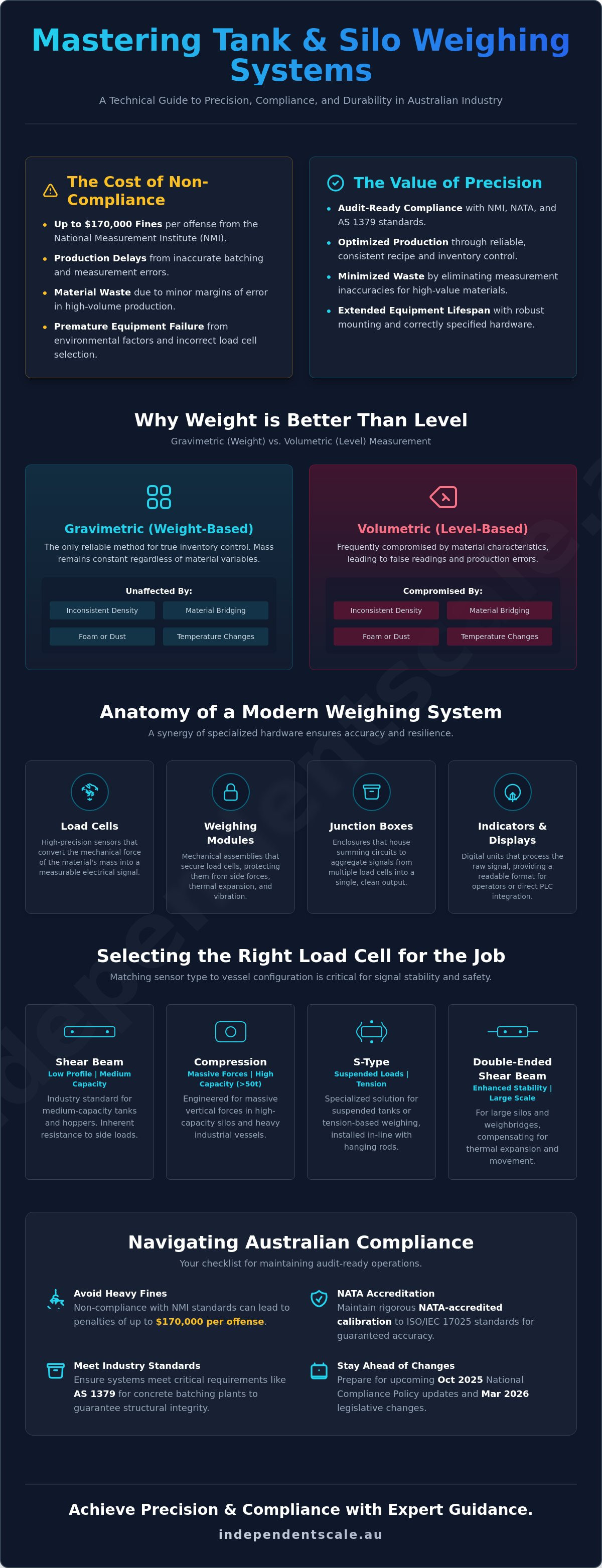
With National Measurement Institute (NMI) fines for non-compliance reaching up to $170,000 per offense, your measurement equipment is a critical risk management asset. You're likely aware that even a minor margin of error in a chemical silo or concrete batching plant leads to production delays and material waste. Selecting the wrong load cell for tank weighing systems often results in premature failure caused by environmental factors like high-pressure washdowns or constant vibration. Precision requires more than just a sensor; it demands a synergy between hardware, mounting assemblies, and rigorous technical standards.
This guide delivers the technical expertise required to master selection criteria and meet Australian compliance standards. You'll learn how to integrate robust mounting assemblies and maintain NATA-accredited calibration to ISO/IEC 17025 standards. We'll cover the latest October 2025 National Compliance Policy updates and the March 2026 legislative instrument changes. By the end of this article, you'll understand how to achieve high-accuracy gravimetric measurement that survives harsh industrial environments while ensuring your facility remains audit-ready and compliant with AS 1379.
Key Takeaways
- Learn to select the optimal load cell for tank weighing systems by evaluating vessel capacity and managing environmental stressors like thermal expansion.
- Discover why gravimetric measurement provides superior accuracy over volumetric methods for industrial materials with inconsistent densities.
- Understand the critical technical requirements for AS 1379 compliance and NATA-accredited calibration to ensure audit-ready operations.
- Gain insights into filtering mechanical noise and vibration using advanced signal conditioners to maintain measurement integrity during agitation.
- Implement robust mounting and installation strategies that extend the operational lifespan of weighing equipment in high-washdown or corrosive environments.
Understanding Load Cell Systems for Tank and Silo Weighing
A precision tank weighing system transforms a static storage vessel into a high-accuracy scale by integrating strain-gauge technology into the vessel's structural supports. A load cell for tank weighing systems acts as a transducer, converting the mechanical force of the material's mass into a measurable electrical signal. For those requiring a foundational overview of the physics behind these sensors, you can explore What is a Load Cell? to understand how force conversion occurs within the internal bridge circuits.
Industrial operations must choose between gravimetric (weight-based) and volumetric (level-based) measurement. Volumetric sensing is frequently compromised by material characteristics. Substances like cement, flour, or aerated liquids change density based on temperature, compaction, or moisture content. Because mass remains constant regardless of these variables, gravimetric measurement is the only reliable method for inventory control and trade-approved transactions. This accuracy is a core requirement for facilities maintaining NATA-accredited standards and compliance with the National Measurement Act 1960.
In the Australian industrial landscape, these systems are critical infrastructure. They're essential for concrete batching plants to meet AS 1379 standards, where precise aggregate and cement ratios determine structural integrity. Chemical processors and food production facilities also rely on these systems to maintain recipe consistency while minimizing material waste during high-volume production runs.
The Advantages of Weighing over Level Sensing
Level sensors often provide false readings when dealing with foam, dust, or material "bridging" inside a silo. These factors alter the perceived surface level without reflecting the actual quantity of product. Weighing systems bypass these issues because the sensors sit outside the process flow, typically beneath the tank legs. This non-contact method is more hygienic for food production and safer for handling corrosive chemicals. It eliminates the risk of sensor degradation or product contamination, significantly reducing maintenance downtime.
Key Components of a Modern Weighing System
A robust industrial system requires a synergy of specialized hardware to maintain accuracy in harsh environments. The core architecture includes:
- Load Cells: High-precision sensors designed to withstand the specific dead loads of the vessel.
- Weighing Modules: Mechanical assemblies that secure the load cell for tank weighing systems while protecting it from side forces and thermal expansion.
- Junction Boxes: Enclosures that house summing circuits to aggregate signals from multiple support points into a single output.
- Indicators and Displays: Digital units that process the raw signal into a readable format for operators or direct PLC integration.
Proper integration of these components ensures the system remains resilient against the vibration and mechanical noise common in heavy industrial settings.
Common Types of Load Cells Used in Tank Systems
Selecting the correct load cell for tank weighing systems involves more than matching a weight rating. The mechanical configuration of the vessel determines the sensor type required to ensure signal stability and structural safety. For medium-capacity tanks and hoppers, shear beam load cells serve as the industry standard. Their low-profile design and inherent resistance to side loads make them ideal for systems where space is constrained but precision remains non-negotiable.
High-capacity silos and heavy industrial vessels exceeding 50 tonnes require compression load cells. These sensors are engineered to handle massive vertical forces while maintaining a compact footprint. If your application involves suspended tanks or tension-based weighing, S-Type load cells are the specialized solution. These are typically installed in-line with hanging rods or cables. For large-scale silos and weighbridges, double-ended shear beams provide enhanced stability. Their dual-ended support design naturally compensates for thermal expansion and movement, which is a common requirement in heavy material processing facilities across Australia.
Selecting the Right Sensor for Your Vessel
Precision begins with accurate capacity calculations. You must factor in the total dead load, which is the weight of the empty tank and all attached hardware, plus the maximum live load of the contents. A common industry rule is to select sensors where the combined capacity is 25% to 50% higher than the total weight to account for shock loading or uneven distribution. The number of support points also impacts accuracy. While a 3-point support system is inherently self-leveling, 4-point systems are often necessary for rectangular vessels or extremely large silos to maintain structural stability. You can browse our full range of industrial load cells to find the specific rating required for your application.
The Role of Tank and Silo Weighing Assemblies
Raw sensors are rarely installed in isolation. Without proper housing, a load cell for tank weighing systems is vulnerable to side forces from wind, mixers, or thermal expansion. These forces cause measurement errors or physical damage to the strain gauge. Specialized tank and silo weighing assemblies are essential mechanical hardware that solve this problem. These modules provide built-in lift-off protection to prevent the tank from tipping in high winds and side-load restraints that neutralize horizontal forces. They feature self-aligning components that ensure the load remains perfectly vertical, even if the tank expands or the foundation shifts slightly. If you're unsure which mounting kit suits your environment, our team provides expert technical consultations to ensure your installation meets Australian safety and accuracy standards.
Managing Environmental and Mechanical Interference
Industrial environments introduce variables that compromise the integrity of a load cell for tank weighing systems. Precision measurement isn't just about the sensor's quality; it's about isolating the system from external forces. In Australia, thermal expansion is a primary concern. A steel silo can expand significantly when exposed to 40°C summer temperatures. This physical growth creates lateral stress on the supports. Without self-aligning mounting assemblies, this expansion translates into side-load errors that skew gravimetric readings.
Mechanical noise from high-speed mixers or heavy-duty pumps also threatens accuracy. These vibrations create "signal jitter," making it difficult for digital indicators to settle on a stable weight. We mitigate this by using advanced signal conditioners that employ digital low-pass filters to strip away high-frequency interference. For outdoor silos, wind loading acts as a variable force. High-profile vessels in coastal or gusty regions require specialized calibration that accounts for wind-induced oscillations to prevent inaccurate inventory data.
In food and chemical processing, washdown protocols are rigorous. Equipment must withstand high-pressure, high-temperature cleaning. We specify sensors with IP68 or IP69K ratings and 316 stainless steel construction. These ratings ensure the internal strain gauges remain hermetically sealed against moisture ingress, which is the leading cause of premature load cell failure in Australian production facilities.
Protection from Electrical Surges and Lightning
Outdoor silos are often the highest points in an industrial complex, making them primary targets for lightning strikes. A single strike can vaporize internal bridge circuits and destroy connected instrumentation. We implement Junction Boxes and Surge Arrestors to provide a sacrificial path for excess voltage, protecting your capital investment. Proper earthing and bonding are also mandatory. We use heavy-duty copper braided straps to bypass the load cells, ensuring that any stray current or welding surges travel through the structure rather than the sensitive electronics.
Mechanical Bypass and Binding Issues
Structural binding is a common "weight thief" in poorly designed systems. If a tank is connected to rigid piping or stiff electrical conduits, these attachments carry a portion of the load. This phenomenon, known as mechanical bypass, results in non-linear readings where the displayed weight doesn't match the actual material added. To achieve high-accuracy measurement, all connections to the weighing vessel must be flexible. We recommend the use of flexible hose couplings and looped conduit runs. During our NATA-accredited calibration process, we perform "push tests" at every support point to identify friction spots or structural interference that might be "stealing" weight from the sensors.
Calibration and Compliance for Australian Industry
Precision is a legal requirement in many Australian industrial sectors. For any commercial transaction where material is sold by weight, the National Measurement Institute (NMI) mandates that the system be "Legal for Trade" certified. Using a non-approved load cell for tank weighing systems for billing purposes is a violation of the National Measurement Act 1960. Under the NMI's National Compliance Policy updated in October 2025, businesses face fines of up to $170,000 per offense for non-compliant measurement practices. Compliance ensures your facility passes 71% of initial audits, a figure reported by the NMI for the 2024-2025 period.
Traceability serves as the backbone of industrial quality control. It provides a documented trail from your on-site measurement back to national standards. This is essential for maintaining ISO 9001 certification and fulfilling the rigorous requirements of ISO/IEC 17025. Regular calibration intervals, typically every 6 to 12 months, are necessary to account for sensor drift, mechanical wear, and environmental fatigue. Without a scheduled verification program, accuracy degrades, leading to material waste that directly impacts your bottom line.
NATA Accredited Calibration Services
NATA accreditation is the highest mark of technical competence in Australia. It confirms that the calibration process, equipment, and technicians meet international standards for reliability. Our process for Load Cell Calibration involves using NMI-certified test weights to verify accuracy across the entire weighing range. For the construction sector, Concrete Batching Plant Calibration is mandatory to meet AS 1379. This standard dictates strict tolerances for ingredient batching to ensure the structural integrity of the finished concrete product.
On-Site Calibration vs. Laboratory Testing
While laboratory testing verifies a sensor's performance in a controlled setting, on-site gravimetric method calibration is superior for tank systems. Testing the load cell for tank weighing systems while it's installed accounts for real-world variables like piping stiffness, structural binding, and thermal expansion. We apply known masses directly to the vessel to ensure the digital output reflects the true material weight. This method identifies "weight thieves" that a laboratory test would miss. For a deeper technical breakdown of these processes, read our Complete Guide to Calibration Services. If your system is overdue for verification, contact us to schedule a NATA-accredited calibration and secure your audit compliance.
Independent Scale Service: Your Australian Partner for Tank Weighing
Independent Scale Service (ISS) provides technical leadership in the Australian weighing industry, backed by over 30 years of specialized operational experience. We currently service 98% of concrete plants across Sydney and maintain long-term partnerships with industry leaders like Holcim, Boral, and Hanson. Our technical team understands that a faulty load cell for tank weighing systems is a critical point of failure that can halt an entire production line. To combat this, we provide a 24/7 emergency response service designed to minimize client downtime and restore production as quickly as possible.
Our service lifecycle covers every stage of industrial measurement, from initial system design and supply to ongoing NATA-accredited calibration. We don't just supply individual sensors; we deliver complete gravimetric solutions that include mechanical mounting assemblies, summing circuits, and surge arrestors. This comprehensive methodology ensures your facility remains compliant with the National Measurement Act 1960 and adheres to the updated October 2025 NMI compliance policies. Our methodical approach to system integration eliminates the common causes of inaccurate inventory readings and premature hardware failure.
Custom Engineering and System Integration
For non-standard vessels or harsh maritime environments, we source specialized components such as Special Purpose and Shackle Pins. These are essential for suspended weighing applications where traditional shear beams are unsuitable. To bridge the gap between hardware and automation, we provide high-performance Conditioners and Transmitters. These devices convert millivolt signals into 4-20mA or digital protocols for seamless PLC integration. If you're planning a new installation, our engineers provide detailed consultations to match hardware to your specific vessel geometry and load requirements.
NATA Certified Accuracy and Reliability
Compliance is a signature of our service. We are NATA accredited to ISO/IEC 17025, providing the highest level of assurance for industrial audits. Our technicians specialize in ensuring batching plants meet AS 1379 requirements, which is critical for construction material quality. When systems fail, we provide professional fault diagnosis and Load Cell Repair services to restore accuracy without the need for total system replacement. Contact our Sydney or Melbourne offices to request a technical site audit and discuss how we can secure the reliability of your industrial weighing infrastructure.
Secure Your Facility's Compliance and Precision
Achieving high-accuracy measurement in industrial environments requires a methodical approach to hardware selection and system isolation. You've seen that the right load cell for tank weighing systems must be paired with specialized mounting assemblies to neutralize thermal expansion and mechanical vibration. These components ensure your data remains reliable even in the harshest Australian conditions. Accurate gravimetric data is the only way to eliminate material waste and maintain production consistency.
Maintaining regulatory compliance is non-negotiable for modern operations. With over 30 years of industry experience, Independent Scale Service ensures your systems remain AS 1379 compliant and NATA accredited to ISO/IEC 17025 standards. Our technical team is ready to assist with initial system design, precision calibration, and 24/7 emergency support to keep your facility operational. We provide the expertise needed to navigate complex NMI regulations and audit requirements.
Don't let inaccurate readings or audit failures disrupt your production schedule. Take the first step toward a more reliable weighing infrastructure today. Request a Quote for Tank Weighing System Supply or Calibration to ensure your facility operates with absolute precision and legal certainty. We look forward to securing your operational accuracy.
Frequently Asked Questions
How many load cells do I need for a vertical tank?
You typically require three or four load cells for a vertical tank. A three-point support system is mathematically stable and self-leveling; it ensures each sensor carries a predictable portion of the load regardless of floor irregularities. For larger silos or rectangular vessels, a four-point system provides superior structural stability and prevents tipping. The total capacity of the chosen load cell for tank weighing systems should exceed the maximum gross weight by at least 25% to account for uneven distribution.
What is the difference between a load cell and a weigh module?
A load cell is the individual sensor that converts force into an electrical signal, while a weigh module is a complete mechanical assembly that houses the sensor. The module includes top and bottom plates, lift-off protection, and side-load restraints. Using a module is essential for tank applications because it protects the sensitive strain gauge from horizontal forces caused by wind or thermal expansion. These mechanical stressors often account for 90% of premature sensor failures in unprotected installations.
How often should a tank weighing system be calibrated?
Industrial tank weighing systems should be calibrated every 6 to 12 months to maintain accuracy and audit compliance. Systems used for trade-approved transactions or those in high-compliance sectors like concrete batching must adhere to stricter schedules. Regular verification ensures your facility meets AS 1379 standards and remains within the 71% of traders found compliant during initial NMI audits. Environmental factors like constant vibration or extreme temperature fluctuations may necessitate more frequent quarterly checks.
Can I weigh a tank that has active mixers or agitators?
You can weigh tanks with active mixers by using digital signal conditioners and mechanical damping hardware. Mixers create dynamic forces that cause signal noise, but electronic low-pass filters can strip away these high-frequency oscillations to reveal the true static weight. It's critical to use a robust load cell for tank weighing systems that can withstand the torque and vibration without fatigue. Flexible couplings on all pipework are mandatory to prevent the mixer's movement from transferring force to the structural supports.
What IP rating is required for load cells in washdown environments?
An IP68 or IP69K rating is mandatory for load cells in industrial washdown environments. IP68 ensures the sensor is hermetically sealed against continuous submersion in water, while IP69K provides protection against high-pressure, high-temperature jet sprays common in food and chemical processing. We recommend 316 stainless steel construction to prevent corrosion from cleaning agents. These specifications are essential for maintaining the 30-year operational lifespan expected of high-quality industrial weighing equipment.
How do I protect my silo load cells from lightning strikes?
Protection from lightning requires a combination of surge arrestors, summing box protection, and structural earthing. You must install heavy-duty copper braided bypass straps across each load cell to provide a low-resistance path for current to reach the ground without passing through the sensor's bridge circuits. Using NMI-compliant junction boxes with built-in gas discharge tubes can prevent sacrificial damage to your digital indicators and PLC interfaces during a strike event. This is a critical safety requirement for outdoor silos.
Can I use load cells for trade-approved tank weighing in Australia?
Yes, you can use load cells for trade-approved weighing provided the entire system is NMI pattern-approved and verified by a licensed technician. In Australia, any commercial transaction where material is sold by weight must use a "Legal for Trade" system. This requires the load cells, indicators, and installation method to meet specific accuracy classes. Failure to use approved equipment for billing can result in fines of up to $170,000 per offense under the National Measurement Act 1960.
What happens if a single load cell fails in a multi-cell system?
If a single load cell fails, the entire system will produce inaccurate readings and lose its calibration integrity. A failed sensor often results in a signal "drift" or a complete signal loss, causing the summing circuit to report an incorrect total weight. This can lead to overfilling or material shortages that disrupt production. Our 24/7 emergency support team provides rapid fault diagnosis to identify the specific failed unit and perform a NATA-accredited recalibration to restore system accuracy.
